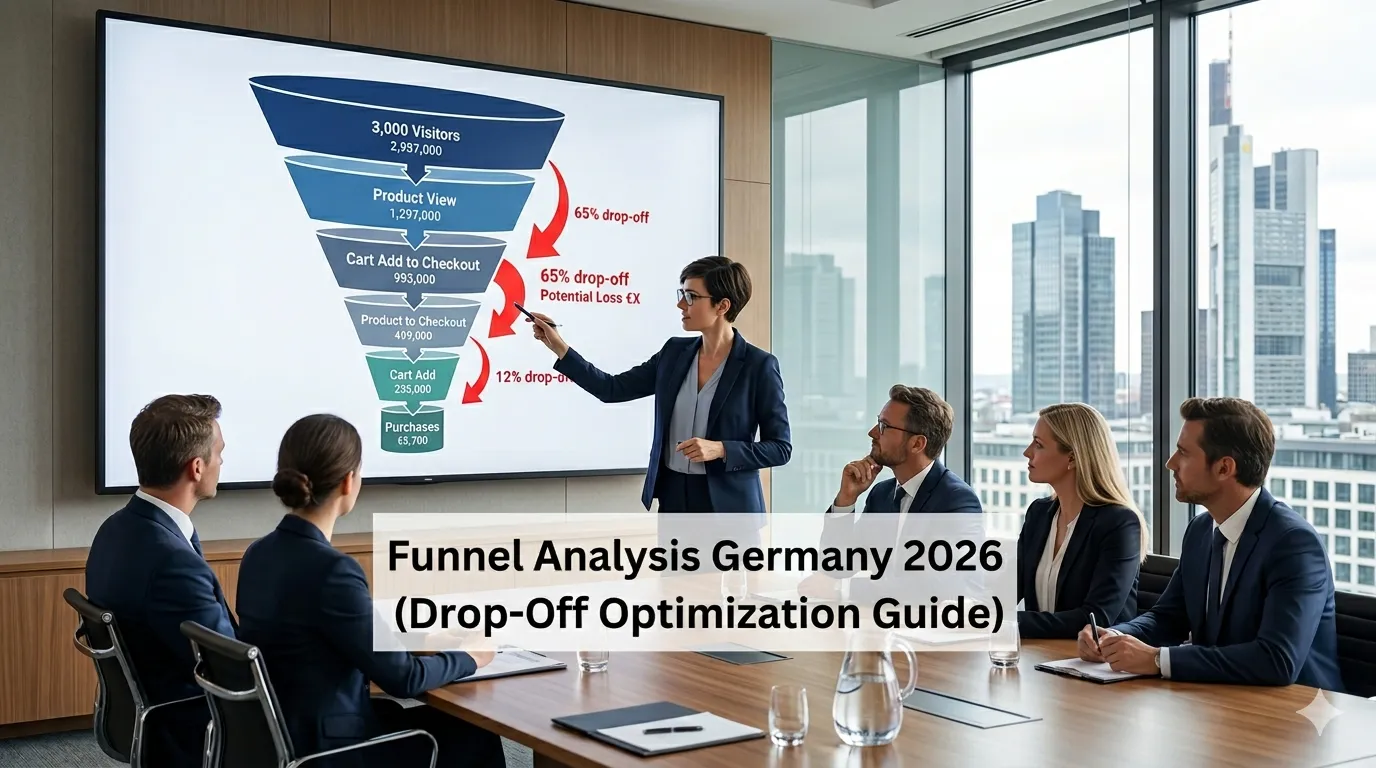
Funnel analysis reveals where users drop off in your conversion journey. For German businesses in 2026, identifying the highest-impact drop-off + fixing it typically delivers more revenue than 10 random optimizations. But defining the right funnels + analyzing them well requires more than basic GA4 reports.
This guide walks through what funnel analysis Germany CRO actually requires in 2026: defining funnels, identifying drop-offs, prioritizing fixes, common German e-commerce + B2B funnels.
For broader CRO see our CRO services Germany guide.
What’s funnel analysis?
Tracking users through sequential steps toward conversion goal:
Example e-commerce funnel
- Homepage visit → 10,000 users
- Product page visit → 4,000 (60% drop)
- Add to cart → 800 (80% drop)
- Checkout start → 600 (25% drop)
- Payment info → 450 (25% drop)
- Purchase complete → 380 (15% drop)
Total conversion: 3.8%.
Where to focus
Biggest drop = biggest opportunity. Here: homepage → product page (60% drop) + cart → checkout consideration.
Why funnel analysis matters
Five reasons:
Reveals real bottlenecks
Aggregate conversion rate hides where the problem actually is.
Quantifies opportunities
Each step’s drop is a measurable opportunity.
Prioritizes effort
Big drop = high-impact area to fix.
Compares segments
Mobile vs desktop, source-by-source. Different funnels.
Tracks improvement
Funnel KPIs over time show CRO impact.
What funnels matter for German businesses?
By business type:
E-commerce
Visit → Category → Product → Cart → Checkout → Purchase.
B2B SaaS (PLG)
Visit → Pricing → Sign up → Activation → First value → Paid conversion.
B2B SaaS (Sales-led)
Visit → Solution → Demo request → Demo → Trial → Closed-won.
Service business
Visit → Service page → Inquiry form → Initial contact → Proposal → Closed-won.
Lead generation
Visit → Content → Email signup → Lead qualification → Sales conversion.
Local services
Visit → Service page → Phone call → Booking → Service delivery.
How do you set up funnel tracking?
A 6-step process:
Step 1: Map the funnel
Document each step user goes through.
Step 2: Define events
GA4 events for each step. Click, form submit, purchase, etc.
Step 3: Implement tracking
GA4 events fired at each step. Verify firing.
Step 4: Set up funnel report
GA4 Explore reports or third-party tools (Mixpanel, Amplitude).
Step 5: Validate
Compare reported numbers to actual business data. Reconcile discrepancies.
Step 6: Establish baseline
Current state per funnel step.
How do you identify highest-impact drops?
Three approaches:
Absolute drop count
Step with most users lost = highest absolute impact. Even moderate % drops matter when traffic is high.
Percentage drop
Step with highest drop rate = where worst friction lives.
Drop value
Drop × downstream revenue = financial impact. E.g., losing 1,000 cart visitors = lost potential revenue of 1,000 × CR × AOV.
For prioritization: combine all three. Biggest absolute drops on highest-value transitions get fixed first.
What German e-commerce funnel drops typically need fixing?
Five common high-impact drops:
Visit → Product page
60–80% drop typical. Improvement: category page optimization, search, navigation.
Product page → Cart
70–95% drop typical. Improvement: clearer value prop, social proof, payment method preview.
Cart → Checkout start
15–40% drop typical. Improvement: lower friction to start, reassurance.
Checkout → Payment
15–30% drop typical. Improvement: form optimization, trust signals.
Payment → Purchase
5–15% drop. Improvement: payment method availability, error handling.
For Shopify-specific abandonment see our Shopify abandoned cart Germany guide.
What German B2B SaaS funnel drops typically need fixing?
Five common B2B drops:
Visit → Pricing page
Variable. Many never visit pricing. Improvement: surface pricing more.
Pricing → Sign up
70–95% drop typical. Improvement: clearer value, social proof, lower-friction signup.
Sign up → Activation
50–80% drop typical. Improvement: onboarding UX, first-value time reduction.
Activation → Paid conversion
70–90% drop typical. Improvement: in-product communication, trial nurturing.
Demo request → Closed-won
70–85% drop typical. Improvement: sales process, demo quality, follow-up.
For B2B SaaS see our SEO for B2B SaaS Germany guide (covers organic acquisition).
How do you segment funnel analysis?
Five high-value segments:
Mobile vs Desktop
Almost always different funnels. Mobile typically converts lower.
Traffic source
Direct, organic, paid, email — different funnels each.
New vs returning visitors
Different drops. Returning typically converts higher.
Device type
Tablet sometimes underperforms.
Geographic
DE vs AT vs CH may differ.
Account type (B2B)
Free trial vs demo vs enterprise — different funnels.
What German-specific funnel considerations?
Four factors:
Cookie banner adds early friction
Banner is first step. Watching how it affects subsequent steps matters.
Trust signal moments
Where users look for trust before converting. Often pre-cart or pre-payment.
Payment method availability
Drops at payment step often = wrong methods offered. SEPA + Klarna critical.
German legal page accessibility
Widerrufsbelehrung visible influences cart-to-checkout drops.
What tools support funnel analysis?
GA4 (free)
Explore reports → Funnel exploration. Powerful + free.
Mixpanel
Product analytics. Strong funnel features. €20+/month per user.
Amplitude
Similar to Mixpanel. Strong funnel + cohort analysis. €0–€2,000+/month.
Heap
Auto-capture analytics. €0–€3,000+/month.
Hotjar Funnel
Within Hotjar Business+. Basic funnel reporting.
For most German growth businesses: GA4 Explore is free + powerful. Mixpanel/Amplitude for product-led companies.
What’s the funnel optimization workflow?
Six steps:
Step 1: Identify biggest drop
Absolute number + financial impact.
Step 2: Qualitative research
Watch session recordings of drop-step users. Survey them.
Step 3: Hypothesize fixes
Multiple potential improvements.
Step 4: Prioritize
Impact × confidence × ease.
Step 5: Test
A/B test changes targeting drop step.
Step 6: Iterate
Implement winners. Move to next biggest drop.
For A/B testing see our A/B testing Germany guide.
What are common funnel analysis mistakes?
Five patterns:
Tracking wrong steps
Funnel definition doesn’t match actual user journey.
Comparing aggregated funnels
Mobile + desktop combined hides device-specific issues.
Ignoring entry points
Different entry points = different funnels. Don’t aggregate.
One-time analysis
Funnel changes over time. Re-analyze quarterly.
No qualitative follow-up
Identifying drop without understanding why = limited insight.
What’s a healthy funnel?
For B2C e-commerce:
- Visit → Product: 30–50% conversion
- Product → Cart: 8–20%
- Cart → Checkout: 60–80%
- Checkout → Purchase: 60–80%
- Overall: 2–5%
For B2B SaaS:
- Visit → Pricing: 5–15%
- Pricing → Signup: 5–20%
- Signup → Activation: 30–60%
- Activation → Paid: 15–30%
- Overall: 1–3%
These are industry medians. Yours varies by vertical + audience.
For broader benchmarks see our conversion rate benchmark Germany guide.
Frequently asked questions about funnel analysis Germany
Tracking users through sequential conversion steps. Identifies drop-offs.
Biggest absolute drop on high-value transition. Combine % drop with traffic volume.
GA4 (free, powerful). Mixpanel, Amplitude (product-led). Heap (auto-capture). Hotjar (basic).
Yes — mobile vs desktop, traffic source, device, geo, account type. Different segments need different fixes.
Quarterly comprehensive. Continuous monitoring of priority funnel steps.
Product → Cart 8–20%. Cart → Checkout 60–80%. Checkout → Purchase 60–80%. Overall 2–5%.
Pricing → Signup 5–20%. Signup → Activation 30–60%. Activation → Paid 15–30%.
Lower aggregate CR than US. SEPA/Klarna critical at payment. Trust signals throughout funnel.
Need help with funnel analysis?
If you’re scoping funnel analysis for your German business and want a 30-minute scoping conversation about setup + optimization priorities, book a meeting or send details via our contact page.
Need expert help? Gem Programmers provides CRO services for businesses in Germany, Austria and Switzerland. Request a free, no-obligation quote and get a clear plan with scope, timeline and price.