
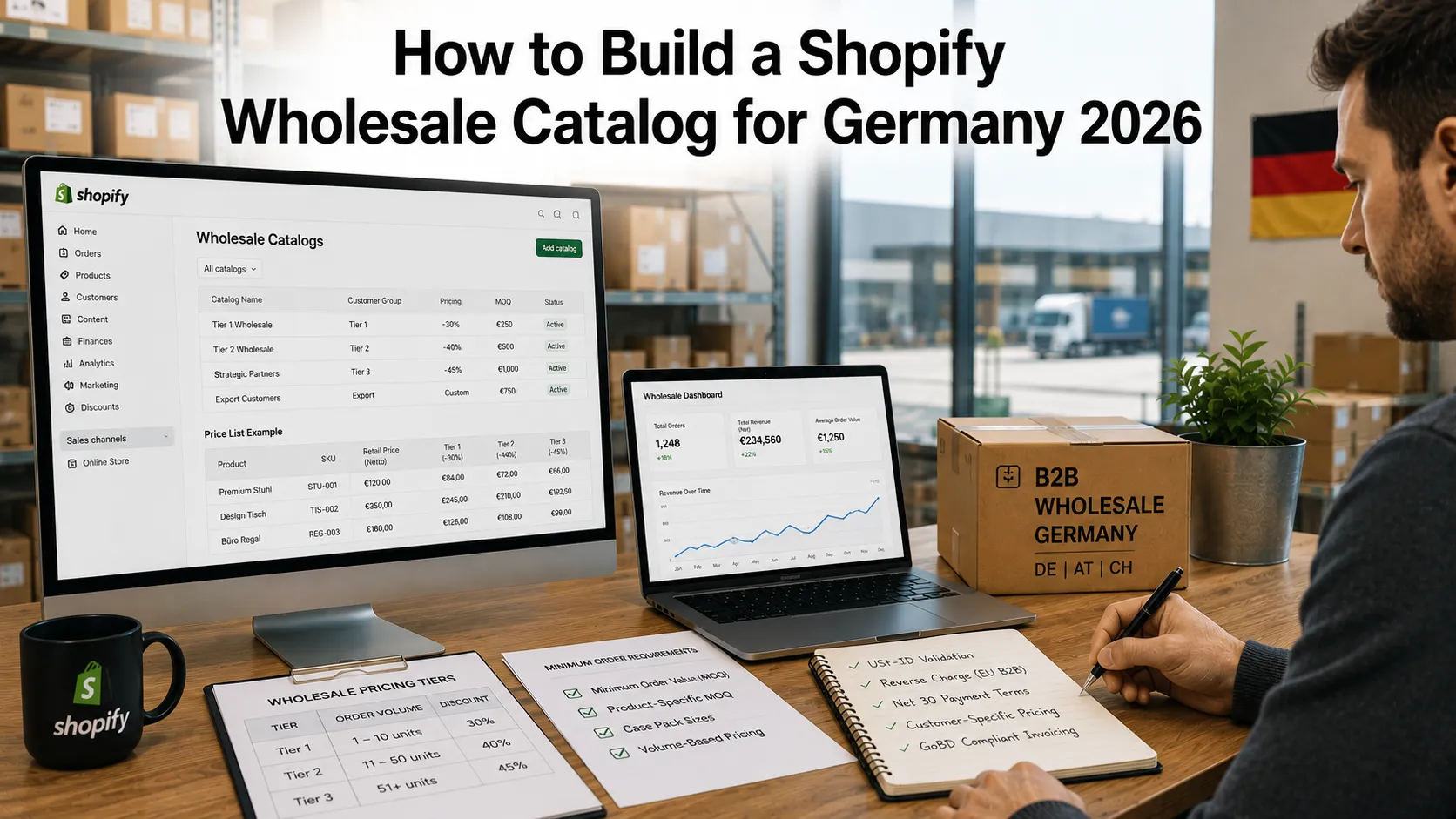
A Shopify wholesale catalog for German Großhandel brands has different commerce needs than B2C D2C. Customer-specific catalogs, minimum order quantities, tiered pricing per volume, net 14/30 payment terms, USt-ID validation — these are commerce table stakes for wholesale, but they’re not Shopify’s default experience.
This guide walks through what Shopify wholesale catalog for German Großhandel actually requires in 2026: Plus B2B vs. standard Shopify wholesale apps, customer-specific pricing setup, minimum order quantities, German wholesale legal requirements, and realistic EUR build costs.
What’s the difference between Shopify B2B and wholesale catalog?
Slight nuance:
Shopify B2B (Plus B2B Suite)
Native Plus feature. Companies, Catalogs, Price Lists, Net Terms, Tax Exemption. Covers most wholesale + B2B procurement use cases. See our Shopify B2B Germany guide.
Wholesale-specific apps (standard Shopify)
For non-Plus stores: apps like Wholesale Pricing Discount, B2BKing, BSS B2B add wholesale features. Less mature than Plus B2B but workable for smaller stores.
Custom wholesale catalog
For unique wholesale workflows beyond either of the above.
For most growing German wholesale brands: Shopify Plus B2B Suite is the right starting point.
What features does a German wholesale catalog need?
Eight essentials:
Login-gated wholesale view
Wholesale catalog only visible to logged-in approved wholesale customers. Retail customers see retail prices.
Customer-specific pricing
Different prices per Company / customer group. Volume tiers (1-10 units, 11-50, 50+).
Minimum Order Quantities (MOQ)
Minimum order amount in EUR or units. Enforce at cart / checkout.
Product-specific MOQ
Some products have higher MOQ (e.g., 100 units for SKU A, 10 units for SKU B).
Pack size and case size
Display + enforce purchase in case sizes (12 units, 24 units, etc.).
USt-ID validation and reverse charge
For EU B2B with valid USt-ID, no VAT charged. Automatic.
Net 14/30/60 payment terms
Customers can buy on terms. Plus B2B handles natively; standard Shopify needs apps + manual workflow.
Quote workflows
Sales rep generates quote, customer converts to order.
What does Shopify wholesale setup cost in Germany?
Plus B2B Suite (standard implementation)
- B2B Suite configuration on existing Plus store
- 5–10 Companies, 2–4 customer-specific Catalogs, Price Lists, MOQ rules
- €18,000–€55,000 for German agency
Plus B2B with deeper customization
- Custom theme for wholesale storefront, custom apps for MOQ enforcement, deeper ERP integration \n \n
- €55,000–€150,000+
Standard Shopify with wholesale app
For smaller wholesale operations on standard Shopify:
- Wholesale Pricing Discount app: €25–€100/month
- B2BKing app: €30–€80/month
- Setup time: 20–60 hours agency
- Build cost: €4,000–€18,000
For broader B2B context see our Shopify B2B Germany guide.
How do you set up Shopify wholesale catalog step by step?
For Plus B2B Suite approach:
Step 1: Activate Plus B2B Suite
If on Plus: enable B2B features.
Step 2: Create wholesale Companies
Manually or CSV import. Each: legal name, USt-ID, address, contact, tier classification.
Step 3: Create wholesale Catalogs
E.g., “Tier 1 Wholesale” (small wholesalers), “Tier 2 Strategic Partners” (large accounts). Assign products. Hide retail-only items.
Step 4: Configure Price Lists per Catalog
Tier 1: 30% discount off retail. Tier 2: 40% discount + volume tiers (50+ units: extra 5% off).
Step 5: Set MOQ rules
Plus + custom app or theme code: enforce minimum cart total or minimum quantity per product. Several apps add MOQ enforcement to standard themes.
Step 6: Configure payment terms
Per Company: Net 14, Net 30, Net 60. Default to upfront for new accounts; relax over time.
Step 7: Set up USt-ID validation and tax exemption
Quaderno or custom: validate USt-ID via VIES. Apply tax exemption to Company.
Step 8: Create wholesale onboarding flo
Application form for new wholesalers. Vetting + approval workflow. Auto-add to appropriate Catalog tier on approval.
Step 9: Set up sales rep dashboard
Plus + custom apps for sales reps to manage Companies, generate draft orders, send quotes.
Step 10: Test end-to-end
Place test wholesale orders for each tier. Verify pricing, MOQ enforcement, payment terms, invoicing.
What German legal requirements apply to wholesale?
Six items:
B2B reverse charge VAT
For EU B2B with valid USt-ID, no German VAT. Reverse charge applied. Invoice marked “Reverse Charge gem. § 13b UStG.”
Wholesale price disclosure
Wholesale prices must be net (without VAT) for B2B context. Display “zzgl. MwSt.” or “netto”.
AGB for wholesale separately
Wholesale AGB typically differs from retail AGB. Different payment terms, return policies, liability limits. Get separate Anwalt review.
Widerrufsrecht exclusion for B2B
B2B-to-B2B sales between two businesses (each acting in business capacity) typically don’t have Widerrufsrecht. State this in wholesale AGB.
Mindestbestellmenge (minimum order quantity) disclosure
MOQ must be clear before checkout. Customer can’t be surprised at cart.
GoBD-compliant wholesale invoicing
Same as retail but with reverse-charge handling. See our Shopify GoBD compliance guide.
What’s the wholesale onboarding flow look like?
Six-step approval flow:
- Wholesale application form on website with required fields: company name, USt-ID, address, contact, sector, expected order volume
- Internal review by sales team
- USt-ID validation via VIES
- Tier assignment based on volume + sector
- Approval email with login credentials
- Welcome packet with wholesale terms, ordering process, key contacts
For complex wholesale: add reference checks, credit checks (Schufa for German Companies if you offer terms).
What about hybrid B2C + B2B brands?
Many German brands do both:
Option 1: Single Plus store
B2B + B2C on same Plus store. Login-gated wholesale catalog. Plus B2B handles this. Cleaner for smaller B2B operations.
Option 2: Expansion Stores (separate B2B + B2C)
Two storefronts: yourbrand.de (B2C) + wholesale.yourbrand.de (B2B). Shared inventory. Plus’s 9 Expansion Stores cover this.
Option 3: Subdomain B2B portal
Plus + custom development for completely separate B2B portal with different UX. Most expensive but most flexible.
For most German hybrid brands: Expansion Stores is the sweet spot — separation of UX, shared inventory + customer database.
What are common Shopify wholesale mistakes German brands make?
Five patterns:
Showing wholesale prices to retail customers
If you mix B2B + B2C on same store without proper login gating, retail customers see wholesale prices. Lost margin + brand damage.
Skipping USt-ID validation
Accepting B2B claims without VIES validation. Tax authority risk.
Wrong AGB for wholesale
Using retail AGB for wholesale customers. Both legal and operational problems.
Manual quote workflow without tooling
Sales reps emailing PDFs back and forth. Painful and error-prone. Use Shopify draft orders + quotes properly.
MOQ enforcement only at cart, not at product page
Customer adds 5 units, gets to cart, sees MOQ is 10. Frustrating UX. Enforce + display at product page.
When should you go beyond Shopify for wholesale?
Three signals:
- Wholesale revenue dominates (€5M+ wholesale revenue alone) and Shopify B2B feels limiting
- Complex multi-level distribution (you sell to distributors who sell to retailers who sell to end customers)
- Industry-specific wholesale workflows (e.g., agricultural commodities, automotive parts) requiring deep customization
For these, evaluate Shopware (B2B Suite is more mature for some German use cases) or commercetools. See our Shopify vs Shopware Germany guide.
Frequently asked questions
Yes via Plus B2B Suite or wholesale apps for smaller stores.
EUR 4k to 150k+ depending on Plus vs standard and scope.
For serious wholesale, yes; for smaller ops, standard plus apps work.
Validate USt-ID via VIES and mark the Company tax-exempt.
Small ops yes; larger ops use Expansion Stores.
Yes; payment, returns, and liability terms differ from retail.
Use Plus plus code or MOQ apps; enforce at product page and cart.
Schufa or credit insurance for new accounts; relationship-based late.
Need help setting up Shopify wholesale?
If you’re scoping wholesale on your German Shopify store and want a 30-minute scoping conversation about Plus B2B vs apps, customer tier strategy, or onboarding workflow, book a meeting or send details via our contact page.