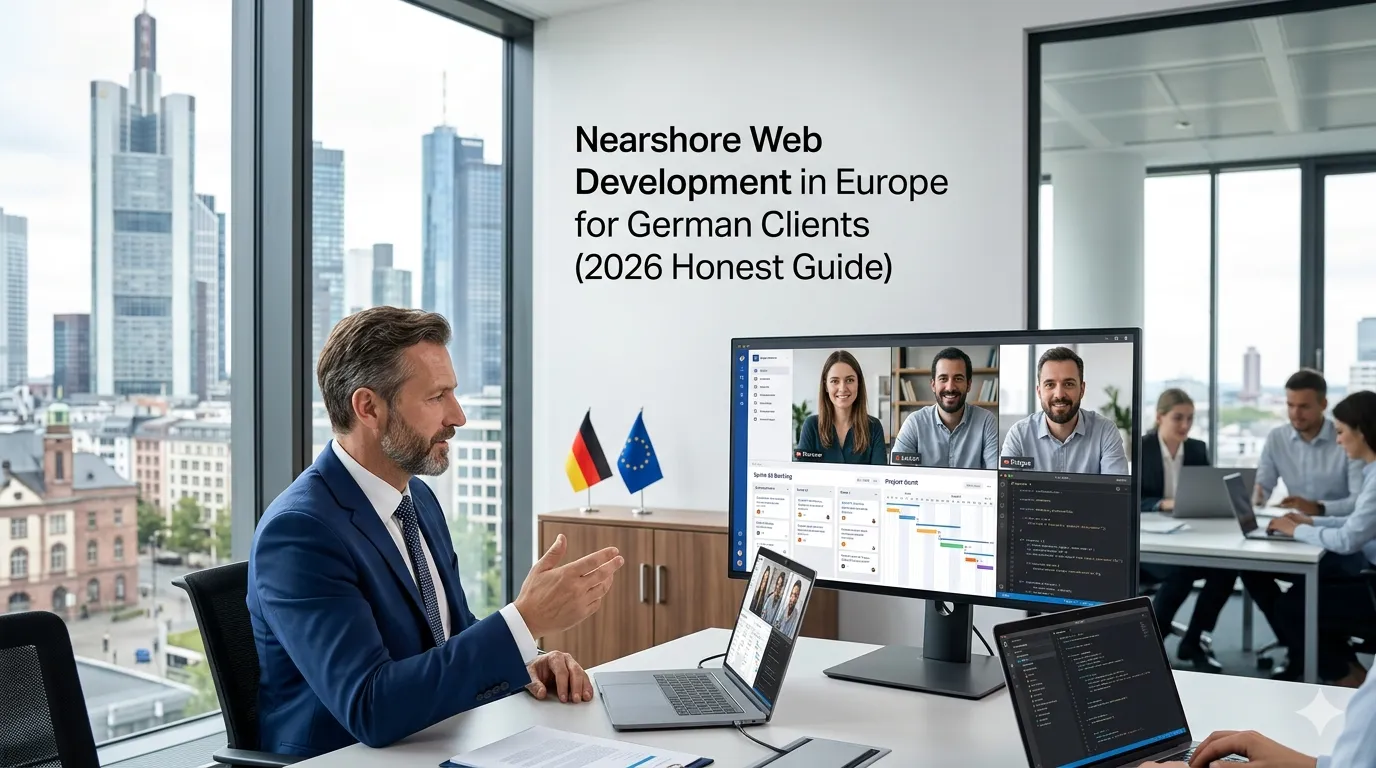
Nearshore web development in Europe is one of the most underrated levers a German GmbH can pull in 2026. Senior engineers in Poland, Romania, Ukraine, Portugal, and Spain deliver work at parity with German seniors at 35–60% lower rates — without the time-zone misery, language gap, or DSGVO complications of US/Asia offshoring. But “nearshore Europe” is not a uniform market. Quality, communication norms, legal infrastructure, and DSGVO posture vary substantially by country and by agency.
This guide walks through what nearshore web development in Europe for German clients actually looks like in 2026: country comparison, EUR rates, DSGVO defensibility, vetting questions, contract structure, and the patterns that consistently produce good outcomes vs. expensive ones.
What does “nearshore” mean in the European context?
For a German GmbH in 2026, nearshore typically means an EU or near-EU country with:
- 0–2 hour time zone offset from Germany (CET ±2)
- EU or strongly EU-aligned legal framework
- Strong English-language working culture
- Mature developer talent pool
- DSGVO-compatible operations
Common nearshore destinations: Poland, Romania, Ukraine, Czech Republic, Bulgaria, Portugal, Spain, parts of Greece, North Macedonia. Sometimes broader: Hungary, Latvia, Lithuania, Estonia, Serbia.
This is distinct from offshore (India, Pakistan, Vietnam, Philippines — see our outsourcing to Pakistan guide) which has different time-zone, communication, and DSGVO trade-offs.
What does nearshore Europe cost in EUR for 2026?
Senior developer hourly rates from quality nearshore agencies serving German clients:
| Country | Junior | Mid | Senior | Lead/Architect |
|---|---|---|---|---|
| Poland | €30–€45 | €45–€70 | €65–€95 | €90–€140 |
| Romania | €25–€40 | €40–€65 | €60–€90 | €85–€130 |
| Ukraine | €22–€38 | €38–€60 | €55–€85 | €80–€120 |
| Czech Republic | €30–€48 | €48–€72 | €68–€95 | €92–€135 |
| Bulgaria | €22–€38 | €38–€62 | €58–€88 | €82–€125 |
| Portugal | €28–€42 | €42–€65 | €62–€95 | €88–€135 |
| Spain | €30–€48 | €48–€72 | €68–€100 | €95–€145 |
Compare to: German rates of €85–€220/hour for similar seniority (see hire React developer guide, hire Node.js developer guide, hire Laravel developer guide).
Net savings: 35–60% vs. German full-Festanstellung loaded cost, with quality at parity for strong agencies.
Which country fits which need?
Poland
The mature default. Largest developer pool in the region, strongest English fluency, robust legal infrastructure, excellent agencies serving German clients. Best for: serious B2B SaaS, FinTech-grade work, enterprise builds.
Romania
Strong technical depth, especially in backend (Java, Node.js, Python). Lower rates than Poland. Best for: backend-heavy work, data-engineering, ML.
Ukraine
Outstanding senior depth despite the war’s operational impact. Rates lowest in the table. Many shops have relocated operations to Poland / Romania / Germany while keeping Ukrainian teams. Best for: senior-tier work where you can verify team locations.
Czech Republic
Smaller pool, higher rates than Romania/Bulgaria but quality very high. Strong for German-adjacent work. Best for: regulated industries, fintech, premium B2B.
Bulgaria
Strong technical talent, lowest rates among quality nearshore options. Best for: budget-conscious mid-market builds.
Portugal
Excellent design and modern frontend talent (Lisbon especially). Strong English fluency. Slightly more expensive than Poland but exceptional for design-led work and Next.js/React ecosystem. Best for: brand-led product work, design-conscious SaaS.
Spain
Strong for full-stack, modern React/Next.js, Laravel/PHP. Lower than Portugal in some regions (Valencia, Sevilla); Madrid/Barcelona top of table. Best for: bilingual EN+ES products, Iberian market expansion.
What’s DSGVO posture like for each country?
All listed countries are EU members or EU-aligned (Ukraine is EU candidate state, broadly compatible data law).
- EU members (Poland, Romania, Czech Republic, Bulgaria, Portugal, Spain): straightforward AVV signing, standard EU intra-community transfer.
- Ukraine: EU adequacy decision in progress as of 2026; use Standard Contractual Clauses for now. Many agencies have EU-resident operating entities to simplify this.
Best practice: signed AVV + sub-processor list + EU-region hosting + GDPR-compatible operational procedures. See our GDPR compliance guide.
What questions should you ask a European nearshore agency?
Beyond standard agency vetting (see how to choose a web development agency guide):
“How many German clients have you served and for how long?”
A track record with German clients indicates familiarity with Mittelstand procurement, DSGVO, GoBD invoicing, communication norms.
“Show me your DSGVO and AVV documentation.”
Real DPA template, sub-processor list, technical/organizational measures (TOMs).
“What’s your senior team retention rate?”
High senior turnover is the silent killer of nearshore quality.
“What’s your communication cadence with German clients?”
Daily standups, weekly written status reports, sprint reviews — see web development project management guide.
“How do you handle IP/Urheberrecht under German law?”
Their contract should grant ausschließliche, übertragbare, unterlizenzierbare Nutzungsrechte. See our web development contract Germany guide.
“What’s your payment structure?”
Monthly invoicing in EUR with German-compatible VAT handling (reverse charge for B2B EU).
“What time zone do your developers work?”
Most nearshore countries are CET or CET+1. 4+ hour overlap with German business hours expected.
“Show me a recent German-client engagement.”
Case study with measurable outcomes. References available for direct contact.
What contract structure works best?
Dedicated developer / dedicated team
Monthly fee per developer (typically €4,500–€15,000/month for senior). Long-term engagement. Maximum continuity and institutional knowledge.
Fixed-price project
Defined scope, agreed price, agreed timeline. Lower flexibility, higher predictability.
Time-and-materials with milestones
Hybrid: hourly billing with monthly caps, milestones at 2–4 week intervals. Common for evolving builds.
For broader engagement model framing see web development project management guide.
What are the most common nearshore mistakes German GmbHs make?
Picking on price alone
The cheapest €25/hour Ukrainian “senior” who turns out to be a 2-year mid-level costs more than a €70/hour Polish actual senior.
Skipping the German-client reference check
Agencies experienced in UK/Dutch work may not understand Mittelstand procurement, GoBD, or Sie-form communication.
Underestimating onboarding cost
First month productivity is typically 50–70% of steady-state. Plan for this.
Not building a proper communication rhythm
Slack/Teams alone is insufficient. Daily 15-min syncs, weekly written status, bi-weekly sprint reviews, monthly retro.
Treating nearshore as a sole vendor for critical work
For mission-critical systems, hybrid teams (in-house architect + nearshore implementation) often outperform pure nearshore.
What does the transition from German agency to nearshore look like?
- Vet thoroughly (questions above).
- Pilot for 1–2 months on a non-critical project before long-term commitment.
- Plan a 2–4 week handover with the existing German team — see switching web development agencies guide.
- Establish strong communication rhythm in the first month.
- Maintain at least one in-house technical lead.
When is nearshore NOT the right answer?
- Heavy stakeholder management with German enterprise / public sector buyers
- Regulated industries where the agency’s specific German regulatory experience is the differentiator (DiGA, BaFin) — see FinTech web development guide and healthcare web development guide
- On-site discovery / co-design workshops are critical
- Total budget is under €15,000
- Native German language operations required
When is hybrid (in-house + nearshore) the right model?
Most common pattern for German SMEs scaling beyond €1M in tech budget:
- 1–2 in-house senior engineers (architecture, leadership, customer-facing)
- 2–8 nearshore developers (implementation, testing, ongoing development)
- Optional: 1 in-house designer + 1 nearshore designer / dedicated UX agency
Common in German SaaS at €1M–€20M ARR scale.
Frequently Asked Questions About Nearshore Web Development in Europe
Senior €55–€100/hr depending on country; ~35–60% less than German €85–€220/hr.
Poland (B2B SaaS/enterprise), Portugal (design-led), Romania (backend), Czech (regulated), Ukraine (senior depth), Bulgaria (budget), Spain (EN+ES).
Yes for EU members; Ukraine uses SCCs pending adequacy — many agencies have EU operating entities.
German-client references, DSGVO/AVV docs, senior retention, communication cadence, IP/Urheberrecht handling.
Yes — 2–4 week handover, pilot on non-critical project, keep one in-house technical lead.
Heavy stakeholder management, regulated industries needing German expertise, on-site workshops, sub-€15k budgets.
Dedicated team for long-term; fixed-price for well-scoped; T&M with milestones for evolving builds.
1–2 in-house seniors plus 2–8 nearshore developers with strong cadence; common at €1M–€20M ARR.
Need help scoping a nearshore engagement?
If you’re evaluating nearshore agencies and want a 30-minute conversation about country choice, vetting, contract structure, or hybrid team design, book a meeting or send details via our contact page.
Need expert help? Gem Programmers provides professional web design services for businesses in Germany, Austria and Switzerland. Request a free, no-obligation quote and get a clear plan with scope, timeline and price.