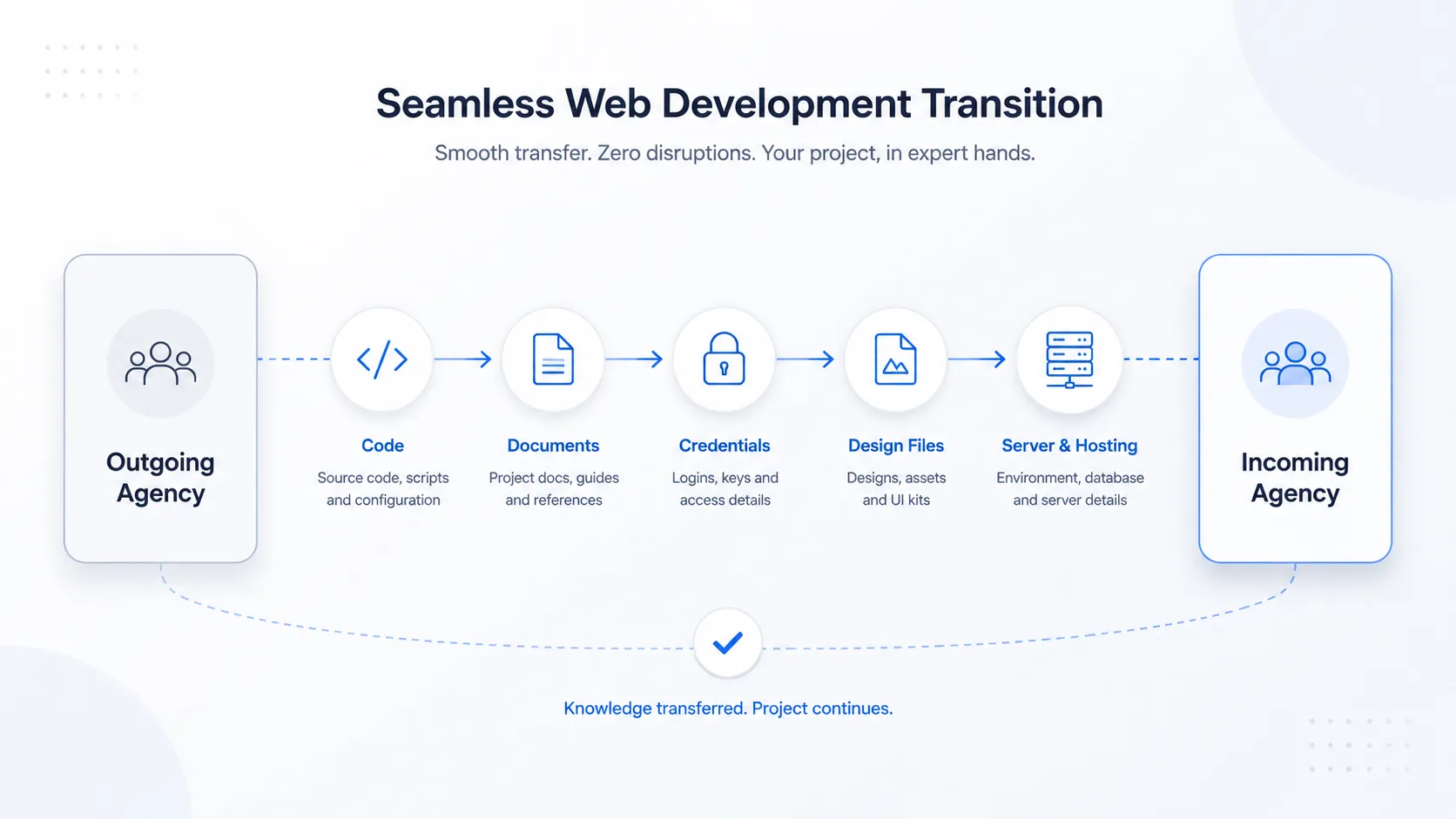
Switching web development agency in Germany is one of the messiest transitions a German GmbH can navigate. Done badly, you end up with: missing source code, locked-out hosting accounts, undocumented architecture, unhappy outgoing vendor leaving traps, and 3–6 months of productivity loss. Done well, you migrate cleanly, and the new agency hits production within 4–8 weeks.
This guide walks through how to actually switch web development agencies in Germany in 2026: signs that it’s time, a step-by-step handover checklist, code/credential/license transfer, legal exit clauses, and the most common transition pitfalls.
What are the signs it’s time to switch agencies?
Five recurring signals from agency post-mortems:
Velocity has collapsed
Features that took 2 weeks now take 6. Bug fixes that took hours now take days. The team isn’t growing or the senior people you started with have moved on.
Communication has degraded
Slow responses, unclear status reports, missed deadlines without explanation. Trust is the operational fuel of an agency relationship; once it goes, it rarely comes back.
Costs keep climbing without scope changes
Hourly rate bumps, “additional discovery” charges, scope-creep invoicing. If you’re paying 50% more for similar output than 12 months ago, the relationship is no longer fair.
Quality has dropped
Bugs in production, performance regressions, security misses (see our WordPress hacked recovery playbook for incident context). A handful is normal; a pattern is a flag.
You’ve outgrown them
Mismatch between your needs (e.g., enterprise scale, regulatory compliance) and their capabilities (e.g., boutique team). Sometimes it’s not their fault — you’ve simply grown past their fit.
When 2+ signals appear consistently for 3+ months, it’s time to plan a transition.
When is switching premature?
Three signals to slow down:
- One bad sprint or one bad bug isn’t a transition trigger.
- Communication issues that haven’t been raised explicitly with the agency (give them a chance to fix first).
- You’re transitioning to save money, but the new agency is materially cheaper for the same scope — usually means lower quality or hidden trade-offs.
For broader hiring framing, see our ” How to choose a Web Development Agency guide.
How do you prepare for the transition (before you tell the outgoing agency)?
Five quiet steps:
1. Inventory your assets
Source code, design files, credentials, accounts, licenses, documentation, and third-party services. Where does each live? Whose account is it on?
2. Identify dependencies
What does the agency uniquely know? Architecture decisions, business logic, customer history, post-launch fixes? Write down what would be lost if they walked away tomorrow.
3. Check the contract
Exit clauses, handover process, IP transfer, and termination notice. Review what your existing contract says — see our web development contract Germany guide.
4. Quietly source the new agency
Vetting (3–5 candidates, references, demos) before the outgoing agency knows you’re leaving. Most outgoing agencies are professional, but some get less helpful once they know they’re losing the account.
5. Define the transition budget and timeline
Realistic: 4–10 weeks transition with 20–50% overhead vs. business-as-usual cost during overlap.
What’s the actual switching playbook?
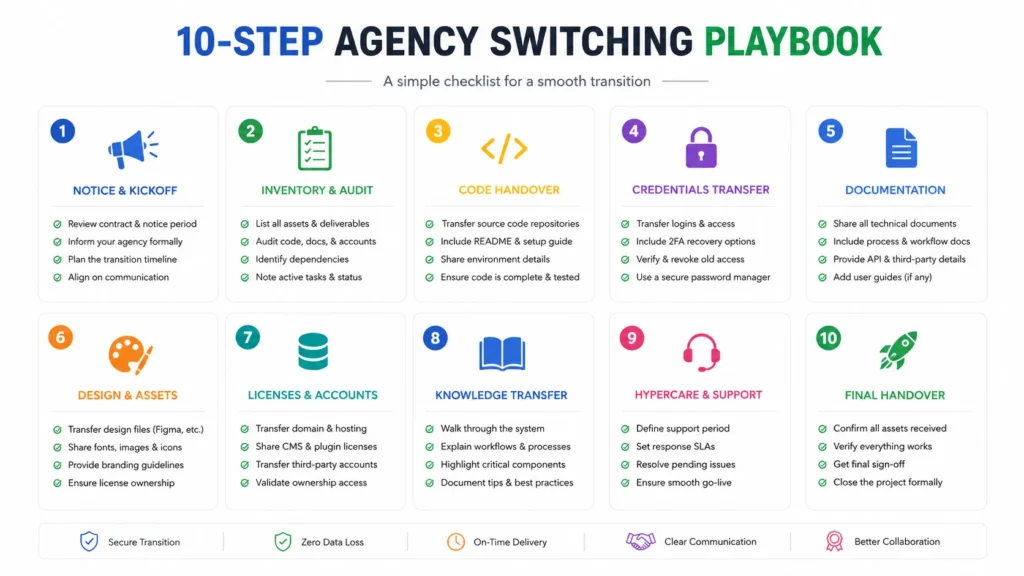
A 10-step process:
Step 1: Formal termination notice
Per the contract’s notice period (typically 30–90 days). In writing, dated, sent registered mail (Einschreiben) for documentation.
Step 2: Handover meeting
Within 7 days of notice. Outgoing agency + incoming agency + your team. Define the scope of handover, timeline, and deliverables.
Step 3: Inventory and audit
Outgoing agency produces a documented inventory: source code locations, architecture diagrams, deployed services, third-party integrations, credentials, and licenses.
Step 4: Source code and Git transfer
All code in your Git account. If you don’t have one, set it up before this step. Outgoing agency pushes all branches, tags, and history.
Step 5: Credentials handover
All hosting, domain, payment processor, email, analytics, and monitoring credentials transferred to your account. Reset passwords on completion.
Step 6: Documentation handover
Architecture decisions, deployment process, runbook for common operations, third-party integration details, known issues, and planned work.
Step 7: Design files handover
Figma (or other) source files transferred to your team’s account. Asset libraries, design system files, icons, illustrations.
Step 8: License transfer
Plugin licenses, premium theme licenses, third-party tools — all transferred to GmbH accounts (or new licenses purchased). Audit which are still under the agency’s name.
Step 9: Knowledge transfer sessions
3–6 sessions where the outgoing agency walks the new team through the codebase, architecture, history. Recorded for future reference.
Step 10: Hypercare period
Outgoing agency available for questions for 30–60 days post-handover. New agency leads day-to-day operations. Final invoice clears at the end of hypercare.
What credentials and assets need to move?
The full list:
Hosting and infrastructure
Domain registrar account, hosting account (Hetzner, Mittwald, Raidboxes, AWS, etc.), DNS records, SSL certificates, CDN account, monitoring services.
Code and version control
Git repository (GitHub, GitLab, Bitbucket). All branches, tags, and history.
Deployment and CI/CD
Build pipeline, deployment scripts, secrets management, and environment variables.
Third-party services
Email delivery (SendGrid, Postmark), analytics (GA4, Plausible, Matomo), payment processors (Stripe, Mollie, PayPal), customer support (Userlike, Crisp), error tracking (Sentry), CRM, and marketing automation.
Plugin and theme licenses
WordPress plugins, premium themes, design system tools — verify under whose account each license sits.
Design files
Figma (or Sketch/XD), brand assets, font licenses, image library, icon library, video assets.
Documentation
README files, architecture docs, deployment runbook, onboarding docs.
Communication archives
Slack/Teams channels with the outgoing agency — should be exported if they contain decisions or documentation.
How long does the handover actually take?
Realistic timelines:
- Small site (brochure, single tenant SaaS): 2–4 weeks
- Mid-size SaaS / multi-tenant product: 6–10 weeks
- Complex enterprise platform: 12–24 weeks
Plan for: 20–50% cost overhead during the overlap period (paying both agencies), plus 4–8 weeks of slower feature velocity as the new agency ramps up.
What does this cost?
Realistic 2026 EUR ranges for the transition itself:
- DIY-managed transition (small site): €0–€3,000 overhead
- Agency-led transition (mid-size): €8,000–€25,000
- Enterprise transition with third-party project lead: €25,000–€80,000+
For a broader cost context, see our web development cost in Germany guide.
How do you handle the outgoing agency relationship professionally?
Three patterns matter:
Direct and timely communication
Tell them as soon as the decision is final. Don’t drag it out. They can handle the news; what they can’t handle is finding out from someone else.
Honor the contract
Pay outstanding invoices. Honor the notice period. Don’t try to recover unused retainer fees not specified in the contract.
Leave the door open
Sometimes the best agency for your next big project is the agency you just left (after their team has grown, after your needs have shifted again). Burn no bridges.
How do you onboard the incoming agency well?
Five practical patterns:
Give them genuine context
Not just code access — context on business, customers, decisions, history. The first 30 days of incoming-agency value is shaped by how much context you transfer.
Define success metrics
What does “successful transition” look like? Feature velocity matching outgoing agency’s last 6-month average? Zero regression incidents? Define and measure.
Plan a small win in week 4
A visible, valuable feature shipped quickly. Builds trust and demonstrates the new agency’s capability.
Document new norms
Status reporting cadence, escalation path, decision rights — codify them from week one. See our web development project management guide.
Expect 3–4 months for full velocity
Even with a great handover, the new team is on a learning curve.
What are the most common transition mistakes German GmbHs make?
Four patterns:
No source code in the GmbH-owned Git
The most common and most expensive mistake. Code in the outgoing agency’s Git account. Handover requires them to push to your account — which they may slow-walk if relations are tense.
Plugin licenses under the agency name
You discover at handover that 15 premium WordPress plugins are licensed under the outgoing agency’s account. The new agency can’t get updates without buying new licenses.
No documentation
The outgoing agency had everything in its head. Now you have a codebase with 200 files and no roadmap.
Skipping the hypercare period
Cutting the outgoing agency off the day after handover. Then, 2 weeks later, a production issue comes up, and you have no one who knows the system to call.
For broader operational considerations, see our WordPress maintenance pricing guide and WordPress backup strategy guide.
Need help with an agency transition
If you’re considering switching web development agencies in Germany and want a 30-minute conversation about transition planning, what to insist on in the handover, or how to vet the incoming agency, book a meeting or send details via our contact page.
Frequently asked questions
Velocity collapsed, communication degraded, costs were climbing without scope change, quality dropped, and there was a capability mismatch. Two or more sustained signals over 3+ months are the trigger.
Small site: 2–4 weeks. Mid-size: 6–10 weeks. Enterprise: 12–24 weeks. Plan for the cost overhead during overlap.
DIY small site: €0–€3,000 overhead. Agency-led mid-size: €8,000–€25,000. Enterprise: €25,000–€80,000+.
If your contract has IP transfer (it should — see our web development contract Germany guide), they’re obligated to push to your Git account. If they refuse, escalate per the contract’s dispute resolution clause.
Document everything in writing. Reference contract clauses. If they continue to obstruct, engage a German IT-Rechtsanwalt — an uncooperative handover often violates standard contract terms.
Yes, 2–4 weeks of overlap is healthy. The new agency learns the codebase while the old agency is still available to answer questions.
Yes, honestly. They may take feedback for their next clients. But don’t expect them to defend themselves at length; just be clear and professional.
No documentation + no GmbH-owned Git. Without these, the new agency has to reverse-engineer a system the outgoing agency had in its head.
Need expert help? Gem Programmers provides web design and development services for businesses in Germany, Austria and Switzerland. Request a free, no-obligation quote and get a clear plan with scope, timeline and price.