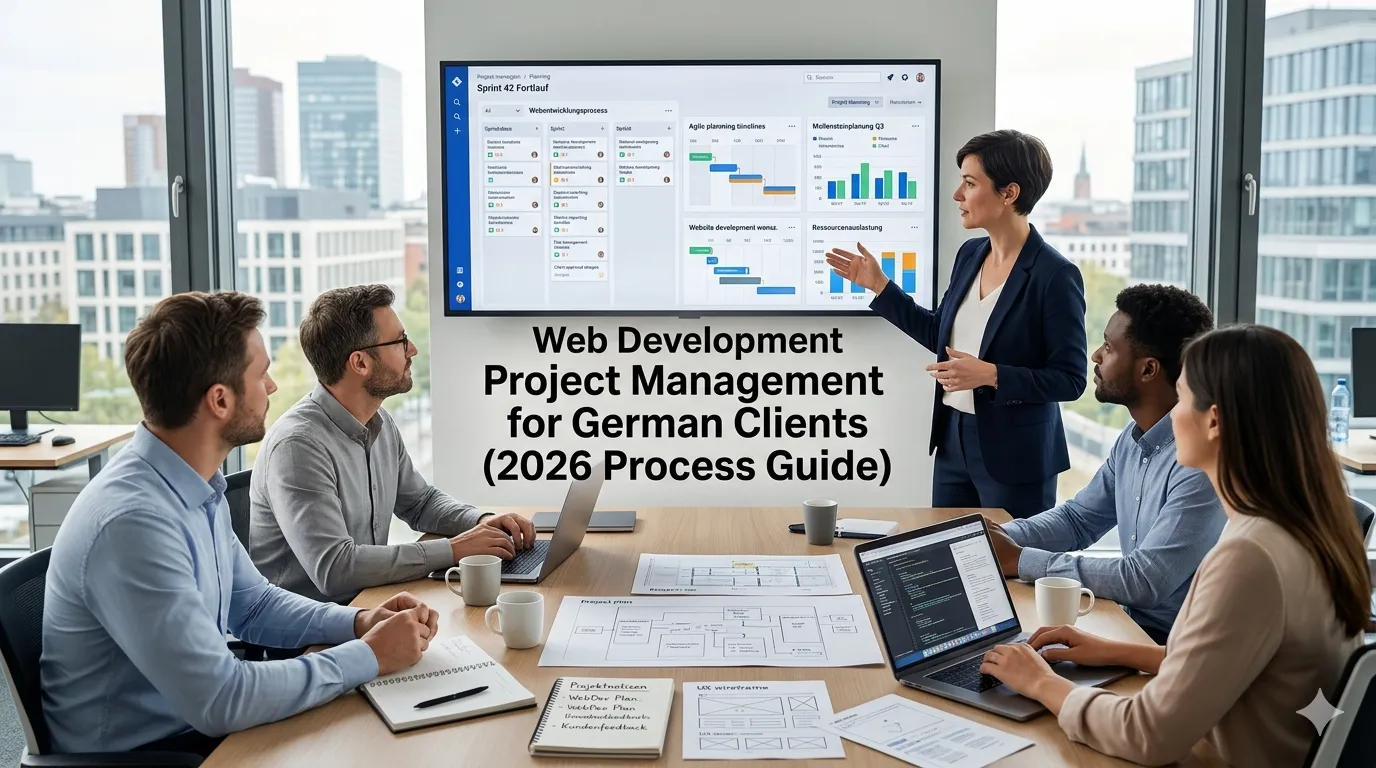
Web development project management for German clients in 2026 is a discipline that quietly separates agencies that scale from agencies that drown. The German Mittelstand and German enterprise expect structured project management — written status reports, scheduled sponsor reviews, clear escalation paths, and documented decisions — at every stage. US-style “agile and we’ll figure it out” doesn’t survive contact with a German procurement department.
This guide walks through what web development project management for German clients actually looks like in 2026: engagement model trade-offs, ceremony cadence, tooling, reporting expectations, and escalation patterns that keep large web builds on track.
What engagement models do German web development projects use?
Four common models:
Fixed-price project
Agreed scope, agreed price, agreed timeline. Vendor takes scope risk.
Pros: budget predictability; agency-friendly for well-scoped work. Cons: harder to accommodate changes; vendor inflates price to cover risk. Best for: well-defined scopes (brochure sites, fixed redesigns, specified features).
Time-and-materials (T&M)
Hourly or daily rate, billed weekly or monthly. Client takes scope risk.
Pros: flexible; quality often higher; easier to course-correct. Cons: budget uncertainty; requires trust. Best for: discovery phases, evolving products, R&D work.
Fixed-price with iteration buffer (hybrid)
Fixed milestones with explicit T&M buffer for refinements.
Pros: balances predictability with flexibility. Cons: requires careful contract drafting. Best for: mid-scale builds with some scope ambiguity.
Retainer / dedicated capacity
Monthly fee for dedicated capacity.
Pros: continuity, deep institutional knowledge, predictable cost. Cons: harder to scale up/down. Best for: ongoing maintenance, product teams without in-house engineering.
For German Mittelstand clients, fixed-price for first engagement, then retainer for ongoing work is the dominant pattern.
For broader cost framing see our web development cost in Germany guide.
What’s the right project methodology for a German web project?
Three patterns:
Modified Scrum (most common)
2-week sprints, sprint planning, daily standups (often async via Slack/Teams), sprint review with client, retrospective.
Kanban with milestone reviews
Continuous flow rather than sprints. Milestones every 2–4 weeks. Good for maintenance work.
Waterfall with agile execution
Phases defined upfront (discovery, design, build, test, launch). Each phase agile internally but milestone-gated externally. Common for German enterprise procurement.
The methodology matters less than: clear written status, scheduled sponsor reviews, escalation paths, documented decisions.
What does a healthy project structure look like for German clients?
Seven elements:
Written kickoff document
5–15 pages covering: scope, milestones, budget, team, communication norms, escalation, definition of done, change control. Signed before code is written.
Sprint or milestone reviews
Every 2–3 weeks. 30–60 minute structured meeting. Demo, decisions, risks, budget burn. Recording or written summary always.
Asynchronous status reports
Weekly written summary: completed, in progress, blocked, decisions needed, budget status. German clients especially value this.
Decision log
All material decisions logged with date, decision-maker, rationale.
Issue tracker hygiene
Linear, Jira, ClickUp, GitHub Issues — pick one and use consistently. Every issue has owner, status, due date, priority.
Escalation protocol
Defined path: project lead → PM → sponsor → executive. SLA on response times.
Documented change control
Scope changes go through change requests with cost/timeline impact.
What tooling do German web development projects typically use?
Common stacks:
- Project management: Linear (startups), Jira (enterprise), ClickUp (mid-market), Asana, Basecamp.
- Communication: Slack (dominant), Microsoft Teams (enterprise/Mittelstand), Discord (some agencies).
- Documentation: Notion, Confluence, Coda, Outline (self-hosted EU).
- Design: Figma, Loom for async video, Maze for usability testing.
- Code: GitHub, GitLab self-hosted (security-sensitive), Bitbucket.
- Time tracking: Harvest, Toggl, Clockify, JIRA Tempo.
For DSGVO-strict clients, prefer EU-hosted or EU-region tools and verify DPAs.
What does week-by-week look like in a typical German web project?
A representative 12-week mid-size build:
- Week 1–2: Discovery and kickoff. Stakeholder interviews, requirements clarification, technical architecture, project plan signed.
- Week 3–4: Design exploration. Wireframes, design system, key screens. Sponsor sign-off end of week 4.
- Week 5–10: Build sprints (3 × 2-week sprints). Demo + sponsor review every 2 weeks.
- Week 11: QA, security review, performance audit, accessibility check (BFSG — see our BFSG accessibility guide).
- Week 12: Launch, hypercare, handover.
Pre-launch (week 11): use our 50-point pre-launch QA checklist.
How should German clients judge project health mid-flight?
Five signals of healthy PM:
Status reports arrive on schedule
No status report = problem.
Decisions get resolved in 1–3 business days
Stuck decisions are the #1 cause of project delay.
Budget burn matches scope progress
If burn is 50% and scope is 25% complete, something is wrong.
Sponsor review meetings happen as scheduled
Cancelled reviews indicate dysfunction.
Bad news arrives early
Strong PMs surface risks early. Weak PMs hide them until unfixable.
What are the most common project management mistakes German clients and agencies make?
Skipping written kickoff
Verbal agreement, vague brief. Six months later, scope disputes.
No defined sponsor
Multiple stakeholders, no decision-maker. Every change requires consensus.
Scope creep via Slack
Each message adds a “small thing.” Use change-request flow for material additions.
Underestimating QA, content, and launch
The build is 70%; QA + content + launch is 30% — and frequently compressed at the end.
For broader context see our 12 common website mistakes guide and 15 red flags when hiring a web developer guide.
How does German procurement shape PM expectations?
For Mittelstand and enterprise:
- Written contracts in German (or with German addendum)
- Invoice compliance per GoBD
- Defined acceptance criteria for each milestone
- Documented sign-offs before invoicing
- AVV signed for vendor processing personal data
- Defined exit / handover process at engagement end
German procurement runs on documents.
When is a project manager worth their cost?
For projects above €30,000 with multiple stakeholders, a dedicated PM is almost always worth their cost. They run rhythms, write reports, manage scope changes, surface risks, translate between developer-speak and stakeholder-speak.
For projects below €30,000 with a single sponsor, the lead developer often runs PM directly.
Frequently Asked Questions About Web Development Project Management in Germany
Fixed-price for defined scope; T&M for evolving work; hybrid for ambiguity; retainer for ongoing capacity.
Modified Scrum dominates; Waterfall with agile execution works for enterprise procurement.
Weekly written summary; sponsor review every 2–3 weeks; steering every 4–6 weeks for larger projects.
Linear/Jira, Slack/Teams, Figma, GitHub/GitLab, Notion/Confluence.
Status reports on time, decisions in 1–3 days, burn matches scope, reviews not cancelled, early bad news.
Escalate via the defined path; demand a written recovery plan with revised milestones and budget.
Yes above €30,000 with multiple stakeholders; smaller projects can run PM via the lead dev.
Early, directly, with options — not hidden until the milestone is missed.
Need help running a project well?
If you’re running a German web development project and want a 30-minute conversation about PM structure, ceremonies, or rescuing a drifting project, book a meeting or send details via our contact page.
Need expert help? Gem Programmers provides web design and development services for businesses in Germany, Austria and Switzerland. Request a free, no-obligation quote and get a clear plan with scope, timeline and price.