
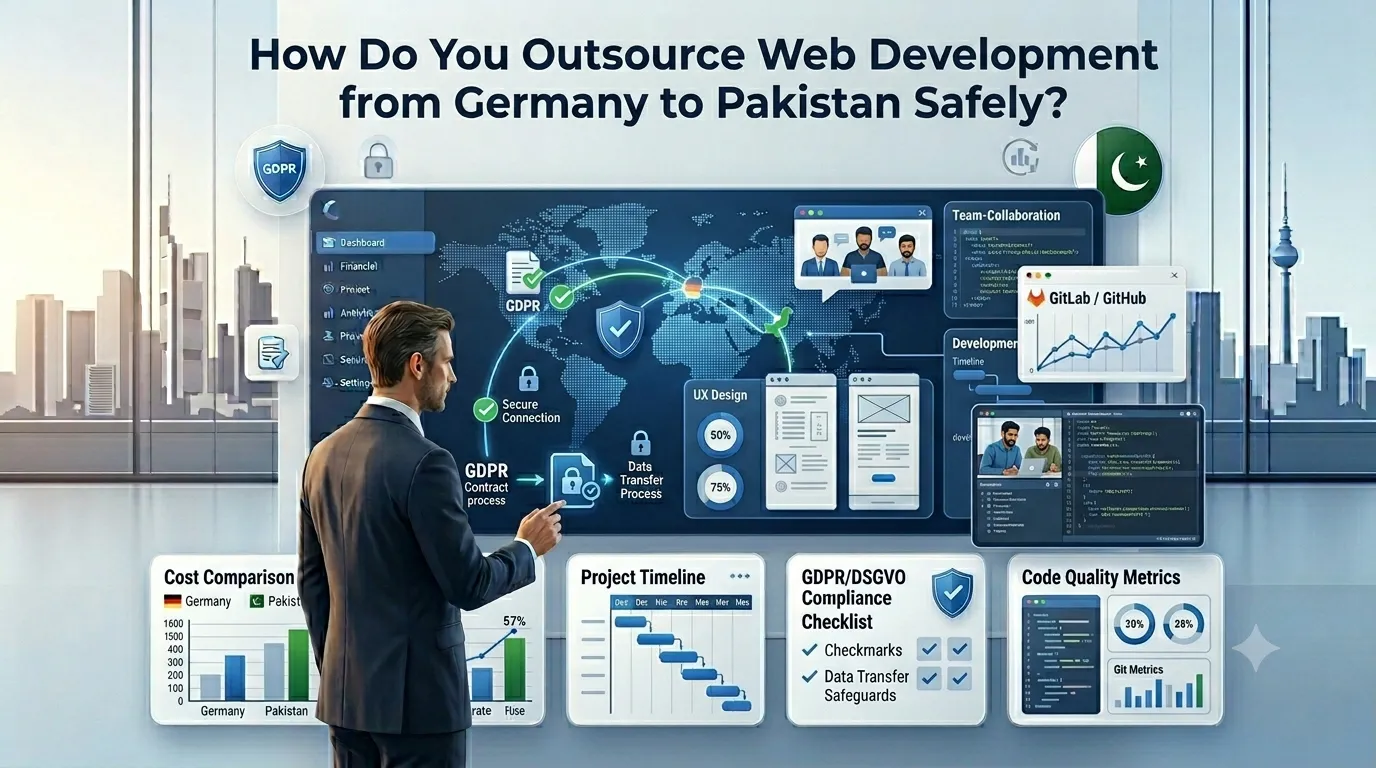
If you’ve been quoted €40,000 by a Berlin agency for a project a Pakistani team could deliver for €12,000, you’re probably already thinking about whether to outsource web development from Germany to Pakistan. This guide gives you a candid answer — including where the cost savings are real, where they break down, and how to structure the arrangement so a GmbH or UG doesn’t end up with a contract law problem or a GDPR exposure.
Written for German SMEs, Mittelstand operations leaders, and English-first founders who care about quality and want to be honest about budget.
Why are German businesses outsourcing web development to Pakistan?
The maths is straightforward. A senior full-stack developer in Berlin or Munich costs €600–€1,200/day fully loaded. The same skill level in Lahore or Karachi is €150–€350/day. For a 60-day build, that’s a difference of €27,000–€51,000 — often more than the entire project budget at a German agency.
Three things changed in the last five years that made Pakistan a real option for DACH clients:
- Senior engineers in Pakistan are now routinely working with US and EU SaaS companies, so English business writing is normal.
- Time-zone overlap with Germany is workable (PKT is GMT+5, so the working day overlaps from 10:00–14:00 CET / 13:00–17:00 PKT).
- EU-compliant contracting structures (with EU entities or trusted EU partner agencies) are now common.
The combination means a Pakistani team can plug into a German project without the chaos of a 12-hour time-zone gap, broken English in tickets, or missing GDPR paperwork.
What’s the honest cost comparison between a Berlin agency and a Pakistan team?
Numbers below are 2026-realistic ranges, net of VAT, for a mid-sized SaaS MVP or e-commerce build.
| Setup | Day rate (senior) | 60-day project cost | Risk profile |
|---|---|---|---|
| Berlin boutique agency | €600 – €1,200 | €36,000 – €72,000 | Lowest risk, highest cost, strong DACH compliance |
| Munich enterprise agency | €900 – €1,500 | €54,000 – €90,000 | Premium delivery, formal processes, enterprise SLAs |
| EU + Pakistan hybrid | €250 – €450 | €15,000 – €27,000 | Sweet spot for €15k–€80k projects |
| Pure Pakistan direct | €150 – €350 | €9,000 – €21,000 | Cheapest, requires you to manage GDPR/IP yourself |
| Eastern Europe hybrid | €350 – €600 | €21,000 – €36,000 | Closer time zone, higher rates than Pakistan |
| India direct | €120 – €280 | €7,200 – €16,800 | Lowest cost, weakest time-zone overlap with CET |
The honest savings vs a Berlin agency: roughly 40–70% on equivalent scope, depending on which setup you choose and what compliance work is included.
What are the real concerns (and honest answers)?
These are the four objections every German founder raises before signing an outsourcing contract. Each has a real answer.
1. “Will Quality Be Lower?”
Sometimes yes, sometimes no — it depends on the team, not the country. The right question is: “What senior developer is doing my work, and what have they shipped before?”
Ask for the names, LinkedIn profiles, and portfolios of the actual people who will write your code. If the agency dodges this, walk away.
2. “Time Zone — Will We Lose a Day?”
In practice, you get 4 hours of overlap between Germany and Pakistan during normal working hours. That’s enough for daily stand-ups, ad-hoc Slack discussion, and weekly demos. Async-friendly teams handle the rest with Loom videos, written tickets, and PR reviews.
The risk is real only if the team has no async discipline. Verify before signing.
3. “What About GDPR and IP Protection?”
This is where bad outsourcing arrangements fail. To protect a GmbH or UG, you need:
- A signed Auftragsverarbeitungsvertrag (AVV/DPA) with the development vendor if they touch personal data.
- An explicit IP transfer clause in the contract.
- A mutual NDA signed before any sensitive briefing.
- Source code in your Git organisation, not the vendor’s.
- EU-hosted databases and infrastructure for production data.
A proper Pakistan-based agency working with EU clients has all five as standard. Most do not — verify.
4. “Contract Law — What If Something Goes Wrong?”
This is the hidden risk. A contract under Pakistani jurisdiction is hard to enforce from Germany. The fix is to structure the engagement through an EU entity (either an EU-registered subsidiary of the Pakistani agency, or a European partner agency that subcontracts the Pakistani team).
The contract then sits under EU jurisdiction, with all the protections German contract law gives you, while the actual work happens in Pakistan. This is the model serious agencies use.
Pakistan vs Eastern Europe vs India: which fits a German project?
For German clients evaluating offshore options, here’s the honest comparison:
- Pakistan. Best price-quality ratio for English-first teams. Time-zone overlap with CET is reasonable. Strong full-stack and JavaScript/React talent pool.
- Eastern Europe (Poland, Romania, Ukraine, Bulgaria). Closer time zone, EU jurisdiction by default, but rates have risen to 1.5–2x Pakistan.
- India. Lowest cost. Larger time-zone gap (less daily overlap). Quality is highly variable — the spread between best and worst teams is enormous.
German SMEs budgeting €10k–€80k will find Pakistan offers the best price-quality ratio. Enterprise projects above €80k with strict EU jurisdiction requirements are safer with Eastern Europe. India stays competitive for very large, low-complexity volume work.
How do you structure an EU-compliant Pakistan engagement?
If you decide to go ahead, here’s the structure that protects your business:
- EU contracting entity. Contract with an EU-registered company (the Pakistani agency’s EU sub, or a partner agency). All paperwork is under EU law.
- EUR invoicing. All invoices in EUR, with correct VAT treatment (reverse charge for EU B2B is typical).
- GDPR layer. Signed AVV/DPA. EU-hosted production environments (Hetzner, AWS Frankfurt, IONOS).
- IP & code custody. Your own GitHub/GitLab org, with all repositories created under your account. Vendor team gets contributor access, not ownership.
- NDA-first onboarding. Mutual NDA signed before any business-sensitive discussion.
- Senior accountability. A named senior engineer on the Pakistani side as your single point of contact, with a backup contact in Europe.
- Daily stand-up + weekly demo cadence. Asynchronous-first culture, with real meetings only when needed.
If a vendor can’t agree to all seven, that’s the conversation to have before you commit.
What should German SMEs outsource and what should they keep in-house?
Outsourcing works best when you keep certain things in-house:
- Strategy, brand, and brief writing. No outside team can do this for you.
- Decision authority. Final scope, design, and feature decisions stay with you.
- German legal compliance reviews. Final legal text (AGB, Impressum, Datenschutz) reviewed by a German lawyer.
- Customer relationships. The vendor should never be customer-facing without you in the loop.
Outsource the execution: design, development, QA, integrations, deployment, ongoing maintenance.
What real use cases does Pakistan outsourcing win for DACH clients?
Based on five years of delivering DACH projects from a Pakistan-based team, these are the sweet-spot scenarios:
- SaaS MVP builds (€15k–€50k, 8–16 weeks)
- Shopify or WooCommerce shops with custom requirements (€10k–€40k)
- Headless WordPress + Next.js builds for content-rich brands (€15k–€60k)
- Internal tools and dashboards (Retool, custom React apps, €8k–€40k)
- API integrations and middleware (€5k–€25k)
- Long-running maintenance retainers (€1,500–€8,000/month)
Where it works less well: heavily regulated DACH industries (banking, healthcare, public sector) where local presence and certifications are mandatory.
What communication and project management actually works?
Two patterns make Pakistan-Germany outsourcing succeed:
- Async-first communication. Long Loom videos, detailed Slack threads, written tickets. Real-time meetings only when async fails.
- Written-first decisions. Every important decision (scope, design, technical) lives in a written document or ticket. Verbal agreements get lost across time zones.
If a vendor wants to “jump on a call” instead of writing a clear spec, that’s a process-discipline warning.
Why does an English-first Pakistan agency often beat a local German boutique?
For founders who don’t speak German fluently, an English-first agency staffed in Pakistan but operating with EU contracts and EUR pricing has a unique advantage: every artefact (Slack messages, code comments, documentation, contracts, invoices) is in English by default.
You don’t have to translate anything. You don’t have to wonder if something is being discussed in a parallel German thread. That’s why we built Gem Programmers specifically for international and English-first clients — including a growing roster of GmbH founders in Berlin, Munich, and Hamburg.
For the comparison angle on hiring English-fluent talent in Germany, see our hire web developer Germany English speaking guide.
Frequently asked questions about outsource web development from Germany to Pakistan
Yes. Handle reverse-charge VAT, sign a GDPR-compliant AVV/DPA, and contract through an EU entity for German law to apply.
Expect 40–70% savings vs a Berlin boutique agency. A €25,000 German project typically lands between €8,000 and €15,000.
PKT is GMT+5, CET is GMT+1 (GMT+2 in summer). Roughly 4 hours of daily working overlap.
Contractual IP transfer, your own GitHub/GitLab org with vendor as contributor only, mutual NDA, and EU-hosted production data.
Pakistan offers slightly better CET overlap (4 hrs vs 3.5 hrs). Quality is team-dependent — vet individuals, not nations.
For a GmbH/UG, contract under EU jurisdiction via the Pakistani agency’s EU entity or a European partner.
Yes, if they have EU client experience. Verify AVV process, EU hosting, CMP setup (Borlabs/Usercentrics), and TTDSG knowledge.
Ready to outsource web development from Germany to Pakistan?
Outsourcing to Pakistan isn’t inherently risky — bad structure is. The savings (40–70% vs German agencies) are real when the engagement is properly structured with EU contracts, EU-hosted production data, signed AVV, and IP custody under your control.
If you’d like to discuss whether your specific project fits this model, you can book a 30-minute scoping call with one of our senior engineers. No pitch deck, no obligation — just an honest opinion on cost, scope, and risk.