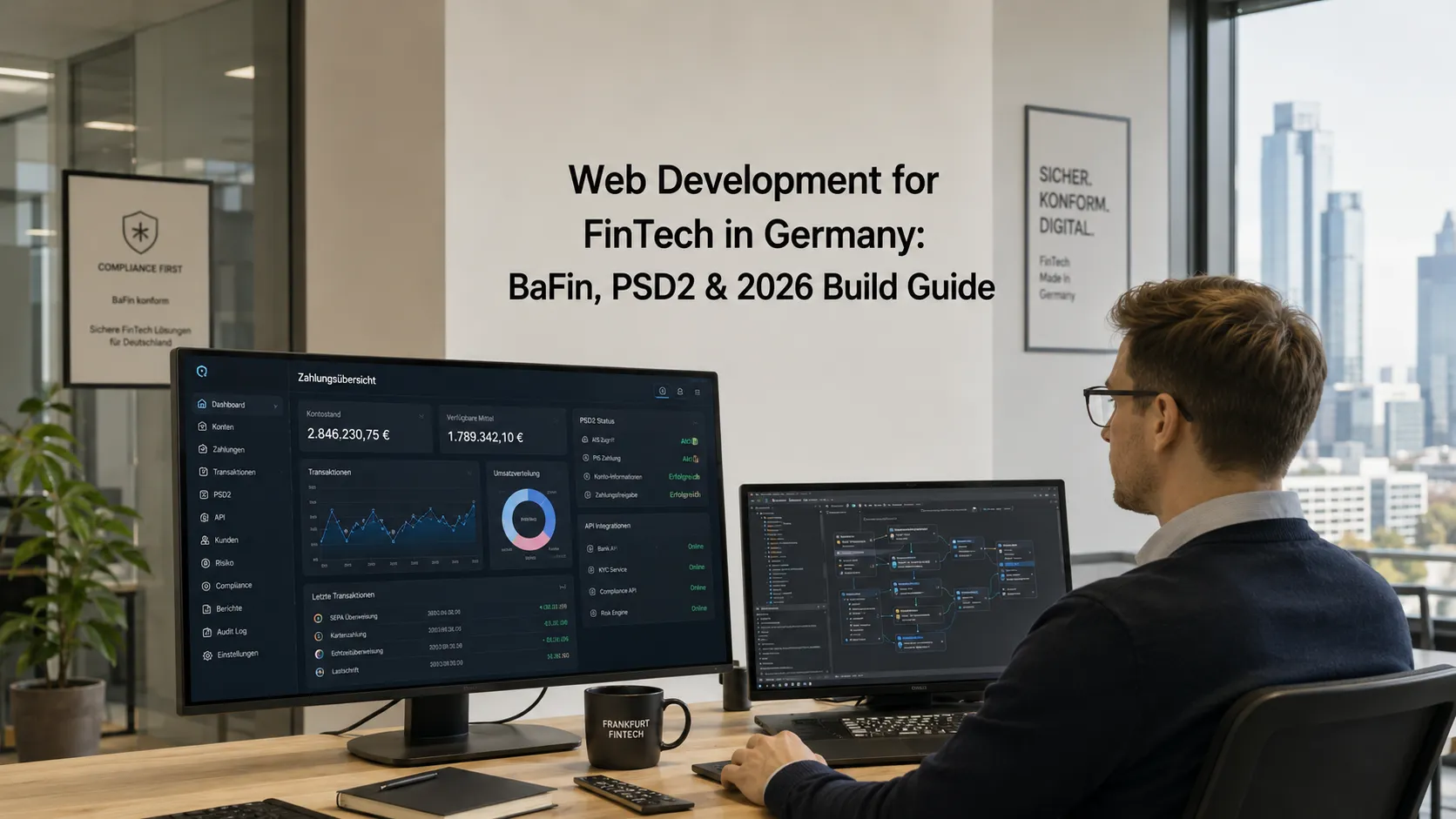
FinTech web development in Germany is not a normal web project. The regulatory weight is enormous: BaFin licensing decisions, MaRisk and BAIT operational requirements, PSD2 Strong Customer Authentication, DORA digital operational resilience, GDPR plus German banking secrecy. The technical stack matters less than whether your team, your agency, and your infrastructure can pass a BaFin audit.
This guide walks through what FinTech web development in Germany actually looks like in 2026: regulatory landscape, build cost realities in EUR, vendor vetting questions specific to regulated financial software, and the architectural decisions that determine whether you reach production at all.
What counts as “FinTech” in Germany in 2026?
Several distinct categories with different regulatory weight:
- Licensed BaFin financial services — banks, payment institutions (ZAG license), e-money institutions, investment firms (KWG license), insurance.
- PSD2 third-party providers — Account Information Service Providers (AISP), Payment Initiation Service Providers (PISP).
- Regulated investment / asset management — robo-advisors, portfolio management platforms, crypto-asset service providers (under MiCA).
- B2B FinTech for the regulated — software for banks, insurers, accountants, Steuerberater.
- Unregulated FinTech-adjacent — accounting tools, invoice software, expense tracking, business banking-adjacent.
The first three carry significant BaFin licensing requirements. The fourth requires careful tenant data handling. The fifth has lighter regulatory load but still hits DSGVO and AML obligations.
The single most expensive mistake in German FinTech: building a product before clarifying which regulatory bucket you’re in.
What regulators and frameworks shape FinTech web development?
- BaFin — German financial regulator. Licenses banks, payment institutions, e-money, investment firms, crypto-asset service providers.
- Bundesbank — payment infrastructure (TARGET2, SEPA), Gläubiger-ID oversight.
- MaRisk / BAIT — operational risk and IT requirements for regulated institutions.
- PSD2 — Strong Customer Authentication (SCA), Open Banking, RTS communication standards.
- DORA — EU Digital Operational Resilience Act effective 2025.
- MiCA — Markets in Crypto-Assets, effective 2024.
- KWG — German banking act; licensing for credit institutions.
- ZAG — German payment services oversight act.
- GwG — German anti-money-laundering law (KYC, AML, suspicious activity reporting).
- DSGVO — see our GDPR compliance guide.
For an early-stage FinTech founder, the first question is: which licensing pathway? The answer dictates everything else.
What does FinTech web development cost in Germany?
Unregulated FinTech-adjacent MVP
- German agency: €60,000–€180,000
- Nearshore with FinTech expertise: €40,000–€120,000
Regulated FinTech MVP (BaFin licensed, PSD2 compliant)
- German agency: €180,000–€650,000
- Nearshore + regulatory consulting: €140,000–€450,000
- Plus BaFin licensing fees + legal: €30,000–€200,000+
Scale-up rebuild
- €350,000–€2,500,000+
For broader cost context see our web development cost in Germany guide and B2B SaaS development guide.
What’s special about FinTech infrastructure in Germany?
Six requirements ordinary web infrastructure doesn’t satisfy:
EU data residency (no exceptions)
Hetzner Cloud Frankfurt, AWS Frankfurt with appropriate config, OVHcloud Strasbourg. BaFin will scrutinize this.
Encryption everywhere
AES-256 at rest, TLS 1.3 in transit, application-level encryption with HSM-managed keys for sensitive fields.
Audit logging that survives discovery
Append-only logs with cryptographic hash chaining. MaRisk demands this.
Multi-region disaster recovery
DORA explicitly requires resilience plans with measurable RTO/RPO targets and tested failover procedures.
Strong authentication (SCA under PSD2)
Two-factor authentication using two of: knowledge, possession, inherence. Cannot be skipped.
Penetration testing and code review
Quarterly pentests minimum. Documented code review processes. Static analysis in CI.
What does a typical German FinTech tech stack look like?
Stable, audit-friendly choices:
- Backend: Java + Spring Boot (most common), Kotlin, or Node.js + NestJS with strict TypeScript. Go for performance-critical paths.
- Frontend: React + Next.js or Angular.
- Database: PostgreSQL with row-level encryption. Some shops use Oracle for legacy compatibility.
- Infrastructure: Hetzner Cloud, AWS Frankfurt, IONOS, or self-hosted DC in Germany. Kubernetes for enterprise.
- Auth: Keycloak self-hosted, ForgeRock for enterprise, IDnow/Onfido for video-ident KYC.
- Payments: SEPA via Stripe/Mollie, or specialist PSP (Mangopay, Treezor, Solarisbank).
- Observability: Self-hosted or EU-region Datadog / Grafana / Prometheus.
How does Banking-as-a-Service (BaaS) change the calculation?
Many German FinTech startups avoid full BaFin licensing by riding on top of a BaaS partner: Solarisbank, Treezor, Mangopay, Swan. The BaaS provider holds the license; you build on their API.
Pro: faster time-to-market (months vs. years), lower upfront cost (€100k–€500k vs. €2M–€10M for own license), proven regulatory infrastructure.
Con: revenue share / per-transaction fees, dependency on partner’s roadmap and uptime, less flexibility.
For most early-stage FinTech in Germany, BaaS is the right starting point. Upgrade to own license when scale justifies the overhead.
What questions should you ask a FinTech development agency?
Beyond standard agency vetting:
“Have you shipped a BaFin-regulated product?”
Real experience matters more than any other signal.
“Walk me through PSD2 SCA implementation.”
Should know: 2FA flow, exemptions (recurring, low-value), trusted beneficiary flow, biometric vs. OTP trade-offs.
“How do you handle AML/KYC integration?”
IDnow, Onfido, Veriff for video-ident; Onfido / SumSub for document verification.
“What’s your audit logging architecture?”
Append-only logs, hash chaining, evidence preservation, retention rules.
“How do you handle penetration testing?”
Quarterly pentests, code review processes, SAST/DAST in CI, vulnerability disclosure policy.
“Show me a DORA operational resilience plan.”
Real document with tested incident response, communication protocols, third-party risk management.
For broader agency vetting see our how to choose a web development agency guide.
What are the most common FinTech build mistakes German founders make?
Building before clarifying regulatory pathway
Wasted 6–12 months on a product whose architecture isn’t BaFin-defensible. Always engage a regulatory lawyer + BaFin specialist first.
Picking US-default infrastructure
AWS us-east-1, default Stripe US, default Vercel. BaFin will reject this. Pick EU from day one.
Underestimating ongoing compliance work
Compliance is permanent ~15–30% engineering overhead. Plan for compliance engineering hires.
Hiring a generic web dev agency for FinTech work
A €30,000 generic agency build is not a FinTech-grade build. Always pay the premium for FinTech-experienced teams.
When does BaaS vs. own license make sense?
- BaaS when: early-stage, fastest time-to-market needed, product fits partner’s menu, transaction volume below €50M/year.
- Own license when: revenue above €5M/year, BaaS fees become material, product needs flexibility, you have €2M+ for licensing + capital.
Most successful German FinTech in 2026 starts on BaaS, then migrates when scale justifies it.
Frequently Asked Questions About FinTech Web Development in Germany
€60,000–€180,000 unregulated MVP; €180,000–€650,000 regulated MVP + €30,000–€200,000+ licensing.
Typically yes for payments, account info, lending, investment management; check with a German regulatory lawyer.
BaaS (Solaris, Treezor, Mangopay) faster and cheaper; full license slower and more flexible.
12–24 months; €125k+ capital for ZAG; €30,000–€200,000+ legal/consulting.
Java + Spring Boot dominates; Kotlin and Node.js + NestJS growing; PostgreSQL on Hetzner/AWS Frankfurt.
No for regulated FinTech; possible but risky for unregulated FinTech-adjacent.
BaFin case studies, compliance-officer references, pen testing and SCA experience.
MiCA applies from 2024 to all crypto-asset service providers in Germany/EU.
Need help scoping a FinTech build?
If you’re at the early stage of a German FinTech and want a 30-minute scoping conversation about regulatory pathway, stack choice, and realistic EUR budget, book a meeting or send details via our contact page.
Need expert help? Gem Programmers provides custom website development for businesses in Germany, Austria and Switzerland. Request a free, no-obligation quote and get a clear plan with scope, timeline and price.