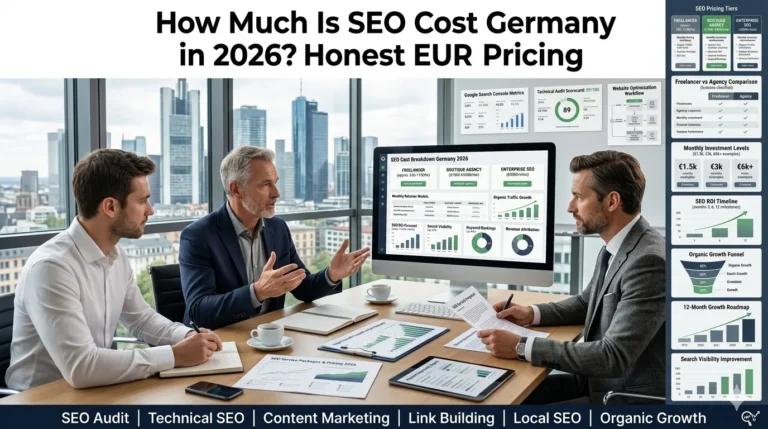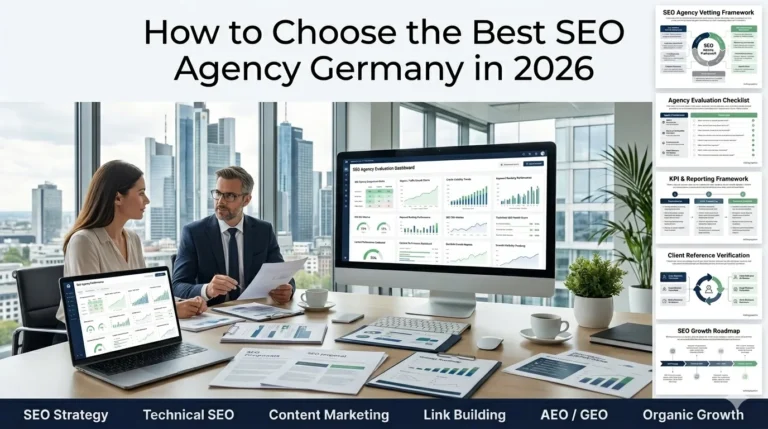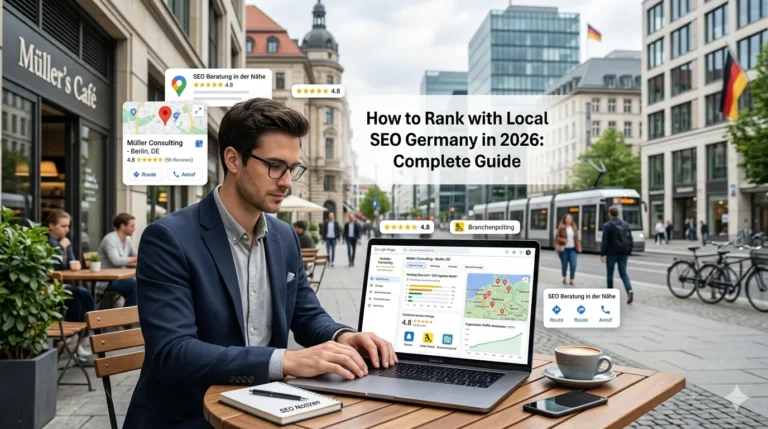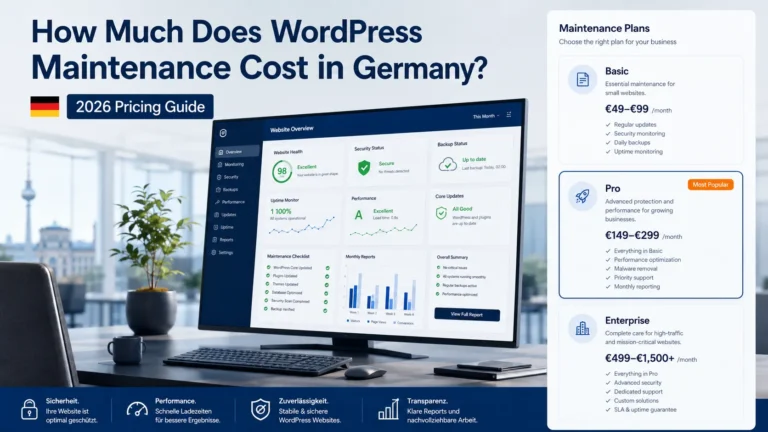
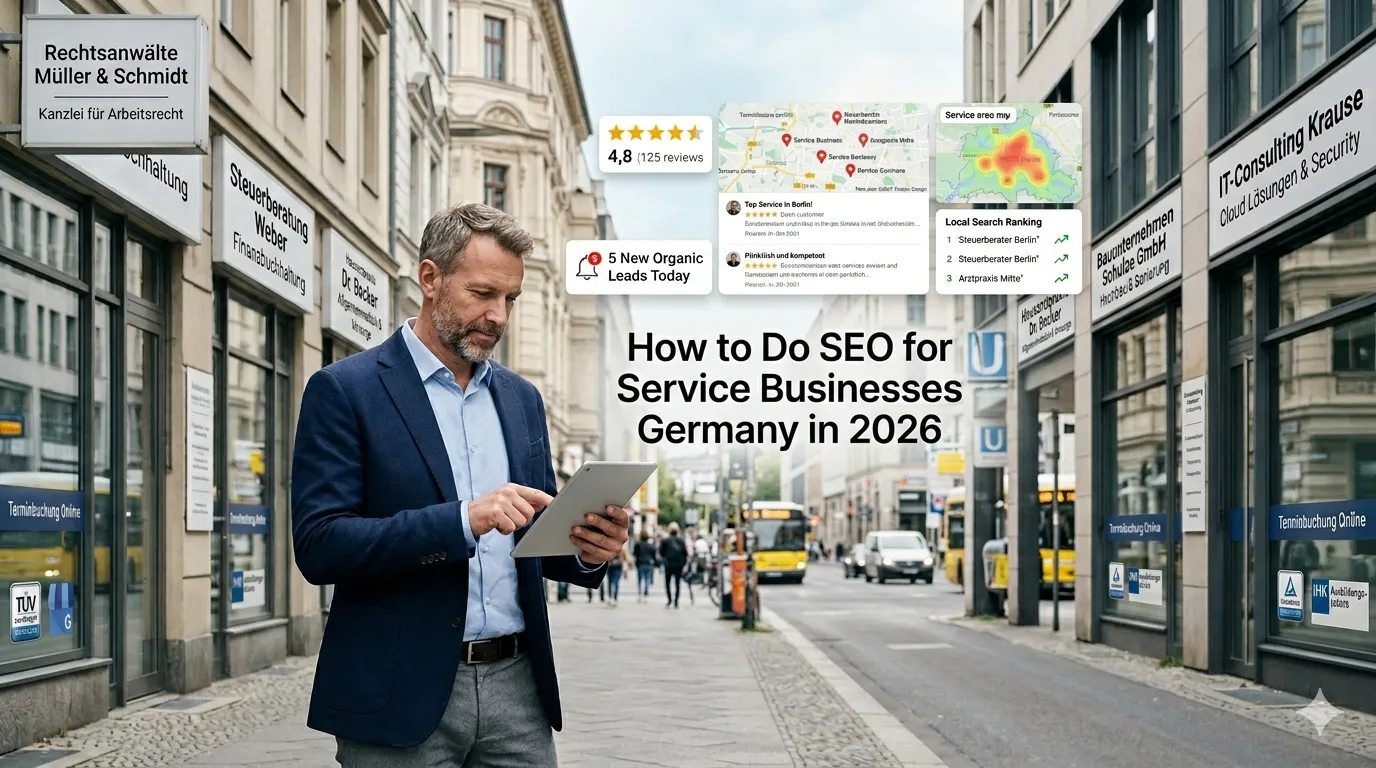
SEO for service businesses Germany follows distinct patterns. German Mittelstand — Steuerberater, Anwälte, Heilpraktiker, Berater, Bauunternehmer, Handwerker, IT-Dienstleister, Marketing-Agenturen — needs different from e-commerce or B2B SaaS. Service businesses live or die by visibility for service + city combinations, sit at intersection of local + national SEO, and depend on trust signals more than competitive verticals.
This guide walks through what SEO for service businesses Germany actually requires in 2026: local + national strategy combination, Mittelstand-specific tactics, service page templates, trust signals, and lead attribution.
For broader local SEO see our local SEO Germany guide.
What’s unique about German service business SEO?
Five characteristics:
Hyper-local intent
“Steuerberater Berlin” beats “Steuerberater” for revenue value. Local pack rankings critical.
Trust signals dominate
Buyers research extensively. Trust signals (reviews, credentials, awards, association memberships) influence both rankings + conversion.
Limited content scale needs
Service businesses don’t need 500 articles. 50–100 well-crafted pages typically suffice.
Conversion-focused over traffic-focused
10 qualified leads/month > 10,000 visitors/month. SEO strategy reflects.
Multi-decision-maker (B2B) or family decision (B2C)
Single visitor may research before bringing partner / boss / family to decide.
What’s the service business SEO architecture?
A typical German service business needs:
Homepage
Brand-level positioning. Brief overview of services. Trust signals (reviews, awards, credentials).
Service pages (one per service)
Comprehensive page per offered service. Optimized for service + topic-related queries.
Location pages (one per location)
If multi-location: dedicated page per location.
Service + city combination pages
“[Service] [City]” pages where market warrants. Examples: “Steuerberatung Berlin,” “Steuerberatung Hamburg.”
Blog / resources
Topic-related educational content. Builds authority + captures TOFU traffic.
About / team
Personal authority. Photos. Credentials. Backgrounds.
Reviews / case studies
Customer success. Testimonials with permission.
Contact + booking
Easy contact + scheduling.
What’s the service page template for German services?
A high-converting service page includes:
Hero section
- H1: descriptive service name + value proposition
- Subtitle: who it’s for + key outcome
- Primary CTA: “Termin vereinbaren” or “Beratung anfragen”
Service overview (400–800 words)
Comprehensive explanation. Sie-form. Specific outcomes addressed.
Trust signals row
Logos of clients, certifications, partnerships.
How it works (300–500 words)
Process explained. Numbered steps. Clarifies what to expect.
Pricing transparency (if applicable)
EUR ranges or “ab €X” minimum. Builds trust. Many German services hide pricing — those that show it convert better.
FAQ section
8–15 common questions. FAQ schema markup.
Customer testimonials / case studies
2–4 specific case studies with measurable outcomes.
CTA reinforcement
Multiple CTAs throughout long page.
Schema markup
LocalBusiness or ProfessionalService schema. FAQ schema
What’s the service + city page strategy?
For service businesses with regional reach:
When to create
If you serve multiple German cities AND each represents meaningful revenue potential.
URL pattern
/steuerberatung-berlin/, /steuerberatung-hamburg/, /steuerberatung-muenchen/
Content per page
400–900 words unique per city. Not just templates with city name swapped:
- City-specific market context
- Local case studies / clients
- Local team or office (if applicable)
- City-specific FAQ
- Travel / meeting logistics
LocalBusiness schema per location
If you have physical office, full LocalBusiness schema.
Avoid duplicate content
Each page genuinely unique. Generic templates with city name swapped get penalized.
For multi-location depth see our multi-location local SEO guide.
What trust signals matter most for German services?
Seven trust signals:
Professional credentials
Steuerberaterkammer membership, Anwaltskammer registration, IHK membership, industry certifications.
Years of experience…
“Seit 2010 für Sie da” matters in German market.
Awards + recognition
Industry awards, Top 100 lists, FAZ recognition.
Customer testimonials
Named testimonials with photos better than anonymous. With permission.
Trusted Shops or similar trust seal
Industry-appropriate trust seal (Trusted Shops, ProvenExpert, Trustpilot).
Association memberships
Berufsverband memberships displayed prominently.
Specific case studies
“Wir haben für Kunde X folgende Ergebnisse erzielt” — specific + measurable.
How does local SEO + national SEO combine?
Service businesses balance both:
Local SEO
Google Business Profile, local citations, location pages, reviews — capture local pack rankings.
National / regional SEO
Content marketing, link building, brand-building — capture broader search demand.
Service + city combinations bridge both
Service + city pages capture local-intent searches with national SEO infrastructure.
For broader local SEO see our local SEO Germany guide and Google Business Profile guide.
What content marketing works for German service businesses?
Five high-impact content types:
1. Expert how-to guides
“Wie wähle ich einen guten Steuerberater?” — captures buyers researching.
2. Process / methodology content
“Unser Beratungsprozess” — builds trust + ranks for procedural queries.
3. Industry analysis + commentary
Trend pieces, industry analysis. Earns links + brand authority.
4. Case studies + customer stories
Specific outcome-focused stories. Compelling for prospects + earns mentions.
5. FAQ-style content
Common questions buyers have. Captures long-tail + AEO citation potential.
What does service business SEO cost in Germany?
Solo professional (Anwalt, Steuerberater)
- DIY foundations: €0
- Freelance SEO support: €800–€2,500/month
- Light content production: €500–€2,000/month
Small service firm (5–20 employees)
- Freelance retainer: €2,500–€5,500/month
- Plus content production: €1,500–€5,000/month
Mid-size service business
- Agency retainer: €4,500–€12,000/month
- In-house marketing lead at scale
For broader SEO cost see our SEO cost Germany guide.
How do you measure service business SEO ROI?
Five metrics:
Local pack rankings for priority queries
“Steuerberater Berlin” + variations.
Organic conversion rate
Visits to inquiries. Healthy: 3–8% for service businesses.
Lead attribution
CRM tracks lead source. Calculate cost per organic lead.
Closed-won attribution
Marketing automation + CRM connect organic leads to closed deals.
Time-to-revenue
Organic visit to closed-won timeline. Often 2–6 months for German services.
For most German service businesses: 10–50 organic leads/month at €500–€5,000+ per closed customer = strong SEO ROI.
What are common service business SEO mistakes?
Five patterns:
Generic service descriptions
“We help businesses with X.” Doesn’t differentiate or rank.
No local SEO investment
Trying to compete nationally when business is fundamentally local.
Hiding pricing entirely
Many German services refuse to show any pricing. Loses to competitors who do.
Skipping trust signals
No testimonials, no credentials displayed, no certifications. Erodes both ranking + conversion.
One-off SEO campaigns
Service business SEO compounds over years. Three-month campaigns waste investment.
Frequently asked questions
Hyper-local intent, trust signal dominance, conversion focus.
Yes with unique content per city plus local schema.
Credentials, experience, awards, testimonials, trust seals, memberships
Generally yes; ranges or starting prices build trust.
EUR 800/month solo to EUR 12,000/month mid-size.
Local pack rankings, conversion rate, CRM attribution.
3-9 months local; 12-18 months pipeline impact.
Local pack for intent; national content for authority.
Need help with service business SEO?
If you’re scoping SEO for your German service business and want a 30-minute scoping conversation about local + national strategy, book a meeting or send details via our contact page.
Need expert help? Gem Programmers provides full-service SEO for businesses in Germany, Austria and Switzerland. Request a free, no-obligation quote and get a clear plan with scope, timeline and price.