The CTA button is the smallest element on your page and statistically the highest-leverage. A homepage might have 2,000 words, 15 sections, 6 images, and one CTA button. Visitors will read maybe 200 of those words and look at 2 of those images — but every visitor who converts clicks the button. The button is where decision becomes action.
Yet most German websites still use generic CTAs (“Mehr erfahren”, “Klicken Sie hier”, “Kontakt”), placed where the eye doesn’t naturally land, in colors that don’t pop, with surrounding copy that doesn’t reduce friction. This guide covers everything we’ve tested across hundreds of German B2B and B2C sites: button copy, color, size, placement, surrounding micro-copy, and the A/B test sequence that works.
Why does CTA copy matter more than CTA design?
Studies consistently rank CTA copy as the highest-leverage button optimization, ahead of color, shape, or size. The copy is what the buyer actually evaluates in the half-second before clicking. “Jetzt kaufen” and “Mehr erfahren” trigger fundamentally different mental states even with identical visual design.
The rule: button copy should match the buyer’s mental state at the exact scroll position. Top-of-funnel homepage visitors respond well to curiosity-driven CTAs like “Mehr erfahren” or “Wie funktioniert es?”.
Pricing page visitors are more decision-ready, so action-focused CTAs like “Plan wählen” or “Jetzt starten” work better.
Checkout-stage users are fully committed, so direct CTAs like “Jetzt kaufen” or “Sicher bezahlen” are most effective.
If your CTA copy doesn’t match the buyer’s stage, you’re either pushing too hard (premature commitment buttons scare buyers off) or too soft (uncommitted buttons fail to convert ready buyers). The most common mistake in German B2B: every button reads “Mehr erfahren” everywhere, which converts neither the curious nor the decided.
If you haven’t read our broader CRO foundation, see CRO services Germany for the strategic overview and landing page optimization for surrounding context that the CTA depends on.
What button copy works best for the German B2B market?
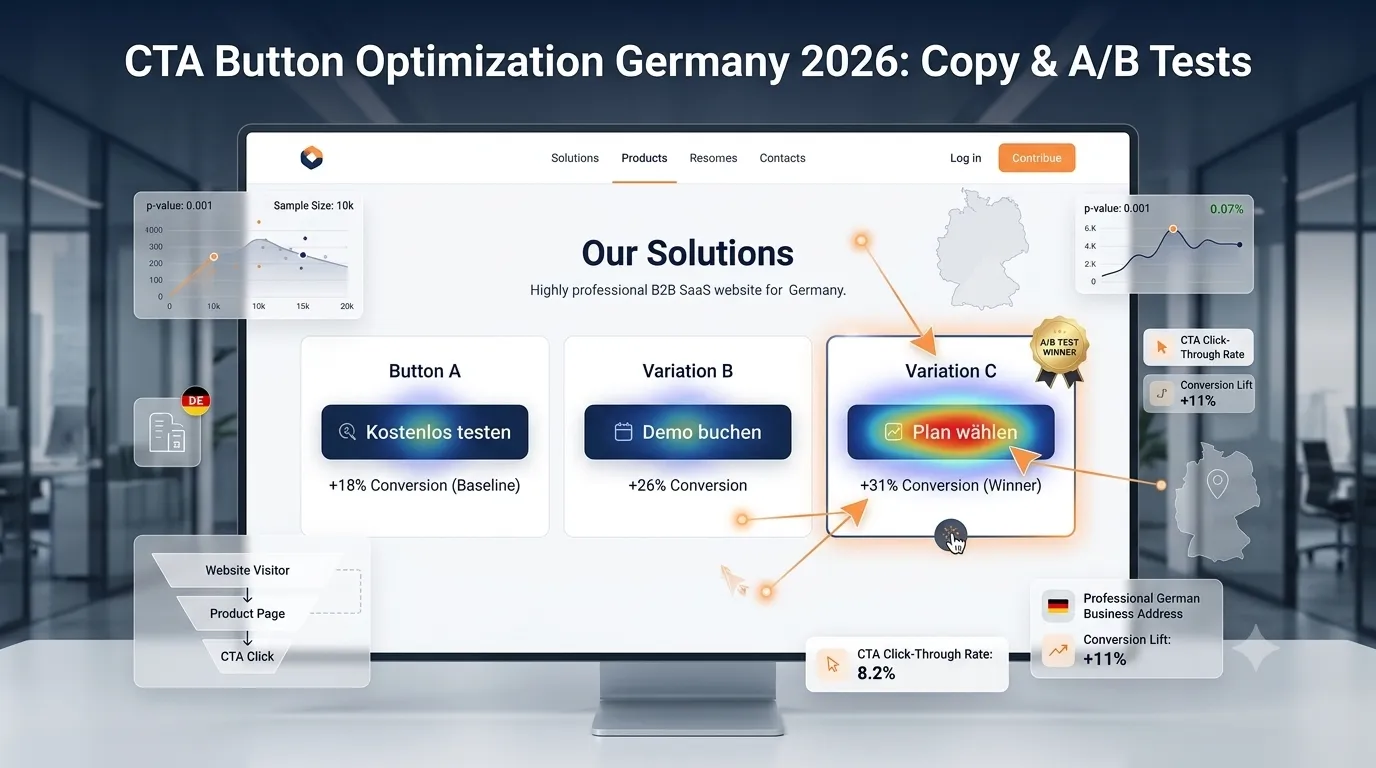
For SaaS trials and signups: “Kostenlos testen” beats “Jetzt anmelden” by 15–25% in our tests. “Kostenlos” addresses the price objection upfront. Adding qualifier — “14 Tage kostenlos testen” or “Kostenlos testen — keine Kreditkarte” — closes another 10–15%.
For demo requests: “Termin buchen” beats “Demo anfordern” because it implies a concrete next step rather than a vague request. “Live-Demo buchen” beats “Termin buchen” when you want to emphasize that something will happen on the call. “15-Minuten-Beratung buchen” sets time expectations and reduces commitment fear.
For pricing pages: “Plan wählen” or “Mit [Plan-Name] starten” beats generic “Jetzt kaufen” because it confirms the buyer has decided which plan. The button effectively acknowledges the buyer’s selection.
For contact/quote pages: “Angebot anfordern” beats “Kontakt” by a wide margin. Buyers don’t want to “contact” — they want a specific outcome. Name the outcome.
For B2C e-commerce: “In den Warenkorb” remains standard and works well. Variants like “Jetzt sichern” or “Mein [Produkt] holen” can outperform in specific contexts. “Sofort kaufen” works for impulse purchases. “Mit Klarna kaufen” or “Mit PayPal kaufen” can outperform the generic “Jetzt kaufen” by showing payment method up front.
For newsletter signups: never “Abonnieren” alone. Always pair with what the subscriber gets: “Wöchentliche Tipps erhalten”, “10% Rabatt sichern”, “Mein Guide herunterladen”.
Should CTA copy be in first person or second person?
First-person (“Mein kostenloses Konto erstellen”, “Meine Demo buchen”) consistently outperforms second-person (“Ihr Konto erstellen”, “Ihre Demo buchen”) in our German market tests. The psychology: first-person creates a sense of ownership and decision before the click happens.
The exception: for very formal B2B audiences (legal, financial services, government contractors), Sie-form with second-person (“Ihre Beratung anfordern”) sometimes outperforms first-person because it matches the expected register. Test specifically in your industry; don’t default to one or the other.
Mixed first/second person: avoid. “Mein Konto bei Ihnen erstellen” reads awkwardly. Pick one register and stick with it across all CTAs on the page.
How long should CTA copy be?
Short (1–3 words) for retention/secondary actions. Medium (3–6 words) for primary actions where qualification matters. Longer copy only when an objection needs answering inline.
Examples by length:
- 1 word: “Weiter”, “Senden”, “OK” — works for confirmed flows where context is established
- 2 words: “Jetzt kaufen”, “Demo buchen” — works for clear single-purpose actions
- 3–4 words: “Kostenlos testen — keine Kreditkarte” — works when objection-answering is needed
- 5+ words: rare, usually a sign that the surrounding context should carry the message
Avoid: “Klicken Sie hier” — uninformative and dated. “Submit” or English in a German site. “Mehr” — too vague unless context makes the target obvious.
What about CTA color and contrast?
There is no universal best color for CTAs. The right color depends on your brand palette and what creates the highest contrast on your specific page. Green CTAs work great if your page is mostly white and blue. Orange CTAs work great if your page is mostly white and dark blue. The pattern: pick a color that no other element on the page uses, then test specific shades.
What matters more than color: contrast ratio. The CTA must “pop” — not blend in with surrounding design elements. Minimum 4.5:1 contrast ratio against the background per WCAG AA accessibility guidelines. Higher (7:1) for the primary CTA on a page if possible.
Red CTAs: work for urgency and consumer e-commerce. Feel aggressive in German B2B. Use green, blue, or orange for B2B unless you have a specific reason to use red.
Black CTAs on white background: high-fashion, minimalist, premium positioning. Works for luxury, design-led B2B SaaS, and design-conscious brands. Doesn’t work for mainstream B2B where visibility matters more than aesthetics.
Brand color CTAs: only acceptable if your brand color has enough contrast against your page background. If your brand color is also your page accent color, your CTA gets visually swallowed. Either change the brand color usage on the page or use a different CTA color.
What size should CTA buttons be?
Mobile: minimum 44x44px tap target per Apple HIG and Google Material Design. Realistically, 48–56px height with 12–16px horizontal padding works best. Smaller buttons feel cramped and miss-tap; larger buttons feel desperate.
Desktop: 44–56px height with adequate horizontal padding for the copy. The button should fit its copy comfortably without crowding, but shouldn’t feel like a banner.
Primary CTA larger than secondary: yes, always. The hierarchy must be visible at a glance. If a buyer sees two same-sized buttons, they pause to evaluate which one to click — and pausing reduces conversion.
Full-width mobile CTAs: usually win for primary actions. The CTA fills the available real estate and is unambiguously the next action. Don’t apply this universally; on cluttered pages full-width buttons feel too aggressive.
What goes around the CTA button?
The 100 pixels around the CTA button are the most valuable real estate on your page. Use them strategically.
Above the CTA: one benefit or risk-reversal sentence. Examples:
- “14 Tage kostenlos testen — jederzeit kündbar”
- “Über 1.200 Mittelstand-Unternehmen vertrauen uns”
- “Kostenlose Lieferung ab 50€”
- “Rückgabe innerhalb von 30 Tagen”
Below the CTA: trust signal or supporting fact. Examples:
- Trusted Shops badge
- “Sichere Zahlung mit SSL-Verschlüsselung”
- Customer count or rating
- “Sicher und DSGVO-konform”
Don’t crowd: max one element above and one below. More than that, the button visually drowns and the buyer doesn’t know which signal to trust.
For trust signal selection specifically, see our trust signals conversion guide and social proof German market guide.
Where on the page should the primary CTA appear?
The “above the fold” rule is overstated. CTAs work well above the fold AND below the fold AND in sticky positions. The goal: a CTA visible whenever a buyer has formed an intent to act, no matter where they are on the page.
For homepages: hero CTA above the fold, secondary CTA at end of each major section, final CTA in the closing block. Buyers form intent at different points based on what convinces them — meet them where they are.
For long-form landing pages: a CTA every 600–800 pixels of scroll. The visitor who is convinced by paragraph 3 shouldn’t have to scroll past paragraph 11 to find a button.
For product pages: primary CTA near the top (price + add-to-cart), repeated after specifications, repeated in a sticky bottom bar for mobile. Three positions, same primary CTA copy.
For pricing pages: a CTA per tier card, then nothing in the middle, then a final CTA below the comparison table. The middle of the page is for evaluation, not action.
Sticky CTAs on mobile: nearly always win on commerce pages. For B2B SaaS, sticky CTAs can feel pushy — test before committing.
Should you have multiple CTAs or just one?
Most pages benefit from one primary CTA and one secondary CTA. Examples:
- Primary: “Kostenlos testen”, Secondary: “Demo buchen”
- Primary: “Jetzt kaufen”, Secondary: “Auf die Wunschliste”
- Primary: “Termin buchen”, Secondary: “Whitepaper herunterladen”
The secondary CTA captures buyers not ready for the primary action. Without it, you lose them entirely. With it, you keep them in your funnel for nurture.
Three or more CTAs of equal visual weight: confuses buyers and reduces conversion. If you genuinely have three audiences (e.g., enterprise, mid-market, SMB), consider three separate landing pages rather than three CTAs on one page.
CTA hierarchy: primary CTA in solid bold color, secondary CTA in outlined or ghost button style, tertiary CTA in text-link style. Visual hierarchy directs attention while preserving options.
What CTA mistakes specifically hurt German conversion?
Patterns we’ve seen consistently underperform in German B2B and B2C:
- English CTAs on a German page: “Get Started” or “Sign Up” on an otherwise German site immediately feels off. Translate properly.
- Vague generic CTAs: “Mehr erfahren” everywhere. Specific outcomes always beat vague exploration.
- Pushy urgency without basis: “Nur noch heute!” on every page is dismissed as marketing. Use urgency only when genuinely time-bound.
- Hidden CTAs: links styled like body text instead of buttons. Buyers don’t recognize them as actions.
- Inconsistent CTA copy across the journey: homepage says “Kostenlos testen”, landing page says “Jetzt anmelden”, checkout says “Konto erstellen”. Continuity matters.
- CTAs that don’t match Google Ads copy: ad says “Free 14-day trial”, page CTA says “Mehr erfahren”. Buyer’s expectation breaks immediately.
- Hover-only CTAs: buttons that only show state on desktop hover. Mobile users can’t hover.
- Too-light micro-copy: trust signals in 10px grey text are visually invisible. If you’re going to add micro-copy, make it readable.
What’s the right CTA copy for cold traffic vs warm traffic?
Cold traffic (first visit, no prior engagement): low-commitment CTAs win. “Mehr erfahren”, “Whitepaper herunterladen”, “Newsletter abonnieren” capture interest without demanding decision.
Warm traffic (returning visitor, scrolled deeply, viewed pricing): higher-commitment CTAs win. “Kostenlos testen”, “Demo buchen”, “Beratung anfordern” convert visitors who have already qualified themselves.
Hot traffic (clicked through from a nurture email, came from a pricing-page ad): direct purchase or strong commitment CTAs win. “Jetzt kaufen”, “Plan wählen”, “Termin buchen” work because the buyer is already deciding.
Most websites use the same CTA across cold and hot traffic, leaving conversions on both ends. Segmenting CTAs by traffic source (or using personalization tools to vary CTAs by user behavior) is one of the highest-impact intermediate-difficulty CRO projects.
What A/B tests should you run on CTAs first?
In order of historical impact:
- Primary CTA copy — usually 10–30% lift potential. Test 3 variants over 4–6 weeks.
- CTA color or contrast — 3–15% lift potential when current button blends into the page.
- Micro-copy above CTA — adding or rewriting one line above the button can move conversion 5–15%.
- Sticky CTA bar on mobile — for commerce, usually wins; for B2B, varies.
- Button size — going from “default” to “large” on a primary CTA often wins 3–8%.
- CTA position above vs below fold — varies by audience and page intent.
- First-person vs second-person CTA copy — typically first-person wins, but test in your context.
- Secondary CTA inclusion — adding a low-commitment secondary often increases overall capture even if primary conversion stays flat.
For test mechanics, see our A/B testing tools, statistical significance, and A/B testing Germany guide.
How long should a CTA test run?
At least 2 weeks of data covering full weekly cycles. Most CTA tests need 4–6 weeks to reach significance because conversion rates are usually 1–5% — small effects on small base rates require lots of visitors to detect.
Run sample size calculations before starting. A typical SaaS pricing-page CTA test (current rate 12%, minimum detectable effect 15% relative) needs ~3,500 visitors per variant. If your pricing page gets 500 visitors/week, that’s 7 weeks per variant or 14 weeks for an A/B test. Plan accordingly or accept that you’ll be testing big effects only.
Don’t stop tests early when they look like they’re winning. False positives are the #1 sin of impatient testing. Stick to your pre-defined sample size and significance threshold.
How do you handle CTAs in the German legal context?
Specific compliance considerations:
- Subscription CTAs: must clearly disclose what the user is subscribing to. “Kostenpflichtig bestellen” required for paid orders per § 312j BGB (“Button-Lösung”). Generic “Bestellen” is not compliant for paid subscriptions.
- Lead form CTAs: must comply with double opt-in for newsletter sign-ups. CTA can say “Newsletter abonnieren” but the confirmation flow must be documented and DSGVO-compliant.
- Cookie consent CTAs: must have equally prominent “Ablehnen” alongside “Akzeptieren” per TTDSG and the recent rulings. A green “Akzeptieren” with a grey or hidden “Ablehnen” is non-compliant.
- Free trial CTAs: must disclose what happens after the trial (auto-charge, manual reactivation, downgrade) before the user commits.
The “Button-Lösung” specifically: any button that initiates a paid order must be labeled “kostenpflichtig bestellen” or equivalent unambiguous wording. “Bestellen” or “Jetzt buchen” alone has been ruled non-compliant in court cases.
What does professional CTA optimization cost?
A focused CTA optimization project (audit, copywriting, design, A/B test setup, 4–6 test cycles across primary pages) typically runs €3,000–€8,000 for a 4–6 week engagement. Standalone CTA work is often bundled into broader landing page or funnel optimization rather than billed separately.
For ongoing testing as part of a CRO retainer, CTA testing is one of the cheapest and highest-frequency test types — typically 2–4 CTA tests per month at standard retainer rates. See our CRO cost Germany guide for retainer context.
Frequently asked questions about CTA button optimization
Mostly hurt for B2B. Emoji feels American + reduces seriousness. B2C younger demographics: test, don’t assume.
Generally no. Looks aggressive. Exception: genuine limited-time urgency.
No. US pattern feels gimmicky to German buyers. Use direct CTAs instead.
Critical. Disabled state, spinner, success confirmation. Use ARIA for accessibility. Prevents double-submits.
Match the next logical step after AI’s answer. Use ‘Termin buchen’ or ‘Kostenlos testen’ over ‘Mehr erfahren.’
Yes for SaaS. Conditional CTA by auth state is standard. Logged-in: drive engagement, not re-acquisition.
Minimal within Germany. DACH split: Austria (‘zzgl. USt.’), Switzerland (‘Fr.’, more formal).
‘Kostenlose Beratung buchen’ or ’15-Minuten-Demo buchen’ — Mittelstand prefers human contact over self-service.
Ready to optimize your CTAs for the German market?
CTA optimization is the lowest-effort, highest-impact CRO work you can do. A single afternoon of CTA copywriting and color testing can yield 15–30% conversion lift on hot traffic. Combined with surrounding micro-copy and trust signals, the compound effect is substantial.
Book a meeting for a free CTA audit where we’ll review your primary pages, identify the top 5 CTA improvements, and show you the test setup that would prove them out fastest. Or browse our conversion rate optimization services and contact us to discuss a CRO engagement that includes CTA optimization as part of the broader funnel work.