Social proof is one of the most influential CRO levers for German buyers. German B2B + B2C audiences research extensively before deciding. Strong social proof — testimonials, customer logos, reviews, case studies — can lift conversion 10–30% on relevant pages. The German market values authentic, specific social proof more than aggressive American “endorsement” patterns.
This guide walks through what social proof German market CRO actually requires in 2026: types of social proof, placement strategy, German cultural specifics, typical conversion lift, and common mistakes.
For broader CRO see our CRO services Germany guide.
Why does social proof work?
Five psychological mechanisms:
Reduces decision risk
Buyers see others made same decision = it’s probably safe.
Validates value
Specific customer outcomes confirm offering’s value.
Builds trust quickly
Faster than building trust from scratch.
Demonstrates fit
“Customers like me” use this = relevant.
Reduces objection cycles
Common objections answered by customer voices.
For German market specifically: social proof amplified vs other markets due to research-heavy buying behavior.
What types of social proof work?
Seven categories:
Customer logo
Recognizable brands. Visual quick validation.
Testimonials
Quotes from named customers. Best with photos + context.
Case studies
Long-form success stories with measurable outcomes.
Reviews + ratings
Star ratings + written reviews. Aggregate trust.
User-generated content
Customer photos, videos, social posts. Authenticity signals.
Awards + recognition
Industry awards, “best of” lists, press mentions.
Statistics
“10,000+ customers,” “5 million users,” “99.9% uptime.”
What German market specifics matter?
Five considerations:
Recognizable German brands matter
German B2B audience needs to recognize logos. Generic international logos less powerful.
Specific outcomes preferred
“40% Kosteneinsparung” beats vague “great experience.”
Named individuals + photos
Real people more credible than anonymous. Privacy consent required.
Press authority signals
“Featured in FAZ / Handelsblatt” = strong credibility in German market.
Industry-specific recognition
Industry associations, certifications (DIN, ISO), specific industry awards.
For broader trust see our Trusted Shops integration guide.
What’s the customer logo strategy?
For German B2B sites:
Above-fold prominent
Subtle but visible. Doesn’t compete with hero message.
Quality over quantity
8-12 recognizable logos > 30 unrecognized.
Sized appropriately
Visible but not overwhelming. Grayscale often works.
Recent + current
Refresh logos as customer base evolves.
Logo rights
Get permission. Some customers restrict logo use.
Industry mix
Show diversity if you serve multiple industries.
What makes a high-converting testimonial?
Six elements:
Real photo of person
Stock photos hurt credibility.
Full name + title + company
Anonymous testimonials less credible.
Specific outcome mentioned
“Reduced costs by €50,000/year” beats “great product.”
Context (industry, use case)
Reader identifies if testimonial applies.
Date / recency
Recent testimonials > years-old.
Verifiable
Customer reachable / discoverable for skeptics.
Length
50-150 words typically optimal. Long enough to be substantial, short enough to scan.
What’s the testimonial placement strategy?
Three placement patterns:
Pattern 1: Distributed throughout pages
Testimonials at key decision points. Pricing page, demo page, signup page.
Pattern 2: Dedicated testimonials page
All testimonials in one place. Linked from main pages.
Pattern 3: Contextual matching
Industry-specific testimonials shown to industry-specific visitors. Personalization.
Above-fold reinforcement
One strong testimonial above fold on landing page.
What’s a case study structure?
A converting B2B case study:
Headline + key metric
“Wie [Customer] [achieved outcome] mit [Product]” “€500k Einsparung in 6 Monaten”
Customer context (paragraph)
Industry, size, situation.
Challenge (2-3 paragraphs)
What pain were they solving?
Solution (2-3 paragraphs)
How your product addressed it.
Results (with specific metrics)
Quantified outcomes. Multiple metrics.
Quote from customer
Named individual + photo.
Call-to-action
“Wie könnte das für Sie aussehen? Demo buchen.”
For broader case studies see our web development case studies Germany guide.
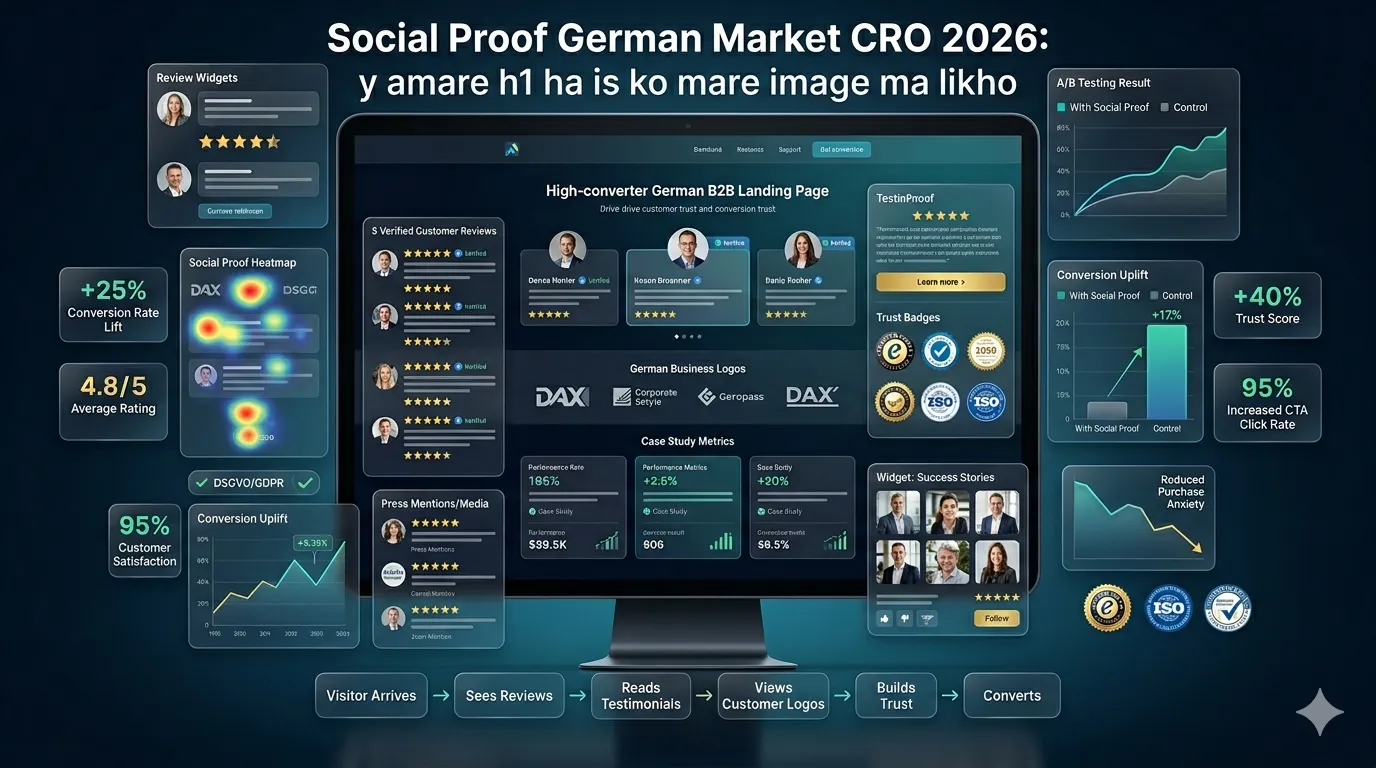
What’s the typical social proof conversion lift?
By tactic:
Customer logos above fold
5–15% conversion lift typical.
Testimonials near CTA
5–20% lift.
Case studies on relevant pages
10–25% lift on those pages.
Review aggregation (4.5+ star)
5–15% lift on product pages.
Press logos / awards
5–15% lift on homepage.
Combined social proof program
20–40% cumulative impact on conversion.
What German legal considerations?
Three compliance items:
Customer consent
For testimonials with names + photos: written consent. Document.
UWG (Gesetz gegen den unlauteren Wettbewerb)
False testimonials illegal. Real customers required.
DSGVO compliance
Customer photos + names = personal data. Process per DSGVO.
Removal on request
Customers can request testimonial removal. Plan workflow.
For broader DSGVO see our GDPR compliance guide.
What about reviews + ratings?
Critical aggregate social proof:
Sources
- Trusted Shops (e-commerce)
- ProvenExpert (service businesses)
- Google Business Profile (local)
- G2 / Capterra (B2B SaaS)
- TripAdvisor / HRS (hospitality)
Display
Star rating + count + sample reviews.
Strategy
Encourage reviews systematically. After purchase / service.
Response
Reply to negative reviews professionally.
Trust seal
Trusted Shops badge + similar.
For Trusted Shops see our Shopify Trusted Shops guide.
What about user-generated content (UGC)?
Effective for B2C especially:
Customer photos with product
Authenticity signals. Better than stock.
Social media mentions
Instagram, TikTok, Twitter mentions.
Video reviews
Authentic user reviews + unboxing.
Customer testimonial videos
Short videos > long text. Higher engagement.
Hashtag campaigns
Encourage tagged content.
What’s the press + awards strategy?
For credibility amplification:
Press mention badges
“Featured in” with publication logos.
Industry awards
Display prominently.
Certifications
Industry certifications, ISO, DIN standards.
“As seen in” sections
Combine logos in dedicated section.
Specific quotes from press
“Best CRM for German Mittelstand — FAZ”
For press strategy see our digital PR Germany guide.
What are common social proof mistakes?
Six patterns:
Generic / stock testimonials
Anonymous, no photos, generic praise. Less credible than no testimonial.
Outdated testimonials
5-year-old testimonials look stale.
Too many low-quality
20 weak testimonials < 5 strong ones.
Wrong audience match
US customer testimonials on German B2B site. Cultural mismatch.
Aggressive placement
Pop-up testimonials feel intrusive in German market.
Faked / manipulated
UWG violation + reputation damage.
How does AI affect social proof in 2026?
Three considerations:
AI-generated testimonials (avoid)
Easy to detect. UWG violation. Reputation risk.
AI-personalized social proof
Show industry-specific testimonials to industry visitors. Dynamic personalization.
AI-generated case studies
For early-stage content: AI summarization of real case study materials. Always factual.
Authenticity premium
As AI content floods market, authentic real customer stories increasingly valuable
What’s the social proof testing approach?
A/B test variants:
Test: Customer logos vs no logos
Above-fold presence.
Test: Long vs short testimonials
Different content lengths.
Test: With photo vs without photo
Personal photos significantly impact.
Test: Industry-specific vs generic
Personalization impact.
Test: Testimonial placement
Different spots on page.
For A/B testing see our A/B testing Germany guide.
Frequently asked questions about social proof German market
German customer logos, outcome testimonials with photos, case studies with metrics, aggregate review ratings.
Above fold on landing pages, near CTAs, dedicated testimonials page, contextual matching.
Combined social proof: 20–40% cumulative impact. Individual tactics 5–25%.
Don’t hide them. Feature positive prominently. Diverse reviews signal authenticity.
Customer consent for names + photos. UWG prohibits false testimonials. DSGVO compliance.
Quality over quantity. 5–10 strong testimonials beat 30 weak ones.
No. UWG violation. Detection easy. Reputation damage.
After-purchase email request. QR codes. In-person ask. Make it easy.
Need help with social proof?
If you’re scoping social proof strategy for your German business and want a 30-minute scoping conversation about types + placement + collection, book a meeting or send details via our contact page.
Need expert help? Gem Programmers provides CRO services for businesses in Germany, Austria and Switzerland. Request a free, no-obligation quote and get a clear plan with scope, timeline and price.