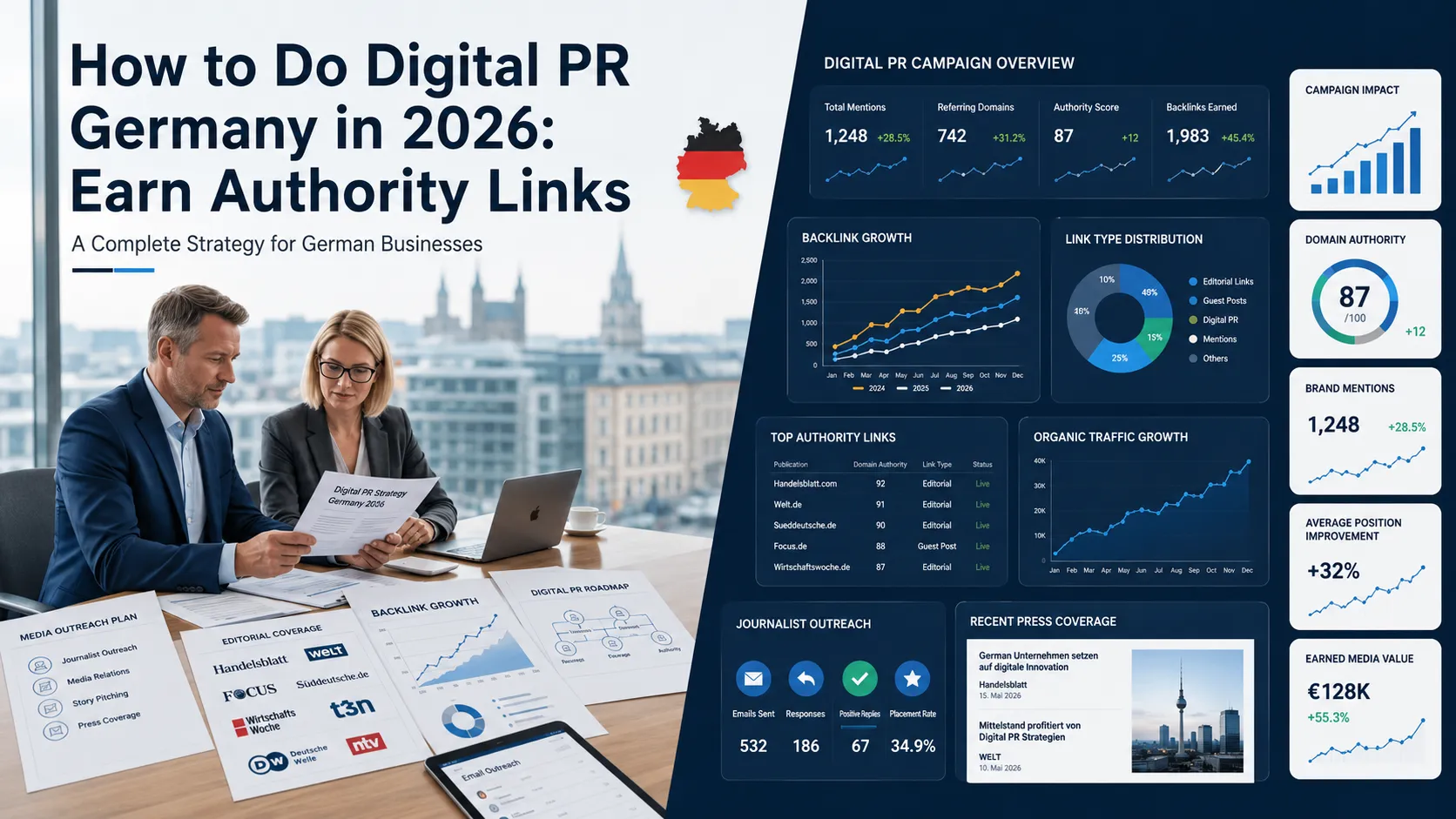
Digital PR Germany earns the highest-value links and brand mentions in 2026: editorial coverage in German publications like FAZ, Süddeutsche, Handelsblatt, Heise, t3n, Gründerszene. Single mention in a major publication can be worth more than 100 mediocre links — for both SEO authority and brand reputation. But effective German digital PR is harder than US-style “link bait” campaigns.
This guide walks through what digital PR Germany SEO actually requires in 2026: pitching German publications, building newsworthy angles, cultivating journalist relationships, realistic EUR cost, and measuring ROI.
For broader link building see our link building Germany 2026 guide.
What is digital PR?
Modern PR practice combining traditional media outreach with SEO + content marketing. Goals:
Editorial backlinks
Earned links from authoritative publications.
Brand mentions
Even unlinked brand mentions build authority + AI search visibility.
Thought leadership
Position your brand as authority in your space.
SEO authority
Major publication links significantly boost domain authority.
AI search visibility
ChatGPT Search / Perplexity / AI Overviews favor content from authoritative sources.
Why does digital PR matter for German SEO?
Five reasons:
High-authority links
A FAZ.net link is worth significantly more than 50 mid-tier links combined.
Trust signals
Publication coverage = third-party validation. Influences both Google + AI engines.
Brand awareness
Direct + indirect traffic from coverage. Brand searches increase.
Defensible advantage
Major publication relationships compound. Hard for competitors to replicate.
AI search amplification
AI engines cite content from authoritative German sources. PR coverage helps your brand show up.
What German publications matter most for digital PR?
Major business publications
- FAZ (Frankfurter Allgemeine Zeitung) – faz.net
- Süddeutsche Zeitung – sueddeutsche.de
- Handelsblatt – handelsblatt.com
- Die Welt – welt.de
- Wirtschaftswoche – wiwo.de
- Manager Magazin – manager-magazin.de
Tech publications
- Heise Online – heise.de
- t3n – t3n.de
- Gründerszene – gruenderszene.de
- Golem – golem.de
- iX – heise.de/ix
Industry publications
- B2B: Computerwoche, CIO, IT-Director
- Marketing: OMR, marketing.de, Internet World
- Industry-specific: dozens of vertical publications per niche
Local German press
City-specific newspapers. Berliner Zeitung, Hamburger Abendblatt, Kölner Stadt-Anzeiger, etc.
What story angles work for German digital PR?
Five angles that consistently get coverage:
1. Original research / German market data
You commission survey, publish findings about German market. Journalists cite for context.
2. Expert commentary on current news
Journalist needs expert quote on industry topic. You provide thoughtful response within their deadline.
3. German-specific industry insight
Contrarian perspective or specific German angle not covered elsewhere.
4. Industry first / launch news
Genuinely newsworthy product launch, business milestone, market entry.
5. Data-driven trend analysis
Combining proprietary data with broader trend interpretation. Often quoted.
What angles don’t work?
Five common mistakes:
Product PR for SEO purposes
“Buy our product” pitches don’t earn editorial coverage. Journalists ignore.
Generic English content translated
“5 Tips for Better SEO” auto-translated for German publications. Boring + nothing new.
Self-congratulatory news
“Company X celebrates 10 years!” Nobody cares unless milestone is genuinely significant.
Hard sells to journalists
Direct asks for “a link” or “coverage” annoy journalists. Build relationship instead.
Mass press releases
Spray-and-pray PR distribution. Most ignored. Targeted pitches work.
What’s the German digital PR process?
Six steps:
Step 1: Develop content + angles
What’s your unique perspective? What data do you have? Where do you see industry trends? Build 5–10 angle ideas per quarter.
Step 2: Identify target journalists
LinkedIn search by publication + beat. Build list of 30–50 relevant journalists per industry.
Step 3: Personalized pitches
Email per journalist. 3 sentences:
- Why I’m reaching out (specific to their recent work
- What I have (angle/data/quote)
- What I’m offering (interview, exclusive, data)
Step 4: Follow up tactfully
Most pitches ignored. Single polite follow-up after 5–7 days.
Step 5: Provide promptly
If journalist responds: deliver fast. They have deadlines. 24-hour response cycle.
Step 6: Build relationships over time
5–10 journalists become real relationships. They cite you naturally over years.
What does digital PR cost in Germany?
Realistic 2026 EUR ranges:
In-house PR team
- PR manager full-time: €60,000–€95,000/year gross
- Plus tools, travel, conferences
Freelance PR consultant
- €1,500–€7,500/month retainer
- Better for mid-size companies
PR agency
- Boutique digital PR: €4,500–€18,000/month
- Full-service PR agency: €15,000–€60,000+/month
Per-campaign
- Single major campaign with research + pitch + follow-up: €5,000–€35,000
Original research investment
- Survey + analysis + publication: €5,000–€50,000
- One-time cost, earns links for years
For broader marketing investment see our SEO cost Germany guide.
How do you measure digital PR ROI?
Six KPIs:
Coverage placements
Number + quality of placements per month/quarter.
Backlinks earned
Direct SEO measurement. Sistrix / Ahrefs detection.
Domain Rating growth
Aggregate authority signal.
Branded search increase
Search Console: branded query volume.
Referral traffic from publications
Analytics: traffic from earned coverage.
Sales / lead attribution
If trackable: leads/sales from PR-driven traffic.
For most German businesses: combination of coverage placements + DR growth + branded search = healthy PR program.
What’s HARO and German equivalents?
Help A Reporter Out (HARO) connects journalists with expert sources.
HARO
US-based, but covers some EU stories. Sign up free. Daily emails with journalist queries.
German equivalents in 2026
- Quoted.com (English but international)
- Various Twitter / LinkedIn journalist communities
- Direct outreach to German journalists more effective than HARO-style platforms
For German market: direct relationships beat platform-based pitching.
What about industry awards + speaking engagements?
Related to PR:
Industry awards
Apply for German industry awards. Winners often get coverage + links.
Speaking at German conferences
OMR, SMX, SEOkomm, Internet World, industry-specific conferences. Speakers get profile pages with backlinks + brand visibility.
Podcast guesting
German business podcasts often feature experts. Show notes typically include guest links.
Thought leadership writing
Op-eds in German publications. Bylines + brand association.
What’s a 12-month German digital PR plan?
1–3 months: Foundation phase
- Identify target publications + journalists
- Develop 3–5 strong story angles
- First pitches go out
- Some early coverage starts
4–6 months: Acceleration phase
- Original research publishes
- Relationships with 3–5 journalists deepen
- Coverage frequency increases
7–12 months: Compounding phase
- Earning coverage without pitching (journalists come to you)
- Speaking engagements + awards add to authority
- Domain Rating noticeably improved
By month 12: established digital PR motion.
What are common digital PR mistakes German businesses make?
Five patterns:
Generic English-style press releases
PRWeb-style distribution. Doesn’t work for German press.
Pitching only product news
Not newsworthy. Pitch insight, data, expert commentary instead.
One-shot pitches without follow-up
Single pitch + no follow-up = wasted effort.
No relationship investment
Treating journalists as cold leads. Build relationships over years.
Skipping original research
Without unique data/perspective, hard to earn coverage. Invest in research-generating content.
How does AI search affect digital PR?
Three considerations in 2026:
AI engines cite authoritative sources
ChatGPT Search + Perplexity reference content from major publications. PR coverage = AI search visibility.
Brand mentions matter without links
AI engines associate brands with topics via mentions. Even unlinked PR mentions valuable.
Expert positioning compounds
Repeated expert mentions in your niche signal AI engines about your expertise.
For AEO context see our AEO Answer Engine Optimization guide.
Frequently asked questions
Modern PR combining media outreach with SEO and content marketing.
EUR 1,500/month freelance to EUR 60,000/month full-service agency.
First placements in months 1-3; compounding by month 12.
FAZ, Suddeutsche, Handelsblatt, Heise, t3n, plus industry vertical publications.
Original research, expert commentary, German-specific insight, industry news.
Product PR, translated content, self-congratulatory news, hard sells.
No; targeted personal pitches work better in German market.
LinkedIn search; build relationships over time.
Need help with digital PR?
If you’re scoping digital PR for your German business and want a 30-minute scoping conversation about angles + journalists + tactics, book a meeting or send details via our contact page.
Need expert help? Gem Programmers provides search engine optimisation services for businesses in Germany, Austria and Switzerland. Request a free, no-obligation quote and get a clear plan with scope, timeline and price.