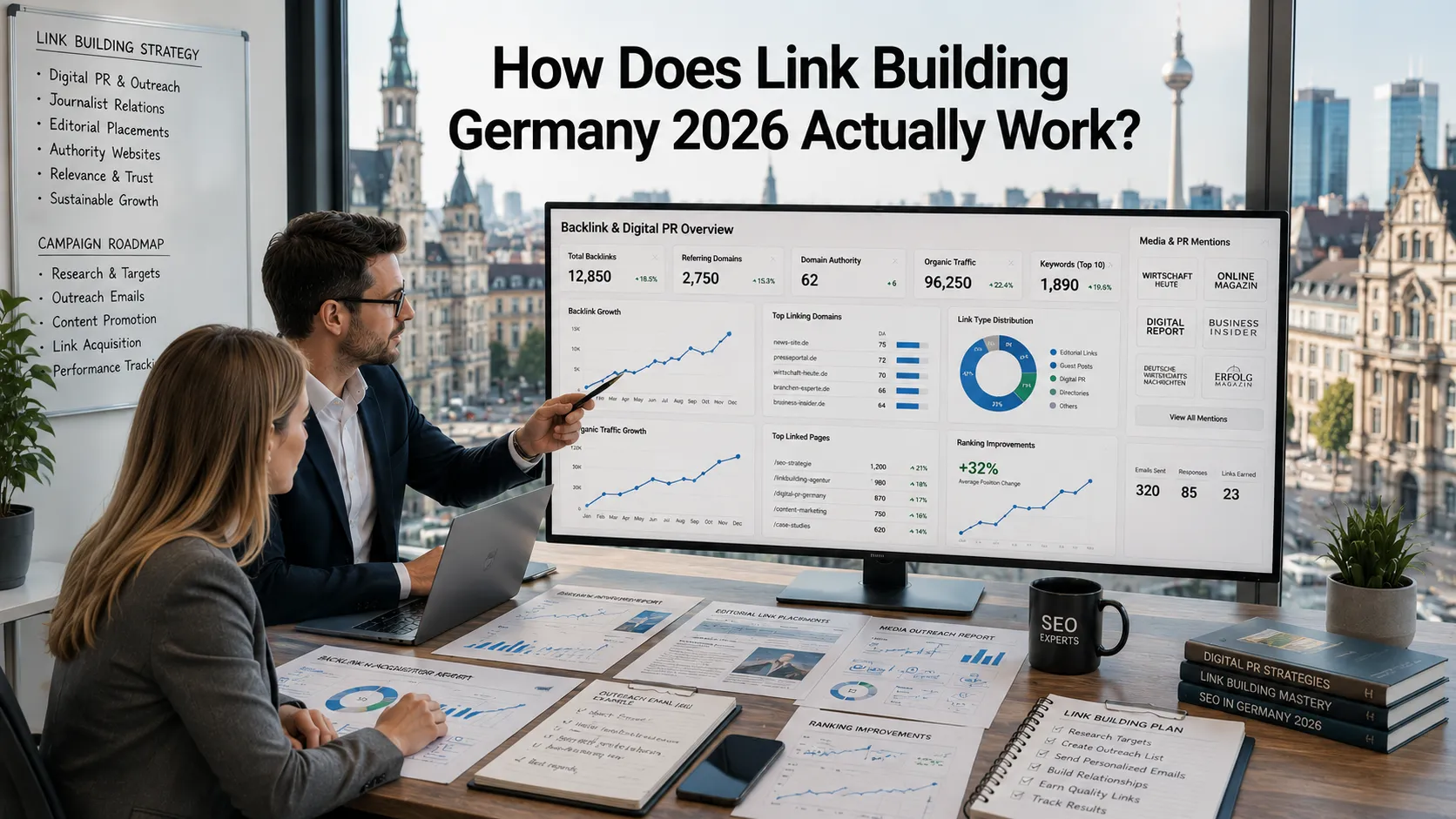
Link building Germany 2026 remains a primary lever for German SEO, but the tactics that work have shifted significantly from 2018-era playbooks. Mass guest posting + link exchanges + PBN links are dead (and dangerous). What works now: digital PR with German publications, partnership-driven links, original research that earns links, and brand-building that compounds over years. This guide walks through what link building Germany 2026 actually requires in 2026: honest tactics that still work, German publication outreach, digital PR, what to avoid (and why it’s risky), realistic EUR cost, and link quality assessment.
Why does link building still matter in 2026?
Despite Google’s evolution, backlinks remain core ranking signal:
External validation
Other sites linking to you = third-party endorsement Google considers.
Topical authority signal
Links from topic-relevant sites signal topical expertise.
Brand trust
Major publication links build brand reputation beyond SEO.
AI search amplification
AI engines (ChatGPT Search, Perplexity, AI Overviews) cite content from authoritative + frequently-linked sources. For broader SEO context see our SEO services Germany guide.
What link building tactics actually work in Germany in 2026?
Six tactics with real ROI:
1. Digital PR with German publications
Pitch story angles to German journalists at FAZ, Süddeutsche, Handelsblatt, Welt, Heise, t3n, Gründerszene. Earn natural editorial links.
2. Original research and data
Publish original German market research, surveys, industry reports. Other publications cite + link to it.
3. HARO / Quoted / Help A Reporter equivalents
Provide expert quotes to journalists writing on relevant topics. German equivalents emerging.
4. Partnership-driven links
Mutual partnerships with complementary German businesses. Industry association memberships. Speaking engagements.
5. Broken-link reclamation
Find broken links pointing to similar content on German sites. Offer your content as replacement.
6. Resource page outreach
German universities, industry associations, professional bodies maintain resource pages. Pitch your content for inclusion if genuinely valuable.
What tactics should you AVOID?
Six tactics that fail or cause damage:
Mass guest posting
Low-quality guest posts on questionable sites = no value or penalty risk.
Paid links
Buying links violates Google guidelines. Detected = penalty.
PBN (Private Blog Networks)
Networks of fake sites built to link to you. Detected = severe penalty.
Link exchanges at scale
“You link to me, I link to you” reciprocal links from unrelated sites. Detected.
Comment spam
Comments on blogs with links. Universally nofollow’d. Waste of time.
Forum signature links
Old-school spam tactic. Universally nofollow’d. No value.
What does link building cost in Germany?
Realistic EUR ranges:
Digital PR campaigns
- Single major German publication placement: €2,000–€15,000 depending on quality + agency
- Multi-publication campaign: €8,000–€60,000
Freelance link building
- Per-link basis (varies by quality): €500–€5,000+ per link
- Monthly retainer: €2,000–€10,000/month for 5–15 links
Agency link building
- Comprehensive campaign: €5,000–€30,000/month for 10–30+ links
Original research investment
- Survey design + execution + write-up: €5,000–€50,000+
- Earns links over months/years as content gets referenced
For broader SEO cost see our SEO cost Germany guide.
What makes a high-quality link?
Six quality factors:
1. Linking site domain authority
DR/DA matters but not solely. DR 80+ German publication > DR 50 German industry site.
2. Topical relevance
Link from technology site to your SaaS = strong. Link from cooking blog to your SaaS = weaker.
3. Editorial vs paid context
Editorial mention by journalist > paid placement.
4. Anchor text naturalness
Natural anchor text mix: brand + URL + descriptive. Not exact-match-keyword stuffed.
5. Page-level context
Link in body content (contextual) > footer link > resource page link.
6. Recency
Recent links carry more weight than old links.
How do you measure link quality?
Tools + criteria:
Ahrefs / Semrush / Sistrix
DR (Domain Rating), DA (Domain Authority), trust flow.
Manual review
Look at the linking site. Does it look legitimate? Real audience? Recent content?
Topical relevance check
Is the linking site topically related to your business?
Anchor text analysis
What text was used for the link? Natural or over-optimized?
Traffic estimation
Does the linking site actually have traffic that might click through?
How do you do digital PR with German publications?
A 5-step process:
Step 1: Identify target publications
FAZ, Süddeutsche, Handelsblatt, Welt for B2B/business. Heise, t3n, Gründerszene for tech. Industry-specific publications for niche.
Step 2: Find relevant journalists
LinkedIn search for journalists at target publications + your industry beat. Build a list.
Step 3: Develop newsworthy angles
What’s pitchable? Original data, expert commentary, contrarian perspective, German-market-specific insight.
Step 4: Outreach
Personalized email pitch. German if appropriate. Subject line + 3-sentence pitch + offer.
Step 5: Follow up + relationship build
Most pitches ignored. Follow up after a week. Build long-term relationships with 5–10 key journalists. For most German businesses: digital PR works best when combined with original research that journalists want to cite.
What about local link building?
For German service businesses + multi-location:
Local chamber of commerce (IHK)
Most cities’ IHK has member directories. Listed = local citation + sometimes link.
Local business associations
Industry-specific local groups.
Local sponsorships
Sponsor local events, sports teams, conferences. Often earn links.
Local news outreach
Local newspapers + magazines. Pitch local angles.
University partnerships
Local universities sometimes link to local business resources. For local SEO context see our local SEO Germany guide.
What’s the typical link building outcome?
Realistic expectations:
First year (€5,000–€10,000/month invested)
- 30–80 quality links earned
- Domain Rating typically grows 5–15 points
- Visible ranking improvements on competitive terms
Second year
- 50–100 additional links
- DR grows another 5–10 points
- Topic authority compounds
Third year+
- Established link profile
- Brand mentions earn links naturally
- New content earns links faster
Link building compounds. Year 1 is investment phase. Year 3+ is payoff.
What’s the link audit process?
Quarterly link audit:
Step 1: Export backlink data
Ahrefs or Semrush export all backlinks pointing to your site.
Step 2: Categorize quality
High-quality (keep), medium (monitor), low (disavow consideration), spammy (likely disavow).
Step 3: Identify toxic links
Spam comments, PBN-looking links, irrelevant link farms.
Step 4: Disavow if needed
Google Disavow tool for clearly-toxic links. Use sparingly.
Step 5: Track over time
Quality trending up? DR growing? New links coming from where? For disavow specifics see our disavow toxic backlinks guide (forthcoming).
What about link building for B2B vs B2C in Germany?
B2B link building
- Industry publications (Heise, t3n, sector-specific)
- B2B conferences + speaking
- Original research + reports
- Industry association memberships
- Trade publication contributions
B2C link building
- Consumer media (FAZ, Süddeutsche, lifestyle magazines)
- Influencer partnerships (real ones, not paid)
- PR campaigns
- Product reviews
- Customer feature stories
Different audiences = different publication targets + tactics.
How does AI search affect link building?
Three considerations in 2026:
Brand mentions matter more
AI engines associate brands with topics through mentions. Even unlinked mentions build authority.
Authoritative citations win
AI engines cite authoritative sources. Links from authoritative sites = AI search visibility.
Original content earns more
AI summarizes content. Original content + data + research gets summarized + cited. For AEO depth see our AEO Answer Engine Optimization guide (forthcoming).
Frequently asked questions
Yes; backlinks remain a core ranking signal.
EUR 500 to 5,000 typical; EUR 2,000 to 15,000 for major publications.
30 to 80 quality links per year is meaningful.
Mass guest posts, paid links, PBNs, link exchanges, comment spam.
LinkedIn search by publication and beat; build relationships.
Sparingly; only for genuinely toxic links.
Year 1 investment; Year 2 visible; Year 3+ compounds.
Yes; earns cited links over years.
Need help with link building?
If you’re scoping link building for your German business and want a 30-minute scoping conversation about tactic selection + budget + outreach, book a meeting or send details via our contact page.
Need expert help? Gem Programmers provides search engine optimisation services for businesses in Germany, Austria and Switzerland. Request a free, no-obligation quote and get a clear plan with scope, timeline and price.