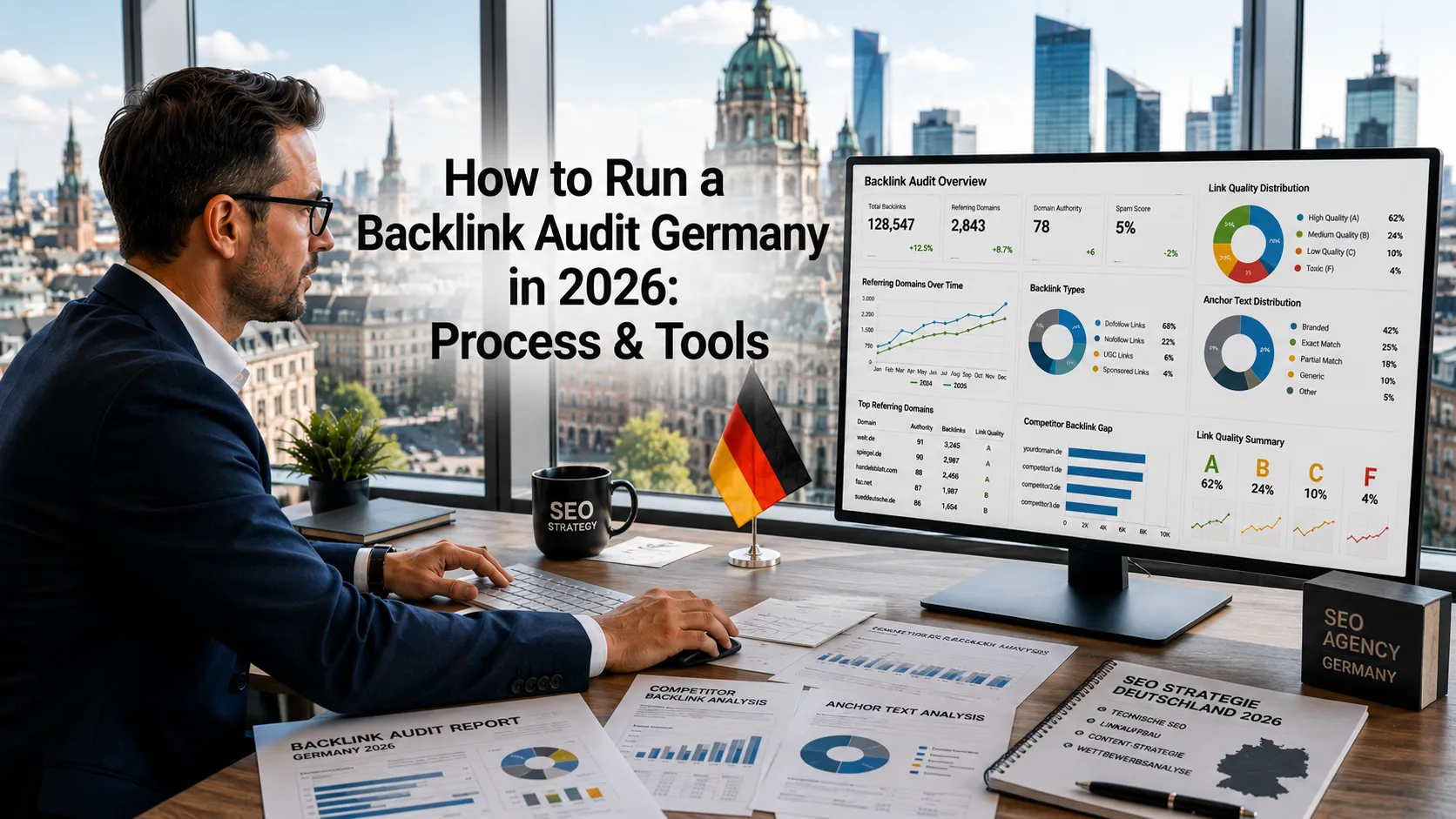
A backlink audit Germany surfaces the real story of your site’s external authority — which links you have, which competitors have links you don’t, which links might hurt rather than help. For German websites running serious SEO in 2026, quarterly backlink audits are foundational discipline.
This guide walks through what a backlink audit Germany actually requires in 2026: tools, quality assessment criteria, competitor backlink research, disavow decision framework, and ongoing monitoring.
What is a backlink audit?
Systematic review of all links pointing to your site, answering:
- What’s the size + quality of our link profile?
- Where do our backlinks come from?
- Which links are growth assets?
- Which links might hurt rankings?
- How do we compare to competitors?
- What opportunities exist?
Audits typically run quarterly. After major SEO events (penalty, drop, migration): immediately.
What tools do you need?
Ahrefs (most popular)
Comprehensive backlink database. Best link discovery. $129+/month.
Semrush
Strong backlink analytics + competitor comparison. $130+/month.
Sistrix
German-market focus. Visibility correlation with link profile. €100–€500+/month.
Google Search Console (free)
Your verified link data. Smaller than Ahrefs/Semrush but authoritative.
Majestic
Trust Flow + Citation Flow metrics. Used less commonly now.
For German SEO audits: Ahrefs + Sistrix + Search Console is the standard professional stack.
What does a backlink audit cover?
Seven analysis areas:
1. Quantity overview
Total backlinks, referring domains, new + lost links over time.
2. Quality distribution
Domain Rating distribution. High DR vs low DR links proportion.
3. Topical relevance
Are linking sites in your niche or random?
4. Anchor text analysis
Branded vs exact-match vs URL vs partial. Healthy mix or over-optimized?
5. Geographic distribution
For German sites: % German domains, % EU, % global.
6. Toxic / suspicious links
Spam, link farms, PBN-style sites.
7. Competitor comparison
Their link counts, sources, anchor distribution.
How do you assess link quality?
A 6-factor framework per link:
1. Linking site DR / DA
Higher is generally better but consider relevance.
2. Topical relevance
Highly relevant > random topic.
3. Editorial context
Body content > footer > sidebar > navigation.
4. Anchor text
Natural anchor (brand, URL) > over-optimized.
5. Linking site traffic
Real audience? Some traffic estimate?
6. Page authority + freshness
Is the linking page itself authoritative + recent?
Score links: A (high quality), B (medium), C (low), D (toxic/disavow candidate).
What does competitor backlink analysis reveal?
For 3–5 direct competitors:
Links they have you don’t
“Link gap” analysis in Ahrefs / Semrush. Reveals outreach targets you missed.
Source patterns
Are they getting links from publications you should also target? Industry directories you missed?
Content types earning links
What pages on their site attract links? Original research? Tools? Definitive guides?
Anchor text patterns
How are they being linked to? Reveals their messaging + branding.
New link velocity
Are they gaining links faster than you? Less is concerning.
What does a toxic link look like?
Six characteristics of risky links:
1. Site has no real audience
Low traffic, low engagement signals. Built for SEO rather than users.
2. Site is in totally unrelated niche
Cooking site linking to your B2B SaaS = suspicious.
3. Link farm / PBN appearance
Site exists primarily to host outbound links.
4. Spammy anchor text
Exact-match keyword stuffing in anchor.
5. Low quality content surrounding link
AI-generated or barely-written content.
6. Non-German low-quality
Random foreign-language sites linking to German business.
When should you disavow?
The disavow tool tells Google “don’t count these links.” Use sparingly.
Disavow when
- Site is genuinely spammy + you can’t get link removed
- You’ve been hit with manual penalty + bad links contribute
- Negative SEO attack with obvious unnatural pattern
Don’t disavow when
- Link is from low-quality but legitimate site
- You’re unsure whether the link is problematic
- Site is just small or obscure (low DR ≠ toxic)
In 2026, Google handles spam better than ever. Disavow is rarely needed. Many SEO professionals don’t disavow at all anymore.
How do you actually do a backlink audit?
A 7-step process:
Step 1: Export backlink data
Ahrefs / Semrush / Sistrix → export all backlinks to spreadsheet.
Step 2: Categorize by quality factors
Add columns for DR, relevance, anchor, etc. Score A/B/C/D.
Step 3: Identify clear toxic patterns
Spam, link farms, PBN-style. Flag for action.
Step 4: Run competitor analysis
Same export for 3–5 competitors. Compare counts, sources, anchors.
Step 5: Identify gaps + opportunities
Their wins you missed = outreach targets.
Step 6: Plan link building from gaps
Prioritized outreach list.
Step 7: Decide on disavow
Only for clearly-toxic patterns. Most often: do nothing.
Documentation
Save audit results. Compare quarterly. Trend analysis.
What KPIs come out of a backlink audit?
Eight metrics:
Total referring domains
How many unique domains link to you. Growth target.
Domain Rating / Authority
Aggregate domain authority signal.
New referring domains per month
Velocity. Healthy growth signals active brand.
Lost referring domains per month
Links go away over time. Healthy if replaced by new.
Average DR of linking domains
Quality measure.
% links from German domains
Geographic relevance for German SEO.
Anchor text distribution
Branded vs descriptive vs exact match. Healthy mix.
Topical relevance score
Estimated by tool or manual review.
What’s the audit cadence?
Quarterly audit
Standard for active SEO programs. Track trends.
Annual deep audit
Once per year: thorough review including competitor analysis, gap identification, strategic plan.
Event-triggered audits
After: penalty, ranking drop, major site changes, suspected negative SEO.
For broader SEO discipline see our SEO services Germany guide.
What’s the German market backlink audit specifics?
Three considerations:
Sistrix integration
Sistrix Visibility + link profile correlation. German-market context.
Local German citations vs editorial links
Different value. Local citations (Gelbe Seiten, IHK) common + cheap. Editorial links (FAZ, Handelsblatt) rare + valuable.
.de TLD bias
Search engines may weight .de links slightly higher for .de-targeting sites.
For broader German SEO see our SEO services Germany guide.
Frequently asked questions
Systematic review of all links to your site.
Ahrefs, Semrush, Sistrix, Search Console combination.
Quarterly plus an annual deep audit.
Spam, link farm, unrelated niche, AI-generated, low-quality non-German source.
Sparingly; mostly not needed in 2026.
Use link gap analysis to find outreach targets.
40 to 60 percent branded; under 5 percent exact match.
Yes for high-value lost links.
Need help with backlink audit?
If you’re scoping a backlink audit for your German site and want a 30-minute scoping conversation about tools + process + outreach plan, book a meeting or send details via our contact page.
Need expert help? Gem Programmers provides SEO services for Germany for businesses in Germany, Austria and Switzerland. Request a free, no-obligation quote and get a clear plan with scope, timeline and price.