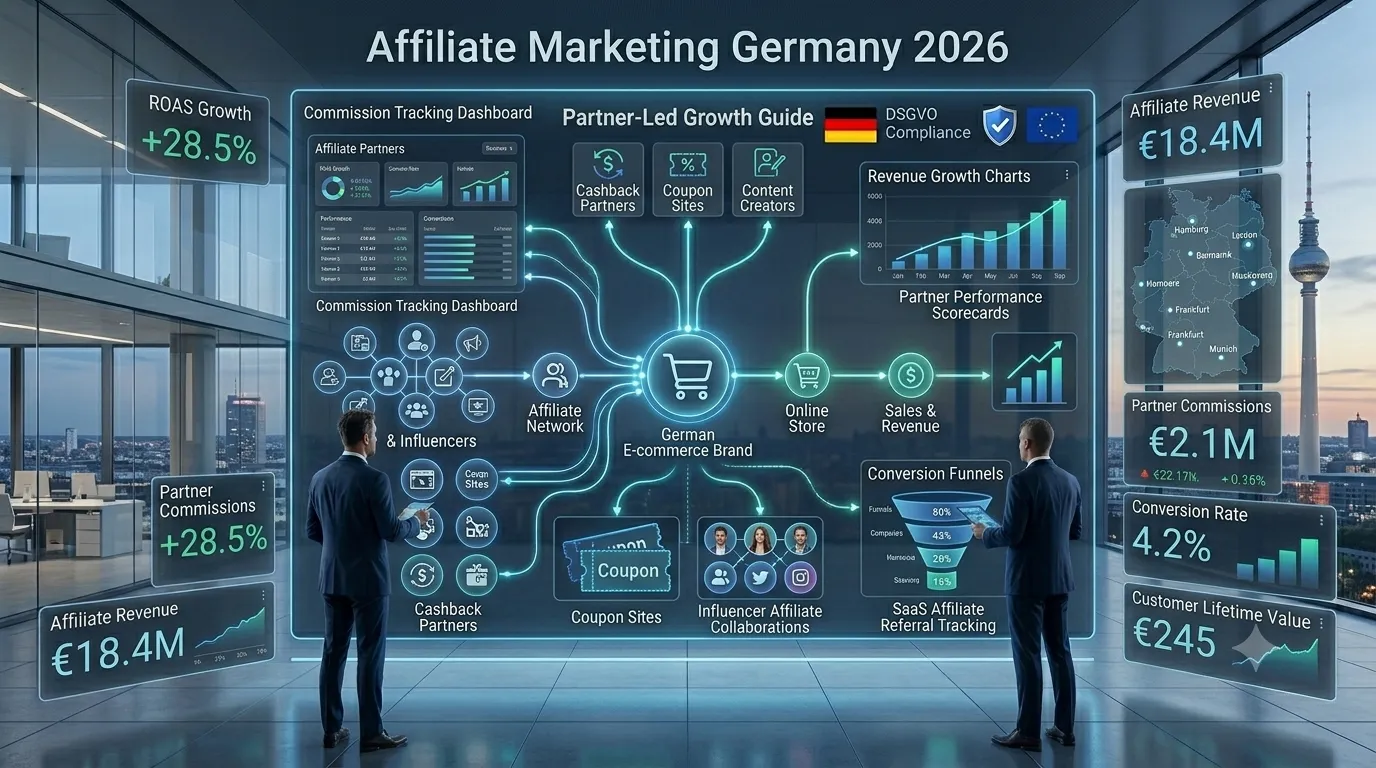
Affiliate marketing is one of the most reliable performance-marketing channels for German businesses — pay per sale, low risk, scalable through partner networks, well-established in DACH. The affiliate marketing Germany is mature: Awin is headquartered in Berlin, the publisher ecosystem is sophisticated, and major brands run substantial affiliate programs alongside their direct paid acquisition.
In 2026, affiliate marketing in Germany operates with strict compliance (DSGVO, disclosure requirements, UWG), professional tracking infrastructure, and increasingly sophisticated publisher partnerships. This guide covers what works for German affiliate marketing: networks, commission structures, publisher recruitment, fraud prevention, and the integration with influencer marketing and content marketing strategies.
What is affiliate marketing and how does it work in Germany?
Affiliate marketing is a partnership model where publishers (affiliates) drive traffic and sales to your business in exchange for commission on conversions. The flow:
- Publisher places branded link, banner, or content on their site/channel
- Visitor clicks affiliate link (with tracking)
- Visitor arrives at advertiser’s site (with cookie or first-party tracking)
- Visitor completes purchase or qualifying action
- Commission is calculated and paid to publisher
Key players in German affiliate ecosystem:
Affiliate networks:
- Awin (formerly affilinet): Berlin-based, DACH market leader
- Tradedoubler: European focus, strong in DACH
- CJ Affiliate (formerly Commission Junction): global with German presence
- Webgains: European network, growing DACH presence
- Impact: SaaS-focused affiliate platform, B2B and tech
- Belboon: German-founded, niche specialist
- Rakuten Advertising: e-commerce-focused
Direct programs:
- Some brands run direct affiliate programs without networks
- Common for high-AOV B2B or premium D2C
- Higher complexity but more control
Publisher types:
- Content sites and blogs
- Coupon/voucher sites (rabatte.de, deals.de, etc.)
- Cashback sites (shoop.de, getmore.de, vouchercloud)
- Loyalty programs (Payback affiliate integration, etc.)
- Comparison sites (check24, idealo affiliate)
- Influencer creator affiliate programs
- Email newsletter affiliates
- YouTube and video affiliates
For broader context, see our digital marketing services Germany guide and influencer marketing Germany guide.
What commission structures work in Germany?
Per-sale commission (most common):
- 3-15% of order value typical for e-commerce
- 5-30% for premium and luxury verticals
- 10-40% for digital products and SaaS
- 30-60% for online courses and high-margin info products
- Flat fee per sale also common for high-AOV products
Per-lead commission (B2B and services):
- €5-€50 per qualified lead
- Higher (€100-€500) for sales-qualified B2B leads
- Used for service businesses, B2B SaaS, financial services
Per-action commission:
- Newsletter signup, app install, free trial
- €1-€20 typical for low-friction actions
- €20-€100 for higher-commitment actions
Tiered commission structures:
- Standard rate for typical publishers
- Premium rate for top performers (10-20% bonus)
- Volume bonuses (e.g., 10% extra after €10K in sales)
- New customer vs returning customer differentials
Cookie duration:
- Standard: 30 days
- Common range: 7-90 days
- Last-click attribution standard
- Some networks support first-click or assist credit
- Longer cookies attract publishers but increase attribution costs
Special commission types:
- Recurring commissions (SaaS): 20-40% recurring on subscription
- Two-tier programs: super-affiliates earn on their sub-affiliates’ sales
- Fixed CPA: cost-per-acquisition fixed regardless of order value
- Hybrid: base CPA + revenue share
Setting commission rates:
- Start at 5-10% for e-commerce
- Reserve 10-15% for top categories or strategic publishers
- Test rate elasticity (does 8% vs 12% meaningfully change publisher activity?)
- Don’t race to bottom on rates — publishers prefer good experience + reasonable rates over cheap rates with poor reliability
What does the German affiliate publisher landscape look like?
Top German publisher categories:
Cashback and loyalty:
- Shoop.de: largest German cashback site
- getmore.de
- igraal.de
- Payback (integration with cashback)
- Coupons.de
Coupon and voucher:
- Sparwelt.de
- Mydealz.de (community-based)
- Coupons.de
- Gutscheine.de
- Rabatte-Coupons.de
Comparison and reviews:
- Check24
- Idealo
- Verivox
- Test.de
- Computerbild and tech review sites
Content sites and blogs:
- Lifestyle blogs and magazines
- Niche enthusiast sites (fitness, food, tech, parenting)
- Industry-specific blogs (B2B)
Influencer and creator affiliates:
- Instagram, TikTok, YouTube creators with affiliate links
- Often via influencer platforms (Reachbird, etc.) or direct
- Growing share of affiliate revenue
Newsletter and email affiliates:
- Curated newsletters with affiliate placements
- Cashback for newsletter subscribers
App-based affiliates:
- Mobile cashback apps (CHECK24-Reisen, etc.)
- Browser extensions (Honey, Joinhoney for DACH)
Strategic considerations:
- Cashback/voucher sites drive volume but attract bargain hunters (lower LTV typically)
- Content publishers drive higher-quality buyers (higher LTV)
- Mix matters — pure cashback dominance can erode margin
- Test customer LTV by publisher type to optimize mix
How do you set up an affiliate program in Germany?
1. Network selection:
- Awin: most popular for DACH; broad publisher base
- Impact: best for SaaS and tech
- CJ: global brands with international affiliate needs
- Direct (in-house): for high-volume specialists with custom needs
2. Program structure:
- Define commission structure
- Set cookie duration
- Define attribution rules
- Set program terms and conditions
- Specify approval flow (auto-approve vs manual)
- DSGVO and compliance requirements
3. Tracking implementation:
- Network tracking pixel on conversion pages
- Server-to-server (S2S) tracking for cookieless reliability
- Postback URLs for app conversions
- Order value passing
- Validation logic (subtract returns, fraud)
4. Creative assets:
- Banner sets (multiple sizes for publisher placement)
- Text links
- Product feed for content publishers
- Coupon codes
- Email templates and newsletter content for publishers
- Video assets for video publishers
5. Publisher recruitment:
- Network’s existing publisher base (search and invite)
- Outreach to strategic publishers
- Application approval flow
- Onboarding documentation
- Welcome bonuses or activation incentives
6. Compliance setup:
- DSGVO documentation (AVV with network, publisher data flows)
- Disclosure requirements communicated to publishers
- Brand bidding rules (allow vs disallow on PPC keywords)
- Trademark protection
- Brand safety guidelines
7. Program launch and management:
- Launch communication to network
- Monthly newsletter to publishers
- Performance reviews and optimization
- Publisher relationship management
- Fraud monitoring and prevention
Setup investment:
- Network setup fees: €1,000-€5,000 one-time
- Monthly network fees: €100-€2,000 (depends on network and volume)
- Network commission on top of publisher commission: 25-35% of publisher commission typical
- Initial creative production: €2,000-€10,000
- In-house management or agency: €2,000-€10,000/month
How do you prevent affiliate fraud in Germany?
Affiliate fraud is a real risk that erodes profitability. Common fraud types:
Cookie stuffing:
- Publisher silently triggers affiliate cookie without user click
- Steals credit from legitimate sources
- Network detection tools catch most but not all
Brand bidding violations:
- Publishers bid on your brand keywords in Google Ads
- Steal organic/branded traffic and claim affiliate commission
- Solution: prohibit brand bidding in program terms, monitor SERPs
Coupon code stuffing:
- Coupon sites generate fake codes
- Users find them, search, see coupon site, click through
- Coupon site takes credit for sales that would have happened anyway
- Solution: control which sites have official codes, last-click attribution rules
Toolbar/extension fraud:
- Browser extensions force-apply affiliate codes
- Even when user came from another source
- Solution: monitor browser extension publishers, prohibit specific practices
Self-affiliate fraud:
- Customer creates account, refers themselves
- Solution: cookie/IP/account matching to detect
Fraud prevention tactics:
- Use network’s built-in fraud detection
- Manual review of large or unusual transactions
- Validation period before commission payout (30 days typical)
- Cancel commission on returns/refunds
- Random audits of top publishers
- Tools: ClickGUARD, TrafficGuard, FraudScore
- Clear program terms with enforcement
Fraud as % of affiliate revenue:
- Well-managed programs: <5% fraud rate
- Average programs: 5-15% fraud rate
- Poorly-managed programs: 20%+ fraud
What KPIs matter for affiliate marketing in Germany?
Program-level:
- Total affiliate revenue
- ROAS (revenue ÷ commission paid)
- Active publisher count
- New publisher signups per month
- Average commission per publisher
Publisher-level:
- Sales per publisher
- Click-to-sale conversion rate by publisher
- Average order value by publisher
- Customer LTV by publisher type
- Top 20 publisher concentration (Pareto risk)
Compliance and quality:
- Disclosure compliance rate
- Brand bidding violations
- Fraud detection rate
- Validated vs reversed commissions
Customer quality:
- New vs returning customer split by publisher
- Customer LTV from affiliate-acquired vs other channels
- Repeat purchase rate from affiliate-acquired customers
- Return/refund rate by publisher
Operational:
- Time to publisher approval
- Publisher communication response time
- Creative asset usage rates
- Newsletter open rates to publishers
How does DSGVO affect affiliate marketing in Germany?
DSGVO compliance for affiliate marketing:
1. Tracking and consent:
- Affiliate tracking cookies subject to consent requirements
- Cookie consent banner must cover affiliate cookies specifically
- Server-side tracking helps recover signal for consent-rejected users
- Document tracking flow in privacy policy
2. Publisher disclosure:
- Affiliate links must be disclosed per TMG and UWG
- “Affiliate-Link” or “Werbung” or “Werbelink” notation
- Compliance is publisher’s responsibility but brand should require
- Non-disclosure creates Abmahnung risk for both publisher and brand
3. Customer data handling:
- Network and publishers process limited customer data (IP, browser fingerprint, conversion data)
- AVV with network and major publishers
- Privacy policy discloses affiliate data flows
- Standard Contractual Clauses for non-EU networks/publishers
4. Voucher and discount code compliance:
- Coupons must reflect actual offers
- Misleading vouchers (fake codes, expired codes) trigger UWG issues
- Restrict who can offer official codes
5. Email marketing by publishers:
- Publishers who send email to their lists need own consent basis
- Brand isn’t directly liable but reputation can suffer
- Verify publisher email practices before partnering
6. Brand bidding rules:
- Brand bidding violations are both fraud and potential trademark issues
- Clear program terms with enforcement
- Monitor SERPs regularly
Frequently asked questions about affiliate marketing Germany
Awin default for DACH. Impact for SaaS/tech. CJ for global. Large brands use multiple.
5–10% general, 8–15% fashion, 10–20% premium. Start mid-range, optimize via LTV by publisher.
Prohibit brand bidding. Monitor SERPs. Non-brand competition acceptable with clear terms.
Yes for SaaS with self-serve. Less for enterprise B2B. Impact/PartnerStack/Tapfiliate are SaaS platforms.
3–6 months break-even. Year 1: meaningful revenue. Year 2+: compounding.
Increasingly merged. Influencers as affiliates with higher commission + better tracking. Hybrid common.
Volume driver but price-sensitive audience. Margin-strategy decision per brand.
Synergistic. Affiliate buyers often start with informational content. Content publishers among top partnerships.
Ready to launch or scale affiliate marketing in Germany?
Affiliate marketing is one of the most reliable, scalable channels for German e-commerce and increasingly for B2B SaaS. Done right with the right network, fair commission structure, fraud prevention, and publisher relationship management — it compounds revenue contribution year after year.
Book a meeting for a free affiliate program consultation where we’ll review your fit for affiliate marketing, recommend networks, and outline a launch plan. Or browse our digital marketing services and contact us to discuss an affiliate engagement.