
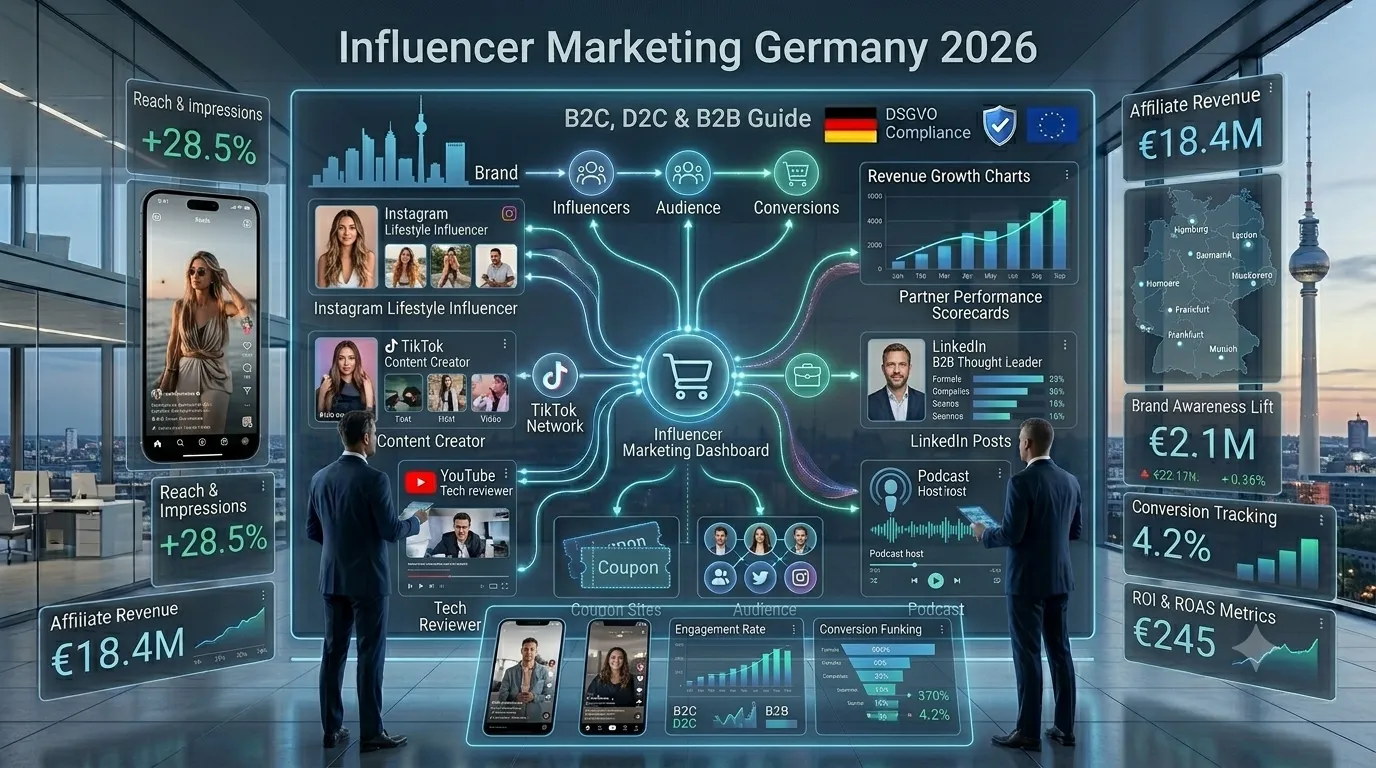
influencer marketing Germany has matured from a B2C fashion-and-beauty curiosity to a multi-billion-euro industry spanning B2C, D2C, B2B, and even Mittelstand brands. The German creator economy now includes hundreds of thousands of active creators across YouTube, Instagram, TikTok, LinkedIn, Twitch, and podcasts. For brands targeting German audiences, working with the right creator at the right scale delivers reach, credibility, and conversion that traditional advertising cannot match.
But German influencer marketing operates under strict regulatory frameworks: disclosure requirements (Werbekennzeichnung), Heilmittelwerbegesetz for health-adjacent claims, UWG rules on misleading content. And the German audience is quicker than US audiences to detect inauthentic partnerships, “selling out,” or low-value sponsored content. This guide covers what works in Germany 2026: how to find creators, how to structure deals, how to comply with disclosure law, and how to measure ROI.
What is the German influencer landscape in 2026?
The German influencer market in 2026 has several distinct segments:
Follower count categories:
- Nano-influencers (1K-10K followers): hyper-niche audiences, highest engagement rates (5-15%), authentic feel
- Micro-influencers (10K-100K): niche communities, strong engagement (3-8%), affordable rates
- Mid-tier influencers (100K-500K): established creators, moderate engagement (1-5%), professional production
- Macro-influencers (500K-2M): significant reach, lower engagement (0.5-3%), professional teams
- Mega-influencers / celebrities (2M+): mass reach, low engagement, premium pricing
Platform-based segmentation:
- Instagram: still dominant for fashion, beauty, lifestyle, travel
- TikTok: fastest growing, dominant for younger audiences (18-35)
- YouTube: deep engagement, long-form content, tech and education
- LinkedIn: B2B creator economy rising fast in DACH
- Twitch: gaming and live streaming
- Podcasts: rising B2B and lifestyle reach
Industry/vertical focus:
- Beauty and fashion (largest segment, mature ecosystem)
- Food and cooking
- Fitness and wellness
- Tech and gadgets
- Travel
- Family and parenting
- Business and finance (B2B-adjacent)
- Gaming
- DIY and home
- Mittelstand-relevant niches (specific industries, professional services)
Market characteristics:
- Top German Instagram beauty/fashion creators: 500K-3M+ followers
- Top German YouTube tech creators: 200K-2M subscribers
- Top German LinkedIn B2B creators: 30K-500K followers
- Top German TikTok creators: 1M-10M+ followers
- Professional creator economy: ~50K full-time creators, 500K+ part-time
For broader context, see our digital marketing services Germany guide and content marketing strategy Germany guide.
How does Werbekennzeichnung work in Germany?
Disclosure requirements for influencer content in Germany are stricter than US:
Legal framework:
- Telemediengesetz (TMG) § 6
- Rundfunkstaatsvertrag and Medienstaatsvertrag
- UWG (Gesetz gegen den unlauteren Wettbewerb)
- BGH (Federal Court of Justice) rulings clarifying application
When disclosure is required:
- Any content where the creator received compensation (money, free product, services)
- Sponsorship arrangements
- Affiliate links and commission arrangements
- Product placements
- Even gifted items without explicit compensation (some interpretations)
How to disclose properly:
- “Werbung” or “Anzeige” labels at the start of post/video
- Must be clearly visible (not hidden in hashtags at end)
- “Bezahlte Partnerschaft” is acceptable on Instagram (uses native tag)
- For videos: visual on-screen disclosure + spoken disclosure
- For long YouTube videos: disclosure at start and recurring
What’s NOT acceptable:
- “Ad” alone (must be in German)
- “Sponsored” alone
- Disclosure only in description/hashtags
- Pre-existing brand mention without disclosure (recommended product the creator owns and likes — still ambiguous; safer to disclose if any past compensation)
Penalties for non-compliance:
- Abmahnung from competitors or consumer protection associations (€500-€3,000 typical)
- Fines from Landesmedienanstalten (state media authorities)
- BGH rulings have established case law
- Both brand and creator can be liable
Best practice:
- Always disclose if any compensation occurred
- Train creators on compliance before campaign
- Brand contracts should require compliant disclosure
- Review content before publication where possible
- For high-risk verticals (health, finance): legal review of content
What types of influencer partnerships work in Germany?
1. Sponsored content / single-post campaigns:
- Creator posts about your product or service
- One-off engagement
- Cost: €100-€50,000+ per post depending on creator size
- Best for: awareness, product launches
2. Long-term ambassador programs:
- Multi-month or annual partnerships
- Creator becomes face of brand for their audience
- Cost: €5,000-€500,000+ per year per ambassador
- Best for: brand building, sustained category investment
3. Affiliate / performance partnerships:
- Creator earns commission on sales
- Often combined with discount code or tracking link
- Lower upfront cost, performance-based
- Cost: 5-30% revenue share typical
- Best for: e-commerce direct response
4. Co-created content:
- Brand and creator collaborate on content
- Branded video series, podcast episodes, content drops
- Cost: €5,000-€100,000+ per project
- Best for: deeper engagement, premium positioning
5. Product collaborations:
- Limited-edition products co-created with creator
- Brand uses creator’s audience for launch
- Cost: revenue share + upfront fee
- Best for: D2C product brands
6. Event appearances:
- Creator attends/promotes brand events
- Hosts at brand-sponsored experiences
- Cost: €5,000-€50,000+ per appearance
- Best for: launch events, conferences, trade shows
7. UGC licensing:
- License creator content for paid amplification
- Use in Meta/TikTok ads or other channels
- Often combined with Spark Ads on TikTok or Branded Content on Meta
- Cost: usage fee + initial content production
- Best for: scaling proven creator content with paid budget
8. White-label content production:
- Creator produces content for brand’s own channels
- No public association with brand
- Cost: production fee only
- Best for: high-volume content needs at lower disclosure complexity
How do you find the right creators for German campaigns?
Discovery methods:
1. Influencer marketing platforms:
- Reachbird (German-focused), Storyclash, Kolsquare, Aspire, Grin
- Search by audience demographics, engagement, vertical
- Cost: €200-€2,000/month for platform access
2. Native platform discovery:
- Instagram Creator search
- TikTok Creator Marketplace
- LinkedIn Creator Accelerator search
- YouTube BrandConnect
- Free but more manual
3. Agency-led discovery:
- Influencer marketing agencies (German-focused)
- Talent management agencies representing creators
- Cost: included in agency retainer
4. Manual research:
- Hashtag exploration for your category
- Competitor analysis (who do they work with?)
- Customer recommendations
- Industry events and conferences
Evaluation criteria:
Audience match:
- Demographics (age, gender, location — DACH percentage)
- Interests aligned with your product
- Audience size appropriate for budget
Engagement quality:
- Engagement rate (target 2-5%+ for serious creators)
- Comment authenticity (real conversations, not bot-driven)
- Story view rates (more accurate than feed engagement)
Content fit:
- Style and aesthetic compatible with brand
- Recent content quality consistent
- Tone and voice aligned
Audience authenticity:
- Check for bot followers (significant percentage indicates fraud)
- Geographic distribution matches claimed (DACH-focused vs US-focused)
- Growth pattern looks organic (not sudden spikes from buying followers)
Brand safety:
- Past content not problematic
- No history of controversies
- Professional in communications
- Compliance-aware (has disclosed properly in past sponsorships)
Past brand work:
- What brands have they worked with?
- Quality of past sponsored content?
- Brands renewed partnerships (signal of effectiveness)
What does influencer marketing cost in Germany?
Realistic 2026 rates by creator tier:
Nano-influencers (1K-10K followers):
- Per Instagram post: €50-€500
- Per TikTok post: €50-€500
- Per YouTube video: €200-€2,000
- Often via product gifting + small fee
Micro-influencers (10K-100K):
- Per Instagram post: €300-€3,000
- Per TikTok post: €300-€2,500
- Per YouTube video: €1,000-€10,000
- Per LinkedIn post (B2B creators): €500-€5,000
Mid-tier influencers (100K-500K):
- Per Instagram post: €1,500-€15,000
- Per TikTok post: €1,500-€12,000
- Per YouTube video: €5,000-€30,000
- Per LinkedIn post: €2,000-€20,000
Macro-influencers (500K-2M):
- Per Instagram post: €10,000-€80,000
- Per TikTok post: €8,000-€60,000
- Per YouTube video: €25,000-€150,000
Mega-influencers / celebrities (2M+):
- Per Instagram post: €50,000-€500,000+
- Per YouTube video: €100,000-€500,000+
Long-term ambassador programs:
- 10-30% discount on per-post rates × volume
- Typical 12-month commitment with 6-12 deliverables per year
Additional considerations:
- Usage rights (organic only vs paid amplification) — paid amplification adds 50-100%
- Exclusivity (excluding competing brands) — adds 30-100%
- Story vs feed vs reel vs all formats — affects pricing
- Geographic exclusivity
- Content approval rights and revision rounds
Performance-based pricing:
- Affiliate commission: 5-30% of revenue
- Performance bonuses on top of fixed fee
- Hybrid models common for D2C brands
For broader cost benchmarks, see our digital marketing cost Germany 2026 guide.
How do you structure influencer campaigns?
Campaign types:
Awareness campaigns:
- Multiple creators amplifying brand message
- Coordinated launch or seasonal pushes
- Mix of follower tiers for reach + engagement
- Measure: reach, impressions, brand awareness lift
Performance campaigns:
- Creators with affiliate links/codes
- Direct sales attribution
- Often with paid amplification (Spark Ads, Branded Content)
- Measure: revenue, ROAS
Content production campaigns:
- Creators produce content for brand reuse
- Brand amplifies via paid media (UGC ads)
- Measure: paid amplification ROAS, content variation lift
Long-term ambassador campaigns:
- Multi-month sustained presence
- Brand-builds through repeated exposure
- Measure: brand search volume, audience growth, brand recall
Campaign workflow:
Strategy phase (Weeks 1–2): Creator selection and planning
- Define campaign goals and KPIs
- Identify 3-5x more creators than needed (some will decline)
- Negotiate terms and contracts
- Brief creators on brand, message, compliance requirements
Production phase (Weeks 3–4): Content creation and approvals
- Creator drafts content
- Brand review (avoid over-editing — kills authenticity)
- Compliance check (proper disclosure)
- Final approval
Launch phase (Weeks 5–6): Publication and amplification
- Coordinated publication schedule
- Brand amplifies top-performing posts via paid (Spark Ads, etc.)
- Real-time monitoring of engagement and feedback
Optimization phase (Weeks 7–8): Analysis and iteration
- Performance reporting
- Creator and content type performance comparison
- Decisions for next campaign cycle
What KPIs matter for influencer marketing in Germany?
Awareness KPIs:
- Reach (unique users seeing content)
- Impressions (total views)
- Brand mentions and tagged content
- Brand search volume lift (Google Trends, Sistrix)
- Earned media value (EMV)
Engagement KPIs:
- Engagement rate (likes + comments + shares ÷ followers)
- Save rate on Instagram (strong intent signal)
- Comment quality and sentiment
- Share rate
- Video completion rates for Reels/Stories/TikTok
Conversion KPIs:
-
- Discount code redemptions (per-creator codes)
- Affiliate link clicks and conversions
- UTM-tagged traffic and conversion
- Landing page conversion from influencer traffic
- Direct sales attribution
Brand KPIs:
- Brand awareness lift (survey-based)
- Brand sentiment shift
- Social listening volume increase
- New follower acquisition for brand accounts
ROI metrics:
- Cost per engagement
- Cost per click
- Cost per acquisition
- Return on ad spend (ROAS) for performance campaigns
- Customer LTV from influencer-acquired customers
Operational metrics:
- Creator response rates (% of outreach that converts to deal)
- Time from brief to published content
- Compliance rate (% of content with proper disclosure)
- Revision cycles per campaign
Frequently asked questions about influencer marketing Germany
Yes for engagement (3–8% vs 0.5–2%). Macros for reach. Mix both for best results.
LinkedIn primary. 10K–200K follower thought leaders. €1,000–€20,000 per partnership.
IG: Bezahlte Partnerschaft + Werbung. TikTok: Branded Content. YT: paid tag + verbal. LinkedIn: #Anzeige. Stories: visible overlay.
HypeAuditor/Modash/Klear. Spikes, low engagement, bot comments, geo mismatch, follow-unfollow patterns.
Yes with whitelist/Spark Ads rights. 50–100% more than organic-only. Highly recommended for ROI.
Small. Virtual influencers face skepticism. AI-assisted real-creator content more common with disclosure.
Complementary. Organic + paid amplification outperforms either alone by 2–3x ROAS.
Direct under 10/year. Agency above. High-stakes partnerships always benefit from agency negotiation.
Ready to launch or scale influencer marketing in Germany?
Influencer marketing in Germany 2026 is a real channel, not a fad. Done right with proper creator selection, authentic partnerships, Werbekennzeichnung compliance, and paid amplification integration — it delivers compounding brand and performance returns that purely-paid channels can’t match.
Book a meeting for a free influencer marketing consultation where we’ll review your brand fit, recommend creator tiers, and outline a pilot campaign structure. Or browse our digital marketing services and contact us to discuss an engagement.