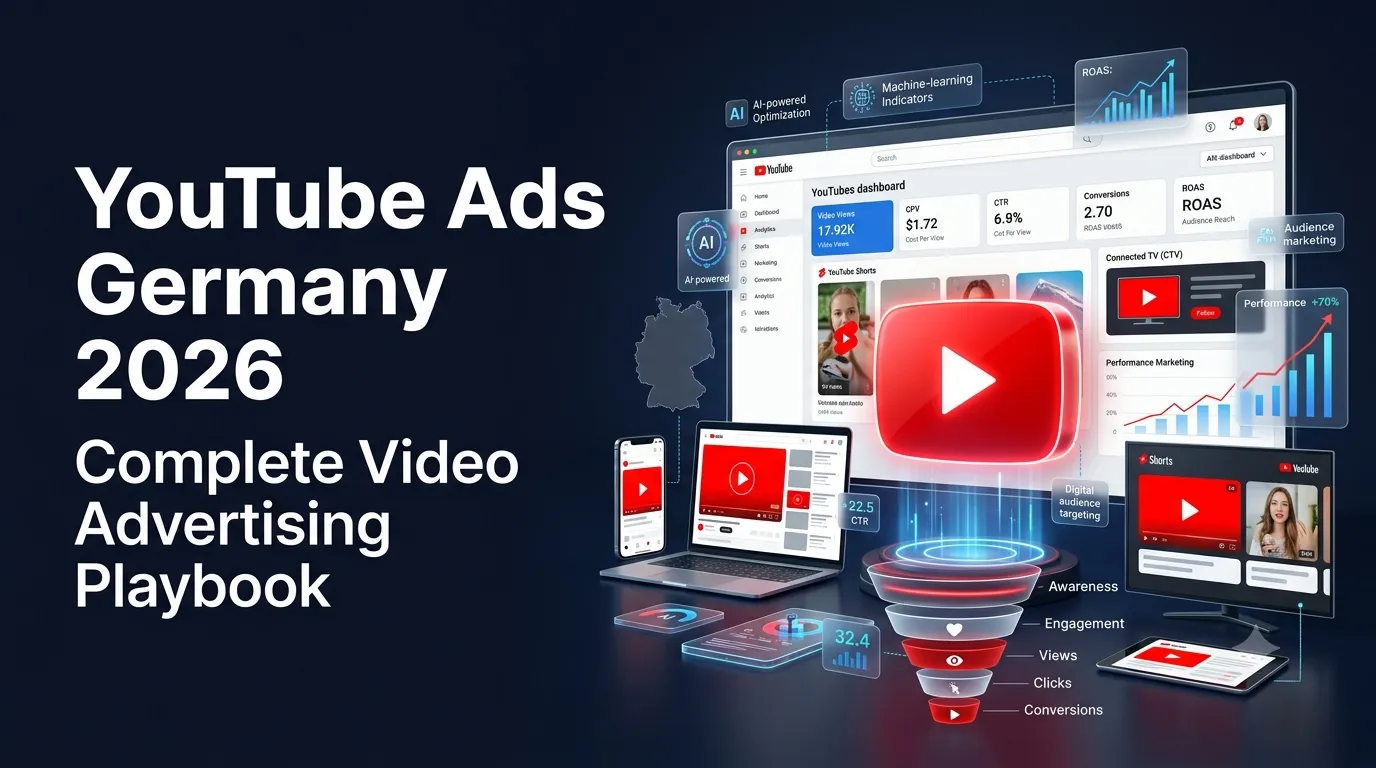
YouTube is the second-largest search engine in the world after Google itself, and the dominant video platform in Germany. Over 49 million Germans use YouTube monthly. The platform spans long-form educational content, short-form Shorts (competing directly with TikTok and Reels), live streams, and connected TV viewing through smart TVs and consoles. For brands willing to invest in video creative, YouTube is one of the highest-leverage paid channels in Germany — capable of driving both top-funnel awareness and direct response conversion.
In 2026, YouTube Ads has matured significantly. Smart bidding and AI-driven targeting handle audience optimization. Shorts ads provide TikTok-style reach within Google’s ecosystem. Performance Max integrates YouTube into automated multi-channel campaigns. Connected TV (CTV) extends reach to living-room screens. This guide covers what works for German advertisers in 2026.
What ad formats does YouTube offer in 2026?
YouTube Ads spans multiple formats:
Skippable In-Stream: pre-roll, mid-roll, or post-roll on long-form videos. Viewer can skip after 5 seconds. Most common format. Pay per view (TrueView).
Non-Skippable In-Stream: 15–20 seconds, must watch in full. Pay per impression. Best for brand awareness with concise message.
Bumper Ads: 6 seconds, non-skippable. Pay per impression. Best for reach and recall building.
In-Feed Video Ads (formerly Discovery Ads): thumbnail in YouTube search results, related videos, home feed. Click to watch. Pay per click on the thumbnail.
Shorts Ads: vertical short-form video ads in the Shorts feed. Direct competitor to TikTok ads.
Masthead: premium placement on YouTube home page. Premium cost; reserved for major brand campaigns.
Outstream Ads: video ads on Google video partner network (outside YouTube itself).
Connected TV (CTV) Ads: YouTube ads served to smart TVs, streaming devices, gaming consoles. Growing rapidly in Germany.
For German campaigns in 2026, the typical mix:
- 40–60% Skippable In-Stream (best balance of cost and engagement)
- 15–25% Shorts Ads (rising fast in DACH)
- 10–20% Bumper Ads (for reach and frequency)
- 5–15% In-Feed Video Ads (for product/service consideration)
- 5–15% CTV Ads (premium awareness)
For broader paid video strategy, see our performance marketing Germany guide.
What campaign objectives should you use?
YouTube campaigns map to Google Ads campaign objectives:
Video Reach Campaign: maximizes reach and impressions; for awareness goals Video Views Campaign: maximizes views with completion focus Brand Lift / Survey-based: measures awareness lift via brand surveys Drive Conversions: optimizes for website conversions via TrueView for Action Drive Sales: e-commerce-focused conversion Drive Leads: lead generation focus App Promotion: app install and engagement Performance Max (includes YouTube): automated multi-channel including YouTube
For German B2C: Drive Conversions and Drive Sales for direct response. Video Reach for brand campaigns. CTV included in reach campaigns.
For German B2B: Video Views for engagement + drive Conversions for downstream demo requests. Often used as upper-funnel feeder to remarketing campaigns.
What audience targeting works on YouTube in Germany?
YouTube targeting categories:
Demographics:
- Age, gender, parental status, household income (where data available)
- Geographic targeting (country, region, city, postal code)
- Language
Affinity audiences:
- Long-term interest categories (Sports fans, Food enthusiasts, etc.)
- Custom affinity (interests defined by you)
In-market audiences:
- People actively researching specific categories (Real estate, Cars, B2B Software, etc.)
- High intent signal
Life events:
- Recently moved, new home, new job, getting married, having a baby
- Powerful for relevant verticals
Detailed demographics:
- College education, employment status, marital status
- Useful for B2B and certain B2C
Custom audiences:
- Customer Match (email/phone upload with consent)
- Website visitors via Google Tag/Pixel
- App users
- YouTube channel viewers and engagement audiences
Topic targeting:
- Target specific YouTube content categories
Placement targeting:
- Specific channels or videos
- Best for niche B2B with named accounts where you know what they watch
Best practices for German YouTube:
- Start broad with audience signals; let creative do the heavy lifting
- In-market audiences excellent for direct response
- Custom audiences and lookalikes for retargeting and expansion
- Avoid over-narrowing — YouTube needs audience scale for smart bidding to work
What creative wins on YouTube in Germany?
Long-form video creative is YouTube’s strength. The principles for German market:
First 5 seconds: capture attention before skip. Brand visible early. Open with hook (question, surprising fact, problem statement).
Length:
- 6 seconds (Bumper): single message, brand recall
- 15-30 seconds: optimal for direct response and brand storytelling
- 30-90 seconds: detailed product demo, customer story, educational
- 90+ seconds: long-form storytelling, only when content earns the runtime
Tone for German market:
- Professional but human
- Concrete benefits over vague claims
- Real people, real products, real stories
- Specific numbers and proof points
- Sie-form for traditional B2B, Du-form for B2C and youth
Content patterns:
- Founder or expert speaking direct-to-camera
- Customer testimonial with quantifiable result
- Product demo showing specific use case
- Before/after transformation
- Industry insight or data presentation
- Comparison content (X vs Y trade-offs)
- Tutorial or step-by-step explainer
Visual quality:
- Professional production for premium brand campaigns
- Authentic phone-shot acceptable for Shorts and certain in-stream
- Subtitles always — even with audio, many viewers consume sound-off in public spaces
- German-language audio (or English with German subs for international content)
- 1080p minimum; 4K for premium and CTV
Creative variation:
- 3–5 video variants per campaign minimum
- Test hooks, story arcs, CTAs, length
- Refresh every 6–8 weeks for awareness; faster for direct response
What does YouTube Ads cost in Germany?
Typical 2026 metrics for German YouTube Ads:
CPV (cost per view, 30s or complete)
- B2C broad audiences: €0.03–€0.10
- B2C precise targeting: €0.08–€0.20
- B2B targeting: €0.15–€0.40
- High-intent in-market audiences: €0.20–€0.50
CPM (for non-skippable, bumper):
- Bumper: €4–€12
- Non-skippable 15-20s: €15–€40
- Premium placements (Masthead): €50–€200+
CTR / Click-through to website
- TrueView for Action: 0.5–2%
- Shorts In-Feed: 0.8–3%
CPL via TrueView for Action:
- B2C: €15–€60
- B2B: €40–€150
CPA (e-commerce):
- Highly variable; 2-5x AOV for break-even
- Strong programs: 3-5x ROAS
Typical monthly spend:
- Testing: €2K–€8K/month
- Scaled awareness program: €15K–€60K/month
- Major brand campaign: €60K–€300K+/month
For cost benchmarks, see our digital marketing cost Germany 2026 guide and Google Ads cost Germany guide.
How does YouTube Shorts advertising work?
YouTube Shorts launched globally in 2021 and has scaled rapidly in DACH. By 2026, Shorts represents a significant share of mobile YouTube viewing.
Shorts Ads characteristics:
- Vertical 9:16 format
- 15-60 seconds typical (up to 60 seconds for the ad)
- Native feel in the Shorts feed
- Direct competitor to TikTok Ads in audience and creative style
Strategic implications:
- Brands running TikTok-style creative can repurpose for Shorts
- Reach younger German audiences who consume Shorts heavily
- Performance often parallels TikTok at similar CPMs
- Integration with Google ecosystem (vs TikTok’s separate ad platform) reduces operational overhead
When to prioritize Shorts:
- Existing TikTok creative production capacity
- Targeting age 18-35 audience
- B2C consumer brands with visual demonstrability
- Mobile-first consideration in your overall strategy
For TikTok strategy that parallels Shorts, see our TikTok Ads Germany guide.
How does Connected TV (CTV) work for German advertisers?
CTV advertising on YouTube — ads shown on smart TVs, Chromecast, Apple TV, gaming consoles — is growing rapidly in Germany.
Audience reach: 60%+ of German households have at least one connected TV device. YouTube on TV is one of the largest CTV environments.
Strategic value:
- Premium ad placement on the largest screen in the household
- Lean-back viewing context (different from mobile/desktop)
- Cannot skip on TV (depending on format)
- Reach light-TV viewers who don’t watch traditional broadcast
Creative considerations:
- TV-optimized creative (16:9, high resolution, designed for distant viewing)
- Brand visible larger and longer
- Audio quality matters more (TV speakers vs phone speakers)
- Less direct response — more brand storytelling
Cost:
- CTV CPMs typically €15–€45 in Germany
- Higher than mobile but reach is premium
- Best for brand awareness and consideration, not direct response
CTV is increasingly integrated into Performance Max and other automated campaign types. Brands running standard YouTube campaigns automatically reach some CTV inventory.
How does YouTube fit with SEO and content marketing?
YouTube is itself the second-largest search engine. Organic YouTube SEO and paid YouTube ads reinforce each other:
Organic YouTube SEO:
- Optimize video titles, descriptions, tags, thumbnails for search
- Build channel authority through consistent posting
- Engagement metrics (watch time, retention) affect ranking
Paid YouTube Ads boost organic by:
- Driving views that signal video popularity to YouTube algorithm
- Building subscriber base through awareness campaigns
- Promoting top-performing organic videos to broader audience
Integration with content marketing:
- Repurpose long-form blog content as videos
- Promote video content via paid ads to expand reach
- Drive paid viewers to subscribe for ongoing organic reach
- Use video transcripts as blog content
For SEO context, see our SEO services Germany guide and content marketing strategy Germany guide (forthcoming).
What DSGVO compliance is required for YouTube Ads?
YouTube Ads tracking falls under the same Google Ads compliance framework:
1. Consent Mode v2: required for serving Google Ads to German users, including YouTube 2. Cookie consent banner: granular consent for ad_storage, analytics_storage, ad_user_data, ad_personalization 3. AVV with Google Ireland Ltd: signed and filed 4. Privacy policy: lists YouTube/Google Ads, data collected, purposes 5. Server-side tracking: for Conversion API and signal recovery 6. Customer Match compliance: documented consent for any uploaded email lists
YouTube-specific considerations:
- Brand suitability filtering for ad placement context
- COPPA / German youth protection compliance (some content categories restricted)
- Music licensing if using original creative with audio
For tracking infrastructure, see our server-side tracking Germany guide and GA4 Consent Mode v2 Germany guide.
What B2B use cases work for YouTube in Germany?
YouTube has stronger B2B applicability in Germany than many marketers realize:
Thought leadership and category education: long-form YouTube content positions your brand as expert. Founder interviews, industry analysis, case study deep-dives.
Product demos for complex B2B: detailed software walkthroughs, manufacturing equipment demos, technical product explanations. YouTube’s long-form format suits B2B depth.
Customer story marketing: 3-5 minute customer case study videos with on-screen results and testimonials.
Awareness for new categories: when buyers don’t yet search for what you offer, YouTube discovery and in-feed ads introduce them.
Retargeting funnel for B2B: viewers of awareness video → in-market audience for direct response YouTube or Google Search.
ABM video content: targeted videos shown to named accounts via placement targeting or company-list audiences.
B2B SaaS demonstration: TrueView for Action ads driving demo requests directly.
For B2B context, see our B2B SaaS CRO guide and LinkedIn Ads B2B Germany guide (often paired with YouTube for B2B).
What KPIs matter for YouTube Ads in Germany?
Top-line:
- ROAS (e-commerce) or CAC (B2B / services)
- Brand awareness lift (for awareness campaigns)
- Marketing-sourced pipeline (B2B)
Channel-level:
- CPV by campaign
- View-through rate (VTR)
- Click-through rate (CTR) for direct response
- Cost per conversion
- Audience reach and frequency
Campaign-level:
- Skip rate (vs target 60-75%)
- Average view duration
- Engagement rate
- Earned actions (subscribes, likes, shares from ad views)
Creative-level:
- Hook rate (% who watch past 5 seconds)
- Hold rate (% who watch to 75% / completion)
- Cost per quality view per creative
- Conversion rate per creative
Diagnostic:
- Placement performance (skippable vs Shorts vs CTV vs in-feed)
- Device breakdown (mobile, desktop, CTV)
- Geographic and demographic patterns
- Audience overlap with other campaigns
Frequently asked questions about YouTube Ads Germany
Run both. 35+ audiences: YouTube wins. No TikTok account: Shorts is simpler Google ecosystem entry.
Awareness: 6–15s. TrueView for Action: 15–30s. Demos: 90–180s. Tutorials: 5–10 min organic.
Marginal. Focus €5K on Google Search Ads first, add YouTube as budget grows.
In-house phone-shot + lightweight agency (€1K–€3K) + freelance editor (€500–€1,500) + AI for variations.
Yes for Shorts and authentic In-Stream. Phone-shot with clear audio works. Native > polished often.
YouTube wins on intent. Meta wins on creative speed. Typical B2C: 40% Meta, 30% Google, 15% YouTube.
New brands: 70/30 awareness-heavy. Established: 30/70 direct-response-heavy. Test for your category.
Podcasts growing but small vs YouTube. Repurpose audio with simple visual to access YouTube audience.
Ready to launch or scale YouTube Ads in Germany?
YouTube combines reach, intent, and creative impact in ways few other channels match. For brands willing to invest in video creative, YouTube delivers compounding returns across both awareness and direct response funnels.
Book a meeting for a free YouTube Ads consultation where we’ll assess creative readiness, identify the best YouTube formats for your brand, and recommend a 90-day test plan. Or browse our digital marketing services and contact us to discuss a YouTube Ads engagement.