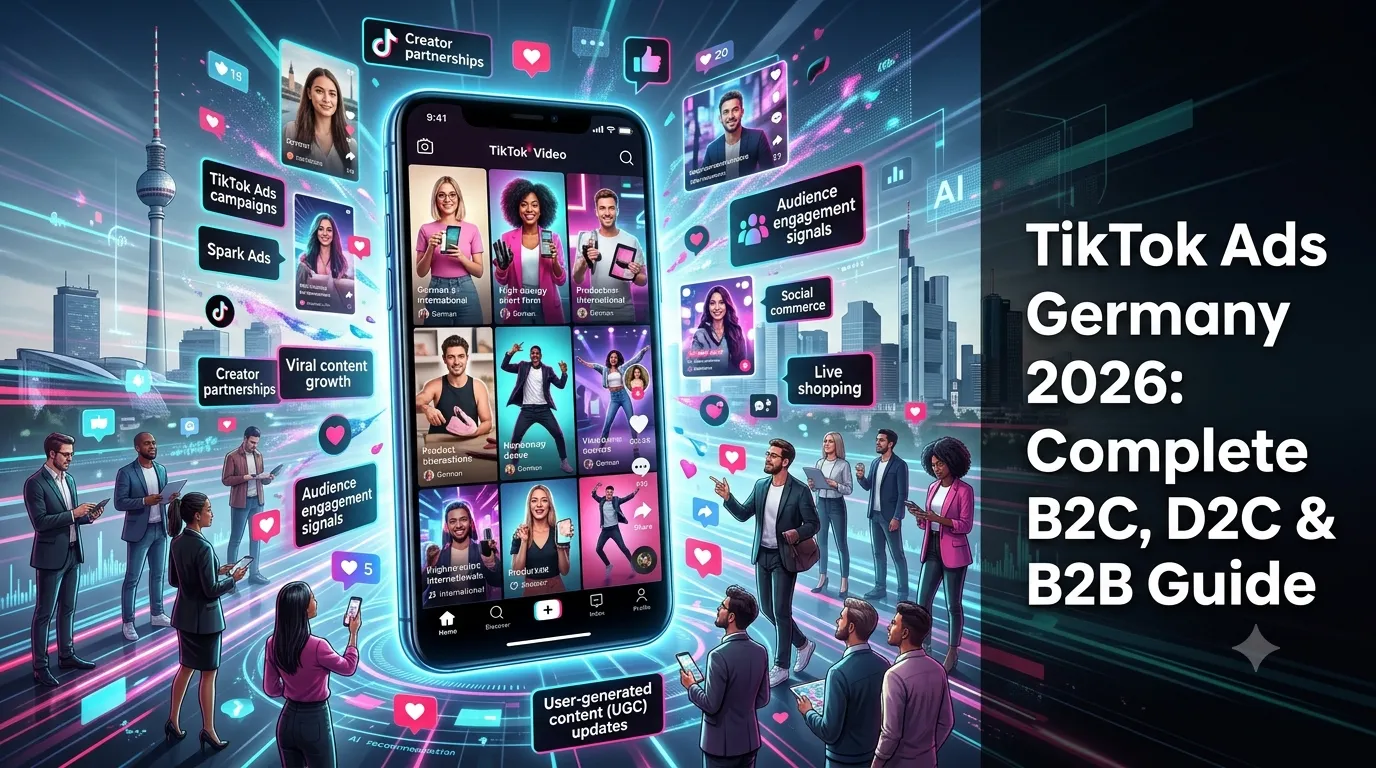
TikTok ads in Germany has crossed the threshold from “youth-only” to “essential paid social channel” for many B2C brands and a growing set of B2B niches. The platform reports 24+ million active German users in 2026, with the audience increasingly spanning ages 18–50. CPMs are still cheaper than Meta in many categories, creative-led optimization is rewarded more than precise targeting, and the algorithm surfaces content based on engagement signals rather than follower count.
For German brands considering TikTok in 2026, the question isn’t “should we” — it’s “how do we make TikTok work for our specific audience and brand.” TikTok requires a creative production approach fundamentally different from Meta or LinkedIn. Polished corporate creative fails. Authentic, fast-paced, native-feeling content wins. This guide covers what actually works on TikTok in the German market.
What is TikTok’s place in German digital marketing in 2026?
TikTok in Germany 2026 has the following characteristics:
Audience reach: 24+ million active users monthly. Demographic spread: 25% age 18–24, 35% age 25–34, 25% age 35–44, 15% age 45+. Skews younger than Meta but no longer “teens only.”
Engagement quality: average session length over 50 minutes daily for active users. Significantly higher than Facebook or Instagram. Algorithm-driven feed (For You Page) surfaces content from any creator, not just followed accounts.
CPM context: 30–60% cheaper than Meta in many German categories. Engagement rates higher. But conversion intent typically lower (entertainment-first platform).
Brand safety improvements: TikTok has significantly improved brand safety and ad placement controls since 2022. Major German brands now run paid TikTok campaigns alongside Meta and LinkedIn.
B2B applicability growing: SaaS, productivity, design tools, education, recruitment — all increasingly viable on TikTok in DACH. Traditional B2B Mittelstand (manufacturing, professional services for B2B) less applicable.
For broader paid social strategy, see our performance marketing Germany guide and Meta Ads Germany guide.
What businesses should advertise on TikTok in Germany?
Strong fit:
- B2C e-commerce (fashion, beauty, home, lifestyle, food)
- D2C product brands with visual demonstrability
- Mobile apps and games
- Online courses and digital products
- Restaurants and local services with visual appeal
- B2B SaaS targeting creators, designers, marketers
- Education and university programs
- Entertainment and media
- Influencer-led and creator economy brands
Moderate fit:
- Travel and hospitality
- Fitness, health and wellness
- Recruitment and employer branding
- B2B SaaS for productivity, design, marketing
Weak fit:
- Traditional Mittelstand B2B manufacturing
- Highly regulated industries (finance, certain healthcare)
- Enterprise B2B with named-account ABM (LinkedIn beats TikTok)
- Professional services where Sie-form formality matters
The honest test: if your brand can produce authentic-feeling, native-style content that people would actually watch — TikTok works. If your brand needs to maintain corporate formality, TikTok works less well.
What ad formats does TikTok offer?
In-Feed Ads: native-style videos in the For You feed. Most common and best-performing.
TopView: full-screen video on app open. Premium awareness placement; expensive.
Brand Takeover: full-screen ad shown for 3-5 seconds when app opens. Premium awareness.
Branded Hashtag Challenge: invite users to participate in a hashtag with branded creative. Drives massive engagement when concept resonates.
Branded Effects: AR effects and filters branded with logo or theme.
Spark Ads: amplify organic posts (from your own account or creators) as paid ads. Often outperforms purpose-built ads.
Collection Ads: e-commerce ads with product carousel below video.
Dynamic Showcase Ads: TikTok’s equivalent of dynamic product ads — personalized product feed based on user signals.
LIVE Shopping Ads: integrated with TikTok Shop for direct purchase during live streams. Growing in Germany.
Lead Generation Forms: native forms for low-friction lead capture.
For most German B2C and emerging B2B, In-Feed Ads + Spark Ads are the workhorses. Premium formats (TopView, Brand Takeover) used selectively for launches and brand campaigns.
What audience targeting works on TikTok in Germany?
TikTok’s targeting is less precise than LinkedIn but more behavior-driven than Meta:
Demographics:
- Age, gender, language
- Location (city-level, Bundesland-level)
- Device, OS, network type
Interest targeting:
- Topic interests (broad: fashion, food, fitness, business, technology)
- Hashtag interests (more specific behavioral signals)
- Creator interactions (people who engage with similar creators)
Behavioral targeting:
- App usage patterns
- Video category interactions
- Purchase intent signals
Custom audiences:
- Customer Match (email/phone upload with consent)
- Website visitors (via TikTok Pixel)
- App users
- Engagement audiences (people who interacted with your account
Lookalike audiences:
- Built from custom audience seeds
- Best seeds: high-LTV customers, recent purchasers, engaged followers
Advantage+ Audience equivalents:
- TikTok has automated targeting modes that the algorithm determines based on conversion signals
- Often outperforms manual targeting once conversion data is sufficient
Best practice for Germany:
- Don’t over-segment: TikTok algorithm needs audience scale to optimize
- Start broad with interest signals; let creative do the targeting
- Custom audiences and lookalikes most valuable
- Use Advantage+ audience modes after collecting initial conversion data
What creative wins on TikTok in Germany?
This is where TikTok differs most from other paid channels. Polished corporate creative consistently underperforms on TikTok. Native-feeling, fast-paced, authentic content wins.
Creative principles for German TikTok:
1. First 1.5 seconds matter most: hook viewers immediately or lose them 2. Vertical 9:16 native format: no horizontal video, no square crops 3. Sound-on optimization: TikTok is sound-on majority of the time (opposite of LinkedIn/Meta) 4. Captions/subtitles: still required for accessibility and silent viewers 5. Native style: feels like user-generated content, not advertising 6. Real people speaking: founder, employee, customer, creator 7. Fast cuts: 1-2 second cuts; minimize static shots 8. Trends-aware: leverage current TikTok trends, sounds, formats where appropriate 9. Specific concrete benefits: not vague claims 10. German-language native: not translated, written for TikTok native audience
Content patterns that work in Germany:
- Product demo with twist or reveal
- Before/after transformation
- “What I wish I knew” educational
- Customer testimonial filmed casually
- Behind-the-scenes look
- “How it’s made” or process video
- Quick tutorial or tip
- Reaction or commentary on industry/trend
- Comedic skit related to product use
- Day-in-the-life of founder/team
Creative production reality: TikTok requires significantly faster creative production than Meta or LinkedIn. Brands shipping 5-10 new ads per week win; brands shipping 5 per month struggle. Budget creative production accordingly: 15–30% of media spend is normal for TikTok-serious brands.
Spark Ads strategy: amplify your best organic posts as ads. Often outperforms purpose-built ads because Spark Ads have authentic engagement signals (real comments, real shares). Build organic TikTok presence first; amplify what works with paid budget.
What does TikTok Ads cost in Germany?
Typical 2026 metrics for German TikTok Ads:
CPM:
- B2C broad audiences: €3–€12
- B2C narrower targeting: €8–€20
- B2B targeting: €10–€30
- Premium formats (TopView, etc.): €30–€80+
CPC:
- B2C: €0.30–€2
- B2B: €1–€5
CPV (cost per video view, 6-second view):
- €0.01–€0.05 typical
- High-engagement creative: €0.005–€0.02
CPL:
- B2C lead magnets: €5–€25
- B2B Lead Gen Forms: €15–€60
- B2B demo requests via website: €50–€200
CPA (e-commerce):
- Highly variable; 2–4x AOV for break-even ROAS
- Strong programs: 3-5x ROAS
Typical monthly spend:
- Testing TikTok: €3K–€10K/month
- Scaled B2C program: €15K–€80K/month
- D2C brand at scale: €50K–€250K+/month
TikTok costs less per impression than Meta in many German categories but requires higher creative production volume. Net per-customer cost often similar; some brands win more efficiently on TikTok due to creative resonance.
How do you set up TikTok tracking and DSGVO compliance?
TikTok tracking infrastructure:
1. TikTok Pixel: client-side tracking pixel installed sitewide
2. Events API (TikTok CAPI): server-side event forwarding for signal recovery on iOS and consent-rejected users
3. Server-side GTM: hosts the Events API integration, EU-hosted (Hetzner, AWS Frankfurt)
4. Consent Mode: granular consent management for TikTok tracking, integrated with cookie banner
5. AVV: signed with TikTok Technology Limited (Ireland)
6. Privacy policy: updated to disclose TikTok data flows
7. Customer Match compliance: email lists uploaded only with proper consent basis documented
TikTok data flows have additional scrutiny in Europe due to Chinese parent company ByteDance. Some European Datenschutzbehörden have raised concerns about TikTok data handling. Best practice: minimize PII shared, hash all data, document consent thoroughly, monitor regulatory developments.
For tracking infrastructure, see our server-side tracking Germany guide and GA4 Consent Mode v2 Germany guide.
What B2B use cases work on TikTok in Germany?
B2B TikTok is rising in DACH. Specific categories that work:
SaaS for creators and marketers: Notion, Figma-equivalent tools, marketing platforms. Audience is on TikTok personally; brand recognition translates to professional consideration.
Productivity and design tools: visual demos work well; “how I use [tool]” content drives consideration.
Recruitment and employer branding: showcasing company culture, team, behind-the-scenes work. Particularly effective for hiring Gen Z and younger millennials in DACH.
Online courses and education: snippets of course content as ads; high-engagement format.
B2B SaaS targeting startups: founder thought leadership, product demos, customer success stories.
Coaching and consulting (B2C-adjacent): personal branding plays well on TikTok.
B2B NOT yet working well in DACH:
- Enterprise B2B sales (LinkedIn beats TikTok)
- Manufacturing and industrial B2B
- Heavy compliance industries (finance, certain healthcare)
- B2B where Sie-form formality is required
The B2B trajectory on TikTok in Germany suggests broader applicability over the next 2-3 years. Brands experimenting now will have learning curve advantage when TikTok becomes mainstream B2B.
How do you handle creator partnerships and influencer integration?
TikTok rewards creator-driven content. Two integration paths:
Spark Ads with creator content:
- Partner with creators to produce videos
- Creator posts on their own account
- You amplify the post as Spark Ad with paid budget
- Authentic engagement signals improve ad performance
- Cost: creator fee (€500–€5,000+ per video for German mid-tier creators) + media budget
TikTok Creator Marketplace:
- Native platform for brand-creator partnerships
- Browse creators by audience, engagement, content style
- Manage briefs, deliverables, payments
- Increasingly used by German Mittelstand for D2C campaigns
Branded Content:
- Creator-led content with brand integration
- Disclosed as paid partnership per German Werberecht and BGH rulings
- Specific disclosure requirements: “Anzeige”, “Werbung”, “Sponsored”
Influencer marketing compliance in Germany:
- Disclosure requirements per Telemediengesetz and UWG
- Clear “Anzeige” or “Werbung” labeling
- Cannot disguise paid content as organic
- See our forthcoming influencer marketing Germany guide for full compliance detail
What KPIs matter for TikTok Ads in Germany?
Top-line:
- ROAS or CAC (depending on business model)
- LTV by TikTok-acquired vs other channels (often lower LTV than search; higher than display)
- Marketing-sourced pipeline (B2B)
Channel-level:
- CPA / CPL by campaign
- ROAS by campaign and ad set
- Audience saturation indicators
- New customer acquisition rate
Campaign-level:
- CTR (typical: 0.8–2.5% for In-Feed Ads)
- CPV and 6-second view rate
- Watch time and completion rate
- Engagement rate (likes, shares, comments)
- Save rate (strong signal of intent)
Creative-level:
- Hook rate (% who watch past first 3 seconds)
- Hold rate (% who watch to 75% or completion)
- Conversion rate per creative variant
- Cost per result per creative variant
Diagnostic:
- Audience size and reach
- Frequency capping
- Day-of-week and time-of-day patterns
- Native organic vs Spark Ad performance compariso
Frequently asked questions about TikTok Ads Germany
Yes for B2C with visual demos. Traditional B2B Mittelstand: not yet, but trajectory worth watching.
Higher volume, cheaper per piece (phone-shot native style). Net similar cost, faster cadence.
Yes but TikTok-native often outperforms reposted Reels. Produce for TikTok first, repurpose to Reels.
Rollout in progress in DACH. D2C in-app purchase has higher conversion than driving to website.
No. 25–45 is ~60% of DACH users. Don’t skip TikTok on outdated demographic assumptions.
Use filters, opt out of categories, monitor placements. Add DoubleVerify/IAS for critical brand safety.
€2K/month minimum. Serious testing: €5K–€10K/month. Primary channel: €15K+/month.
Events API + server-side tracking + hashed PII + Consent Mode required. Table stakes for performance.
Ready to launch or scale TikTok Ads in Germany?
TikTok is one of the highest-velocity learning channels in 2026. Brands that commit to fast creative iteration, native-style content, and proper tracking infrastructure are building competitive advantages that compound. The cost to test is moderate; the upside for fit-right brands is substantial.
Book a meeting for a free TikTok Ads consultation where we’ll assess whether TikTok fits your business, review your creative production capacity, and recommend a testing plan. Or browse our digital marketing services and contact us to start the conversation.