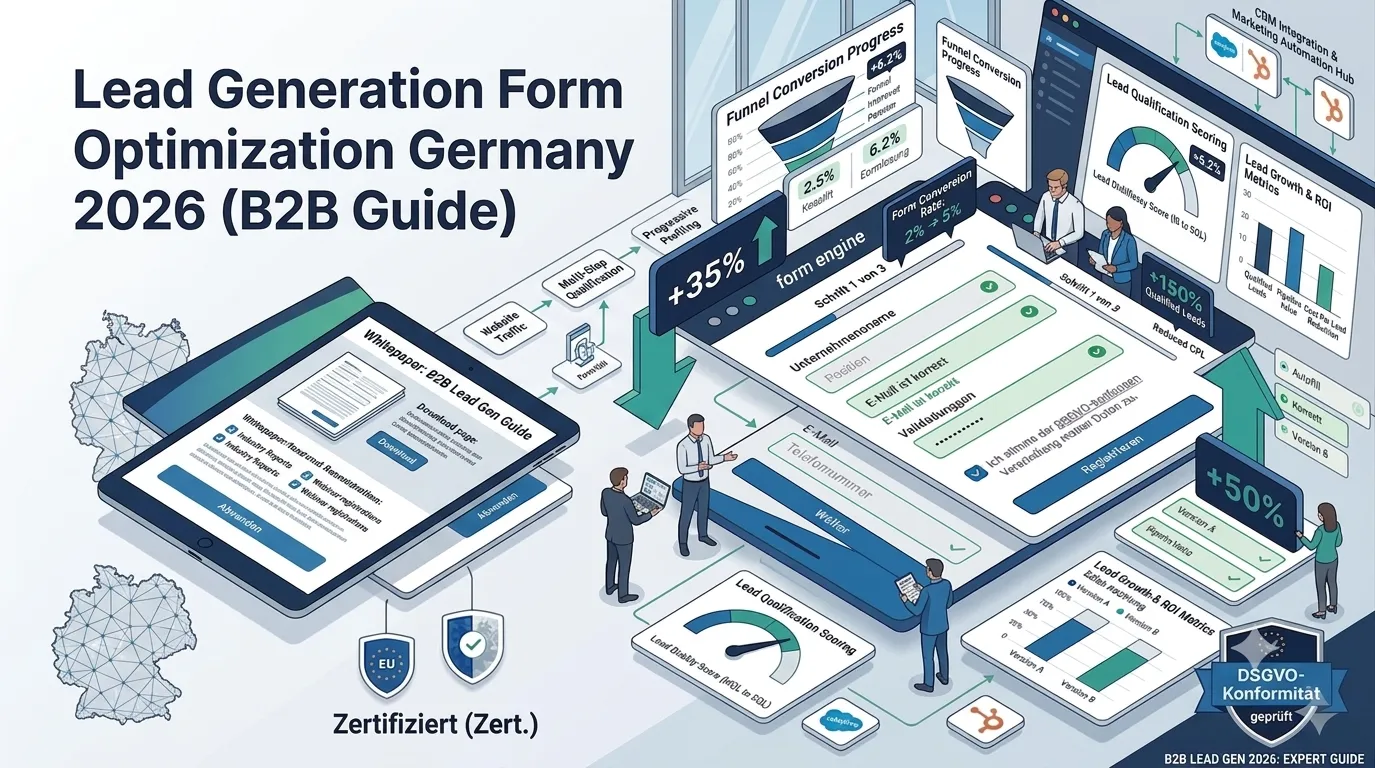
Lead generation forms are the bridge between traffic and qualified pipeline. For German B2B in 2026, optimizing these forms means balancing two opposing pressures: ask less (more leads) vs. ask more (better qualification). Get the balance right and you generate 2–3x more qualified pipeline at same traffic.
This guide walks through what lead generation form optimization for Germany actually requires in 2026: field reduction principles, lead magnet design, DSGVO consent integration, multi-step forms, and qualification balance.
For broader form CRO see our form optimization conversion guide.
What’s lead generation form optimization?
Maximizing qualified pipeline from any given traffic via form design.
The trade-off
- Fewer fields = more leads, less qualification
- More fields = fewer leads, higher quality
- Goal: find optimal balance for your funnel
Forms that matter
- Contact / inquiry form
- Newsletter signup
- Lead magnet download (eBook, whitepaper, template)
- Demo request
- Webinar registration
- Free trial signup
For broader CRO see our CRO services Germany guide.
What’s the typical lead gen conversion rate?
By form type:
Newsletter signup
1–5% of page visitors. Higher with relevant offer.
Lead magnet download
15–40% of landing page visitors. Stronger commitment vs newsletter.
Webinar registration
20–40% of landing page visitors.
Demo request
1–5% of page visitors. Higher-friction conversion.
Free trial signup
2–8% typical. Higher with stronger value proposition.
Contact form
3–10% typical on service pages.
What’s the right field count per form type?
By stage:
Newsletter signup
1-2 fields. Email + optional name.
Lead magnet (TOFU – awareness stage)
2-3 fields. Email + name + company.
Webinar registration
3-4 fields. Plus role/industry.
Demo request (BOFU – decision stage)
4-6 fields. Plus use case, timeline.
Free trial signup
3-5 fields. Email + name + company + role.
Contact form
3-5 fields. Email + name + message + optional fields.
Quote request
5-8 fields. Detailed qualification.
For form depth see our form optimization conversion guide.
What lead magnets work in Germany?
Five high-converting lead magnet types:
1. Industry-specific guide
“German Mittelstand Procurement Software Guide 2026”
2. Checklist / template
“Steuerberater Wechsel Checklist” — actionable + immediately useful
3. Benchmark report
“Salary benchmark German Software Engineer 2026”
4. ROI / cost calculator
Interactive tool. Personalized output.
5. Comparison guide
“Top 10 CRMs for German B2B compared”
Avoid generic
“Top 10 marketing tips” — too generic, low value.
What’s the German DSGVO consent requirement?
For lead generation:
Marketing consent checkbox
Required. Explicit, not pre-checked.
Sample wording
“☐ Ja, ich möchte den Newsletter erhalten und stimme der Verarbeitung meiner Daten gemäß Datenschutzerklärung zu.”
Double-opt-in for newsletter
Required. Send confirmation email. User clicks confirm.
Bestandskunden-Marketing exception
For existing customers: “similar product/service” marketing allowed without separate consent if opt-out available.
Document consent
Timestamp, IP, text version.
For DSGVO see our GDPR compliance guide.
What’s the multi-step lead gen approach?
For longer forms:
Why multi-step
Single 8-field form: ~25% completion. Multi-step 4-field × 2: ~50% completion.
Step structure
- Step 1: Email + basic info (3 fields)
- Step 2: Additional qualification (3-4 fields)
- Step 3: Submit + confirmation
Why it works
- Less overwhelming
- Sunk-cost commits user
- Progress visible
- Easier to track step-level drop
When to use
For 6+ field forms. Multi-step typically wins.
For multi-step see our form optimization conversion guide.
What German-specific form copy works?
Five patterns:
Sie-form labels
“Ihre E-Mail-Adresse” for professional context.
Outcome-focused CTAs
“Whitepaper herunterladen” beats “Senden”
Reassurance below submit
“Kein Spam – wir versenden 1-2 E-Mails pro Monat” for newsletter.
Specific value promise
“Sie erhalten den 30-Seiten-Guide direkt nach Eintragung.”
Error messages helpful
“Bitte geben Sie eine gültige E-Mail ein” not “Invalid.”
What trust signals work near lead gen forms?
Five trust signals:
Customer logos
Subtle, below form. “Über 5,000 Newsletter-Abonnenten.”
Privacy reassurance
“Wir teilen Ihre Daten niemals” near submit.
Specific subscriber count
“Schließen Sie sich 10,000+ deutschen B2B-Entscheidern an.”
Sample preview
For lead magnet: show first 2-3 pages preview.
Testimonial about content
“Dieser Guide hat mir geholfen, X zu erreichen.” From real customer.
What about gated vs ungated content?
Gated content (behind form)
Higher commitment from user. Lower volume of access. Generates leads.
Ungated content (open access)
Higher volume of access. No lead capture. Builds brand + SEO.
Strategy
Mix. Gate high-value assets (long reports, exclusive data). Ungate top-of-funnel content (blog posts, basic guides).
Hybrid approach
Tease content. Show first 30%. Gate rest behind email.
What does lead gen form optimization look like in practice?
A typical workflow:
Baseline
10,000 visitors → 200 form submissions (2% CR) → 50 qualified leads.
Optimize fields
Reduce from 8 to 5 fields. Increase to 350 submissions (3.5% CR). 75 qualified leads (less qualification but more volume).
Add multi-step
For complex forms. Or split into multiple smaller forms.
A/B test copy
Headline + CTA copy.
Trust signal placement
Above + below form.
Result
500+ submissions (5% CR). 100 qualified leads. 2x improvement.
For A/B testing see our A/B testing Germany guide.
What German Mittelstand-specific considerations?
Four factors:
Email signature length
German B2B prefer formal email signatures. Form should capture full name + title + company.
Phone number expected (B2B)
Despite preference for reduced fields, many German B2B prospects expect phone fields.
Industry-specific qualification
“Welche Branche?” question helps qualify Mittelstand verticals.
Decision-maker identification
“Welche Rolle haben Sie im Entscheidungsprozess?” critical for qualification.
For B2B SaaS see our SEO for B2B SaaS Germany guide.
What tools support lead gen optimization?
Form builders
- Typeform (modern, multi-step)
- Tally (newer alternative)
- JotForm
- Gravity Forms (WordPress)
- Native React/Vue for custom
Lead capture platforms
- HubSpot Forms
- Marketo Forms
- Salesforce Web-to-Lead
- ConvertKit (creator-focused)
A/B testing on forms
VWO, Optimizely, Convert. See our A/B testing tools guide.
What are common lead gen form mistakes?
Six patterns:
Too many fields
12-field forms for newsletter. Reduces completion 50–70%.
Generic CTA
“Submit” instead of outcome-focused “Whitepaper herunterladen.”
No DSGVO consent
Or pre-checked consent box. DSGVO violation.
Missing privacy reassurance
User doesn’t know what happens with data.
Generic lead magnets
“Top 10 marketing tips.” Low value. Few want it.
No multi-step for complex forms
8+ field single page. Should be multi-step.
What about progressive profiling?
Advanced lead gen technique:
Concept
Don’t ask all qualification at once. Ask additional info each subsequent interaction.
Example
- First visit: email + name only
- Second visit: company + role
- Third visit: industry + use case
Tools supporting
HubSpot, Marketo, Salesforce Pardot.
Benefits
Higher completion rate per form. Cumulatively better qualification.
Trade-off
Longer time to fully qualified lead.
How do you measure lead gen form performance?
Five KPIs:
Form completion rate
Submissions / form views.
Cost per lead
Marketing spend / qualified leads.
Lead quality score
Marketing-qualified leads / total leads.
Sales-accepted leads
Sales-accepted / marketing-qualified.
Customer acquisition cost
Total cost / closed-won customers.
For analytics see our GA4 conversion tracking guide.
How does AI help lead gen forms in 2026?
Three applications:
AI form completion suggestions
Auto-fill based on inferred attributes.
Real-time validation
Email validation, company existence check.
Smart lead scoring
AI scores leads based on form data + behavior.
Form analytics + recommendations
AI surfaces optimization opportunities.
Frequently asked questions about lead generation form optimization
Newsletter 1–2. Lead magnet 2–3. Webinar 3–4. Demo 4–6. Trial 3–5. Contact 3–5. Quote 5–8.
Industry-specific guides, checklists, benchmark reports, ROI calculators, comparison guides.
Explicit consent checkbox (not pre-checked). Double-opt-in for newsletter. Document consent.
For 6+ field forms: yes. 25–40% completion improvement typical.
Customer logos, privacy reassurance, subscriber count, sample preview, content testimonial.
Different qualification questions over multiple interactions vs all at once.
Test field reduction. Measure both volume + sales-accepted leads. Optimize for SQL conversion.
Newsletter 1–5%. Lead magnet 15–40%. Webinar 20–40%. Demo 1–5%. Trial 2–8%.
Need help with lead gen forms?
If you’re scoping lead generation CRO for your German business and want a 30-minute scoping conversation about field optimization + lead magnets, book a meeting or send details via our contact page.
Need expert help? Gem Programmers provides conversion rate optimization services for businesses in Germany, Austria and Switzerland. Request a free, no-obligation quote and get a clear plan with scope, timeline and price.