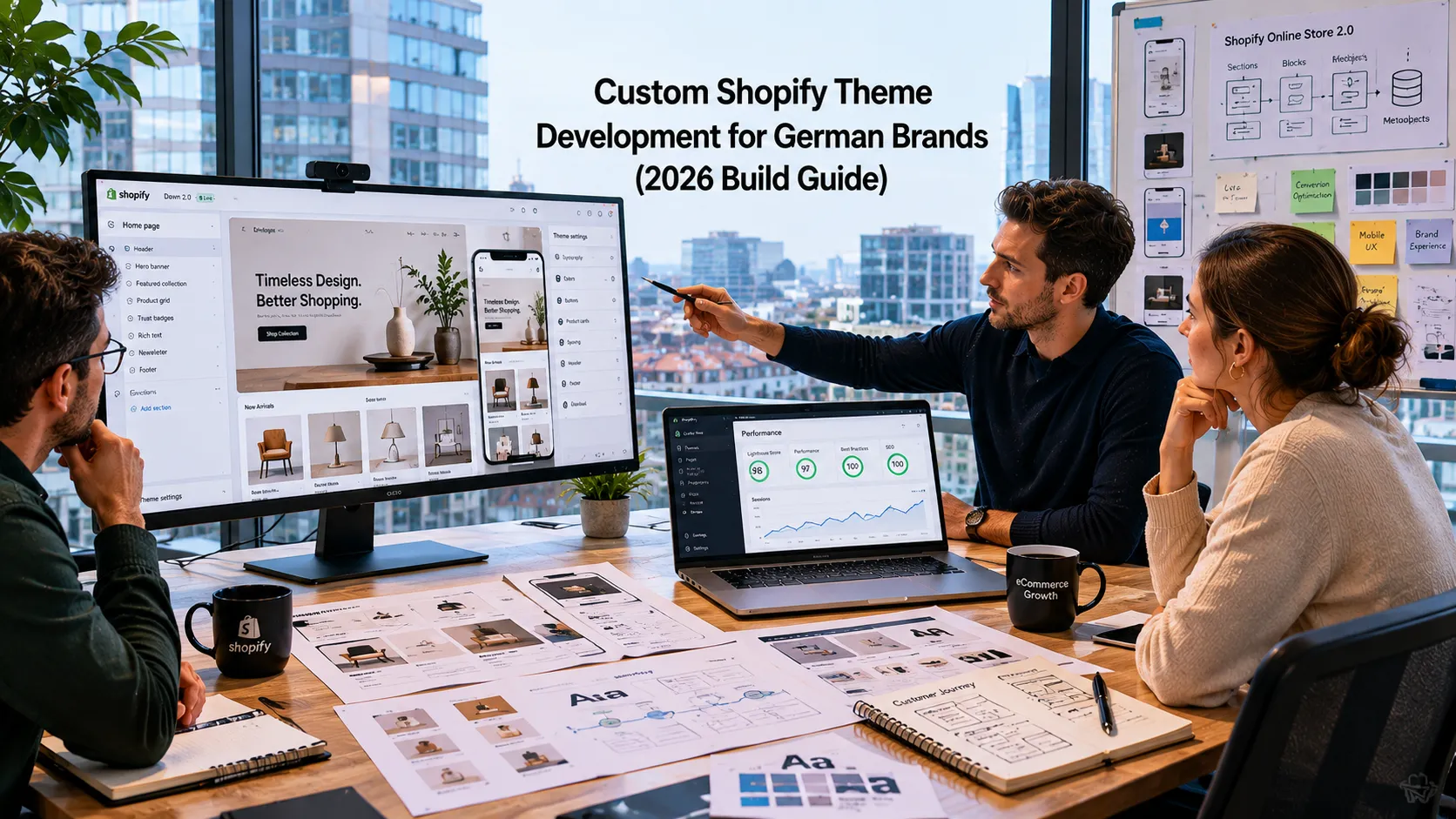
A custom Shopify theme development is the right call for some brands and an expensive vanity project for others. The 2026 Shopify theme ecosystem has matured dramatically: modern free themes like Dawn rival paid themes from 2022, and Online Store 2.0 sections eliminate most of the “we need custom” reasons that existed even 18 months ago. The decision between customizing a starter theme and building a fully custom Shopify theme can shift €30,000–€100,000+ in your budget.
This guide walks through what custom Shopify theme development actually requires for a German brand in 2026: when custom is justified vs over-engineered, the OS 2.0 architecture you should use, EUR build costs, performance discipline, and the German legal-stack integration that determines whether your custom theme actually works for German buyers.
When is a custom Shopify theme actually worth it?
Six trigger conditions:
Your brand has a strong unique visual system
If your brand has distinctive typography, motion language, scroll behaviors, or interaction patterns that no off-the-shelf theme can match, custom is justified.
You have a brand-conscious target customer
Premium-tier customers notice when a brand uses a clearly off-the-shelf theme. Custom signals investment + quality.
You’re at Shopify Plus tier
Custom theme pays back faster at Plus revenue scale.
You’ve outgrown the limits of premium themes
If you’ve heavily customized Impulse, Symmetry, Empire, Showcase and still feel constrained, fresh custom may be cleaner than further customization.
You need integration with custom apps
Custom apps + custom theme integrate cleanly; off-the-shelf theme + custom app integration is more friction.
You can afford ongoing maintenance
Custom themes need ongoing updates as Shopify evolves. Budget for it.
When is a starter theme + customization the right call?
Five signals to stay with starter:
You’re under €1M annual revenue
The 5–10% conversion lift custom might provide doesn’t yet justify €30,000+ build cost.
You don’t have a distinctive brand identity yet
Brand-first comes from product, voice, customer experience — not from custom theme. Spend money on positioning first.
Your team can’t maintain custom code
Custom themes need maintenance. Without in-house capability or agency retainer, custom decays into broken code.
Time-to-market is critical
Customizing a starter theme launches in 4–10 weeks. Custom builds take 8–18 weeks minimum.
Free themes (Dawn) cover 85% of what you need
Modern Dawn + custom OS 2.0 sections + carefully chosen apps gets you a long way without custom theme.
What does custom Shopify theme development cost in Germany in 2026?
Light customization of existing theme
- Boutique freelancer: €2,500–€8,000
- Mid-size agency: €4,000–€15,000
Heavy customization of existing theme
- Freelancer: €6,000–€20,000
- Mid-size agency: €12,000–€35,000
- Top-tier agency: €25,000–€65,000
Custom theme from scratch (standard Shopify)
- Mid-size agency: €15,000–€55,000
- Top-tier agency: €45,000–€140,000
Custom theme for Shopify Plus
- €55,000–€180,000+
Headless Hydrogen storefront (instead of Liquid theme)
- €45,000–€180,000+
- Plus Oxygen / Vercel hosting
For broader Shopify cost see our Shopify development services guide and Shopify cost Germany guide.
What does the OS 2.0 architecture actually require?
Modern Shopify themes in 2026 are built on Online Store 2.0:
Sections everywhere
Every page (home, product, collection, blog, custom) is a stack of JSON-driven sections. Merchants can drag, drop, reorder, configure via theme editor.
App blocks
Apps can inject blocks into any section. Builders can place app-driven content into any layout point.
Metafields and metaobjects
Custom data on products, customers, orders, collections. Metaobjects allow custom content types (testimonials, FAQ, recipe cards).
Liquid templates
Liquid 6+ syntax, with improvements in iteration, conditional rendering, and metafield access.
Theme block-style architecture
A theme that can’t expose 90%+ of its content as merchant-editable sections is considered out of date.
Theme inspector + theme check
Performance debugging in theme editor + automated linting in CI for theme quality.
A custom theme that doesn’t embrace OS 2.0 will feel obsolete within a year.
What does performance look like for a custom theme?
Performance benchmarks for a well-built German Shopify theme in 2026:
- Lighthouse Performance: 85+ desktop, 75+ mobile
- LCP: under 2.0s
- TBT: under 200ms
- CLS: under 0.05
To hit these:
- Lazy-load images below the fold
- Defer non-critical JS including most apps
- Use Shopify’s image filters for proper sizing
- Critical CSS inlined for above-the-fold styles
- Minimize app stack — every app adds JS
- Avoid heavy hero animations that block render
Custom themes should beat off-the-shelf on performance because you control every byte. If your custom theme is slower than Dawn, the agency built it badly.
What German-specific integrations does the theme need?
Five must-have integrations baked into the theme:
Germanized for Shopify (Widerrufsbelehrung, Grundpreis)
Theme must respect Germanized’s checkout customizations and Grundpreis display per §1 PAngV.
Trusted Shops badge
Trust seal in header/footer. Trustbadge customizable per Trusted Shops widget config.
Cookie banner respects pre-consent assets
No tracking scripts in theme.liquid that load before cookie consent. Marketing pixels via consent-gated app blocks.
SEPA + Klarna + PayPal at checkout
Payment method icons in footer (legally required to display before checkout). Klarna express checkout button placement.
German language locale defaults
Locale strings in DE by default. Auto-translation tools (Weglot, Langify) only as fallback for multi-language.
What are the most common custom theme mistakes German brands make?
Four patterns:
Building before brand is mature
Custom theme on top of unclear brand identity = expensive mistake. Get brand right first.
Over-engineering visual complexity
Bad design with custom code is worse than good design with off-the-shelf. Hire a great designer first.
Ignoring OS 2.0
A custom theme in 2026 that doesn’t use sections, blocks, metaobjects properly is obsolete the day it launches.
Skipping performance discipline
A custom theme that performs worse than Dawn fails the most basic justification for custom.
When should you do headless (Hydrogen) instead of Liquid theme?
Headless makes sense when:
- Performance is the primary differentiator — Hydrogen on Oxygen can outperform Liquid themes
- You want React component model — Hydrogen is React-based, fits modern frontend teams
- You need deep content integration — pulling from Contentful, Sanity, or other CMSes alongside Shopify
- Brand experience needs go beyond Liquid limits — complex animations, scroll-driven storytelling, app-like interactions
For most German D2C brands at €1M–€10M revenue, Liquid theme on OS 2.0 is enough. Hydrogen makes sense above that range or for design-led brand experiences.
See our headless WordPress with Next.js guide for headless commerce framing.
When should you skip theme work entirely and configure Dawn?
Dawn (Shopify’s free flagship theme) covers 85% of German D2C needs in 2026. Configure Dawn when:
- Brand identity is still evolving
- Budget under €5,000 for theme work
- Time-to-market in weeks, not months
- You want Shopify’s official ongoing maintenance via theme updates
Many successful German D2C brands run a customized Dawn + small section customizations + great photography + smart copywriting. Don’t underestimate this option.
Frequently Asked Questions About Custom Shopify Theme Development in Germany
€2,500–€15,000 light; €12,000–€65,000 heavy; €15,000–€140,000 custom; €55,000+ Plus/Hydrogen.
Distinctive brand visual system, premium-tier customers, Plus tier, custom apps, ongoing maintenance capacity.
4–8 weeks light; 6–12 heavy; 8–18 custom from scratch; 12–24 Plus/Hydrogen.
Yes — mandatory in 2026; any theme without sections/blocks/metaobjects is obsolete at launch.
For €5M+ brands with strong frontend teams; most SMEs are fine on OS 2.0 Liquid.
Lighthouse 85+ desktop / 75+ mobile; LCP <2.0s; CLS <0.05.
Germanized, Trusted Shops, consent-gated tracking, SEPA/Klarna/PayPal, German locale defaults.
Dawn for evolving brand under €5,000; custom for mature brand €15,000+ with distinctive visual system.
Need help scoping a theme build?
If you’re weighing custom vs. customize, or trying to figure out the right theme strategy for your German store, the fastest path is a 30-minute scoping call.
Book a meeting or send details via our contact page.
Need expert help? Gem Programmers provides Shopify development services for businesses in Germany, Austria and Switzerland. Request a free, no-obligation quote and get a clear plan with scope, timeline and price.