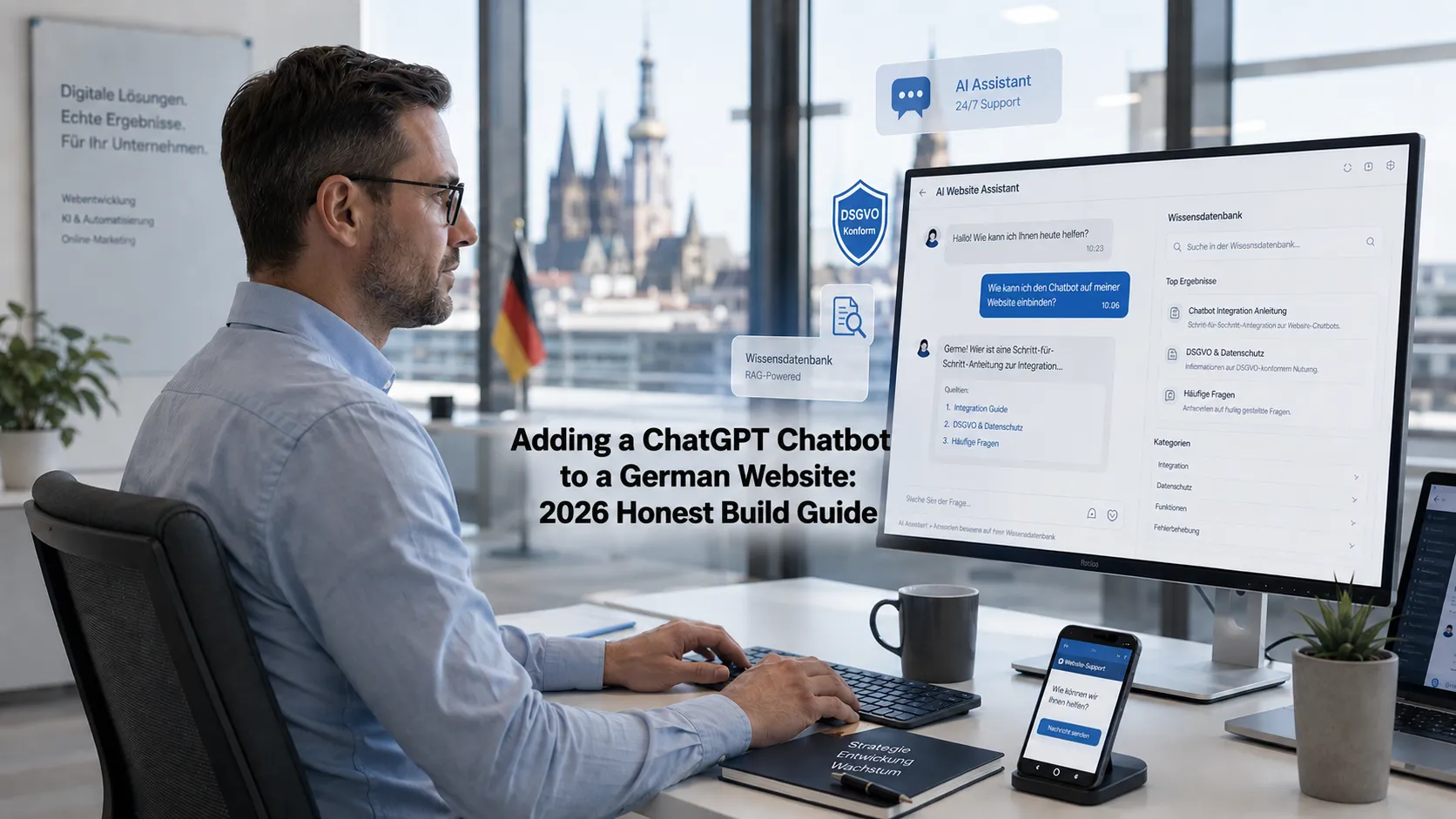
Adding “a ChatGPT chatbot to my website” was an exotic idea in 2023. In 2026 it’s table stakes for most German service businesses — but the gap between “embedded a chatbot widget” and “deployed an AI assistant that actually answers customer questions correctly, stays on-brand, and doesn’t trigger a DSGVO problem” is wider than ever.
This guide walks through how to add a ChatGPT-style chatbot to a German website in 2026: which tools work, how to set up Retrieval-Augmented Generation (RAG) so the bot knows your specific business, what it costs in EUR, and how to keep it DSGVO-defensible when the underlying model (GPT-4o, Claude Sonnet 4.6, etc.) is US-hosted.
What is a “ChatGPT chatbot” on a website actually doing in 2026?
Four distinct architectures get called “AI chatbot” — they behave very differently:
- Generic ChatGPT-style chat — visitor types, the bot responds using the base LLM’s general knowledge. Useless for business-specific questions (“what does YOUR pricing look like?”). Rarely deployed seriously in 2026.
- Retrieval-Augmented Generation (RAG) — the bot has access to YOUR documents (website pages, PDFs, knowledge base) and pulls relevant information into the prompt before answering. The 2026 standard for business chatbots.
- Function-calling / agentic chat — the bot can take actions: book a meeting, look up an order, create a ticket. More complex to build but more useful.
- Hybrid bot + human handover — the bot handles common cases; transfers to a human when confidence drops or the visitor requests it.
For a German service business, the realistic deployment is RAG + human handover (option 2 + 4). Function-calling adds value when you have systems to integrate.
When is an AI chatbot worth deploying on a German website?
Signals that an AI chatbot will pay back its build cost:
- Your support inbox has 50+ repetitive questions per week that all have documented answers
- Visitors abandon high-intent pages (pricing, FAQ, checkout) without converting because they can’t find an answer fast
- Your team can’t staff live chat across business hours, let alone evenings and weekends
- You have a body of content (FAQ, blog, documentation, PDFs) that the bot can ground its answers in
- You sell across multiple time zones / late hours / non-business days
Signals that an AI chatbot is premature:
- Your site gets under 200 unique visitors per day
- You don’t have written knowledge to feed the RAG system
- Your product is too custom for any chatbot to answer correctly
- Your buyers are high-touch enterprise and a chatbot would feel beneath the brand
For most German SMEs in the right zone, an AI chatbot deflects 40–70% of support contacts within 3 months of proper deployment.
What are the best AI chatbot platforms for German websites in 2026?
The realistic landscape, comparing pricing in approximate EUR.
| Platform | Type | Price (EUR/mo) | EU Hosting | RAG Built-in | German Quality |
|---|---|---|---|---|---|
| Userlike + AI Automation Hub | German chat + AI add-on | €290–€870/mo | Yes (DE) | Yes | Excellent |
| Intercom Fin | Intercom + AI | $0.99/resolution + Intercom seats | US-hosted | Yes | Strong |
| HubSpot Breeze Agents | HubSpot built-in AI | Included Pro+ | EU regions | Yes | Strong |
| Crisp + AI Bot | Crisp + AI add-on | €25–€95 + AI fees | Yes (FR) | Yes | Good |
| Tidio Lyro | Tidio + AI | $39–$749/mo | EU region available | Yes | Good |
| Chatbase | RAG-focused SaaS | $19–$499/mo | US-hosted | Yes (focus) | Good |
| Custom build (Claude/GPT + LangChain) | Custom | €0 + API costs | Your hosting | Yes (you build) | Excellent |
| Voiceflow / Botpress | Bot builders | €0–€500+/mo | Varies | Yes | Good |
For most German clients we recommend three patterns:
- Userlike Automation Hub — German-built, German-hosted, AI chatbot natively in a familiar chat platform. The simplest DSGVO story.
- HubSpot Breeze (if on HubSpot) — included with HubSpot Pro/Enterprise, EU region available, deep CRM integration.
- Custom build with Claude API or OpenAI API — for businesses with a developer team or budget for one. Maximum control, can match brand voice precisely.
What is RAG and why does it matter for a German business chatbot?
RAG (Retrieval-Augmented Generation) is the architecture that lets a chatbot answer questions about YOUR specific business — your pricing, your services, your policies — without hallucinating.
The flow:
- You collect your knowledge: website content, FAQs, PDFs, documentation, past support replies.
- The content gets chunked into small pieces and converted to vector embeddings (high-dimensional numerical representations).
- The embeddings are stored in a vector database (Pinecone, Weaviate, Qdrant, pgvector).
- When a visitor asks a question, their question is also embedded, then matched against the stored embeddings to find the most relevant content chunks.
- Those chunks are inserted into the prompt sent to the LLM (“Here are the relevant company documents — answer the user’s question using only this information”).
- The LLM responds based on YOUR content, not its training data.
The result: a chatbot that answers “What does WordPress maintenance cost?” with YOUR exact pricing, not a generic industry estimate.
Without RAG, a “ChatGPT chatbot” is essentially useless for business questions. Every serious 2026 deployment uses RAG.
How does an AI chatbot stay DSGVO compliant when the LLM is US-hosted?
The hard question. GPT-4o is OpenAI (US). Claude Sonnet is Anthropic (US). Most state-of-the-art LLMs are US-hosted by default. For German clients there are four defensible patterns:
Pattern 1: OpenAI Enterprise / Azure OpenAI EU region
OpenAI Enterprise and Azure OpenAI Service offer EU region deployment with zero training, full data residency, and signed DPAs (Data Processing Agreements). For German businesses with serious DSGVO requirements, a ChatGPT chatbot German website setup using Azure OpenAI in West Europe (Netherlands) or Sweden Central is the cleanest path.
Pattern 2: Anthropic Claude via AWS Bedrock EU
Claude is available through AWS Bedrock in eu-central-1 (Frankfurt). EU region, signed DPA via AWS, no training on your data. Strong DSGVO posture.
Pattern 3: Mistral / Aleph Alpha (EU-native LLMs)
Mistral (French) and Aleph Alpha (German, Heidelberg) provide EU-based LLM hosting. For a ChatGPT chatbot German website, performance is solid for German-language tasks and often excellent for Germany-specific use cases. Trade-off: not yet matching GPT-4o / Claude quality on the hardest reasoning tasks.
Pattern 4: Pseudonymize / strip personal data before sending
Strip names, emails, phone numbers from user messages before sending them to the LLM. Process the LLM response, re-insert context locally. Adds complexity but minimizes data exposure.
The combination most German clients land on: Azure OpenAI in EU or AWS Bedrock Frankfurt + RAG database self-hosted on Hetzner + careful prompt construction that doesn’t expose customer data.
What does building an AI chatbot for a German website cost?
Realistic 2026 EUR ranges.
Off-the-shelf RAG chatbot (no-code)
Tools like Chatbase, Tidio Lyro, or Userlike Automation Hub with their built-in AI:
- Platform subscription: €30–€500/month
- LLM/API costs: typically included, sometimes metered separately
- Setup time: 4–20 hours of your own work
- Knowledge base preparation: 5–30 hours of content cleanup
- Total to launch: €30–€2,000 first month, then €30–€500/month ongoing
Agency-built RAG chatbot
For a German service business wanting a polished branded chatbot with custom prompts, EU LLM hosting, CRM integration, and human handover:
- Build: €6,000–€18,000
- Monthly hosting + LLM costs: €100–€600
- Maintenance + content updates: €200–€800/month
Custom build with function calling
When the chatbot needs to do things: look up orders, schedule appointments, create tickets, update CRM:
- Build: €18,000–€55,000
- Monthly hosting + LLM costs: €300–€1,500
- Maintenance: €500–€2,000/month
Enterprise multi-agent system
Complex assistants spanning multiple departments, multi-language, integration with internal systems:
- Build: €60,000–€250,000+
- Monthly: €2,000–€10,000+
How do you prepare content for a RAG chatbot?
The RAG-quality determines bot-quality. Garbage in, garbage out. Practical steps:
Audit existing content
Pull together every FAQ entry, every service page, every blog post relevant to common questions, your top 50 past customer support emails (anonymized), pricing documents, and policy documents (refund, shipping, AGB) for a ChatGPT chatbot German website setup.
Clean and structure
For each piece of content, ensure:
- A clear title that summarizes the content
- Plain text or markdown (PDFs work but text is cleaner)
- One topic per document — don’t combine “shipping policy” + “return policy” + “warranty” into one file
- Date-stamp it (so the bot knows what’s current vs. archive)
Chunk thoughtfully
Most RAG systems chunk content into 300–800 token pieces. The chunk boundary matters — split on natural breaks (headings, paragraphs), not mid-sentence. Most no-code RAG tools do this automatically, but the results are often mediocre.
Identify gaps
Run sample queries through your knowledge base BEFORE deploying. If “Was kostet ein Custom WordPress Plugin?” doesn’t return relevant chunks, you haven’t fed in the content the bot needs.
The single biggest mistake we see: deploying a RAG bot with 8 FAQ entries as the entire knowledge base. The bot has nothing to retrieve, so it falls back to generic responses or hallucinates.
How do you write a German-friendly system prompt?
The system prompt shapes the bot’s voice. For a German business chatbot, we typically include:
- The brand voice and tone (e.g., “Sie form, professional, factual, no emojis”)
- Hard constraints (“Only answer questions about [Company]. For unrelated questions, politely decline and redirect.”)
- Behavior on uncertainty (“If you don’t know the answer, say so honestly and offer to connect to a human agent.”)
- Format expectations (“Keep answers under 120 words unless detail is essential.”)
- DSGVO-safety constraints (“Never repeat back or store personal data the visitor shared.”)
- Brand-specific facts that should anchor every response
A weak system prompt is the second biggest reason chatbots feel off-brand. Spend an hour on it, test extensively before launch.
How do you handle human handover from the chatbot?
Three clean patterns:
Confidence-based handover
When the bot’s confidence in its answer drops below a threshold, it automatically offers human handover: “Lassen Sie mich einen Kollegen für Sie hinzuziehen — Sie hören innerhalb von 4 Stunden zurück.”
Intent-based handover
Certain user inputs trigger immediate handover regardless of bot capability: complaints, refund requests, technical issues, “speak to a human” requests. Detect via keyword or LLM classifier.
Time-of-day handover
During business hours, the bot can offer “Soll ich Sie direkt mit einem Mitarbeiter verbinden?” After hours, fall back to a contact form with a clear response-time promise.
All three should be available. Visitors who feel trapped with a bot escalate to angry public reviews — the cost of a clean handover is much lower than the cost of bad reviews.
What are the biggest mistakes German businesses make with AI chatbots?
After auditing dozens of deployed bots, four patterns dominate:
Treating the bot as “set it and forget it”
The bot’s effectiveness depends on the knowledge base. The knowledge base drifts as your products, pricing, and policies change. A bot deployed in January 2026 with no updates is half-useful by July. Build a monthly content refresh into your maintenance plan.
Letting the bot pretend to be a human
Once a German B2B customer realizes “Sandra” is actually a bot, trust collapses. Be explicit about being an AI assistant — visitors actually respond MORE positively to “Ich bin der KI-Assistent von Gem Programmers” than to a fake human persona.
No fallback to human
Bots that can’t escalate become rage points for visitors who genuinely need help. Even the best bot fails 5–15% of the time. The handover path matters more than the bot quality.
Skipping the DSGVO conversation
Datenschutzerklärung must mention the chatbot, the LLM provider, the data flow. AVV must be signed with the platform. Visitors must be able to opt out and request data deletion. We’ve seen German bots pulled offline within 48 hours of launch because the Datenschutzbehörde got a complaint.
When should you build a custom ChatGPT chatbot German website instead of using a platform?
Configure existing platforms by default. Build custom when:
- Your knowledge base is structurally complex (federated across multiple systems, real-time pricing, dynamic inventory)
- You need function calling for actions no SaaS platform supports
- Your DSGVO posture demands self-hosted LLM (Mistral, Aleph Alpha, Llama on Hetzner)
- You’re at enterprise scale and SaaS per-resolution pricing genuinely hurts the math
For the rest, configuring Userlike Automation Hub, HubSpot Breeze, or Crisp AI Bot delivers 80% of the value at 5–15% of the cost.
For more on the build vs. buy question, see our custom WordPress plugin development guide and the live chat tools guide.
Frequently Asked Questions About a ChatGPT Chatbot for German Websites
Yes — EU-region LLM (Azure OpenAI EU/AWS Bedrock Frankfurt), signed DPA, EU RAG database, consent-gated widget.
€30–€500/month no-code; €6,000–€18,000 agency build; €18,000–€55,000 custom; €60,000+ enterprise.
Userlike Automation Hub for DSGVO-strict; HubSpot Breeze if on HubSpot; custom Azure/Bedrock for branded.
No — 40–70% deflection of common queries; team shifts to harder 30%.
70–85% accuracy on in-scope questions when the knowledge base is well-prepared.
GPT-4o, Claude Sonnet 4.6, Aleph Alpha, Mistral all strong on German; system prompt sets the tone.
1–3 weeks no-code; 4–8 weeks agency; 8–16 weeks custom; 4–9 months enterprise.
Whichever has EU-region availability and matches quality needs; Aleph Alpha/Mistral for sovereignty-strict.
Ready to deploy a chatbot on your German website?
A well-built AI chatbot is one of the highest-ROI additions a German service business can make in 2026 — IF it’s built right. Wrong tool, wrong knowledge base, wrong handover flow, and it becomes a customer-trust liability instead.
If you want a 30-minute scoping call where we map the right platform, knowledge base, and DSGVO posture for your specific business, book a meeting or send the details via our contact page.
Need expert help? Gem Programmers provides custom website development for businesses in Germany, Austria and Switzerland. Request a free, no-obligation quote and get a clear plan with scope, timeline and price.