
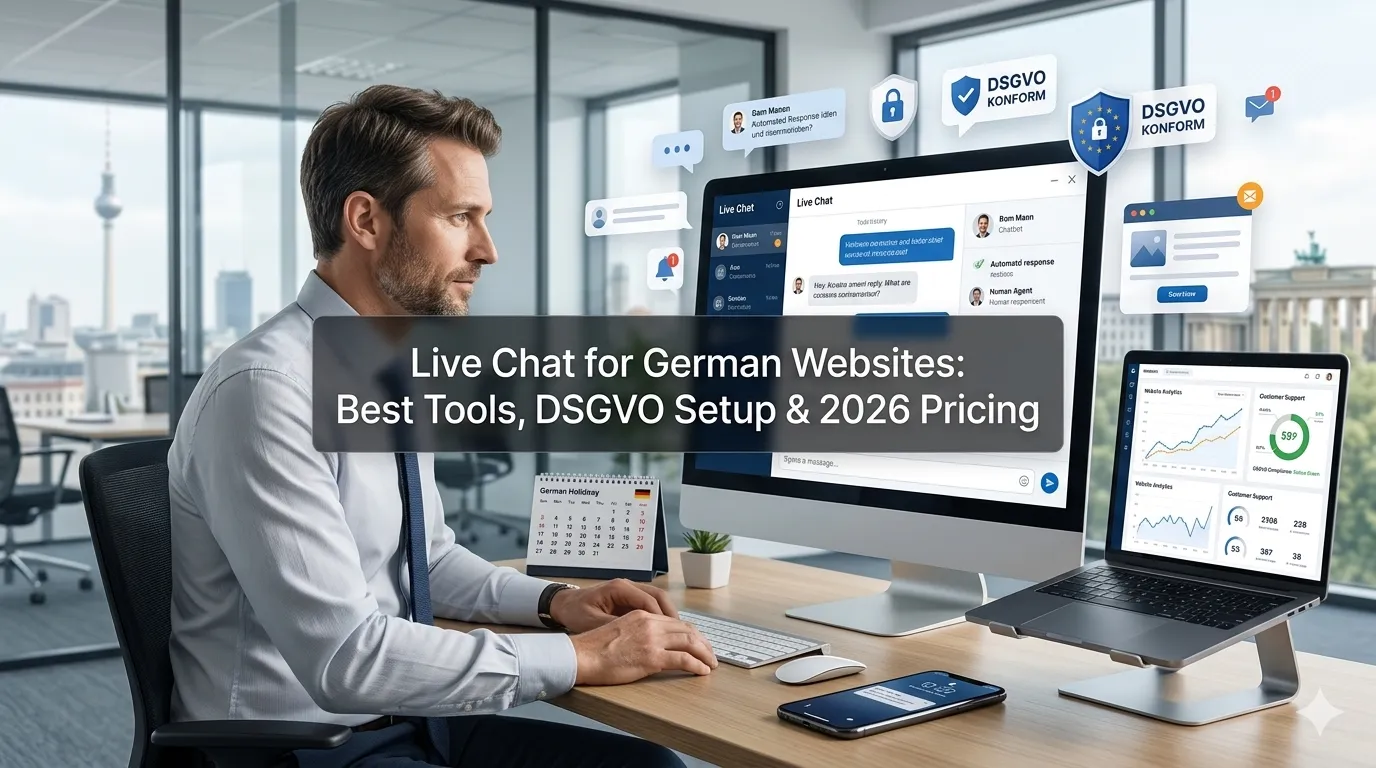
Adding live chat to a German website is one of those changes that sounds simple — paste a snippet, done — but actually involves a stack of decisions when it comes to live chat German websites: which tool handles DSGVO cleanly without a cookie banner storm, which one supports German-speaking agents, which one has the right CRM integration, and which one doesn’t quietly route customer data to a US data center.
This guide walks through the realistic options for adding live chat to a German website in 2026: which tools are DSGVO-defensible, what each costs in EUR, how they handle German-language support, and what setup details actually matter.
What does “live chat” actually mean on a German website in 2026?
Three overlapping things, depending on how you set it up:
- Pure live chat — a real human agent responds to visitors in real time. Best for high-stakes services where conversion depends on conversation.
- Hybrid live chat + chatbot — a chatbot handles common questions; humans take over when the conversation gets complex.
- AI-first chat (with optional human handover) — an LLM-based chatbot handles 80–90% of queries; agents only step in for escalations.
In 2026 most German businesses run option 2 or 3. Pure live chat is rare outside premium B2B sales.
Why does DSGVO matter so much for live chat in Germany?
Because live chat collects personal data (IP, browser fingerprint, message content, often name + email) from the very first interaction — usually before the visitor consented to anything.
Under DSGVO, that’s a problem unless either:
- The chat widget loads only after explicit consent (e.g., the visitor clicked the chat icon), AND
- The data is processed on EU infrastructure with a signed AVV (Auftragsverarbeitungsvertrag)
Many popular US chat tools — Intercom, Drift, LiveChat, Tidio defaults — load their full tracking script on every page view, which is a DSGVO violation under the strict reading German Datenschutzbehörden have taken since 2023. The fix is either: choose an EU-hosted tool, or configure your US tool carefully to delay loading until consent.
Cookie banner mistakes here are one of the most common reasons German Datenschutzbehörden issue Abmahnungen.
What are the best live chat tools for German websites in 2026?
The honest comparison. EUR prices approximate for 2026.
| Tool | Origin | Price (EUR/mo) | EU Hosted | Native German | AI/Bot Built-in |
|---|---|---|---|---|---|
| Userlike | Cologne (DE) | €0–€290/mo | Yes (DE) | Yes | Yes |
| Crisp | France | €0–€95/team | Yes (FR) | Yes (DE locale) | Yes |
| HubSpot Chat | US (EU OK) | Included w/ HubSpot | EU regions | Yes (DE locale) | Yes |
| Tawk.to | US | Free | US-hosted | Limited | Limited |
| LiveChat | Poland (EU) | $20–$59/agent | EU regions | Yes (DE locale) | Yes |
| Intercom | US | €74–€395+/seat | US-hosted | Yes (DE locale) | Yes (Fin AI) |
| Drift | US | Custom enterprise | US-hosted | Limited | Yes |
| Smartsupp | Czech Republic | €0–€44.50/agent | EU-hosted | Yes (DE locale) | Yes |
| Olark | US | $29–$99/seat | US-hosted | Limited | Limited |
| Zammad | Berlin (DE) | Self-hosted free / Cloud €5/agent | Yes (DE) | Yes | Limited |
For DSGVO-sensitive German businesses we recommend three:
- Userlike — Cologne-based, German-native, strong DSGVO posture, full-featured.
- Crisp — French, EU-hosted, modern UX, generous free tier.
- HubSpot Chat — if you’re already on HubSpot, EU region setup makes it the path of least resistance.
For ultra-budget setups, Tawk.to (free) and Smartsupp (low-cost EU-hosted) are reasonable starting points with caveats on consent flow.
When should you choose Userlike?
Userlike is built in Cologne by a German team, hosted in Germany, and explicitly designed for live chat German websites. It includes messaging integrations (WhatsApp Business, Facebook Messenger, Telegram, SMS — all DSGVO-aware) and has by far the cleanest German-language UX and support.
- Pricing: Free tier for 1 chat seat; paid plans €90–€290/month.
- Best for: Mid-sized German businesses that want a German-built, German-hosted tool without compromise.
- Trade-offs: More expensive than Crisp or Smartsupp at the top tier.
For Mittelstand B2B sales sites and German Praxen-style service businesses, Userlike is consistently the right choice.
When should you choose Crisp?
Crisp is French, EU-hosted (Paris region), with strong DSGVO posture and a modern UX that feels closer to Intercom than to traditional chat tools.
- Pricing: Free tier covers most starter use; paid plans €25–€95/month per team (not per agent — important for small teams).
- Best for: SaaS startups, modern e-commerce, design-led brands.
- Trade-offs: German is supported but not native; the German market is not the primary focus.
When should you choose HubSpot Chat?
If you’re already on HubSpot CRM (or seriously considering it), HubSpot Chat is part of the same suite — chat messages flow into CRM contacts, marketing automation, and ticket queues. EU region available with the right HubSpot plan.
- Pricing: Included with HubSpot plans (free tier, then €18–€3,300/month depending on HubSpot tier).
- Best for: B2B sales-focused German businesses already on HubSpot.
- Trade-offs: Not standalone — only sensible if you’re on HubSpot for other reasons.
When should you avoid Intercom, Drift, LiveChat (US tier)?
These tools are excellent products. They’re widely used. But for DSGVO-strict German businesses they require careful setup:
- AVV must be signed before launch
- Standard Contractual Clauses (SCC) for international data transfer
- Consent-gated loading — the script should not load until the visitor has consented
- IP anonymization must be enabled in tool settings
- Data retention must be configured to match your DSGVO posture
We have German clients running Intercom successfully — it just requires deliberate setup with these five points checked. For a smaller business without an in-house Datenschutzbeauftragter, an EU-hosted tool is much simpler.
How does the chat widget integrate with WordPress and other German sites?
All modern chat tools provide a JavaScript snippet that drops into your site’s <head> or <body>. For specific platforms:
- WordPress — most tools have a dedicated plugin (Userlike, Crisp, HubSpot, Tawk). Configure consent flow with the tool’s plugin + your cookie banner (Cookiebot, Borlabs Cookie, Real Cookie Banner).
- Shopify — same snippet approach. Most chat tools provide a Shopify-specific app.
- Webflow / static sites — paste the script in the site settings. Manual consent integration if your site doesn’t have a cookie management plugin.
- Custom Next.js / React sites — wrap the chat snippet in a consent-gated component that loads after the user accepts.
The single most common error: the chat script loads on every page before consent. Fix: gate the snippet behind your consent banner.
What does adding live chat to a German website cost?
Realistic 2026 EUR ranges.
DIY setup with a free tier
- Userlike free or Crisp free: €0/month
- Tawk.to free: €0/month
- Setup time: 1–4 hours
- Total to launch: €0
Standard small-business setup
For a 1–3 agent team with proper DSGVO configuration:
- Tool subscription: €25–€90/month
- Setup + consent integration: €300–€1,200 one-time
Mid-sized business setup
5–15 agents, CRM integration, custom chatbot flows:
- Tool subscription: €150–€650/month
- Setup + integration build: €1,500–€5,000
- Ongoing optimization: €100–€400/month
Enterprise setup
20+ agents, multi-language, AI handover, custom integrations:
- Tool subscription: €1,200–€6,000+/month
- Build + integration: €10,000–€60,000+
- Ongoing: €600–€2,500/month
What chat features actually move conversions for German visitors?
Three features correlate with real conversion lift:
Proactive prompts (after dwell time)
A chat invitation that appears after 30–60 seconds on a high-intent page (pricing, contact, checkout). Lifts engagement 3–5x vs. silent chat. Must be DSGVO-aware — proactive prompts that initiate before consent are problematic.
Co-browsing / screen sharing for B2B
For complex B2B sales (>€5,000 ticket sizes), the agent guiding the visitor through a pricing page or demo screen converts dramatically better than text-only chat. Userlike and Crisp both support co-browsing.
Offline form fallback
When agents are offline, the chat widget converts to a contact form with promised follow-up time. Don’t lose nighttime visitors.
What doesn’t move conversion as much as people assume:
- Chatbot greetings (“Hi! How can I help?”) that fire instantly — these often feel intrusive
- Excessive emoji use in agent messages — German B2B buyers prefer formal communication
- AI bot pretending to be a human — once detected, it destroys trust irreversibly
What language and tone work best for German chat agents?
German B2B and Mittelstand visitors prefer:
- Sie form as default, unless your brand is explicitly du
- Direct, factual responses — not “Let me check on that for you!” cheerleader tone
- Quick acknowledgement followed by substantive answer — “Einen Moment, ich prüfe das.” then the actual answer in 30–90 seconds
- Clear escalation when the agent doesn’t know — “Das gebe ich an unsere Fachabteilung weiter, Sie hören innerhalb von 24 Stunden zurück.”
The most common mistakes German agents make on chat: copy-paste US-style customer service phrasing, over-emoji, and corporate jargon that obscures real answers.
When should you not add live chat?
Live chat isn’t always a win. Skip it when:
- You can’t staff it consistently (intermittent coverage damages trust faster than no chat at all)
- Your team isn’t comfortable communicating in German + English in real time
- Your sales cycle is months-long enterprise and chat would attract low-quality leads
- You don’t have a clear handoff to a CRM or ticket system
For solo founders and lean teams, an AI chatbot with offline form fallback is often better than human chat that’s unavailable 80% of the day.
When should you build a custom chat system?
Almost never. The off-the-shelf tools cover 95% of needs. Custom makes sense when:
- You’re operating at enterprise scale with regulatory requirements that no SaaS tool can fully meet
- You need tight integration with a custom internal system (not just CRM)
- You’re a SaaS building chat into your own product
Custom builds for these solutions typically run €25,000–€80,000+. For most businesses, configuring an existing tool is the more practical and cost-effective option. To explore the build vs. buy decision in more detail, see our custom WordPress plugin development guide.
Frequently Asked Questions About Live Chat for German Websites
Yes if consent-gated, AVV signed, IP anonymisation on; EU-hosted tools make it easier.
Userlike for Mittelstand; Crisp for SaaS; HubSpot Chat for HubSpot users.
€0 free tier; €25–€90/month small-biz; €150–€650/month mid-sized; €1,200+ enterprise.
Yes with signed AVV and consent-gated loading; EU-hosted alternatives are usually safer.
Both — chatbot for common questions 24/7, humans for complex cases.
Indirectly via dwell time and bounce rate; the bigger win is 3–5x conversion lift.
Within 60 seconds during business hours; show offline form with 24h promise outside hours.
Yes — Userlike, Crisp, HubSpot, Smartsupp, LiveChat all integrate with major CRMs.
Ready to add live chat to your German website?
Live chat done well moves conversions noticeably. Done poorly — wrong DSGVO setup, undersized team, intrusive bots — it creates more problems than it solves.
If you want a 30-minute conversation about the right tool, setup, and team model for your specific situation, book a meeting or send the details via our contact page.