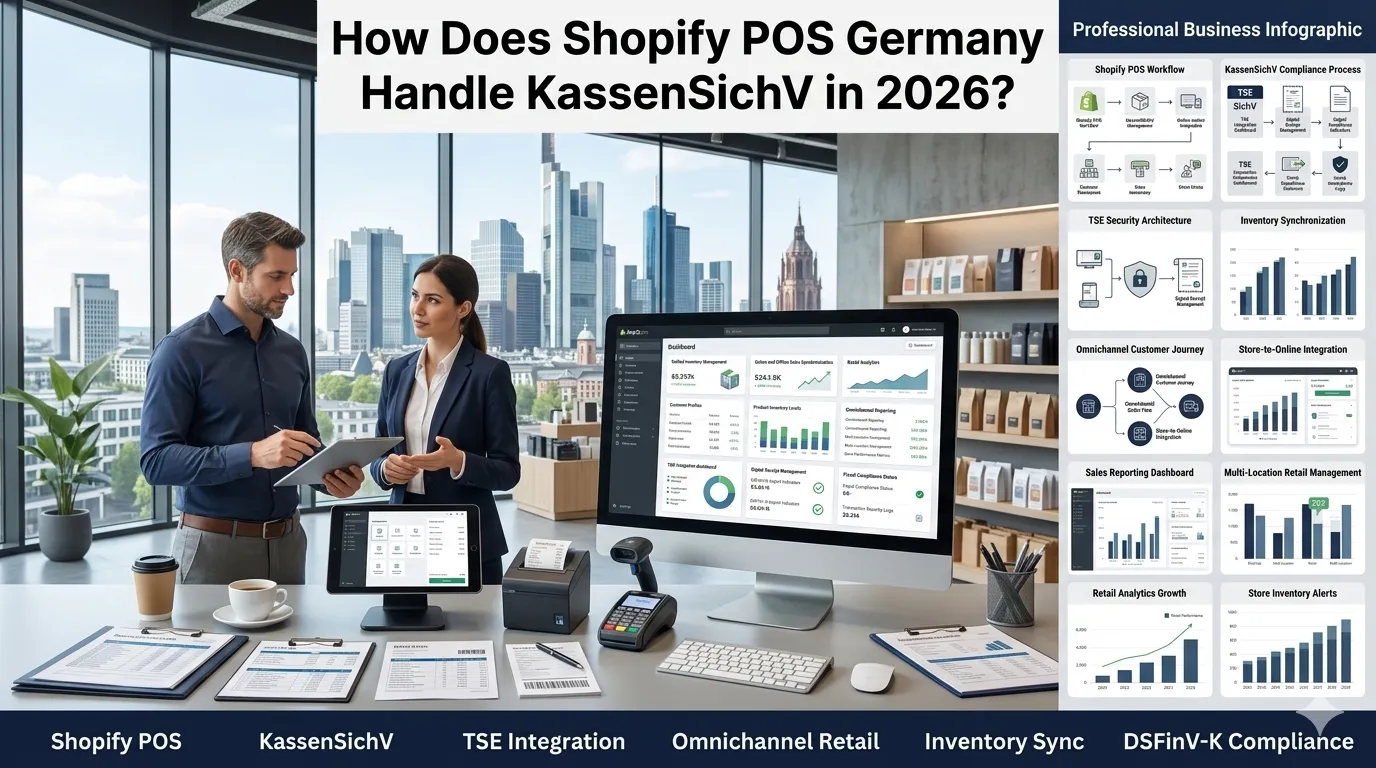
Shopify POS Germany unifies online and offline retail for brands with physical stores or pop-up presence. The single biggest challenge for German retailers: KassenSichV (Kassensicherungsverordnung) compliance, which requires every cash register in Germany to have a certified TSE (Technische Sicherheitseinrichtung) tamper-proof device. Shopify POS’s standard configuration doesn’t natively handle German TSE — you need specific Shopify-compatible TSE solutions to operate legally in Germany.
This guide walks through what Shopify POS Germany for omnichannel retail actually requires in 2026: TSE/KassenSichV compliance, hardware, EUR costs, omnichannel unification with Shopify online store, and which retailers it fits.
What does Shopify POS offer for German retailers in 2026?
Shopify POS is Shopify’s brick-and-mortar point-of-sale system. Connects to your Shopify online store, sharing:
Unified inventory
Stock levels sync across online + retail locations. Sell a product in-store; it updates online instantly.
Unified customers
Customer who buys online appears in POS history; in-store buyer can be tagged for online email marketing.
Unified orders
All orders (online + in-store) in one admin.
Unified payments
Card terminals, mobile payments, cash all flow into Shopify Payments.
Multi-location
Multiple physical stores, each with its own inventory + staff + reporting, all unified online.
Reporting + analytics
Combined online + retail performance dashboards.
Why is German POS complicated?
KassenSichV (since 2020)
Every cash register in Germany must have a certified TSE (tamper-proof device) recording every transaction. Federal mandate, enforced by tax authorities. Non-compliance: fines up to €25,000.
TSE certification
Devices certified by Bundesamt für Sicherheit in der Informationstechnik (BSI). Approved providers: Epson, Bundesdruckerei, fiskaltrust, D-Trust, others.
DSFinV-K (digital tax interface)
Standardized digital data structure for tax audit export. POS systems must export in this format.
Belegausgabepflicht (receipt obligation)
Customer-facing receipt for every transaction. Can be digital (email, QR code) but must be provided.
These requirements are not negotiable. Operating without TSE compliance in Germany is illegal.
Does Shopify POS support German TSE / KassenSichV?
Direct native TSE support has historically been a gap. As of 2026, the practical paths:
Option 1: Shopify POS + third-party TSE integration
Some German fiscalization providers integrate with Shopify POS via apps + middleware. Examples: fiskaltrust integrations, fiskaly cloud TSE solutions.
This is the standard path for serious German Shopify POS deployments in 2026.
Option 2: Shopify POS + parallel TSE-certified register
For some retailers: Shopify POS as the operational tool + separate TSE-certified register for transaction recording. Inefficient but works.
Option 3: Shopify POS only for non-cash transactions
For pop-ups and online-pickup-only operations where no cash register is operated, KassenSichV’s stricter rules may not apply (consult with Steuerberater).
Option 4: Alternative POS (not Shopify) with deeper German compliance
For traditional German retail with significant cash transactions, dedicated German POS systems (Tillhub, Lightspeed, gastronovi for hospitality) often have more mature TSE integration.
Always engage a German Steuerberater familiar with KassenSichV before deploying Shopify POS in a cash-handling environment.
What does Shopify POS cost in Germany in 2026?
Shopify POS Lite
Included with all Shopify plans. Basic POS features. Not enough for full retail; suitable for pop-ups.
Shopify POS Pro
~€89/month per location. Full retail features: staff management, advanced inventory, customer profiles, custom permissions.
Hardware
- iPad / Android tablet as POS device: customer-supplied or €300–€800
- Receipt printer: €150–€400
- Cash drawer: €100–€250
- Card terminal (Shopify Payment Reader): €49–€289 depending on model
- Barcode scanner: €50–€200
Total hardware per location: €600–€2,000.
TSE compliance
- Cloud TSE (fiskaltrust, fiskaly): €25–€80/month per device
- Hardware TSE: €200–€500 one-time + maintenance
Integration + setup
- Agency setup for POS + TSE + inventory unification: €5,000–€25,000
For a small German retailer: total Shopify POS setup ~€1,500–€5,000 hardware + €110–€170/month ongoing (POS Pro + TSE).
When does Shopify POS fit a German retailer?
Four trigger conditions:
You already run Shopify online and want unified ops
Online + offline unified inventory, customers, reporting. Strong fit.
Pop-up + event retail
Mobile retail without permanent cash register infrastructure. Shopify POS Lite + TSE-cloud solution works.
Small-medium specialty retail
Single store or 2–5 stores, modern brand, tech-friendly team. Shopify POS Pro + TSE integration.
Cafés / hospitality (with caveats)
Possible but Germany has dedicated hospitality POS systems with deeper integration (gastronovi, Vectron, Orderbird). For pure retail, Shopify POS fits better than for hospitality.
When does Shopify POS NOT fit German retail?
Three signals:
Heavy cash handling without solid TSE integration
If 60%+ of transactions are cash and your TSE solution is shaky, consider dedicated German POS systems.
Complex inventory + warehouse management beyond Shopify
If you run JTL-Wawi or SAP as ERP, Shopify POS may not integrate as deeply.
Multi-tier retail / wholesale + B2B + B2C mix
Complex pricing across channels may exceed Shopify POS capabilities.
What German retailers actually use Shopify POS in 2026?
Common profiles:
- D2C brands with flagship store(s) — Berlin, Hamburg, Munich brand stores
- Boutique specialty retail — books, fashion, accessories, niche food
- Pop-up event retailers — markets, festivals, temporary stores
- Cafe + retail hybrids (with limitations)
- Showroom-style retailers — appointment-based, low cash flow
Less common: high-volume grocery, fast-food, traditional German Mittelstand retail.
How does omnichannel unification actually work?
Three key flows:
Online order with in-store pickup
Customer orders online → marked for store pickup → store staff prepares → customer arrives + checks in via POS → completion.
In-store purchase syncing online customer profile
Customer who bought online + buys again in-store → linked customer record → email marketing sees combined LTV.
Inventory unification
Real-time stock across all locations. Online buyers see “in stock in Berlin store” if relevant. In-store staff sees “we can ship to customer from Hamburg warehouse.”
Returns at any location
Online order returned in-store. In-store order returned online. Unified return flow.
For German retailers committed to omnichannel: this unification is the primary value of Shopify POS.
What are common Shopify POS Germany mistakes?
Five patterns:
Deploying without TSE solution
Operating cash register without TSE = illegal. Verify TSE integration before opening.
Wrong receipt format
Receipts must meet German content requirements. Default Shopify receipts may need German-compliant customization.
Ignoring DSFinV-K export
Tax audit will demand DSFinV-K-compatible export. Verify your TSE+POS combo produces this.
Not training staff on TSE flow
Staff bypassing TSE for “quick sales” = compliance failure. Train rigorously.
Skipping Steuerberater for POS setup
Each German retail setup has nuances. Engage your Steuerberater before going live.
What about hospitality (Gastronomie)?
For cafes, restaurants, and bars, Shopify POS has certain limitations compared to hospitality-focused POS systems used in Germany.
- gastronovi (Bremen)
- Vectron
- Orderbird
- iZettle / Square (with limitations)
- Tillhub
For pure retail businesses with no food or drink ordering, Shopify POS is usually sufficient and works effectively.
When should you build a custom POS integration?
For Plus-scale retailers with €5M+ revenue and complex retail operations:
- Custom Shopify app for advanced staff workflows
- Custom inventory rules across locations
- Integration with German ERP (JTL-Wawi, SAP B1)
- Custom reporting + analytics
Custom POS development: €25,000–€120,000+ depending on scope.
For most German Shopify POS users: standard + TSE integration suffices.
Frequently asked questions
Yes with proper TSE integration for cash register compliance.
POS Pro EUR 89/month plus hardware, TSE cloud, and setup costs.
German law mandating certified TSE on every cash register.
Use fiskaltrust or fiskaly cloud TSE with Shopify POS integration.
Only for non-cash or pop-up scenarios; confirm with a Steuerberater.
Use gastronovi, Vectron, or Orderbird; Shopify POS has hospitality limits.
1 to 2 weeks for pop-up; 6 to 12 weeks for multi-location with TSE.
Only if omnichannel unification provides clear value over middleware sync
Need help with Shopify POS setup?
If you’re considering Shopify POS for your German retail operation and want a 30-minute scoping conversation about TSE compliance, hardware choice, and omnichannel unification, book a meeting or send details via our contact page.
Need expert help? Gem Programmers provides experienced Shopify developers for businesses in Germany, Austria and Switzerland. Request a free, no-obligation quote and get a clear plan with scope, timeline and price.