
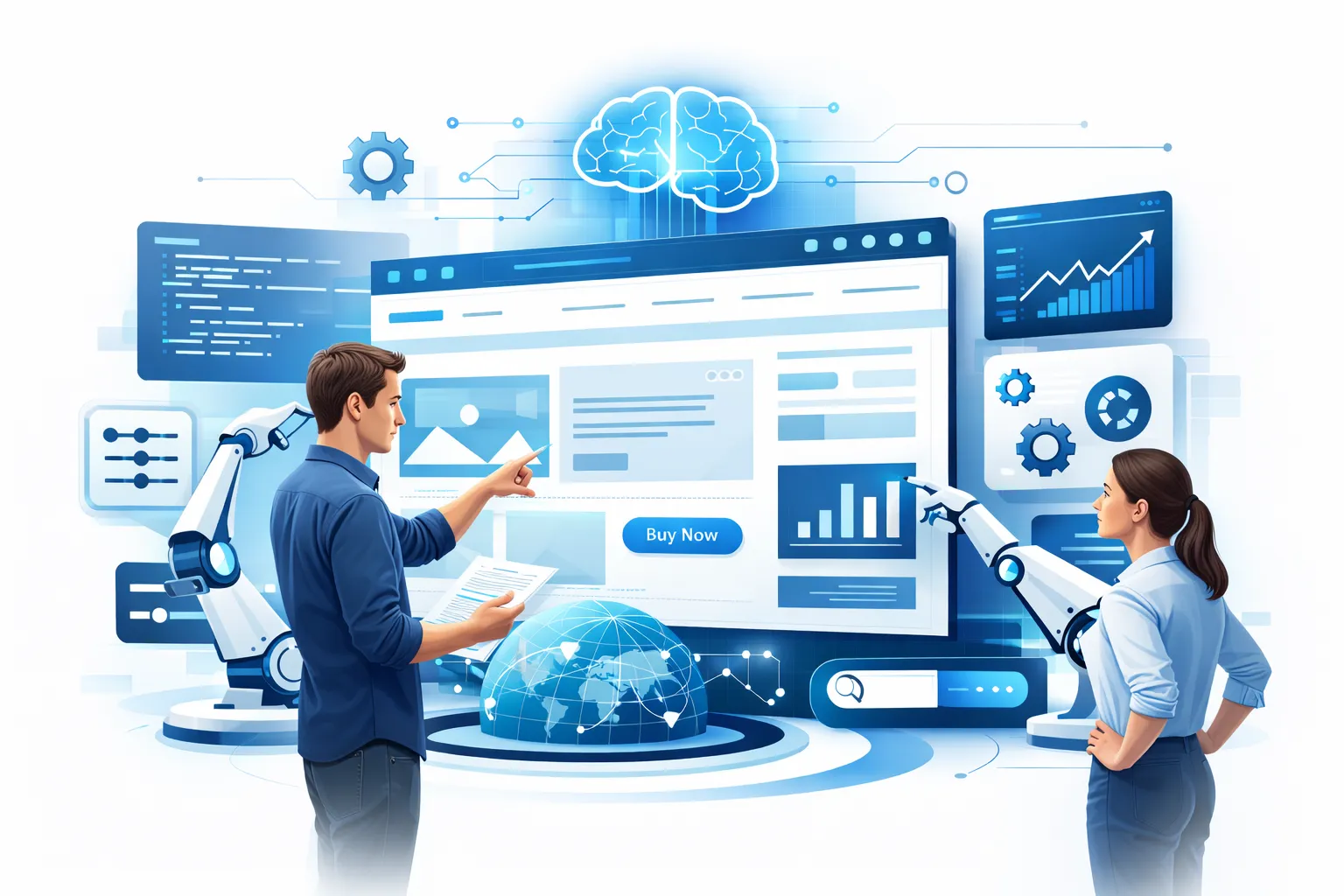
AI-powered website development uses machine learning tools to accelerate design, code generation, content production, and personalization — producing websites faster and often better than traditional development alone. The reality in 2026: AI is a force multiplier for human developers, not a replacement. The teams that win combine AI execution speed with human strategic judgment.
This guide explains what AI-powered website development actually delivers, where it helps and where it hurts, what it costs, and how to evaluate whether AI-assisted development fits your project.
What does AI-powered website development actually include?
Modern AI-assisted development engagements use AI across the full project lifecycle:
- Design generation — AI tools (Figma AI, Galileo, Uizard) generating initial design concepts that humans refine
- Code generation — Claude, GitHub Copilot, Cursor accelerating component development and reducing boilerplate
- Content production — AI-assisted page copy, product descriptions, blog content with human editing
- Image generation — Midjourney, DALL-E, Stable Diffusion for custom imagery
- Personalization — dynamic content based on visitor behavior using ML-driven decisioning
- Testing and QA — AI-assisted test generation, accessibility audits, performance analysis
- SEO optimization — AI tools for keyword research, content briefs, schema generation, AEO/GEO structure
Where does AI help most in website development?
- Boilerplate code — AI generates routine components 5–10x faster than typing from scratch
- Content production — page copy, product descriptions, blog posts (with human editing)
- Image variations — custom imagery at scale without stock photo limitations
- Accessibility audits — AI tools catch accessibility issues humans miss
- Testing — AI-generated test cases and automated regression testing
- Personalization at scale — ML-driven content variation impossible with rules-based approaches
Where does AI hurt in website development?
- Strategic decisions — AI can’t decide what to build, only how to build what’s specified
- Unique brand voice and identity — AI defaults to generic; brand requires human judgment
- Complex architectural decisions — AI-generated code often misses long-term implications
- Security-critical code — AI-generated security code needs careful human review
- Hallucinated APIs and functions — AI confidently generates code calling functions that don’t exist
- Edge cases — AI-generated code often handles happy path but breaks on edge cases
The pattern: AI accelerates the work; human judgment shapes what’s worth building and ensures it’s built right. Programs that try to replace developers with AI produce sites that work in demos but break in production.
What does AI-powered website development cost?
- AI tool stack — $200–$1,500/month (Cursor, Claude/GPT, design AI tools)
- AI-assisted small business site — $3,000–$15,000 (faster than pure custom but with quality preserved)
- AI-assisted mid-market site — $15,000–$60,000
- Enterprise AI-powered builds — $60,000–$300,000+ with personalization, ML decisioning
Net effect: AI-assisted development is typically 20–40% cheaper or 2–3x faster than pure custom — if quality is maintained through human oversight. Cheap AI-only development without quality control produces sites that cost more to fix than they saved during build.
How does AI affect website performance and SEO?
AI tools can produce both better and worse outcomes for performance and SEO. The variables:
Better outcomes when AI is used carefully:
- Faster image optimization (AI compression, format conversion)
- Better content variety and depth (AI-assisted production)
- Schema markup generation
- Accessibility improvements (catches issues humans miss)
Worse outcomes when AI is used carelessly:
- AI-generated bloated code (unnecessary dependencies, inefficient patterns)
- AI-generated thin content that Google demotes
- Generic copy that fails to differentiate
- Hallucinated structured data that breaks rich results
How do you evaluate an AI-powered development agency?
- What’s your AI tool stack and how do you use each tool?
- What’s the ratio of AI-generated code to human-written code in your typical project?
- What’s your human review process for AI-generated code?
- Show me three sites you built where AI played a meaningful role
- What’s your approach to security review on AI-generated code?
- How do you handle AI hallucinations and bad outputs?
Red flags: agencies promoting “100% AI development” (signals lack of quality control), no human review process described, rates dramatically below market (skipping the review step), refusal to discuss AI tooling specifically.
What integrates with AI-powered website development?
- Website development services
- SEO services — AI tools accelerate SEO work but don’t replace strategy
- Conversion rate optimization — AI-driven personalization is a CRO frontier
- Digital marketing — AI in marketing automation, content, ad optimization
Frequently asked questions about AI-powered website development
What industries benefit most from AI-powered website development?
Content-heavy sites (publishers, e-commerce with large catalogs), sites needing personalization (SaaS, e-commerce), sites in fast-iterating categories where speed matters. Less benefit for: highly regulated content (medical, legal, financial — hallucination risk too high), brand-led sites where unique voice matters most.
Is AI-powered website development expensive?
Typically 20–40% cheaper or 2–3x faster than pure custom — when quality is maintained through human oversight. Cheap AI-only development without quality control produces sites that cost more to fix than they saved during build.
Can AI handle website maintenance?
Partial: AI can monitor performance, detect anomalies, generate fix suggestions. But applying fixes, especially security patches, still requires human judgment. AI-assisted maintenance is faster than pure manual; AI-replaced maintenance creates risk.
Is AI-powered website development secure?
Only if security-critical code is human-reviewed. AI models can generate insecure code patterns confidently (SQL injection vectors, XSS vulnerabilities, broken auth). Security review is non-negotiable.
How does AI help with user experience?
AI personalization can adapt content to visitor segments, behavior history, and inferred intent. ML-driven recommendations for e-commerce. AI-assisted accessibility (catches issues humans miss). AI-generated design variations for A/B testing.
Can AI-powered websites rank on Google?
Yes, when AI is used carefully with human oversight. Google’s stance: content quality matters; production method doesn’t. AI-assisted sites with proper human editing rank as well as human-only sites. Unedited AI output gets demoted by Google’s quality algorithms.
Will AI replace web developers?
Not in 2026 and unlikely soon. AI accelerates developer work — 5–10x faster on boilerplate, 2–3x faster on routine builds — but strategic decisions, architecture, security, and quality control require human judgment. Best developers in 2026 use AI extensively while remaining indispensable.
Ready to talk about AI-powered website development?
AI is a force multiplier for development, not a replacement. The teams winning combine AI speed with human judgment to deliver better sites faster than either pure-AI or pure-human approaches alone.
Book a meeting for a free consultation on AI-powered development — we’ll review your project requirements, recommend where AI adds value vs where pure custom is justified, and outline realistic scope. Or browse our website development services and contact us directly.