
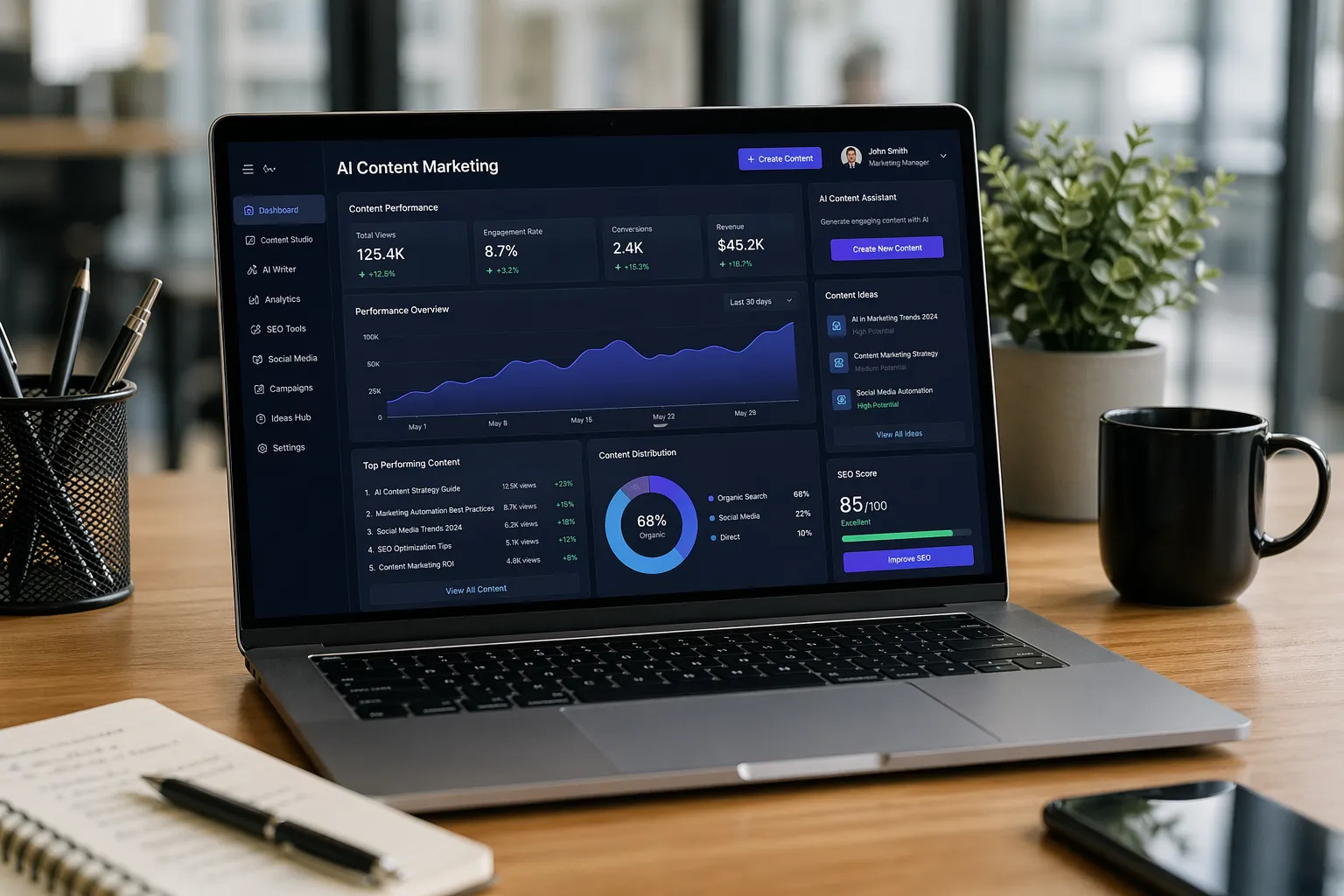
AI content marketing services use machine learning tools to accelerate content production, improve SEO targeting, and personalize delivery at scale. Done well, they 3–5x content output without proportional cost increase. Done poorly, they produce generic content that ranks worse than human-written work and damages brand authority.
This guide explains what AI content marketing services actually deliver, where they help, where they hurt, and how to evaluate whether AI-assisted content marketing fits your business in 2026.
What do AI content marketing services actually include?
A modern AI content engagement covers:
- AI-assisted research — topic clustering, SERP analysis, keyword opportunity identification using tools like Surfer SEO, Clearscope, MarketMuse
- AI-assisted drafting — first drafts generated by GPT-4, Claude, or similar, then heavily edited by humans for accuracy, voice, and quality
- AI-assisted optimization — SEO score improvement, schema markup generation, meta description and title optimization
- AI search optimization — structuring content for citation by ChatGPT, Perplexity, Claude, Google AI Overviews
- Content personalization — dynamic content based on visitor segment or behavior
- Distribution and amplification — AI-assisted social posts, email sequences, repurposing
Where do AI content marketing services help most?
- Volume content production — publishing 2–3x more articles with same team via AI-assisted drafting
- Repetitive content patterns — product descriptions at scale, FAQ sections, glossary entries
- SEO research and optimization — faster keyword research, content briefs, SERP analysis
- Content repurposing — turning one blog post into LinkedIn posts, threads, email newsletter, video script
- Translation and localization — multi-language content with human review
- Personalization — dynamic content based on visitor data
Where do AI content marketing services hurt?
- Thought leadership content — AI can’t generate original insights, hot takes, or expert perspective
- Unedited AI output — generic, lacks specifics, often factually wrong, signals “AI-generated” to readers and search engines
- Highly technical or regulated content — medical, legal, financial advice; AI hallucinations create liability
- Brand voice consistency — AI defaults to generic corporate voice; brand voice requires careful prompt engineering and human editing
- Original research and case studies — AI can’t interview customers or analyze proprietary data
The pattern: AI accelerates execution; human judgment, expertise, and originality remain irreplaceable. Programs that use AI for speed while keeping humans for substance win. Programs that try to replace humans entirely produce content that hurts brand and SEO.
What does AI-assisted content marketing actually cost?
- AI tool stack — $200–$2,500/month (Claude/ChatGPT Pro, Surfer SEO, Clearscope, Jasper, etc.)
- Content production agency (AI-assisted) — $3,000–$15,000/month for 8–20 pieces
- Enterprise AI content program — $15,000–$60,000+/month for 30–80 pieces with personalization
The cost-per-piece is typically 30–60% lower than fully human-written content of equivalent quality. Volume increases 2–3x. Net effect: more content for less money — IF the quality is maintained through proper human editing.
How does AI content marketing affect SEO in 2026?
Google’s stance: content quality matters; production method doesn’t. AI-generated content can rank if it’s high quality. Unedited AI slop gets demoted by Google’s quality algorithms.
What works in 2026:
- AI for first drafts, humans for editing, fact-checking, and original perspective
- Named author bylines with credentials (signals E-E-A-T)
- Specific data, named sources, real examples
- Question-format headings for AI search engines
- Comprehensive coverage rather than thin surface-level content
What hurts in 2026:
- Pure AI-generated content with no human editing
- Anonymous “admin” bylines (no E-E-A-T)
- Generic content with no specific data or examples
- Mass-produced thin content (Google’s helpful content update specifically targets this)
How do you evaluate an AI content marketing agency?
Questions to ask:
- What’s your human editing process for AI-generated drafts?
- How do you handle fact-checking AI output?
- Show me content you’ve produced — specifically the AI-assisted pieces and the human edits applied
- What’s your ratio of AI to human time on a typical piece?
- How do you maintain brand voice consistency across AI-assisted pieces?
- What’s your approach to AI search optimization (AEO/GEO)?
Red flags: agencies producing 50+ pieces/month at low cost (almost certainly minimal human editing), refusal to show production process, generic-sounding existing content.
What integrates with AI content marketing?
- Digital marketing
- SEO services — content is SEO fuel
- Website development — where content lives
- Conversion rate optimization — content drives traffic that must convert
Frequently asked questions about AI content marketing services
What are AI content marketing services?
Content marketing where AI tools accelerate research, drafting, optimization, and personalization. Done well: AI for speed, humans for substance and quality. Done poorly: unedited AI output that hurts brand and SEO.
How do AI content marketing services improve SEO?
Faster keyword research, better content briefs, optimization tools, AEO/GEO structure for AI search engines. Volume increase compounds organic traffic over time. But quality remains the deciding factor — high-volume low-quality content hurts more than helps.
Is AI-generated content good for businesses?
With proper human editing: yes. As raw output without editing: rarely. The best content engines in 2026 use AI for drafting + humans for editing, fact-checking, brand voice, and original perspective.
How much do AI content marketing services cost?
AI tool stack: $200–$2,500/month. Production agency: $3K–$15K/month for 8–20 pieces. Enterprise: $15K–$60K+/month. Typically 30–60% cheaper per piece than fully human-written content of equivalent quality.
Can small businesses use AI content marketing?
Yes, often most cost-effectively. AI tools democratize content production — small businesses can match or exceed mid-market content velocity. The constraint is editing quality, not generation capacity.
Do AI content services replace human writers?
No, they accelerate human writers. Best programs use AI to 2–3x writer output by handling research, first drafts, and optimization — while writers focus on editing, voice, and original perspective. Pure AI without humans produces low-value content.
How quickly can I see results from AI content marketing?
Content production velocity: immediate (2–3x output within 30 days). SEO traffic from new content: 3–6 months for first results, 9–18 months for meaningful compounding. AI doesn’t speed up SEO timeline — it speeds up content production within that timeline.
Ready to talk about AI content marketing services?
AI content marketing is a force multiplier when paired with human editing and strategic discipline. The businesses that win combine AI execution speed with human strategic judgment — not businesses that try to replace humans with AI.
Book a meeting for a free content strategy consultation — we’ll review your current content production, recommend an AI-assisted approach for your specific situation, and outline realistic scope. Or browse our digital marketing services and contact us directly.