Running a Shopify store is easy. Getting visitors to convert into paying customers is the real challenge.
If you’re getting traffic but struggling with low sales, poor checkout completion, or high cart abandonment, this guide is for you. You’ll learn actionable Shopify conversion tips that improve user experience, build trust, and help your store perform better in traditional search and AI-powered answers (AEO/GEO).
What is a Shopify conversion rate?
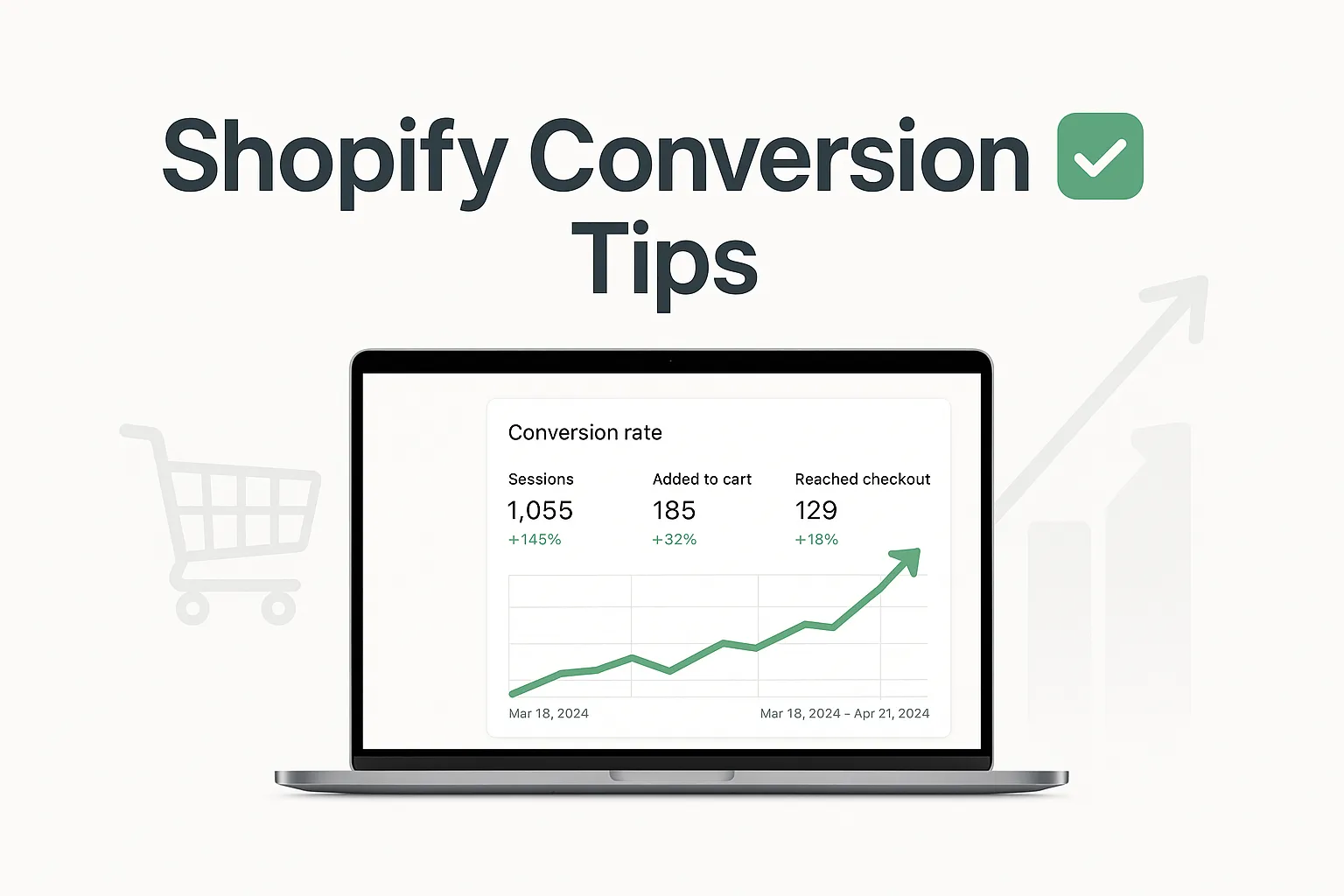
Your Shopify conversion rate is the percentage of visitors who complete a desired action — usually making a purchase.
Formula: Conversion Rate = (Orders ÷ Visitors) × 100
Average Shopify conversion rate: 1.5–3%. High-performing stores: 3–5%+. If you’re below this range, conversion speed optimization should be your top priority.
Why does Shopify conversion optimization matter in 2026?
- Search behavior has changed
- Users expect faster decisions
- AI tools summarize buying advice
- Zero-click searches are increasing
That means your store must convince both humans and AI systems. Conversion optimization is no longer just design — it’s clarity, trust, and structured information.
1. Optimize your Shopify store speed
Slow websites kill conversions. Even a 1-second delay can reduce conversions by up to 7%.
How to improve speed:
- Use lightweight Shopify themes
- Compress images
- Remove unused apps
- Enable lazy loading
- Use Shopify’s built-in CDN
Fast sites are more likely to be recommended by AI answers.
2. Simplify navigation for faster decisions
Confusing menus mean lost sales. Best practices:
- Clear product categories
- No more than 7 main menu items
- Add “Best Sellers” and “New Arrivals”
- Use search with auto-suggestions
Goal: help users find products in 3 clicks or less.
3. Optimize product pages for conversions
Your product page decides the sale. Must-have elements:
- Clear product title
- Benefit-driven description
- High-quality images
- Pricing transparency
- Visible call-to-action (Add to Cart)
Focus on benefits, not just features. “Soft, breathable cotton for all-day comfort” beats “100% cotton fabric.”
4. Write SEO and conversion-friendly product descriptions
Most Shopify development stores write generic descriptions — that’s a mistake. High-converting descriptions should:
- Answer common buyer questions
- Use bullet points for scanability
- Include specific use cases
- Reduce buyer objections
Clear, structured descriptions help AI tools understand and summarize your product.
5. Use high-quality product images and videos
Online shoppers can’t touch products — visuals sell for you. Best practices:
- Multiple angles per product
- Lifestyle images showing use in context
- Zoom functionality
- Short demo videos
Videos can increase conversions by up to 80%.
6. Build trust with social proof
People trust people. Add:
- Customer reviews
- Star ratings
- User-generated photos
- Testimonials
Place reviews near the Add to Cart button for maximum impact.
7. Reduce cart abandonment
Average cart abandonment rate is around 70%. Common reasons include hidden fees, forced account creation, and long checkout processes.
Fixes:
- Show shipping costs early
- Allow guest checkout
- Use progress indicators
- Save cart automatically
8. Optimize the Shopify checkout experience
Checkout is where most conversions fail. Best practices:
- One-page checkout where possible
- Autofill fields
- Multiple payment options (credit/debit, PayPal, Apple Pay, Google Pay, Buy Now Pay Later)
- Clear error messages
9. Use clear, strong call-to-actions (CTAs)
Your CTA should be obvious and action-driven. Strong examples: “Add to Cart,” “Buy Now,” “Get Yours Today,” “Checkout Securely.” Avoid weak CTAs like “Submit” or “Continue.”
10. Leverage scarcity and urgency (ethically)
Scarcity motivates action. Effective tactics:
- Low stock messages (when true)
- Limited-time offers
- Countdown timers for real sales
- Flash sales
Never fake urgency — it damages trust and conversion rates over time.
11. Mobile optimization is non-negotiable
Over 70% of Shopify traffic comes from mobile. Mobile optimization tips: large buttons, readable fonts, fast load times, thumb-friendly navigation. Test your store on multiple real devices regularly.
12. Use live chat and support options
Customers hesitate when they have questions. Add live chat, WhatsApp support, comprehensive FAQ sections, and chatbots for common queries. Instant answers convert better than “Contact us” forms.
13. Create clear shipping and return policies
Unclear policies scare buyers. Best practice: dedicated shipping policy page, easy return process, money-back guarantees. Display these near checkout for reassurance.
14. Personalize the user experience
Personalization increases conversions dramatically. Examples: recently viewed products, personalized recommendations, location-based offers. Even small personalization improves trust.
15. Use A/B testing for continuous improvement
Never guess — test. Test headlines, CTAs, product images, pricing formats, checkout layouts. Small changes can bring big wins when tested systematically.
16. Optimize for zero-click and AI answers (AEO/GEO)
Modern SEO isn’t just about rankings. Optimize for featured snippets, AI-generated answers, and conversational queries. Use clear headings, answer questions directly, structure content logically, and add FAQs. AI tools prefer clean, factual, well-structured content.
17. Add FAQs to reduce buyer friction
FAQs remove hesitation. Include answers to: shipping time, returns, payments, product usage, guarantees. This improves user experience, conversion rate, and AI visibility simultaneously.
18. Use trust badges and security signals
Security concerns stop purchases. Add SSL badge, secure checkout icons, payment provider logos. Trust signals near payment forms drive conversion.
19. Optimize internal linking
Guide users through your store with “You may also like,” “Frequently bought together,” and related collections. This increases average order value (AOV).
20. Track analytics and user behavior
Data reveals problems. Tools: Shopify Analytics, Google Analytics 4, heatmaps (Hotjar, Microsoft Clarity), session recordings. Watch where users drop off, then fix it.
21. Keep your store updated
Outdated stores lose credibility. Update content, products, pricing, policies, and UX elements regularly. Fresh stores convert better and rank better.
Final thoughts
Improving Shopify conversions isn’t about one trick — it’s about systematically removing friction and building trust. When you combine strong UX, clear messaging, smart SEO, and AEO/GEO optimization, you create a store that converts users AND gets referenced by AI tools.
Start with small changes, measure results, and keep improving.