
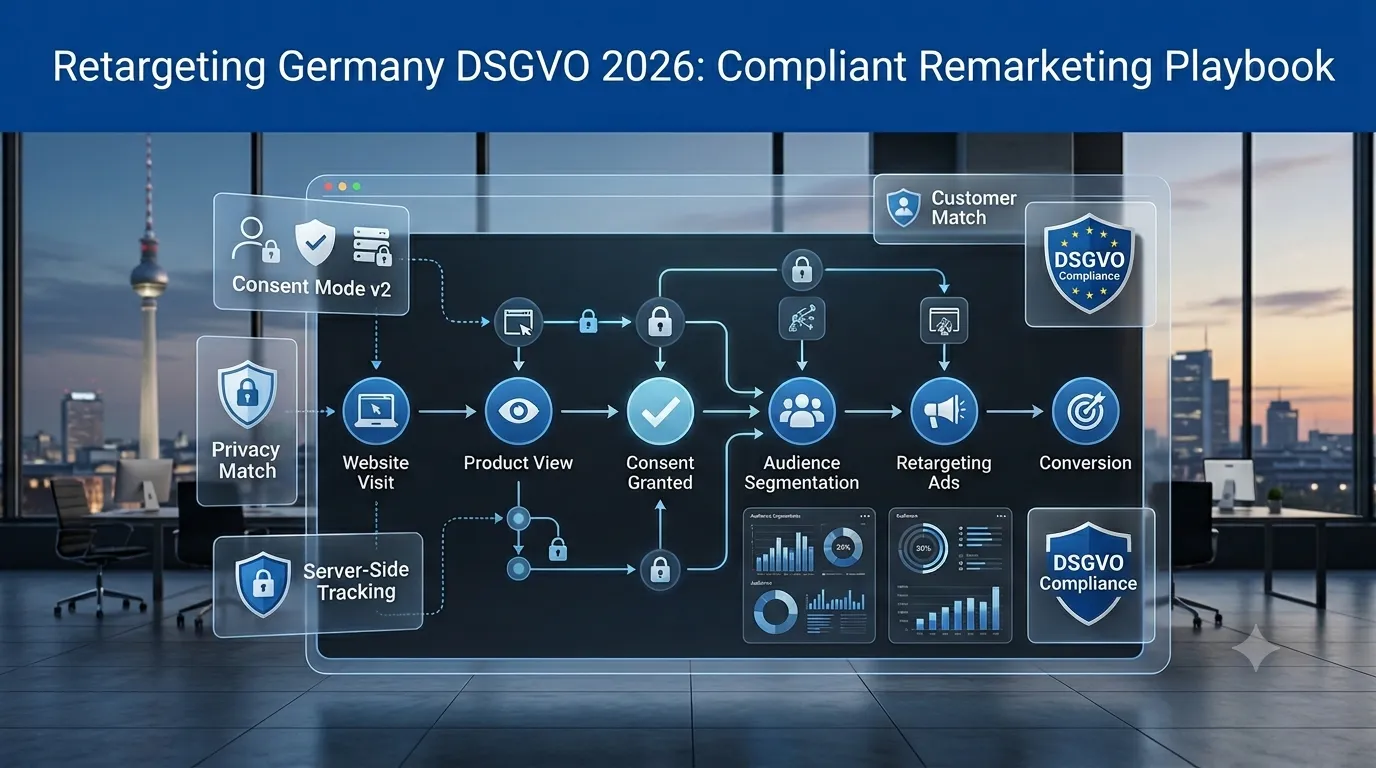
Retargeting is one of the highest-ROI activities in digital marketing. Visitors who came to your site and didn’t convert represent the most valuable cold audience you’ll ever have — they already know your brand, they showed interest, they need one more nudge. Yet retargeting in Germany 2026 is more constrained than ever by DSGVO, TTDSG, consent requirements, and the death of third-party cookies.
The good news: retargeting still works in Germany when set up correctly. With Consent Mode v2, server-side tracking, Customer Match, and engagement-based audience definitions, you can build retargeting programs that respect privacy AND deliver strong ROAS. This guide covers exactly how to do that in 2026.
What is retargeting in 2026 and how is it different from earlier years?
Retargeting (also called remarketing) is the practice of showing ads to people who have already interacted with your brand — visited your website, viewed a product, abandoned a cart, watched a video, opened an email, or signed up but didn’t purchase.
How retargeting has changed:
2018-2020: third-party cookies tracked users across the open web. You could retarget anyone who visited your site as they browsed anywhere else on the internet. CPMs cheap, scale massive.
2021-2022: iOS 14.5 cut Meta’s pixel signal. Browser privacy features (ITP in Safari, ETP in Firefox) cut third-party cookie reach. Audience sizes shrank, CPMs rose.
2023-2024: Chrome’s Privacy Sandbox preparations, third-party cookie deprecation announcements. Server-side tracking became standard. First-party data infrastructure became table stakes.
2025-2026: Third-party cookies functionally dead in major browsers. Retargeting depends on first-party signals, Customer Match, server-side tracking, and consent management. Sophisticated programs work; sloppy programs don’t.
The implications for German marketers: retargeting isn’t dead, but it requires more infrastructure than 5 years ago. The brands winning are the ones who built first-party data foundations and consent-compliant tracking earlier.
For broader context, see our performance marketing Germany guide and programmatic advertising Germany guide.
What audiences should you build for retargeting in Germany?
Modern retargeting audiences depend on first-party signals:
Website visitor audiences:
- All visitors (broadest; lowest intent)
- Visitors who viewed specific pages (e.g., pricing, product, demo)
- Visitors who spent >2 minutes on site (engagement signal)
- Cart abandoners (highest intent for e-commerce)
- Form starters who didn’t complete (high intent for B2B)
- Visitors who watched specific video on site
Customer Match audiences:
- Existing customers (for upsell/expansion or exclusion)
- Trial users who didn’t convert
- Newsletter subscribers who haven’t purchased
- High-value customer lookalikes
- Lapsed customers (haven’t purchased in 6+ months)
Engagement audiences:
- Email openers who didn’t click
- Email clickers who didn’t convert
- Social media engagers
- Video viewers (50%+, 75%+, 100% completion tiers)
- App users (by behavior segment)
CRM-sourced audiences:
- MQLs not yet converted to SQL
- Stalled sales opportunities
- Customers in renewal window
- Specific lifecycle stage segments
Best practice combinations:
- High-intent: cart abandoners + demo page viewers, last 14 days
- Medium-intent: product page viewers + newsletter subscribers, last 30 days
- Brand awareness: all visitors + lookalikes of customers, last 90 days
The mistake most German B2B Mittelstand make: building only “all visitors” audience. The granular intent-based audiences deliver 3-10x better ROI but require more setup.
What channels can you retarget through?
Google Ads retargeting:
- Display Network (display banners on millions of partner sites)
- YouTube (video ads)
- Performance Max (includes retargeting placements automatically)
- Search remarketing (RLSA — remarketing lists for search ads)
- Customer Match for Search and Display
Meta Ads retargeting:
- Facebook and Instagram feed, Stories, Reels
- Custom Audiences from Pixel/CAPI events
- Customer Lists upload
- Lookalike audiences from retargeting seeds
LinkedIn Ads retargeting:
- Website visitors via Insight Tag
- Engagement audiences (engaged with company posts)
- Lead Gen Form openers
- Customer/Account list upload for ABM retargeting
TikTok Ads retargeting:
- Website visitors via TikTok Pixel
- Engagement audiences
- Customer Lists
Programmatic retargeting:
- Open-web display via DSPs (DV360, TTD)
- CTV retargeting
- Native retargeting (Outbrain, Taboola, plista)
- Less precise than walled gardens in 2026 due to cookie loss
Email retargeting:
- Abandoned cart sequences
- Re-engagement campaigns
- Behavioral trigger emails
- The most owned and reliable retargeting channel
SMS / WhatsApp retargeting:
- Cart abandonment SMS (with consent)
- WhatsApp Business sequences for customer engagement
- Growing in Germany; compliance-sensitive
Best practice: run retargeting across 3-5 channels for maximum coverage. Different users see different channels. A single-channel retargeting program misses 60-80% of available reach.
What DSGVO compliance is required for retargeting in Germany?
DSGVO + TTDSG impose specific requirements for retargeting:
1. Consent banner with granular options:
- Cookie consent banner must offer granular control (marketing, analytics, personalization separately)
- “Akzeptieren” and “Ablehnen” with equal prominence
- Specific consent for retargeting/marketing cookies
- Consent timestamp recorded per session
2. Consent Mode v2 implementation:
- Google services (Ads, Analytics) require Consent Mode v2 for German users
- Pass consent state to all tracking pixels and APIs
- Different behavior when consent is granted vs denied
3. Server-side tracking:
- Server-side GTM or equivalent hosted in EU
- Hash PII before forwarding to ad platforms
- Conditional firing based on consent state
4. Vendor agreements:
- AVV (Auftragsverarbeitungsvertrag) with every ad platform (Google, Meta, LinkedIn, TikTok, DSPs)
- Standard Contractual Clauses for non-EU data transfers
- Documented in Verzeichnis von Verarbeitungstätigkeiten
5. Customer Match consent basis:
- Email lists uploaded with documented consent
- Existing customer relationship is valid basis with proper privacy notice
- Easy opt-out mechanism
6. Frequency caps and limits:
- Excessive retargeting frequency can be flagged as harassment by some German authorities
- Best practice: cap at 8-12 impressions per user per week
- Suppress retargeting after 30 days post-visit unless re-engaged
7. Right to be forgotten:
- Process for users to request removal from retargeting audiences
- Documented in privacy policy
- Implemented within 30 days of request
The compliance lift is substantial but manageable. The reward: programs that respect users and don’t trigger Datenschutzbehörde investigations or Abmahnung.
For tracking infrastructure deep-dive, see our server-side tracking Germany guide and GA4 Consent Mode v2 Germany guide.
What creative works for retargeting in Germany?
Retargeting creative is different from prospecting creative. Visitors already know your brand; the goal is to overcome specific objections or remind them of value.
Creative principles for retargeting:
1. Context matters: address what the user already viewed
- Cart abandoners see the abandoned products
- Demo page viewers see demo CTAs
- Pricing page viewers see pricing reassurance
- Generic creative wastes the targeting precision
2. Address objections: why did they not convert the first time?
- Price concerns → discount or money-back guarantee messaging
- Trust concerns → testimonials, ratings, trust badges
- Information gaps → “Have questions? Talk to expert”
- Feature concerns → comparison with alternatives
3. Urgency without manipulation:
- “Your cart expires in 24 hours” only if literally true
- “Limited stock” only if literally true
- Avoid fake scarcity (UWG compliance issue + erodes trust)
4. Variety and rotation:
- 5-10 creative variants minimum per audience
- Rotate to prevent fatigue (users seeing same ad 50 times grow resentful)
- Refresh creative every 3-4 weeks
5. Match channel context:
- LinkedIn retargeting: professional tone, value-led
- Meta retargeting: visual, lifestyle-led
- Google Display retargeting: simple, direct
- Email retargeting: personal, in-depth
Creative formats by funnel position:
- Awareness retargeting: brand recall, video, image
- Consideration retargeting: testimonials, social proof, comparison
- Decision retargeting: offer, demo CTA, urgency
What does retargeting cost in Germany?
Retargeting CPMs are typically higher than prospecting because audiences are smaller and more valuable:
Display retargeting:
- CPM: €8-€30
- CPC: €0.50-€3
- Generally cheapest retargeting
Meta retargeting:
- CPM: €15-€50
- CPC: €0.80-€4
- High engagement, strong conversion
LinkedIn retargeting (B2B):
- CPM: €80-€200
- CPC: €6-€15
- Expensive but high-intent for B2B
Google Display retargeting:
- CPM: €5-€20
- CPC: €0.40-€2
- Broad reach across Google partner network
Programmatic retargeting:
- CPM: €10-€40
- More complex setup; harder ROI measurement
ROAS expectations:
- E-commerce retargeting: 5-15x ROAS healthy
- B2B retargeting: harder to measure in pure ROAS; measure pipeline contribution
Typical retargeting budget allocation:
- 15-25% of total paid budget for B2C
- 10-20% for B2B
- Below 10%, you’re under-retargeting
- Above 30%, you’re audience-burning (small audiences, high frequency)
What’s the right retargeting frequency?
Frequency = average number of times a user sees your ad per time period.
Healthy frequency by channel:
- Display: 5-8 impressions per user per week
- Meta: 3-5 impressions per user per week
- LinkedIn: 3-5 impressions per user per week
- YouTube: 2-4 impressions per user per week
Symptoms of over-frequency:
- CPM rising while CTR declining
- Negative engagement (negative comments, hide ad clicks)
- Brand sentiment surveys showing fatigue
- High user complaints
Frequency caps in campaign setup:
- Set hard caps per platform
- Use Meta’s frequency cap setting (e.g., 4 per week)
- Google Ads frequency caps available at campaign/ad group level
- Programmatic via DSP frequency caps
Audience suppression:
- Suppress converters (don’t keep retargeting people who already bought)
- Suppress lapsed audiences (>60 days without engagement)
- Refresh audiences regularly to add new visitors, drop stale ones
What KPIs matter for retargeting in Germany?
Top-line:
- ROAS attributed to retargeting
- Incremental conversion lift (vs no-retarget control group if testable)
- Customer LTV from retargeting-influenced conversions
Channel-level:
- CPA per retargeting audience
- Conversion rate per retargeting audience
- Frequency by audience segment
- Audience size and reach
Campaign-level:
- CTR by audience and creative
- View-through conversions (interpret carefully)
- Cost per result by funnel stage
Diagnostic:
- Audience overlap across channels
- Time to conversion from first retargeting impression
- Funnel progression (visited → engaged → converted)
Caveats:
- Retargeting often gets last-click credit unfairly — visitor would have converted anyway
- Incrementality testing (holdout groups) reveals true retargeting value
- Don’t over-rely on click-attributed metrics; use multi-touch attribution
Frequently asked questions about retargeting Germany DSGVO
4–8/week acceptable. Above 12/week risks negative sentiment. Track ad sentiment + complaints.
Not via pixels. Use Consent Mode v2 + consented audiences + Customer Match.
Existing customers: yes (legitimate interest) with easy opt-out. Non-customers: double opt-in required.
Directional only. Over-credits retargeting. Use incrementality testing for true value.
Hashed list upload + AVV + documented consent. Existing customers: valid basis. Cold lists: explicit consent.
Compliance-heavy: explicit opt-in + clear value + easy opt-out. Can outperform email in high-touch B2B.
Brand safety tools + category exclusions. DoubleVerify/IAS for programmatic. Walled gardens default usually fine.
Yes. Stay active 90–180 days, progress through funnel stages, integrate email, measure pipeline.
Ready to build DSGVO-compliant retargeting that actually works?
Retargeting in 2026 Germany requires more infrastructure than five years ago but delivers stronger ROI when set up correctly. The brands winning have: first-party data foundations, server-side tracking, granular audience segmentation, consent-compliant tracking, and creative tailored to funnel position.
Book a meeting for a free retargeting audit where we’ll review your current setup, compliance posture, audience definitions, and creative strategy to identify the top 5 improvements. Or browse our digital marketing services and contact us to discuss a retargeting engagement.