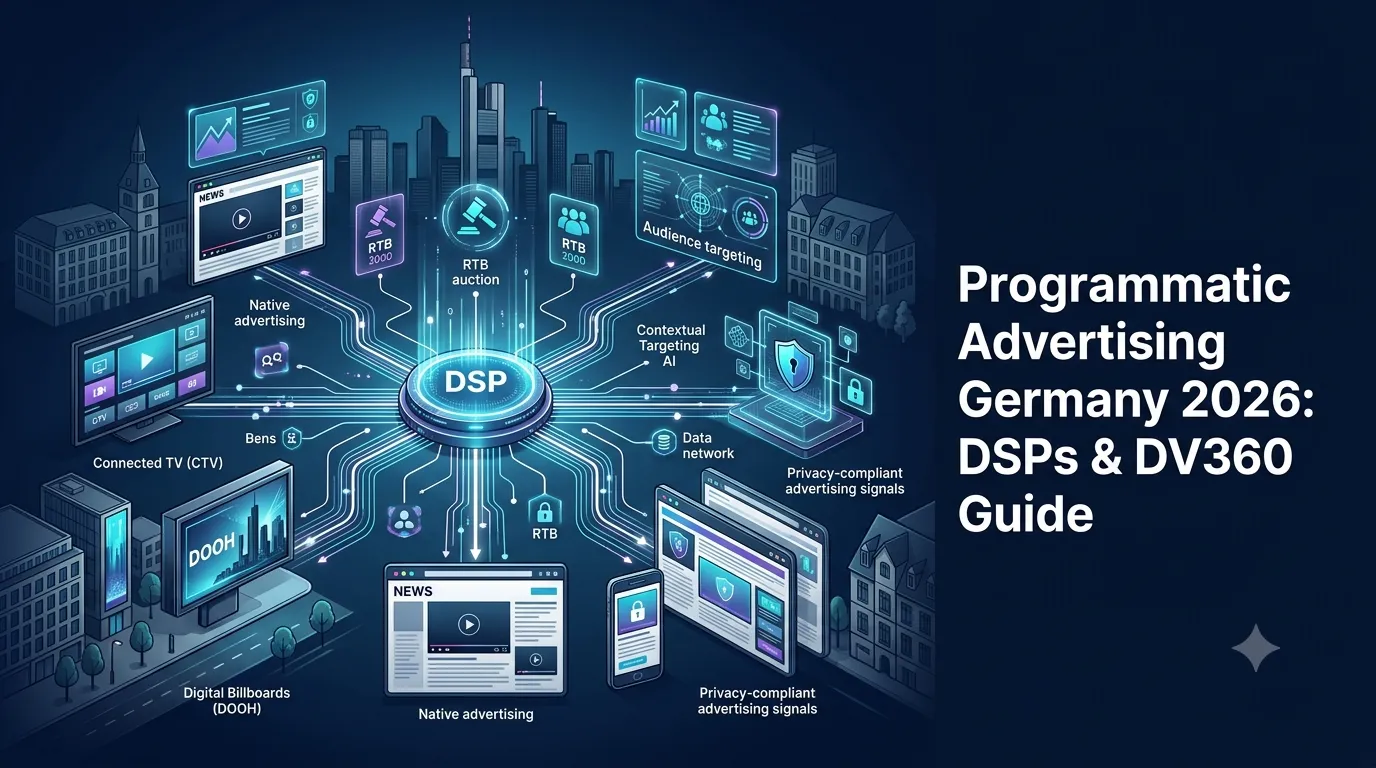
Programmatic advertising is the automated buying of digital ad inventory through bidding systems and demand-side platforms (DSPs). It spans display banners, native ads, programmatic video, audio, digital out-of-home (DOOH), and connected TV (CTV). For German advertisers, programmatic represents a meaningful share of premium digital ad inventory — and a category that’s been transformed by privacy regulation, the death of third-party cookies, and the rise of contextual and first-party data targeting.
In 2026, programmatic in Germany is more sophisticated and more challenging than five years ago. The major DSPs (DV360, The Trade Desk, Amazon DSP, Adform for European focus) all serve German inventory. Native ad networks (plista, Outbrain, Taboola) have strong DACH presence. CTV programmatic is growing rapidly. But the targeting precision that defined early programmatic has shifted toward audience modeling, contextual targeting, and curated marketplaces. This guide covers what works.
What is programmatic advertising and how is it different from direct buys?
Programmatic advertising is automated buying of ad inventory through real-time bidding (RTB) or programmatic direct deals.
Real-time bidding (RTB): each impression auctioned individually based on user, context, and bidder data. Microseconds-fast auctions across billions of daily impressions.
Programmatic direct / Private Marketplaces (PMP): pre-negotiated deals between brand and publisher, executed programmatically. Premium inventory, more control, higher CPMs.
Programmatic guaranteed: reserved inventory at fixed price, programmatically delivered. Most predictable; closer to traditional media buys.
Versus direct buys: traditional direct media buys (negotiate with publisher, fixed placement, fixed period, fixed price). Programmatic offers more scale and audience precision but less guaranteed placement.
Versus walled gardens: Google Ads, Meta Ads, LinkedIn Ads, TikTok Ads — these are also programmatic but operate within closed ecosystems. “Programmatic advertising” usually refers to open-web programmatic outside walled gardens.
For broader paid strategy context, see our performance marketing Germany guide.
What programmatic channels are available in Germany?
Display banners:
- Standard sizes (728×90, 300×250, 160×600, 970×250, etc.)
- Mostly mid-to-low funnel awareness and retargeting
- DSPs: DV360, The Trade Desk, Adform, Amazon DSP, Xandr
Programmatic video:
- Pre-roll, mid-roll, out-stream video
- YouTube via DV360; non-YouTube via The Trade Desk and others
- High-engagement format; rising share of programmatic
Native advertising:
- Content recommendation widgets (Outbrain, Taboola)
- Native-style display (plista in DACH specifically, Sharethrough)
- Better engagement than standard banners
Audio advertising:
- Spotify, podcast networks, streaming radio
- Growing but smaller than US market in DACH
Digital Out-of-Home (DOOH):
- Billboards, transit screens, retail screens programmatically bought
- DSPs: Hivestack, Vistar Media, Broadsign
- Rising rapidly in major German cities
Connected TV (CTV):
- Smart TV, gaming console, streaming device ads
- Bought via DV360, The Trade Desk, AdGear
- Premium awareness placement
Retail Media Networks:
- Amazon Ads, Otto, Zalando, Rewe — retailer-owned ad platforms
- Strong purchase-intent audience
- Growing rapidly in DACH
Curated marketplaces and private exchanges:
- DACH-specific publisher consortia
- Quality-controlled inventory
- Better brand safety than open RTB
What DSPs work best for German campaigns?
The major DSPs serving German inventory:
DV360 (Display & Video 360):
- Google’s enterprise DSP
- Strong YouTube inventory access
- Integration with Google ecosystem (Search Ads, Analytics, etc.)
- Best for advertisers already in Google ecosystem
- Pricing: typically 12-20% media fee + tech fees
The Trade Desk (TTD):
- Independent DSP
- Strong CTV inventory
- Industry-leading targeting and data integrations
- Best for sophisticated advertisers with first-party data strategy
- Pricing: typically 15-22% media fee
Amazon DSP:
- Strong purchase-intent data (Amazon shopping signals)
- Best for brands selling on Amazon or e-commerce broadly
- Limited to Amazon’s audience data
- Pricing: typically 10-18% media fee
Adform (European focus):
- Strong DACH market presence
- Integrated DMP + DSP + Ad Server
- Better European privacy compliance posture
- Good for European-focused enterprise advertisers
- Pricing: typically 12-20% media fee
Yahoo DSP (formerly Verizon Media): meaningful inventory access but smaller German market share
Xandr (Microsoft): enterprise DSP with strong CTV; less independent presence than 5 years ago
Choice criteria for German advertisers:
- Already on Google Ads → DV360 reduces operational overhead
- Need CTV at scale → TTD or DV360
- Heavy Amazon ecosystem → Amazon DSP
- European compliance priority → Adform or TTD
- Brand-safety-first → TTD or curated PMPs across any DSP
For smaller advertisers (€20K/month or less), self-serve options like StackAdapt or AdRoll provide programmatic access without enterprise DSP commitments.
What audience targeting works in programmatic post-cookies?
Third-party cookies are functionally dead. Audience targeting in 2026 programmatic relies on:
1. First-party data activation:
- Customer Match (email/phone lists with consent)
- CRM-sourced audiences
- Website visitors via first-party pixel
- Most valuable in 2026; brands without first-party data strategy disadvantaged
2. Contextual targeting:
- Page content analysis (URL, text content, video transcript)
- Topic categories and IAB taxonomy
- Powered by AI semantic analysis (not just keyword matching)
- Growing rapidly as cookies decline
- Brand safety integration
3. ID-less / identity solutions:
- Universal IDs (UID2, LiveRamp ATS, ID5) — alternatives to third-party cookies
- Adoption varies; not universal
- Some publisher and DSP coverage
4. Cohort-based targeting:
- Google’s Topics API (cookie alternative for interest categories)
- Aggregated, privacy-preserving signals
- Less precise than cookies but functional for broad targeting
5. Curated marketplaces:
- Pre-defined audience packages from publishers and data partners
- Quality-controlled audience definitions
- Compliance-friendly
6. Modeled audiences:
- AI-modeled lookalikes from seed audiences
- Increasingly accurate without cookie tracking
- DSP-native and third-party model providers
Best practice for German programmatic in 2026:
- Build first-party audience strategy first
- Layer contextual targeting for scale
- Use universal IDs as cookie alternatives where available
- Avoid over-reliance on third-party data segments
What is brand safety in programmatic and how do you handle it in Germany?
Brand safety = ensuring ads don’t appear next to harmful, illegal, or brand-damaging content. Critical in programmatic where ads buy individual impressions across millions of sites.
Brand safety risks in open programmatic:
- Ads next to controversial news, extremist content, fake news
- Ads on pirated or illegal content sites
- Ads in user-generated content with inappropriate contex
- Ads in low-quality “made for advertising” sites
- Ads next to direct competitor content
Brand safety tools and partners:
- DoubleVerify: brand safety, viewability, fraud verification
- Integral Ad Science (IAS): similar capabilities
- Adloox: European brand safety focus
- Brand suitability frameworks: GARM (Global Alliance for Responsible Media) standards
Curated marketplaces for brand safety:
- Premium publisher PMPs with pre-vetted inventory
- DACH-specific publisher consortia
- Higher CPMs but brand-safe by default
Brand safety best practices:
- Pre-bid brand safety filtering via verification partner
- Post-bid measurement and reporting
- Block lists (always-exclude sites/categories)
- Allow lists (only run on pre-approved sites — most conservative)
- Curated marketplaces for premium campaigns
- Regular audit of where ads actually ran
What does programmatic cost in Germany?
Programmatic cost components:
Media spend: actual ad impressions purchased DSP technology fee: 10-22% of media spend typical Data fees: third-party audience data (DMP segments, intent data) — 5-15% of media spend Verification fees: DoubleVerify, IAS — typically 3-8% of media spend Agency / managed service fee: 15-30% of media spend if outsourced Creative production: variable
Typical effective CPMs in Germany:
Open RTB display: €0.50–€5 Premium display (PMPs): €3–€20 Open RTB video: €5–€20 Premium video PMPs: €15–€50 CTV programmatic: €15–€45 Native (Outbrain, Taboola, plista): €2–€15 Programmatic audio (Spotify, podcasts): €8–€30 Programmatic DOOH: €5–€40 depending on placement
Minimum viable programmatic budget: typically €15K-€30K/month for meaningful learning at the DSP. Below that, you’re better served by self-serve platforms (Google Ads, Meta, LinkedIn) or smaller DSP options.
Typical mid-market programmatic spend: €30K-€150K/month for serious DACH campaigns Enterprise programmatic spend: €100K-€2M+/month
For broader cost context, see our digital marketing cost Germany 2026 guide.
When does programmatic outside walled gardens make sense?
Walled gardens (Google, Meta, LinkedIn, Amazon, TikTok) capture roughly 70-80% of digital ad spend. Open programmatic captures the remaining 20-30%. When does open programmatic make sense?
Strong use cases:
- Premium awareness campaigns with brand-safe PMPs
- CTV at scale (most CTV inventory programmatic)
- DOOH integration for omnichannel campaigns
- B2B with first-party data activation across open web
- Retargeting beyond walled garden audiences
- Reaching specific premium publisher inventory not available in walled gardens
- Native content distribution on premium news/publisher sites
Weak use cases:
- Small budgets (<€15K/month) — walled gardens are more efficien
- Pure performance with measurable ROI shorter than 30 days (walled gardens beat programmatic on attribution)
- Brand-new advertisers without first-party data foundation
- Simple direct-response campaigns
The honest assessment: most German Mittelstand B2B and SMB B2C do not need open programmatic. The walled gardens capture most of the needed reach efficiently. Open programmatic justified mainly for: brand-led campaigns, CTV, omnichannel including DOOH, or scale beyond walled garden ceilings.
How does DSGVO affect programmatic in Germany?
DSGVO has hit open programmatic harder than walled gardens. Specific issues:
Consent management complexity:
- Each programmatic vendor in the bid chain needs consent basis
- TCF (Transparency & Consent Framework) v2.2 is the IAB standard
- Many German publishers have strict consent gates
- Consent rejection rates affect programmatic reach significantly
Data transfer issues:
- Schrems II ruling complicates US data transfers
- Some German publishers and DSPs restrict non-EU data flow
- Standard Contractual Clauses (SCCs) required for transfers
Vendor reduction:
- Some German publishers limit number of DSPs and tech vendors they accept
- Simplification trend post-DSGVO
Compliance requirements for programmatic in Germany:
- TCF v2.2 consent integration in DSP campaigns
- AVV with each DSP and tech vendor in the chain
- Cookie consent banner with granular DSP/programmatic consent
- Privacy policy disclosing programmatic data flows
- Documentation in Verzeichnis von Verarbeitungstätigkeiten
- Server-side tracking integration where possible
For tracking infrastructure, see our server-side tracking Germany guide.
What programmatic strategies work for German B2B?
B2B programmatic is narrower than B2C but specific tactics work:
Account-based programmatic (ABM):
- Target named accounts via IP targeting or audience match
- LinkedIn ABM remains stronger for B2B in DACH, but programmatic ABM extends reach
- Costs higher CPMs but reaches buyers off LinkedIn
Contextual targeting for B2B campaigns:
- German B2B publisher contexts (Wirtschaftswoche, Handelsblatt, Heise, Computerwoche, t3n)
- Industry-specific verticals via PMPs
- Combine with thought leadership content
Intent data activation for B2B audiences:
- Bombora, 6sense, Cognism — surge intent data
- Layer in DSPs to target accounts showing buying signals
- Premium for high-AOV B2B
CTV advertising for B2B brands:
- Reach executives in living rooms
- Combine with LinkedIn account targeting for omnichannel
- Premium budgets only
For B2B-specific programmatic, see our LinkedIn Ads B2B Germany guide (most B2B paid budget belongs there) and forthcoming account-based marketing ABM Germany guide.
What KPIs matter for programmatic in Germany?
Awareness campaigns:
- Reach (unique users reached)
- Frequency (impressions per user)
- Brand lift surveys (awareness, consideration, intent metrics)
- Viewability rate (target 70%+)
- Audibility (for video)
Performance campaigns:
- CPL or CPA
- ROAS (for e-commerce)
- View-through conversions (with caution — over-attribution risk)
- Click-through rate (typical: 0.05-0.3% for display, 0.2-1% for native)
Quality and brand safety:
- Viewability % (impressions actually seen)
- Brand safety pass rate
- Fraud / invalid traffic (IVT) rate (target <5%)
- Domain quality scores
Programmatic-specific:
- Win rate (% of bids you win)
- Effective CPM after data and verification fees
- Bid landscape efficiency
- Audience reach extension vs walled gardens
Frequently asked questions about programmatic advertising Germany
Walled gardens until €30K+/month budget. Programmatic adds value above €50K–€100K/month.
GDN is Google-only. Programmatic adds PMPs and other networks. Start GDN, expand at scale.
DoubleVerify/IAS, pre-bid filtering, curated PMPs, IVT monitoring, ads.txt/sellers.json validation.
B2C: increasingly yes. B2B: only for executive-audience scale. Test if budget permits.
Rising. Amazon Ads + Otto, Zalando, Rewe. Allocate 15–30% of B2C budget if selling through these.
Foundational. Without first-party data, 2026 programmatic targeting is significantly handicapped.
€8K–€15K/month managed if €30K–€80K media spend. Below: self-serve DSPs or walled gardens.
Programmatic for scale + precision. Direct for guaranteed premium placement. Hybrid is common.
Ready to evaluate programmatic for your German campaigns?
Programmatic advertising in 2026 is more sophisticated, more challenging, and more important for brands at scale. For Mittelstand B2C and enterprise advertisers, programmatic enables reach, audience targeting, and channel diversification beyond walled gardens.
Book a meeting for a free programmatic consultation where we’ll assess whether programmatic fits your scale and strategy, evaluate DSP options, and recommend a testing approach. Or browse our digital marketing services and contact us directly.