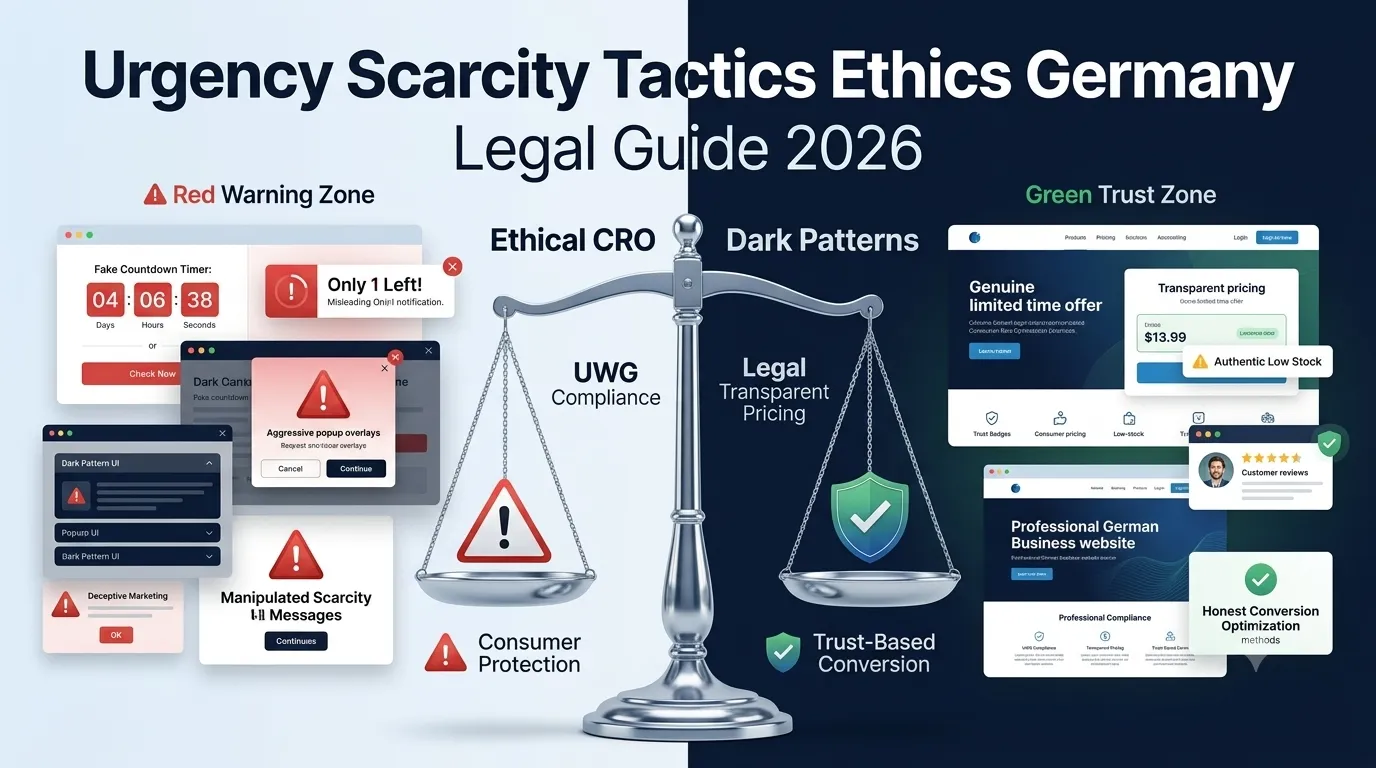
Urgency + scarcity tactics that work in the US often backfire in Germany. Some are illegal under UWG (unfair competition law). Some are technically legal but kill trust. Others — done ethically — significantly improve conversion. For German websites in 2026, the line between effective urgency + manipulative dark patterns matters more than ever.
This guide walks through what urgency scarcity tactics ethics in Germany actually work in 2026: what’s legal under UWG, which patterns are dark patterns vs ethical, which approaches lift conversion, and the German cultural nuances.
For broader CRO see our CRO services Germany guide.
What’s urgency vs scarcity?
Two related but distinct CRO tactics:
Urgency
Time-based pressure. “Sale ends Friday.” “Limited-time offer.”
Scarcity
Quantity-based pressure. “Only 3 left.” “Limited edition.”
Combined
“Only 5 spots left at this price — closes Friday.”
Both work by
Creating fear of missing out (FOMO). Driving immediate action vs deferred decision.
What’s legal in Germany?
Germany’s UWG (Gesetz gegen den unlauteren Wettbewerb) restricts certain manipulative tactics:
Legal Aspects of Urgency Scarcity Tactics Ethics
- Real time-limited offers (sale actually ends)
- Real stock levels (truthful low inventory)
- Genuine limited editions
- Time-limited registration windows
- Honest “almost gone” messages
Illegal & Risky Urgency Scarcity Tactics Ethics Practices
- Fake countdown timers
- Fabricated “only X left” with actual unlimited inventory
- Misleading “ending soon” with no actual end
- Pre-checked dark pattern boxes
- Hidden costs revealed only at checkout
- “Selten in deinem Land” geographic manipulation
UWG enforcement is real. Competitors send Abmahnungen for false urgency.
Dark Patterns vs ethical urgency tactics:
Manipulative design patterns that exploit user psychology and violate urgency scarcity tactics ethics:
Common dark patterns
- Fake urgency (“only 2 minutes left!”)
- Fake scarcity (“only 1 left!”)
- Hidden costs revealed at checkout
- Pre-checked boxes (subscription confirms)
- Confirmshaming (“No, I don’t want to save money”)
- Roach motel (easy to subscribe, hard to cancel)
- Misdirection (deceptive CTA placement)
- Bait and switch
- Forced continuity (auto-renew without clear notice)
For German market, dark patterns often:
- Violate UWG
- Damage brand reputation
- Trigger negative reviews
- Get Abmahnungen
- Don’t actually work long-term
What ethical urgency works in Germany?
Five legitimate tactics:
Real time-limited sales
“Sommerschlussverkauf bis 31. August” — actual end date.
Real low-stock alerts
“Nur noch 3 verfügbar” when actually true.
Limited edition products
Genuinely limited production runs.
Registration deadlines
Webinar registration genuinely closes before event.
Price increases announced
“Preise steigen ab 1. September” — actual price change.
These work because
Honest + transparent + creates real reason to act. Not manipulation.
German Market Preferences for Urgency Scarcity Ethics:
German cultural factors:
Skepticism of urgency claims
Germans question claims more than other markets. “Limited time!” often distrusted.
Honesty values
Direct communication preferred. Manipulation backfires.
Long-term relationship orientation
German B2B values long-term relationships over short-term tricks.
Conservative buying behavior
Research-heavy decisions. Hard to rush.
Implication
Subtle, honest urgency > aggressive manipulation. German market less responsive to FOMO than US. This is why ethical urgency scarcity tactics matter more in Germany than aggressive conversion tactics.
What’s the typical conversion lift from urgency?
Real urgency (sales, deadlines)
10–25% lift typical. Sustainable.
Fake urgency
Short-term lift but reputation damage. Long-term negative.
Real scarcity (stock)
5–15% lift typical when genuine.
Fake scarcity
Similar to fake urgency — short-term gain, long-term loss.
For German market: focus on genuine urgency only.
What about countdown timers?
Two types:
Legitimate countdown timers
- End of sale (real)
- Registration deadline (real)
- Product launch (real)
Dark pattern countdown timers
Fake countdown that resets. “Reserves your spot for 10 minutes” with no actual reservation.
Implementation Guidance for Urgency Scarcity Tactics Ethics
- Tie to real event/deadline
- Honest about what happens at end
- Same end time for all visitors (not personalized fake)
Aggressive timers
“Only 30 seconds!” feel manipulative. Even if real. Calm tone better for German market.
What about “Live activity” notifications?
The “Sarah from Berlin just bought!” notifications:
Legitimate
If actually real-time data with consent.
Dark pattern
If generated/fake or stale data presented as fresh.
German market reception
Often viewed skeptically. Less effective than US market.
Better alternative
Aggregate “5,000 Bestellungen heute” or recent named testimonials.
What about pricing scarcity / dynamic pricing?
Different scenarios:
Genuine dynamic pricing
Airline, hotel pricing change based on demand. Legal.
Honest “price rising soon”
If actually rising. Legal + works.
Personalized fake “your special discount”
If everyone gets it. Misleading.
Disclosure required
Per UWG, pricing methodology should be reasonably clear.
What about pop-ups + exit-intent?
Used carefully:
Effective + ethical
Single value-add popup (discount, lead magnet). Easy dismiss.
Annoying + ineffective
Multiple popups per visit. Hard to close. Pre-checked subscription.
Mobile considerations
Mobile pop-ups especially intrusive. Google penalizes for intrusive mobile interstitials.
German market
Conservative use. Single subtle popup > aggressive multiple.
What ethical CRO patterns actually work in Germany?
Six high-impact patterns:
1. Real social proof
Customer count, review ratings, named testimonials.
2. Trust signals
Trusted Shops, certifications, awards.
3. Clear value proposition
What you do + for who + why care.
4. Real product information
Detailed specs, honest descriptions.
5. Transparent pricing
EUR prices visible. Hidden costs forbidden.
6. Money-back guarantee
Genuine guarantees with clear terms.
These work without manipulation. Sustainable long-term.
For social proof see our social proof German market guide
What are common ethical mistakes in Urgency Scarcity Tactics Ethics?
Five patterns to avoid:
Aggressive American playbook
“BUY NOW!!! LAST CHANCE!!!” — fails in German market.
Fake countdown timers
Detected easily. Triggers UWG concern.
Misleading scarcity
“Only 1 left” with unlimited inventory. Lawsuit risk.
Hidden costs
Per §312j BGB, all costs visible before checkout.
Confirmshaming
“No, I don’t want to save €50” type guilt patterns.
What’s the long-term cost of dark patterns?
Five consequences:
Negative reviews
Visible online. Erode trust.
Abmahnungen
Competitor lawsuits. Expensive.
Customer churn
Customers who feel manipulated leave faster.
Brand reputation
Long-term brand damage hard to repair.
Regulatory scrutiny
Increasing EU regulation around dark patterns.
For German legal context see our GDPR compliance guide.
What’s the right CRO approach for German market?
Five principles:
Be honest
If urgency is real, it works. If not, don’t fake it.
Subtle > aggressive
Calm professional tone beats loud claims.
Quality > quantity
One trusted testimonial > 10 weak claims.
Long-term relationship orientation
Optimize for repeat customers + word-of-mouth.
Trust before urgency
Build trust first. Add urgency only when trust established.
How does AI affect Urgency Scarcity Tactics Ethics in 2026?
Two considerations:
AI-personalized urgency (concerning)
“Just for you this offer” with fake personalization. Dark pattern.
AI authentic personalization (ethical)
Real personalization based on consented data. Acceptable.
AI-generated fake reviews (illegal)
UWG violation. Detection improving.
AI-driven dynamic offers (gray area)
Real-time pricing/offers based on inventory + demand. Generally acceptable if transparent.
Frequently asked questions
Real sales, real low-stock, limited editions, registration deadlines, announced price increases. Honesty essential.
Fake countdowns, fabricated scarcity, misleading ‘ending soon,’ pre-checked dark patterns, hidden costs.
Short-term yes, long-term no. Brand damage + Abmahnungen + customer churn outweigh short-term gain.
Real urgency: 10–25% lift. Fake urgency: short-term lift but long-term loss.
If tied to real event/deadline: yes. If fake/resetting: no (UWG concern).
Conservative use. German market skeptical. Aggregate stats work better.
Single value-add popup. Easy dismiss. Avoid mobile interstitials.
Brand reputation, negative reviews, Abmahnungen, customer churn, regulatory risk.
Need help with ethical CRO?
If you’re scoping CRO strategy for your German business and want a 30-minute scoping conversation about ethical persuasion + UWG-safe tactics, book a meeting or send details via our contact page.
Need expert help? Gem Programmers provides conversion rate optimization services for businesses in Germany, Austria and Switzerland. Request a free, no-obligation quote and get a clear plan with scope, timeline and price.