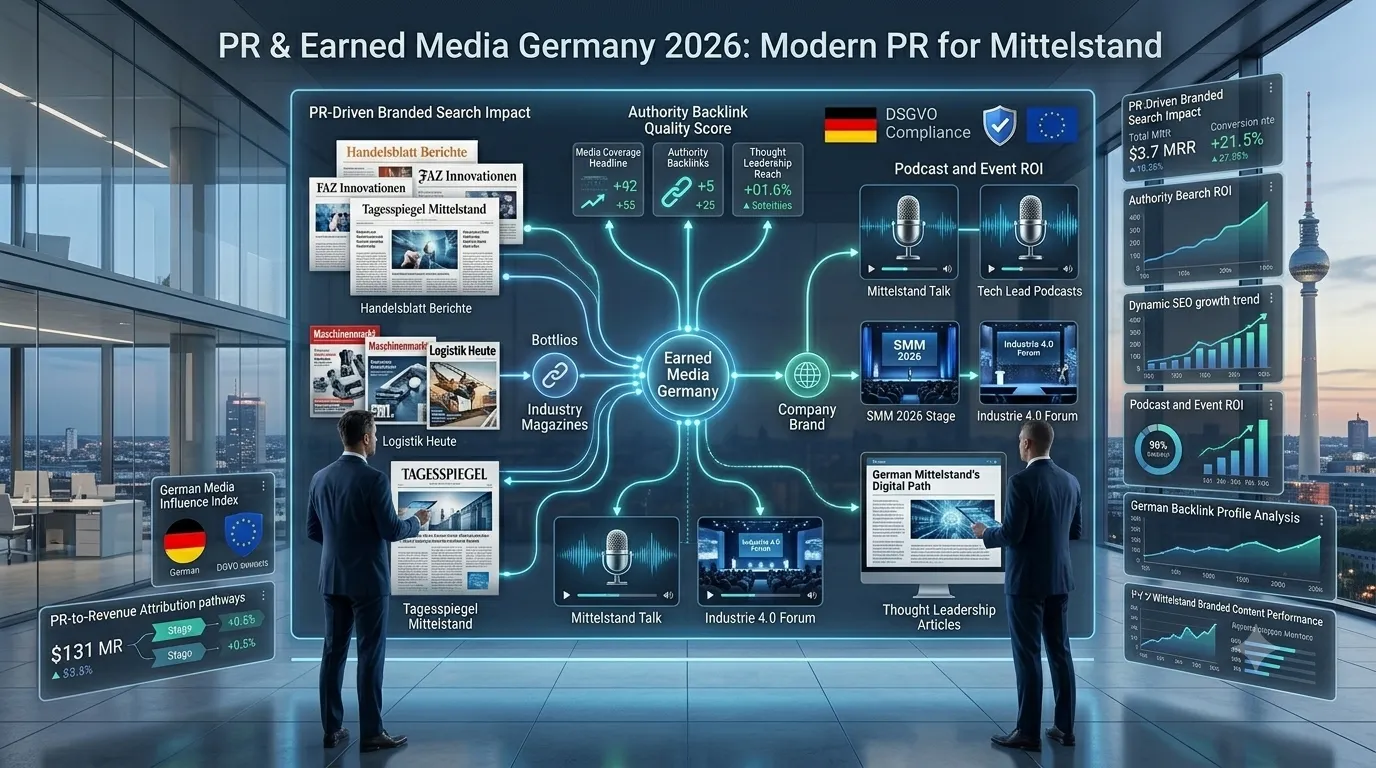
PR Germany earned media are often underestimated in modern digital marketing — yet they remain among the highest-leverage channels for German Mittelstand and B2B brands. Coverage in Handelsblatt, t3n, Wirtschaftswoche, Heise, or industry trade publications signals credibility that paid advertising cannot replicate. Backlinks from authoritative German publications boost SEO authority that compounds for years. Speaking opportunities, industry awards, and analyst recognition open enterprise doors that lead generation alone cannot.
In 2026, German PR has evolved beyond traditional press release distribution. Digital PR for SEO, podcast guesting, industry award participation, thought leadership in target publications, and integration with content marketing make PR more measurable and strategic than ever. This guide explains what works for modern PR in Germany — what to invest in, what to skip, and how to measure success.
What does PR include in 2026 and how is it different from advertising?
PR (Public Relations) is the strategic management of brand reputation and earned media — coverage you don’t pay for directly. The core distinction from advertising:
Advertising:
- You pay for placement
- You control the message exactly
- Audience knows it’s paid
- Lower credibility per impression
- Scales with budget
Earned media (PR):
- Coverage earned through value, story, news, expertise
- You influence but don’t control the message
- Audience treats as editorial/independent
- Higher credibility per impression
- Doesn’t scale linearly with money
Modern PR scope in 2026:
Traditional media relations:
- Press releases to journalists
- Pitched articles and exclusives
- Op-eds and contributed pieces
- Crisis communications
- Industry analyst relations
Digital PR:
- Online publication coverage (with backlinks for SEO)
- Outreach to bloggers and online journalists
- Newsworthy data and research distribution
- Linkable assets (studies, tools, calculators)
Speaking and events:
- Conference speaking opportunities
- Podcast guesting
- Webinar appearances on others’ shows
- Industry award participation
Thought leadership:
- Founder/CEO bylines in target publications
- Executive social presence (LinkedIn, Twitter)
- Book authorship
- Original research and analysis
Influencer relations (overlapping with influencer marketing):
- Long-term relationships with industry experts
- Earned mentions vs paid sponsorships
- See our influencer marketing Germany guide
Community building:
- Industry groups and associations
- Customer community programs
- User conferences and events
- Open source contributions (for tech brands)
For broader marketing context, see our digital marketing services Germany guide.
What’s the German media landscape for B2B PR?
Tier 1 German business publications:
- Handelsblatt: business daily, premium B2B audience
- Wirtschaftswoche: weekly business magazine
- FAZ (Frankfurter Allgemeine Zeitung): general + business
- Süddeutsche Zeitung: general daily
- manager magazin: monthly business deep-dives
- Capital: business and finance monthly
Tech and digital publications:
- Heise (heise.de, c’t, iX): tech professional audience
- t3n: digital business, startups, SaaS
- Computerwoche: enterprise IT
- CIO.de: enterprise IT leadership
- WUV (W&V): marketing and media industry
- Horizont: marketing trade publication
- OMR: marketing and digital business platform/publication
- Internet World Business: e-commerce and digital
Industry-specific trade publications:
- VDMA publications (machinery)
- VDA publications (automotive)
- Springer Professional (multi-industry technical)
- DACH-specific industry verticals (finance, healthcare, energy, etc.)
Regional publications:
- Bundesland and city-specific business publications
- Local Wirtschaftswoche regional editions
- Mittelstand-focused regional outlets
Online-only and emerging:
- Gründerszene (startups)
- Edition F (women in business)
- Industry-specific online communities
- Newsletter publications (DACH equivalents of US business newsletters)
Podcasts as media:
- B2B-focused podcasts increasingly relevant
- Top German B2B podcasts have 10K-100K weekly listeners
- Industry-specific podcasts in tech, marketing, finance
What does modern PR strategy look like for German Mittelstand?
A realistic German Mittelstand B2B PR strategy in 2026:
Foundation (months 1-3):
- Brand narrative and key messages
- Media list of 50-200 relevant journalists/outlets
- Spokesperson preparation (CEO, CMO, subject experts)
- Press room on website with assets, bios, fact sheets
- DSGVO-compliant press contact handling
Pitch streams (ongoing):
News and announcements
- Funding announcements
- Major customer wins
- Product launches
- Executive hires
- Awards received
- Cadence: 4-12 per year
Thought leadership bylines
- Executive-authored articles in target publications
- Industry trend analysis
- Original research findings
- Cadence: 1-2 per month
Data and research distribution
- Original survey data (industry benchmarks)
- Analysis of customer base data (anonymized)
- Trend reports
- Cadence: 2-4 per year, with ongoing repurposing
Founder/expert podcast and event appearances
- Pitch CEO/founders to podcasts in target industries
- Conference speaking applications
- Webinar guest appearances
- Cadence: 1-2 podcasts/events per month
Reactive opportunities
- News-jacking when industry events create relevant context
- Expert commentary on breaking news
- Cadence: 4-12 per year opportunistic
Industry awards and recognition
- Apply to relevant industry awards
- B2B awards (Gartner Magic Quadrant, G2 Crown, Capterra, etc.)
- Mittelstand awards (Top 100, Best Place to Work, etc.)
- Cadence: 4-10 applications per year
Annual cadence rhythm:
- January: Year-ahead predictions and trend pieces
- Q1: Annual data releases, industry forecasts
- Q2-Q3: Customer success stories, product depth
- October-November: Year-in-review, planning content
- December: Holiday content, year-end summaries
What does PR cost in Germany?
In-house PR:
- PR Manager / Director: €70K-€130K base + benefits = €91K-€169K fully loaded
- Communications Specialist: €50K-€80K base = €65K-€104K fully loaded
- Small in-house team (2-3 people): €200K-€350K/year fully loaded
PR agency retainer:
- Boutique agency: €4,000-€10,000/month
- Mid-sized agency: €8,000-€25,000/month
- Large agency: €20,000-€80,000+/month
Freelance PR consultant:
- €1,500-€6,000/month for ongoing program
- €100-€300/hour for project work
Specific service costs:
- Press release distribution (PR Newswire, Pressemitteilungen.de): €200-€2,000 per release
- Media database subscriptions (Cision, Meltwater, Vuelio): €5,000-€30,000/year
- Press monitoring service: €1,000-€15,000/year
- Award entries: €500-€10,000 per award entry
Crisis communications retainer:
- €2,000-€10,000/month for retainer
- Hourly charges during active crisis
- Worth the cost for brands with reputation risk
Total annual PR investment for serious Mittelstand program: typically €100K-€500K/year all-in (in-house + agency support + tools + entries).
For broader cost context, see our digital marketing cost Germany 2026 guide.
How does Digital PR drive SEO in Germany?
Digital PR specifically aims to earn backlinks from authoritative German publications — a major SEO ranking factor.
Digital PR tactics:
1. Newsworthy data and research:
- Original surveys (industry trends, consumer behavior)
- Analysis of proprietary data (anonymized customer insights)
- Trend reports with specific German market data
- Outreach to journalists with the story angle, data, and graphics ready to use
2. Linkable assets:
- Calculators (mortgage calc, ROI calc, etc.)
- Comprehensive guides positioned as resources
- Tools and templates
- Interactive industry maps or comparisons
3. Expert source positioning:
- Help A Reporter Out (HARO) equivalent in Germany
- Journalist directories with subject expertise listed
- Build relationships with industry journalists
- Be available for quotes and commentary
4. Newsworthy opinions:
- Strong contrarian takes on industry topics
- Predictions backed by data
- Critique of industry practices (with substance)
5. Event-driven outreach:
- Comment on industry events as they happen
- Be the German voice on global news
- Be available for tight deadlines
Backlinks from German publications:
- Tier 1 publication backlink: significant SEO authority transfer
- Tier 2/3 publication: still valuable, more achievable
- 5-15 quality backlinks per quarter is healthy for active digital PR
- Compounds dramatically over 12-24 months
For SEO context, see our SEO services Germany guide and link building Germany 2026 guide.
How do you build relationships with German journalists?
German B2B journalists are similar to US counterparts in some ways, different in others:
What works:
- Pitches in German (translation rarely flies)
- Substantive story angles, not generic announcements
- Exclusive access (data, executive interviews)
- Clear “what’s news here” framing
- Concrete numbers and proof points
- Following up after initial pitch (1-2 follow-ups, not aggressive)
- Sending the right story to the right journalist (research their beat)
- Long-term relationships, not transactional pitches
What doesn’t work:
- Generic press releases blast-sent
- US-style aggressive pitching
- Hyperbolic claims (“revolutionary”, “game-changer”)
- Vague “thought leadership” without substance
- Demanding coverage
- Following up too aggressively
- Translated English content with cultural references that don’t transfer
Tools for journalist research:
- LinkedIn for journalist profiles and recent articles
- Publication archives for their past coverage
- Media databases (Cision, Meltwater) with beat information
- Industry events where journalists speak or moderate
Building long-term relationships:
- Offer expert commentary without asking for coverage in return
- Provide useful information for stories not directly about your brand
- Respect off-the-record requests
- Don’t ghost when story doesn’t include your brand
- Send genuine thanks after coverage (not promotional)
- Meet in person at industry events when possible
What KPIs matter for PR Germany earned media?
Volume metrics:
- Number of articles/mentions per month
- Tier 1 vs Tier 2 vs Tier 3 coverage breakdown
- Backlinks earned (with domain authority)
- Press release pickup rate
Quality metrics:
- Sentiment of coverage (positive, neutral, negative)
- Message penetration (% of articles containing key messages)
- Spokesperson quotes featured
- Brand visibility (mentions, logo, screenshots)
Audience metrics:
- Estimated reach of coverage
- Target audience match (B2B decision-makers vs general)
- Geographic distribution (DACH-focused vs international)
SEO metrics (Digital PR):
- Backlinks from authoritative publications
- Domain Rating (DR) of linking sites
- Referring domains growth
- Organic traffic to linked pages
Business impact:
- Branded search volume lift after major coverage
- Direct traffic spikes from coverage events
- Sales conversations referencing coverage
- Customer acquisition attributed to PR
Operational:
- Pitch success rate (pitches → published)
- Journalist response rates
- Time from pitch to publication
- Cost per quality placement (total PR spend ÷ Tier 1+2 placements)
Earned Media Value (EMV):
- Estimated equivalent paid media value of earned coverage
- Useful for stakeholder communication
- Imperfect but directionally useful
Frequently asked questions about PR & earned media Germany
Both. 15–25% on PR for established Mittelstand. Early-stage: performance first. Mature: PR essential.
Quick: 90 days. Brand: 12–24 months. SEO: 6–12 months. Analyst relations: 12–36 months.
Yes SMB/early-stage. Founder-led works. Hybrid common at scale.
3-month prep. Embargoes + pre-briefings + launch day + follow-up. €30K–€150K for major launches.
Acknowledge fast, no spin, fix the problem. Have a plan before you need it.
Gartner/Forrester/IDC matter for enterprise B2B. €30K–€150K/year. Pays back via enterprise deals.
Major. Exec LinkedIn presence drives PR via thought leadership + journalist relationships.
Diminished. Useful for SEO + formal announcements. Direct pitches beat mass distribution.
Ready to build or scale PR Germany earned media
PR and earned media remain among the highest-leverage long-term marketing investments for German B2B Mittelstand and SaaS. Done with discipline — clear narrative, journalist relationships, news-worthy stories, integration with SEO and content — PR compounds brand authority for years.
Book a meeting for a free PR strategy consultation where we’ll review your current brand presence in German media, identify high-leverage PR opportunities, and recommend a 12-month PR roadmap. Or browse our digital marketing services and contact us to discuss a PR engagement.