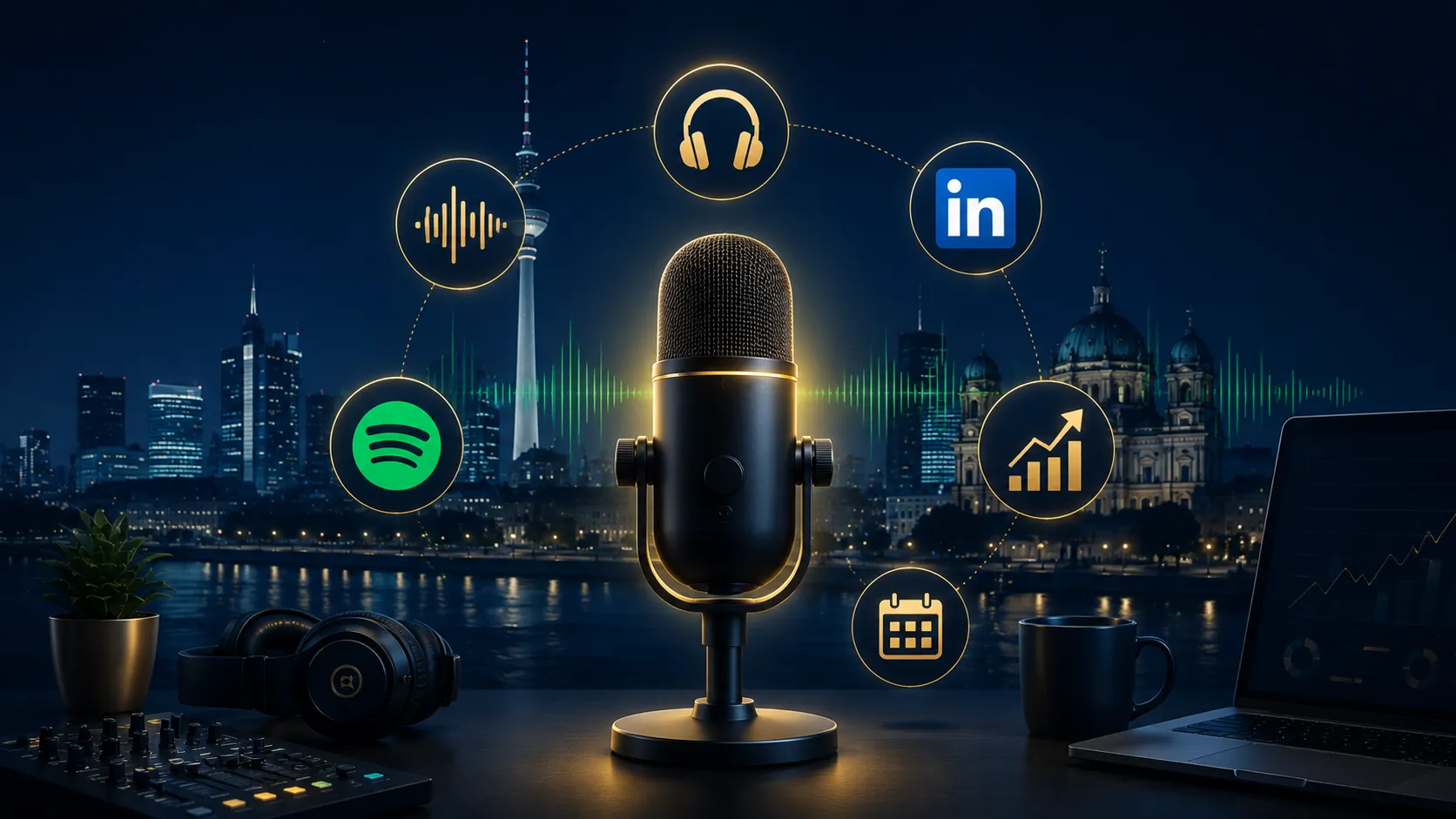
Podcast marketing in Germany has evolved from an emerging tactic to established channel by 2026. Roughly 30% of German adults listen to podcasts weekly, and consumption skews heavily toward professional B2B decision-makers, founders, executives, and senior specialists — exactly the audiences that B2B marketers want to reach. For brands willing to invest in audio content, podcasting delivers depth of engagement (45-90 minute attention sessions) that no other digital channel matches.
Podcast marketing has two distinct paths: branded podcasting (you produce a show) and podcast guesting (you appear on others’ shows). Both work, with different cost structures and timelines. This guide covers both paths for the German B2B context: production, distribution, audience building, monetization through pipeline contribution, and integration with broader marketing strategy.
What is the German podcast landscape in 2026?
The German podcast market in 2026:
Audience size:
- 30% of German adults listen to podcasts weekly
- 50%+ of professional B2B decision-makers listen at least monthly
- The average listener consumes 8+ episodes per week
- Mobile-first listening (commute, gym, walking)
Platform distribution:
- Spotify: ~40% market share in Germany (dominant)
- Apple Podcasts: ~25%
- YouTube Podcasts: ~15% (growing fast)
- Deezer, Audible, Amazon Music: ~15% combined
- Niche platforms (Pocket Casts, Overcast): ~5%
Content category trends in DACH:
- Business/finance podcasts (largest professional segment)
- True crime (the largest entertainment segment)
- News and politics
- Technology and startups
- Health and wellness
- Comedy and entertainment
- Marketing, sales, B2B-specific
Notable German B2B podcasts (illustrative examples):
- OMR Podcast (marketing/digital business)
- Doppelgänger Tech Talk (tech/finance)
- Handelsblatt Today (business news)
- Industry-specific podcasts in SaaS, finance, and manufacturing
B2B podcast metrics in Germany:
- Top B2B podcasts: 10K-100K weekly listeners
- Mid-tier: 1K-10K weekly listeners
- Niche specialist: 200-1K weekly listeners (often valuable for ABM)
- Most podcasts in Germany have <2K listeners (long-tail distribution)
For broader content context, see our content marketing strategy Germany guide and digital marketing services Germany guide.
Should you launch your own podcast or be a guest on others?
Branded podcast (you produce):
Pros:
- Owned audience asset
- Compounding listener base
- Sales enablement (long-form prospect education)
- Thought leadership positioning
- SEO benefit (transcripts as content)
- Network building (guests become connections)
- Editorial control
Cons:
- Significant production commitment (typically 2-5 hours per episode)
- Slow audience growth (typically 12-24 months to meaningful size)
- Editorial workload sustains forever (don’t quit at episode 6)
- Production cost (€500-€5,000 per episode)
- Hard to measure direct ROI
Best for: brands with deep expertise in a specific topic, willing to commit 12-24 months, with an executive willing to host
Podcast guesting (appear on others):
Pros:
- Borrowed audience (no audience building required)
- Fast time-to-impact (weeks, not months)
- Lower cost (mostly time investment)
- Builds a personal brand for executive guests
- Generates content snippets for own marketing
- Authority by association
Cons:
- Don’t own the audience
- Limited editorial control
- Episode-by-episode rather than continuous presence
- Hard to scale beyond personal capacity
- Variable quality of podcasts and host preparation
Best for: executives building personal brand, brands wanting fast podcast exposure, ABM-focused B2B targeting specific account audiences
Hybrid approach (most common for serious B2B):
- Launch own branded podcast (long-term asset)
- Executive guests on relevant podcasts (immediate reach)
- Cross-promote: guest on others, invite them to yours
- Repurpose: clips from both for social
For Mittelstand B2B SaaS or services serious about content, a hybrid approach is optimal.
How do you produce a high-quality B2B podcast in German?
Episode formats that work:
1. Expert interviews:
- Host interviews an industry expert
- Most common B2B format
- Easy to produce (guest brings content)
- Builds a network through invitations
2. Founder conversations:
- Interview successful founders/executives
- Strong for entrepreneur audiences
- Premium content positioning
3. Customer success deep-dives:
- Customer + brand co-host
- Detailed case study format
- Sales enablement valuable
4. Industry analysis:
- Host + co-host discussing trends
- Original analysis and commentary
- Builds thought leadership
5. Solo episodes:
- Host-only content
- Strong opinions, hot takes, deep dives
- Hard to sustain at the quality level
6. Roundtable discussions:
- Multiple guests on one topic
- Higher production complexity
- Excellent depth
Length recommendations:
- 30-45 minutes: optimal for German B2B audiences
- 60-90 minutes: works for deeper interviews
- Under 30 minutes: often feels superficial
- Over 90 minutes: tests listener’s patience
Cadence:
- Weekly: most effective for audience building (but demanding)
- Bi-weekly: sustainable for many B2B podcasts
- Monthly: minimum to maintain audience momentum
- Seasons of 8-12 episodes: increasingly popular alternative to continuous publishing
Production quality essentials:
Audio:
- Professional microphones (Shure SM7B, Sennheiser MK4, Røde NT1 typical)
- Acoustic-treated recording space (or quality home setup)
- Pop filters, shock mounts
- Professional editing (noise reduction, EQ, leveling)
- Music intro/outro
Recording:
- Riverside.fm, Squadcast, Zencastr: remote recording platforms with separate audio tracks
- Zoom recording is acceptable, but of lower quality
- Always back up recordings
Editing:
- Descript: text-based audio editing, popular
- Adobe Audition: traditional DAW for serious editing
- Logic Pro / Pro Tools: enterprise audio editing
Show notes and SEO:
- Full transcript published (SEO benefit)
- Episode summary
- Key takeaways bullet points
- Guest links and resources
- Timestamps for major topics
How do you grow a podcast audience in Germany?
Audience-building tactics:
1. Distribution to major platforms:
- Spotify (apply for Spotify for Podcasters)
- Apple Podcasts (submit via Apple Podcasts Connect)
- YouTube Podcasts (video version optional)
- Deezer, Amazon Music, Audible
- German platforms (Audio Now, etc.)
2. Host as audience leverage:
- Existing personal brand grows podcast
- LinkedIn presence drives podcast subscribers
- Newsletter cross-promotion
3. Guest amplification:
- Each guest shares an episode with their audience
- Provide a social media kit for easy sharing
- Tag guests in all promotions
4. Cross-promotion with other podcasts:
- Cross-promote with complementary B2B podcasts
- Trailer swaps
- Guest swaps (you guest on theirs, they guest on yours)
5. Paid promotion:
- Podcast advertising on similar podcasts
- LinkedIn Ads promoting podcast episodes
- Spotify advertising
6. SEO from transcripts:
- Each episode transcript ranks for relevant terms
- Long-tail traffic compounds
- Drives subscribers from search
7. Repurpose for social:
- Audio clips on LinkedIn (native audio)
- Quote graphics on social
- Video clips on YouTube/TikTok
- Newsletter content
8. Community engagement:
- LinkedIn groups discussing topics
- Industry communities (Slack, Discord)
- Direct outreach to engaged listeners
9. Awards and rankings:
- German Podcast Awards (Deutscher Podcastpreis)
- Industry-specific podcast rankings
- Apple Podcasts featured charts
10. Speaking at conferences:
- Promote the podcast at events
- Live podcast recordings at conferences
- Industry event panels with podcast brand visibility
Growth timeline:
- Months 1-6: foundation, slow growth (0-200 listeners per episode)
- Months 7-12: building momentum (200-1,000 listeners per episode)
- Year 2: established presence (1,000-5,000 listeners per episode for niche B2B)
- Year 3+: compounding (5,000-25,000+ for successful programs)
How do you guest on podcasts effectively?
Identifying podcasts to guest on:
1. Audience match:
- Listener demographics align with your ICP
- Topics relevant to your expertise
- Show size appropriate (not too small to matter, not too large to access)
2. Host quality:
- Good interviewers ask substantive questions
- Production quality reflects on you
- Editorial integrity (won’t edit you misleadingly)
3. Reach:
- 1K-50K listeners per episode is a typical valuable range for B2B
- Bigger shows are harder to access but have a higher reach
- Niche shows more accessible and often higher-conversion audiences
Pitching to podcasts:
Subject line examples that work:
- “[Specific expertise] for [Podcast Name].”
- “Story for the show: [specific angle].”
- “[Mutual connection] suggested I reach out.”
Pitch email structure:
- Compliment specific recent episode (proves you listen)
- Brief credentials (1-2 sentences)
- Specific topic angle for the show
- Why now (timing relevance)
- Easy next step (15-min call to discuss)
What podcast hosts want:
- Substantive guest with real insights
- Unique angle or perspective
- Engaging speaker (good audio voice, energy)
- Promotion participation (guest shares episode)
- Easy to work with (responsive, prepared)
Preparation before recording:
- Listen to 3-5 recent episodes
- Prepare 3-5 key talking points
- Test equipment the day before
- Quiet recording space
- Glass of water, notes nearby
During recording:
- Energetic delivery (audio loses non-verbal cues)
- Specific examples and stories
- Concrete numbers and data
- Mention brand once or twice (don’t oversell)
- Generous with insights (don’t hold back)
Post-recording:
- Share the episode with your audience (LinkedIn, newsletter, social)
- Tag podcast and host
- Thank the host publicly
- Build relationship for future opportunities
Volume considerations:
- Quality over quantity (1-2 great podcasts per month > 8 mediocre)
- Consistent presence over 12 months builds a compounding personal brand
- Track conversions from podcast appearances (where possible)
How do you measure podcast marketing success?
Audience metrics:
- Downloads/streams per episode (target depends on niche)
- Average completion rate (target: 70%+)
- Subscriber growth rate
- Geographic distribution (DACH share)
- Demographic match to the target audience
Engagement metrics:
- Listener-to-action conversion (visit website, sign up, contact)
- Email signups from podcast listeners
- Newsletter mention engagement
- Social media engagement on podcast content
Pipeline contribution (B2B specifically):
- Lead source attribution: “How did you hear about us?” survey responses
- Direct traffic spikes after notable episodes
- Sales conversation mentions of a podcast
- Influence on pipeline (multi-touch attribution, including podcast touches)
Brand metrics:
- Brand search volume lift
- Direct traffic share
- LinkedIn follower growth
- Industry mention frequency
- Speaking invitations and award nominations
Operational metrics:
- Time per episode (production efficiency)
- Cost per episode
- Episode publication consistency
- Audience growth rate
Caveats:
- Podcast attribution is notoriously hard
- Listeners rarely click links during listening
- Influence is real but indirect
- Best measured over long horizons (12+ months)
- Combine quantitative + qualitative (sales feedback)
What does podcast marketing cost in Germany?
Branded podcast costs:
Equipment (one-time):
- Professional microphone: €300-€1,000
- Audio interface: €200-€500
- Acoustic treatment: €500-€3,000
- Recording software: €100-€500
- Total equipment: €1,000-€5,000
Per-episode production:
- Host time: internal cost
- Guest coordination: 1-2 hours
- Recording: 1-2 hours
- Editing: 2-4 hours (€100-€500 outsourced)
- Show notes: 1-2 hours (€50-€200 outsourced)
- Distribution and promotion: 2-3 hours
Total per-episode cost: €500-€3,000 depending on production quality
Annual program cost:
- Weekly podcast (50 episodes): €25K-€150K/year
- Bi-weekly (25 episodes): €12K-€75K/year
- Monthly (12 episodes): €6K-€36K/year
Hosting platforms (annual):
- Anchor (free), Spotify for Podcasters, Buzzsprout, Captivate
- €0-€600/year typical
Podcast guesting costs:
- Minimal direct cost
- Time investment: 5-10 hours per guesting (prep + record + promotion)
- 10-20 podcast appearances per year: typical for an active personal brand
Total annual podcast marketing investment:
- Hybrid program (own podcast + guesting): €20K-€100K/year typical
- High-end branded podcast with paid promotion: €50K-€300K/year
- Pure guesting strategy: €5K-€20K/year (mostly time)
For a broader cost context, see our digital marketing cost in Germany 2026 guide.
How does podcast advertising work for advertisers?
If you don’t want to produce your own podcast but want to reach podcast audiences, podcast advertising is an option:
Ad types:
- Host-read ads: most effective; host endorses product. Premium pricing.
- Pre-roll ads: at the start of the episode, 15-30 seconds
- Mid-roll ads: in the middle, longer (60-90 seconds), highest engagement
- Post-roll ads: at the end, lower engagement
Networks and direct buys:
- Podcastone Germany, Audio Now, ARD Podcasts
- Spotify Audience Network
- Direct buys with major shows
- Programmatic via SXM Media, AdsWizz
Pricing:
- CPM: €15-€50 for German podcast audiences
- Host-read with endorsement: €100-€500+ CPM
- Sponsored episodes (whole episode): €5K-€50K+
Targeting:
- Audience by category and interest
- Geographic targeting
- Listener demographics
Best for:
- B2C with a broad consumer audience
- B2B targeting a specific professional audience podcast follows
- Brand awareness alongside performance
Less effective for:
- Tightly-targeted niche B2B (use guesting instead)
- Low brand recognition (podcast ads work better for known brands)
Frequently asked questions about podcast marketing in Germany
For Germany-focused B2B: German. And for DACH + international tech audiences: English with German episodes mixed in or an alternative German version. For pure international tech: English. Most German Mittelstand B2B should produce in German.
Branded podcast: 12-24 months for meaningful pipeline contribution. Podcast guesting: weeks to months for personal brand impact. Set 18-24 month commitment expectations for branded podcast launches.
30-45 minutes optimal for most B2B audiences. Long enough for substance, short enough for commute consumption. 60+ minutes works for deep technical content. Under 30 minutes often feels rushed.
Several ways: (1) Top-of-funnel awareness for ICP, (2) Mid-funnel education for known prospects (send episode link), (3) Customer references (interview customers as guests), (4) Sales enablement content for objection handling, (5) Direct lead generation (mention CTA, link in show notes).
AI tools: transcription (Descript, Otter.ai), summarization, show notes drafting, clip identification, and social content generation. AI doesn’t replace human host energy and conversation flow. Use AI for production speed; keep host delivery, human.
Increasingly important. The video version on YouTube provides discovery, SEO, and engagement that audio-only doesn’t. Many German B2B podcasts now publish a video version alongside audio. Adds production complexity, but worth it.
Build credible expertise first. Pitch with specific angles, not generic “I’d love to be a guest.” Use mutual connections when possible. Listen to the show extensively before pitching. Make hosts’ lives easy with prepared talking points and concrete examples.
Ready to launch or scale podcast marketing in Germany?
Podcast marketing rewards patience and substance. The German B2B brands building podcast audiences in 2026 are creating compounding distribution advantages that paid-only competitors can’t easily replicate. Whether through owned branded podcast, executive guesting, or both, podcast is an increasingly essential B2B marketing channel.
Book a meeting for a free podcast marketing consultation where we’ll assess your podcast strategy fit, recommend an approach (branded vs guesting vs hybrid), and outline a 12-month plan. Or browse our digital marketing services and contact us to discuss a podcast marketing engagement.