
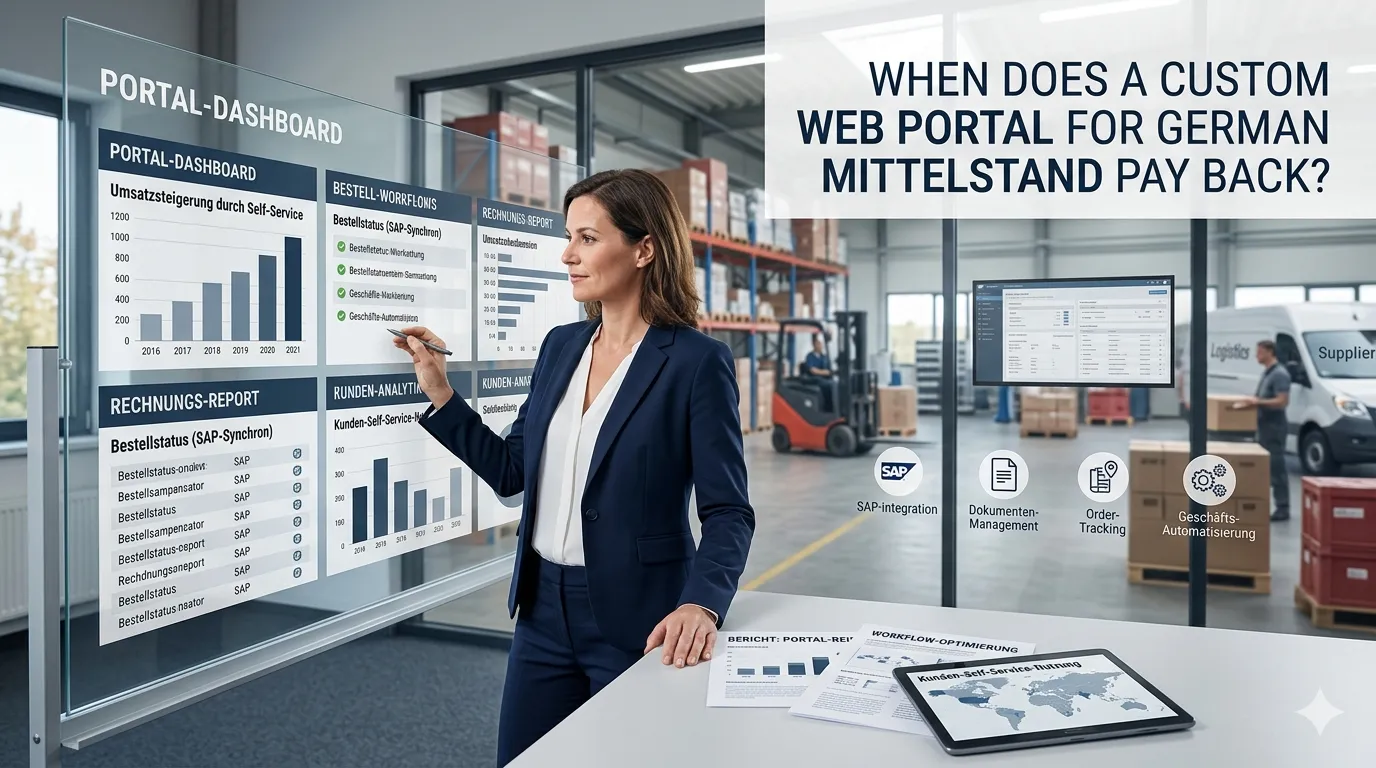
A custom web portal for German Mittelstand companies is one of the highest-ROI digital projects when the legacy customer experience is “email + phone + PDFs.” Most Mittelstand operations leaders know they need one. Few know how to scope, budget, or sequence it without buying into either over-engineered enterprise platforms or under-built portal-builder tools that don’t survive year two.
This guide gives you the build-vs-buy framing, the use cases where a custom portal pays back fastest, and realistic EUR budgets for German Mittelstand projects.
Why do Mittelstand companies build custom web portals?
The classic German Mittelstand customer experience: phone the sales rep, email a PDF order, wait for an email confirmation, get an invoice via post. It works — until competitors offer 24/7 self-service portals and start winning RFPs partly because of that.
Custom portals deliver value across five common workflows:
- Customer self-service. Order history, invoices, shipment tracking, document downloads, support tickets.
- B2B catalogue with customer-specific pricing. Each customer sees their negotiated price, volume tiers, contract catalogue.
- Supplier collaboration. Inbound suppliers submit quotations, manage delivery schedules, exchange documents.
- Dealer / reseller management. Multi-tier sales channels with regional pricing, sales territory rules, co-marketing materials.
- Internal operations. Custom tools for sales, operations, customer service — sometimes the highest ROI is internal-facing.
Each one has different complexity and budget. Don’t try to build all five in V1.
Build vs buy: when does each win?
Buy when:
- Workflow fits Salesforce Communities, SAP CX, HubSpot Customer Portal, or similar
- You’re under 200 active portal users
- Limited customisation required (mostly content + branding)
- Budget is firmly under €25,000
Build custom when:
- Existing SAP / proprietary ERP needs deep integration
- Customer-specific pricing rules are complex
- GoBD-compliant audit trails for B2B transactions are required
- Multi-language with localised contract documents matters
- 3-year TCO of off-the-shelf exceeds €60,000 once seat licences scale
For most Mittelstand projects above €50,000 of customisation, building wins on flexibility, control, and long-term cost.
What are realistic EUR budgets for Mittelstand portal projects?
Honest 2026 ranges:
| Portal type | Budget range | Timeline | Users |
|---|---|---|---|
| Basic customer portal | €25,000 – €60,000 | 12–18 weeks | 50–500 |
| Customer + supplier portal | €60,000 – €120,000 | 18–28 weeks | 500–2,000 |
| Dealer / multi-tier sales portal | €80,000 – €180,000 | 22–36 weeks | 1,000–10,000 |
| Full Mittelstand B2B platform | €150,000 – €400,000 | 9–18 months | 5,000+ |
For broader budget context, see our Web Development Cost Germany 2026 guide.
What five use cases pay back fastest?
1. Invoice & Order History (Customer Self-Service)
Customer logs in, sees all invoices and orders, downloads PDFs, queries unpaid items. Customer service ticket reduction: typically 25–40%.
2. Quote Request → Quotation Workflow
Customer requests quote → automated routing → sales rep responds → versioned quotation → customer accepts. Lead-to-quote time: typically halved.
3. Shipment Tracking with Live ERP Sync
Customer sees real-time status pulled from TMS / ERP. Reduces “Where’s my order?” calls by 40–60% in logistics-heavy businesses.
4. Document Repository
Drawings, specs, contracts, certificates, AGB — all accessible to the right user with audit trail. Replaces 90% of email attachments.
5. Internal Operations Tool
Custom dashboard for sales or operations team. Often the highest ROI because internal users use it daily.
How does SAP integration actually work?
Many Mittelstand companies run on SAP Business One, S/4HANA, or older ECC systems. Integration realities:
- Mature APIs in modern SAP. S/4HANA exposes OData APIs for most master data and transactional flows.
- Legacy SAP (older ECC). Often requires middleware (SAP PI/PO, custom RFC connectors) or direct DB access.
- Microsoft Dynamics, Sage, ABAS — each has its own integration patterns; budget more for less-popular ERPs.
- Real-time vs batch sync. Most portals work fine with hourly sync for non-critical data; real-time only where genuinely needed.
Budget €10,000–€40,000 for SAP integration depending on system version and complexity. Don’t accept “we’ll figure it out” — get the integration scoped specifically.
How does Datev / Lexware / Sevdesk integration work?
For Mittelstand operations, accounting integration is usually part of the portal scope:
- Datev: customer master data sync, invoice export, payment status sync. Official APIs exist (DATEV-Schnittstelle).
- Lexware Office: REST API for SMBs. Lighter than Datev but functional for smaller Mittelstand.
- Sevdesk: modern REST API, easiest of the three to integrate.
- GoBD compliance: ensure audit trails meet 10-year retention with immutable change history.
For Datev specifics, see our Custom CRM Development for German SME guide.
How do authentication and SSO work for a Mittelstand portal?
Mittelstand portals typically need SSO from day one:
- Microsoft 365 / Azure AD — most common for German Mittelstand customers
- Google Workspace — for tech-forward customers
- Self-hosted Keycloak — for companies wanting full control of identity
- Auth0 / Clerk — fastest setup, managed service, GDPR-friendly EU regions
For B2B portals, consider supporting customer-side SSO too — large enterprise customers may require federation with their own Azure AD or Okta.
What’s the tech stack for Mittelstand portals in 2026?
Our default stack for these projects:
- Backend: NestJS or Laravel for business logic
- Frontend: Next.js + TypeScript + Tailwind
- Database: PostgreSQL on Hetzner Frankfurt (GDPR-friendly)
- Auth: Auth0 / Clerk managed, or Keycloak self-hosted
- Hosting: Hetzner Cloud or AWS Frankfurt with ISO 27001 operator
- Monitoring: Sentry + Grafana Cloud
- CI/CD: GitHub Actions + automatic preview deployments
This stack delivers performance, GDPR data residency, and DACH developer hireability.
How does a phased delivery approach work?
Big-bang portal launches fail. The pattern that works:
- Phase 1 (10–14 weeks): Core authentication, customer profile, order history, invoice download. Ship to 20 pilot users.
- Phase 2 (8–10 weeks): Quote workflow, document repository, support tickets. Expand to all customers.
- Phase 3 (10–12 weeks): Advanced features per usage data — supplier portal, multilingual, custom catalogues.
- Phase 4 (ongoing): Optimisation, new features, regulatory updates.
Each phase ships a usable product. Each phase has measurable ROI.
What does a custom portal actually save in ROI?
For a typical 50-person Mittelstand operation serving 500 B2B customers:
- Customer service tickets: -30% = ~€60,000/year saved in support time
- Sales rep time on routine order queries: -25% = ~€40,000/year
- Faster quote turnaround: 10–15% revenue uplift on RFPs won
- Accounting reconciliation (Datev integration): ~10–15 hours/week saved
- Reduced PDF email volume / IT support: ~€10,000/year
Total quantifiable ROI: often €150,000–€350,000/year for a €100,000 build. Payback within 6–12 months is normal.
What German-specific compliance layer is required?
Mittelstand portals invariably need:
- GDPR / DSGVO compliance baked in (consent, AVV with hosting, data minimisation)
- GoBD audit trails for any financial transaction touchpoint
- BFSG accessibility if the portal is consumer-facing
- Datenschutzerklärung and Impressum updated for portal scope
- AVV with SAP / Datev / hosting vendors
Treat compliance as a Week 1 discovery item, not a Week 20 audit.
What common mistakes do Mittelstand companies make?
Five patterns we see fail:
- Building too many features in V1. Ship 5 features well, learn, iterate.
- No internal product owner. Operations needs to own the project, not IT.
- Underestimating SAP integration effort. Get this scoped with real SAP architects, not “we’ll figure it out”.
- Treating compliance as a Week 20 audit. GoBD and DSGVO are Week 1 work.
- Skipping pilot user feedback. Internal demos don’t replace 20 real customers using the portal for a month.
How do you choose an agency for a Mittelstand portal project?
Specific vetting for portal projects:
- “Show me a Mittelstand portal you’ve delivered. What was the SAP integration approach?”
- “How do you handle Datev / Lexware integration with audit trail requirements?”
- “What’s your discovery process for understanding existing operational workflows?”
- “How do you structure phased delivery to minimise risk?”
Agencies who’ve done Mittelstand work answer specifically. Agencies who’ve only done SaaS or B2C consumer sites usually struggle with the integration depth.
Frequently asked questions about custom web portal for German Mittelstand
Custom web app giving customers/suppliers/internal users self-service to workflows, typically with SAP/Datev integration.
Basic €25k–€60k. Customer+supplier €60k–€120k. Full B2B platform €150k–€400k+.
Basic 12–18 weeks, multi-feature 22–36 weeks, full platform 9–18 months. Phased delivery.
SAP integration. Duplicate data sources cause more problems. €10k–€40k typical effort.
Rarely. Mittelstand portals need complex logic and audit trails that fit poorly in WordPress.
One ops-side product owner. Phased delivery with pilots. SAP scoped upfront. Compliance Week 1.
Ready to scope a custom web portal for German Mittelstand?
For most Mittelstand operations, a custom portal pays for itself in 6–12 months once Phase 1 is live and customers start self-serving. The keys are realistic phased scope, deep DACH-aware integration capability (SAP / Datev / GoBD / DSGVO), and a partner who’s actually delivered for Mittelstand clients before.
If you’d like a discovery workshop for a portal project you’re considering, you can book a meeting with our team. Or browse our website development services for the broader delivery model.