Most Mittelstand companies end up considering custom CRM development for German SME workflows only after their third year of trying to bend Salesforce, HubSpot, or Pipedrive around a process the off-the-shelf tools weren’t designed for. By then, the team has accumulated workarounds, Excel exports, and three different spreadsheets the sales team trusts more than the CRM itself.
This guide walks through the honest build-vs-buy decision, the hidden costs of off-the-shelf systems for German SMEs (especially GoBD and Datev integration), and realistic budgets for custom CRM development — so a Mittelstand operations director or German GmbH founder can decide once and stop revisiting.
When do off-the-shelf CRMs stop working for German SMEs?
Salesforce, HubSpot, and Pipedrive are excellent tools — for the workflows they were designed for. The pain starts when a German SME has specific operational rules that don’t map cleanly:
- A B2B Mittelstand company with multi-step technical sales involving CAD attachments, quotation revisions, and Angebot tracking
- A service business with German Stundenzettel requirements and Datev-compatible export needs
- A wholesale distributor with regional pricing tiers, customer-specific catalogues, and Außendienst territory rules
- A regulated industry (healthcare, financial services) where data residency in Germany is non-negotiable
In each case, you can force-fit an off-the-shelf CRM, but the workarounds accumulate. Three years later you’re paying €40,000/year in licences for a tool the team avoids using.
Build vs buy: which decision tree fits your CRM?
Don’t build custom unless one of these is clearly true:
Reasons NOT to Build Custom
- Standard sales pipeline (lead → opportunity → close)
- Off-the-shelf CRM ships with what you need
- Fewer than 10 sales users
- No specialised compliance requirement
- Budget under €15,000
In these cases, HubSpot, Pipedrive, or Salesforce Essentials wins. Pay the licence, accept the constraints, save the engineering cost.
Reasons to Build Custom
- Multiple unique workflows you’ve documented across years
- Tight integration required with Datev, Lexware, Sevdesk, SAP Business One, or proprietary ERP
- GoBD-compliant audit trails and Steuerprüfung readiness needed
- Customer data must remain on German servers (medical, banking, public-sector clients)
- Existing tools’ licence costs are €30,000+/year and growing with headcount
- You’ve already built 6+ Zapier workflows trying to glue tools together
If three or more apply, a custom CRM development project pays back in 18–30 months, often sooner.
What are the hidden costs of cheap off-the-shelf CRMs?
The €25/user/month CRM looks cheap until you add up the year-3 reality:
- Licences (e.g., 15 users × €25/mo × 12) = €4,500/year
- Power-user upgrade for managers (×3 × €60/mo × 12) = €2,160/year
- Add-on integrations (Datev sync, document generation, e-signature) = €3,000–€8,000/year
- Premium support tier required for SLAs = €2,000–€6,000/year
- Internal admin time managing customisations = €10,000–€20,000/year
- Productivity loss from team avoiding the CRM (untracked) = often the biggest cost
Real 3-year TCO for a 15-person SME on a “cheap” off-the-shelf CRM: easily €60,000–€120,000.
A custom CRM development project quoted at €40,000–€80,000 with €1,500/month maintenance starts looking very different.
What do German SMEs specifically need a custom CRM for?
These are the use cases where building wins clearly for Mittelstand businesses:
- Datev / Lexware / Sevdesk integration. Two-way sync of customers, invoices, and payment status. Few off-the-shelf CRMs handle this cleanly. Custom can.
- GoBD-compliant document storage. Every customer interaction with regulatory implications captured, time-stamped, and exportable for Steuerprüfung.
- Angebot (quotation) workflow. Multi-revision quotations with versioning, approval chains, and PDF generation matching company AGB.
- Außendienst territory management. Sales reps assigned to regions, customers, or industries with strict access controls.
- Custom pricing logic. Customer-specific catalogues, volume discounts, contract pricing — easily 10x easier in a custom build than configured in Salesforce.
- Multilingual sales pipelines. DE/EN/FR/IT pipelines with locale-specific contract documents and tax rules.
What are realistic budgets for custom CRM development in 2026?
Honest 2026 EUR ranges for a German SME custom CRM build:
| Project tier | Budget range | What’s inside |
|---|---|---|
| Lean MVP CRM | €15,000 – €30,000 | Core pipeline, contact management, simple Datev export, single team |
| Mid-market build | €30,000 – €80,000 | Multi-user roles, quotation workflow, full Datev/Lexware sync, document generation, basic mobile |
| Mittelstand-scale | €80,000 – €200,000 | Multi-entity support, ERP integration, complex pricing rules, advanced reporting, mobile + offline |
| Enterprise / regulated | €200,000+ | Banking/healthcare-grade compliance, audit logs, SSO, custom workflows per business unit |
These are exclusive of VAT. For most Mittelstand operations, the mid-market range (€30k–€80k) is where the right balance of customisation and pragmatism sits.
For broader cost context, see our Web Development Cost Germany 2026 guide.
How does GoBD compliance shape a German SME CRM?
GoBD (Grundsätze zur ordnungsmäßigen Führung und Aufbewahrung von Büchern, Aufzeichnungen und Unterlagen in elektronischer Form) is the German tax authority’s framework for digital record-keeping. For any CRM touching sales, quotations, invoices, or customer financials, GoBD matters.
Practical implications:
- Immutable audit trails. Every change to a quote, customer record, or invoice timestamped and unmodifiable after the fact.
- 10-year retention. Records preserved with integrity for the German Aufbewahrungspflicht.
- Export readiness. GoBD-compliant export format (typically CSV/XML following the Beschreibungsstandard).
- No silent overwrites. Edits create new versions, not replacements.
Most off-the-shelf international CRMs are not GoBD-compliant out of the box. A custom build can be designed for GoBD from day one — and is often a major reason German SMEs build rather than buy.
Why is Datev / Lexware / Sevdesk integration make-or-break?
If your accounting runs through Datev (the dominant DACH accounting standard), Lexware, Sevdesk, or another German accounting system, CRM-accounting integration is a daily-pain test.
What good integration looks like:
- New customer in CRM → automatic creation in Datev with correct account assignment
- Invoice generated in CRM → matching Buchungssatz in Datev
- Payment received in Datev → status sync back to CRM
- Customer master data stays consistent without manual reconciliation
A typical custom CRM project budgets €5,000–€15,000 for Datev or Lexware integration alone — and saves the operations team 10+ hours per week.
How do you reduce risk with phased CRM delivery?
The biggest failure mode for custom CRM projects isn’t budget — it’s scope. Six-month “big bang” rebuilds are where SMEs lose €100,000+ on projects that never ship.
The pattern that works for German Mittelstand:
- Phase 1 (8–12 weeks): Core pipeline, contact management, basic reporting. Replace one off-the-shelf tool. Ship to 5 users.
- Phase 2 (8 weeks): Datev / Lexware integration. Quotation workflow. Onboard full sales team.
- Phase 3 (10 weeks): Custom workflows, mobile, advanced reporting. Add operations and management dashboards.
- Phase 4 (ongoing): Optimisation, new features, regulatory updates.
Each phase ships a usable product. Each phase delivers ROI. The team’s feedback shapes phases 2+, so you don’t build features no one asked for.
What tech stack should a custom CRM use in 2026?
For a German SME custom CRM, our default stack is:
- Backend: Node.js + NestJS or Laravel (mature, German developer pool available)
- Database: PostgreSQL on Hetzner Cloud (Frankfurt, GDPR-friendly, ISO 27001 partners)
- Frontend: Next.js + React + TypeScript, deployed on Vercel (or self-hosted on Hetzner)
- Auth: Auth0, Clerk, or self-hosted Keycloak for SSO with Microsoft 365 / Google Workspace
- Integrations: Direct Datev/Lexware/Sevdesk APIs, plus a webhook-driven sync layer
- Email & calendar: Microsoft Graph or Google Workspace API
- Document generation: Server-side PDF rendering for Angebote, invoices, contracts
- Monitoring: Sentry for errors, Grafana Cloud for metrics, GDPR-aware logging
This stack delivers performance, GDPR-friendly data residency, and a developer pool that’s available in both Germany and English-first nearshore markets.
How does a custom CRM pay back for a German SME?
The ROI math typically works like this for a 15-person Mittelstand operations team:
- Time saved in CRM data entry and reconciliation: 8 hours/week × 12 people = 96 hours/week
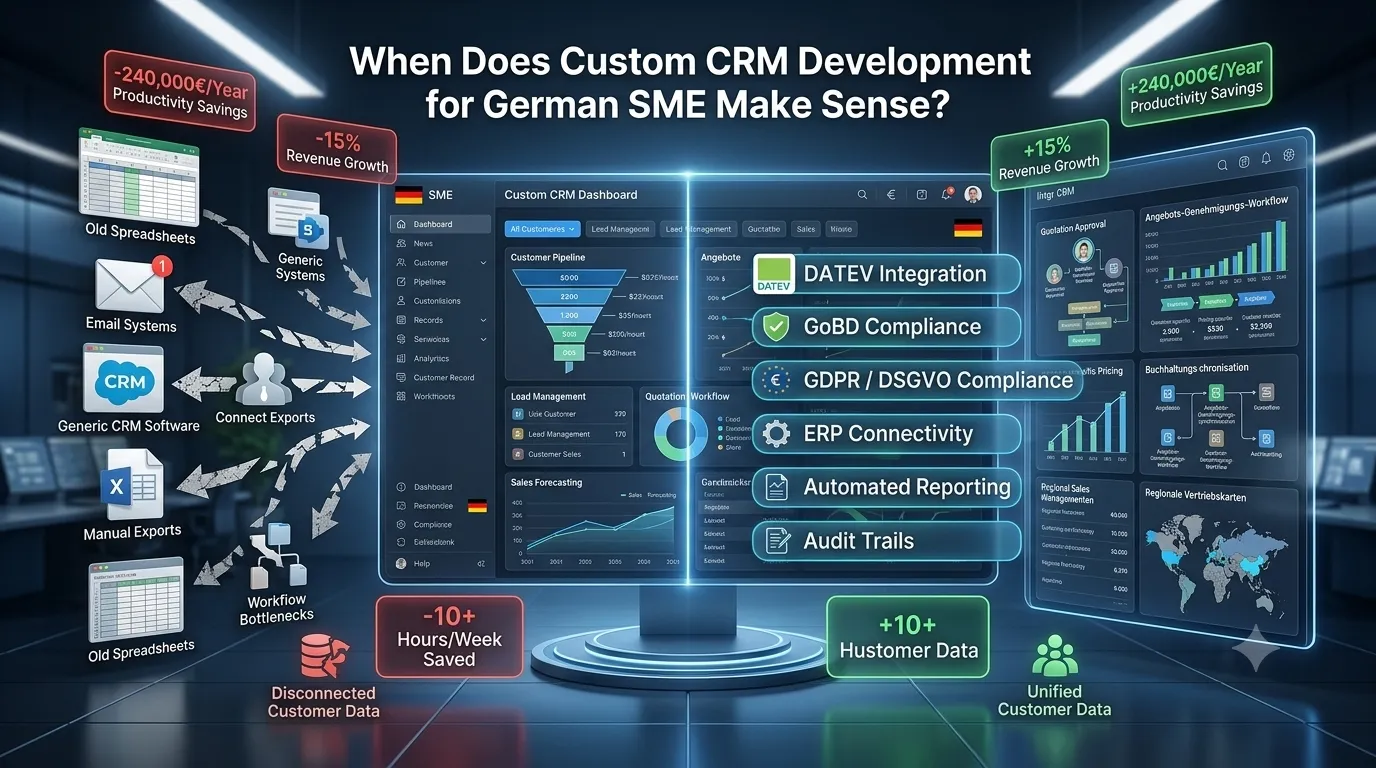
- At €50/hr loaded cost: €4,800/week × 50 weeks = €240,000/year saved in productivity
- Datev integration alone: 10–15 hours/week of accounting reconciliation eliminated
- Avoided licence cost vs scaling Salesforce: €15,000–€40,000/year
- Lost-deal recovery from better pipeline hygiene: typically 5–15% revenue uplift
Even using conservative numbers, a €60,000 custom CRM build pays back inside 12 months. The qualitative benefit — a team that actually uses the system — is usually the bigger story.
How do you run a custom CRM discovery sprint?
The right way to start: a 2-week discovery sprint before any code is written.
- Day 1–3: Workshops with sales, operations, customer service, accounting
- Day 4–6: Process mapping. What happens today, where are the friction points?
- Day 7–9: Off-the-shelf gap analysis. What can we get from HubSpot/Salesforce and what genuinely needs custom?
- Day 10: Scope document. Phased plan. Realistic budget bracket.
Cost: €5,000–€12,000. Result: a document the leadership team can decide from, with no commitment to build yet. Most German SMEs make the build/buy decision more confidently with this artefact.
What common mistakes do German SMEs make on custom CRM projects?
Five patterns we see fail repeatedly:
- Building too many features in Phase 1. Ship small, learn, then expand. The features the team uses in month 6 are rarely the ones they predicted in month 1.
- No designated internal product owner. Custom CRM needs a single person with authority to make scope calls.
- Skipping Datev integration to “save money”. Then spending €30,000 over two years on accounting workarounds.
- Treating it as IT, not operations. A CRM is a business tool. The buyer should be operations, not IT.
- Hiring developers who don’t know DACH compliance. GoBD, GDPR, AVV — all real requirements that an offshore team without DACH experience misses.
Frequently asked questions about custom CRM development for German SME
Off-the-shelf wins for under 10 users on standard pipelines. Build for Datev, GoBD, German-specific workflows, or €30k+/year fit issues.
Lean MVPs €15k–€30k. Mid-market €30k–€80k. Enterprise/regulated €100k–€250k+. Budget 15–20% extra for year-one maintenance.
Phase 1: 8–12 weeks. Mid-market full build: 6–9 months. Mittelstand with deep ERP integration: 12–18 months.
German digital record-keeping framework. Needs immutable audit trails and 10-year retention. International CRMs rarely meet GoBD natively.
Yes via official APIs. Costs €5k–€15k and saves 10+ hours/week in operations.
Node.js/NestJS or Laravel, PostgreSQL on Hetzner Frankfurt, Next.js + TypeScript, Auth0/Keycloak SSO.
Run a 2-week discovery, build in phases, assign one ops-side owner, hire DACH-experienced devs, don’t skip Datev.
Ready to scope custom CRM development for German SME?
For most Mittelstand businesses, custom CRM development is the right answer when off-the-shelf tools have stopped fitting the workflow — and the workarounds are costing more than a custom build would. The payback is rarely from feature richness; it’s from a tool the team actually uses every day.
If you’d like to scope whether a custom CRM makes sense for your business, you can book a 30-minute discovery call with our team. We design CRMs specifically for DACH operations with native Datev integration and GoBD compliance built in. Or explore our website development services page for our broader delivery model.