
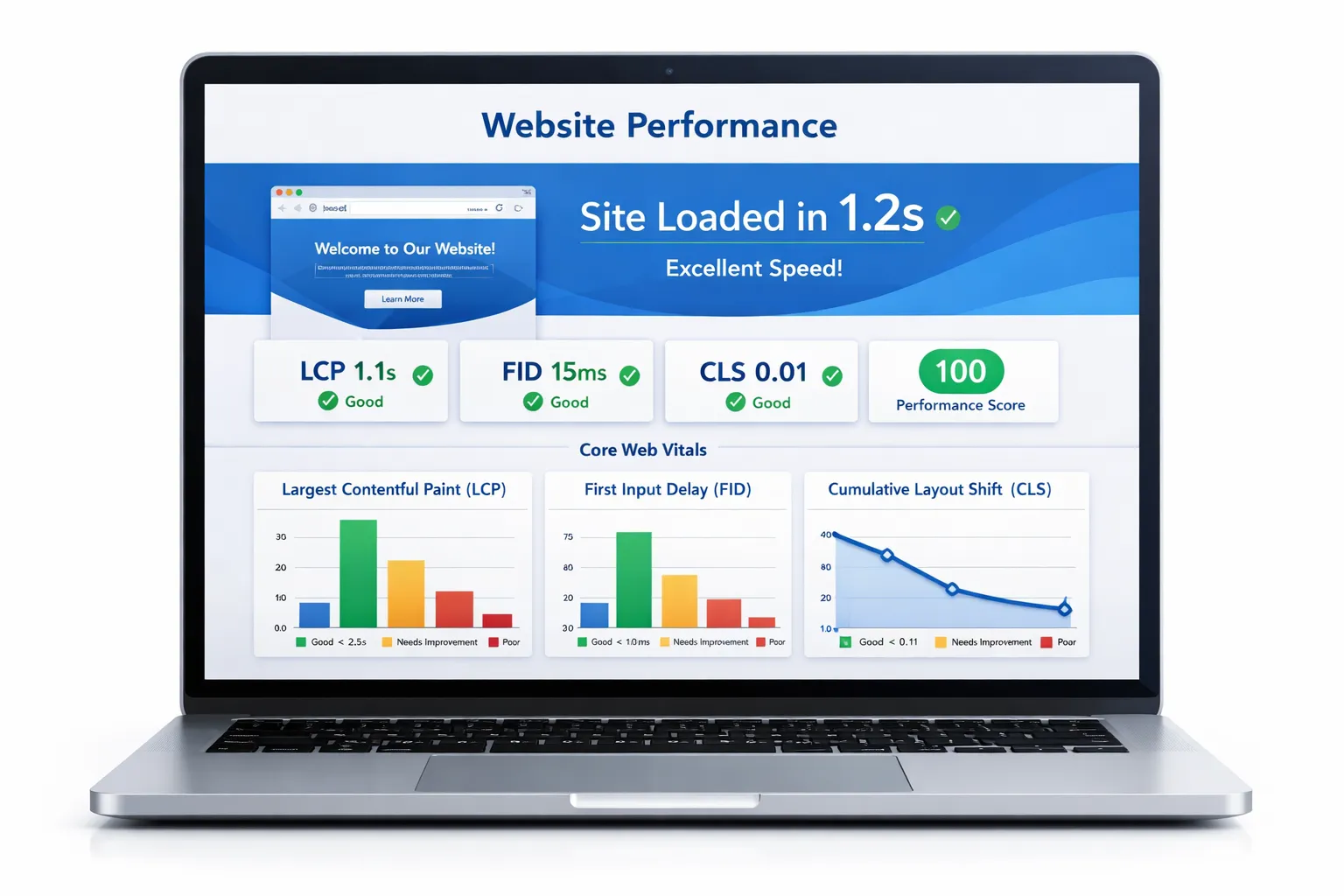
In today’s digital environment, users do not wait. They do not analyze. They do not give second chances. The moment someone clicks on your website, a silent judgment begins. Within seconds, they decide whether to stay or leave, and that decision is heavily influenced by how fast your website loads.
This is where website speed and SEO become deeply connected. A slow website does not just reduce performance—it damages your entire digital presence. It affects how search engines rank your pages, how users perceive your brand, and how effectively your website converts visitors into customers.
Many businesses invest heavily in design, ads, and content, but ignore speed. The result is simple: traffic comes, but conversions do not. Rankings fluctuate, but growth does not happen. The missing piece in most cases is performance.
Website speed is not just a technical factor anymore. It is a business growth driver.
What Website Speed Really Means in Modern SEO
Website speed is often misunderstood as just page load time, but in reality, it is a combination of multiple performance signals that together define user experience. A website might appear visually loaded but still feel slow if users cannot interact with it immediately.
Modern SEO considers speed through real user experience metrics. It measures how quickly content appears, how fast users can interact, and how stable the layout remains during loading. These factors shape the perception of quality and reliability.
When a website responds quickly, it creates a smooth and frictionless experience. When it delays, even slightly, it introduces hesitation. That hesitation directly impacts user behavior and ultimately business outcomes.
Why Website Speed Is a Ranking Factor in Search Engines
Search engines aim to deliver the best possible experience to users. A slow website contradicts that goal. This is why speed has become an essential ranking factor, especially after the introduction of Core Web Vitals.
Google evaluates how real users experience your website. If your pages take too long to load or feel unresponsive, your rankings can suffer even if your content is strong.
A fast website signals efficiency, reliability, and quality. A slow website signals poor optimization and weak user experience. Over time, Search Engine Optimization websites that consistently deliver better performance.
From an SEO perspective, speed influences not just rankings but also how efficiently your site is crawled and indexed. Faster websites allow search engines to process more pages in less time, increasing your chances of visibility.
The Direct Connection Between Speed and User Behavior
User behavior is highly sensitive to speed. People expect instant access to information, and any delay creates friction. That friction leads to frustration, and frustration leads to exits.
When a website loads quickly, users feel in control. They navigate smoothly, explore more pages, and engage with content. When it loads slowly, they feel resistance. Even before reading anything, they are already considering leaving.
This behavioral shift is critical because search engines track user signals. High bounce rates, low dwell time, and poor engagement are all indicators that your website is not meeting expectations. These signals can indirectly impact your SEO performance.
Speed shapes behavior, and behavior shapes rankings.
How Website Speed Impacts Conversions and Revenue
From a business perspective, the most important impact of website speed is on conversions. Every second of delay reduces the likelihood that a user will take action.
A fast website creates momentum. Users move quickly from interest to action. They trust the process, feel comfortable navigating, and complete desired actions such as signing up or making a purchase.
A slow website breaks that momentum. It introduces doubt. Users begin to question reliability, security, and professionalism. Even if your offer is strong, the experience weakens its impact.
Conversion is not just about what you offer. It is about how smoothly users can access it.
Key Conversion Impacts of Slow Speed:
- Users leave before the page fully loads
- Call-to-actions are never seen
- Checkout processes feel unreliable
- Mobile users abandon sessions faster
- Trust decreases due to poor performance
The Relationship Between Speed, UX, and Trust
User experience and speed are not separate elements. They are deeply connected. A fast website enhances usability, while a slow website disrupts it.
When users interact with a fast website, everything feels natural. Pages respond instantly, navigation is smooth, and actions feel effortless. This creates a sense of professionalism and trust.
On the other hand, a slow website feels broken. Even small delays can make users think something is wrong. This perception directly affects how they view your brand.
Trust is not built only through design or content. It is built through experience. Speed is one of the strongest experience signals.
Core Web Vitals: The Metrics That Define Performance
Core Web Vitals are Google’s way of measuring real user experience. These metrics focus on loading performance, interactivity, and visual stability. They provide a clear framework for understanding how users perceive your website.
Instead of focusing only on technical performance, Core Web Vitals emphasize how performance feels to the user. This shift has changed how websites are optimized.
A website that scores well on these metrics is not just fast—it feels fast.
Core Web Vitals Include:
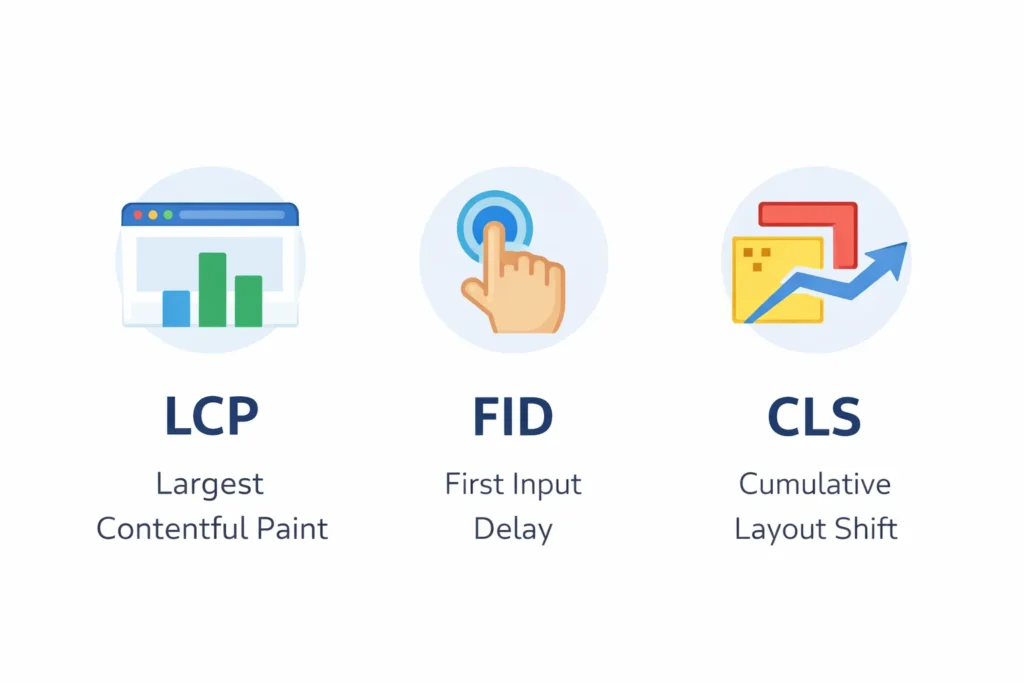
- Largest Contentful Paint (LCP) – measures loading speed
- First Input Delay (FID) – measures interactivity
- Cumulative Layout Shift (CLS) – measures visual stability
Common Reasons Why Websites Become Slow
Most performance issues come from avoidable mistakes. Businesses often prioritize design and features without considering their impact on speed.
Heavy visuals, unoptimized code, and poor hosting decisions are some of the most common reasons behind slow websites. Over time, these issues accumulate and create noticeable delays.
Another major issue is the lack of performance testing. Many websites are launched without proper speed audits, which leads to hidden problems affecting both SEO and Conversion Rate.
Common Speed Issues:
- Large, uncompressed images
- Excessive plugins and scripts
- Poor hosting infrastructure
- No caching implementation
- Too many HTTP requests
- Lack of mobile optimization
Advanced Strategies to Improve Website Speed
Improving website speed requires a strategic approach. It is not about applying one fix but optimizing multiple layers of performance.
The first step is identifying bottlenecks. Once you understand where delays are coming from, you can apply targeted improvements that deliver measurable results.
Modern optimization focuses on both frontend and backend performance. This includes improving how content is delivered, how code is executed, and how quickly servers respond.
Effective Speed Optimization Techniques:
- Compress and properly size all images
- Use modern formats like WebP
- Minify CSS, JavaScript, and HTML
- Enable browser and server caching
- Use a Content Delivery Network (CDN)
- Reduce render-blocking resources
- Optimize server response time
- Limit unnecessary plugins
Mobile Speed: The Most Critical Factor Today
Mobile performance is now more important than desktop. Most users access websites through mobile devices, and search engines follow a mobile-first indexing approach.
This means your mobile website determines your overall SEO performance. If your mobile experience is slow or unresponsive, it directly affects rankings and conversions.
Mobile users are also less patient. They are often browsing on the go, with limited time and attention. A delay of even a few seconds can cause them to leave instantly.
Optimizing for mobile speed is no longer optional. It is essential.
How to Measure and Monitor Website Speed
You cannot improve what you do not measure. Regular performance analysis is necessary to maintain speed and identify new issues.
Professional tools provide detailed insights into how your website performs under real conditions. They highlight problem areas and offer actionable recommendations.
Monitoring should not be a one-time task. As your website grows, new elements can impact performance, making continuous optimization important.
Recommended Tools:
- Google PageSpeed Insights
- GTmetrix
- Lighthouse
Strategic Advantage: Why Speed Gives You a Competitive Edge
Most businesses overlook website speed. This creates an opportunity for those who prioritize performance.
A faster website stands out instantly. It creates a better first impression, delivers a smoother experience, and builds trust more effectively than slower competitors.
When everything else is equal—price, product, service—speed becomes the deciding factor.
It is one of the few areas where small improvements can create significant competitive advantages.
Conclusion
Website speed is no longer just a technical detail. It is the foundation of SEO, user experience, and conversions. It influences how users interact with your website and how search engines evaluate its quality.
A fast website creates trust, improves engagement, and increases conversions. A slow website does the opposite. It pushes users away, reduces visibility, and limits growth.
If you want to improve rankings, increase conversions, and build a strong online presence, optimizing website speed and SEO should be your top priority.
Faqs
Website speed affects SEO by improving user experience, reducing bounce rates, and helping search engines crawl efficiently, which leads to better rankings and increased organic traffic.
A good website load time is under three seconds, ensuring users can access content quickly and interact without delays, improving engagement and conversions.
Slow websites frustrate users, delay interactions, and reduce trust, causing visitors to leave before completing actions like purchases or form submissions.
Core Web Vitals are performance metrics that measure loading speed, interactivity, and visual stability to evaluate user experience on a website.
You can improve speed by optimizing images, reducing scripts, enabling caching, using a CDN, and improving hosting performance.
Yes, mobile speed is critical due to mobile-first indexing, meaning Google primarily uses the mobile version of your website for ranking.
Tools like Google PageSpeed Insights, GTmetrix, and Lighthouse help analyze performance and provide recommendations for improving speed and user experience.