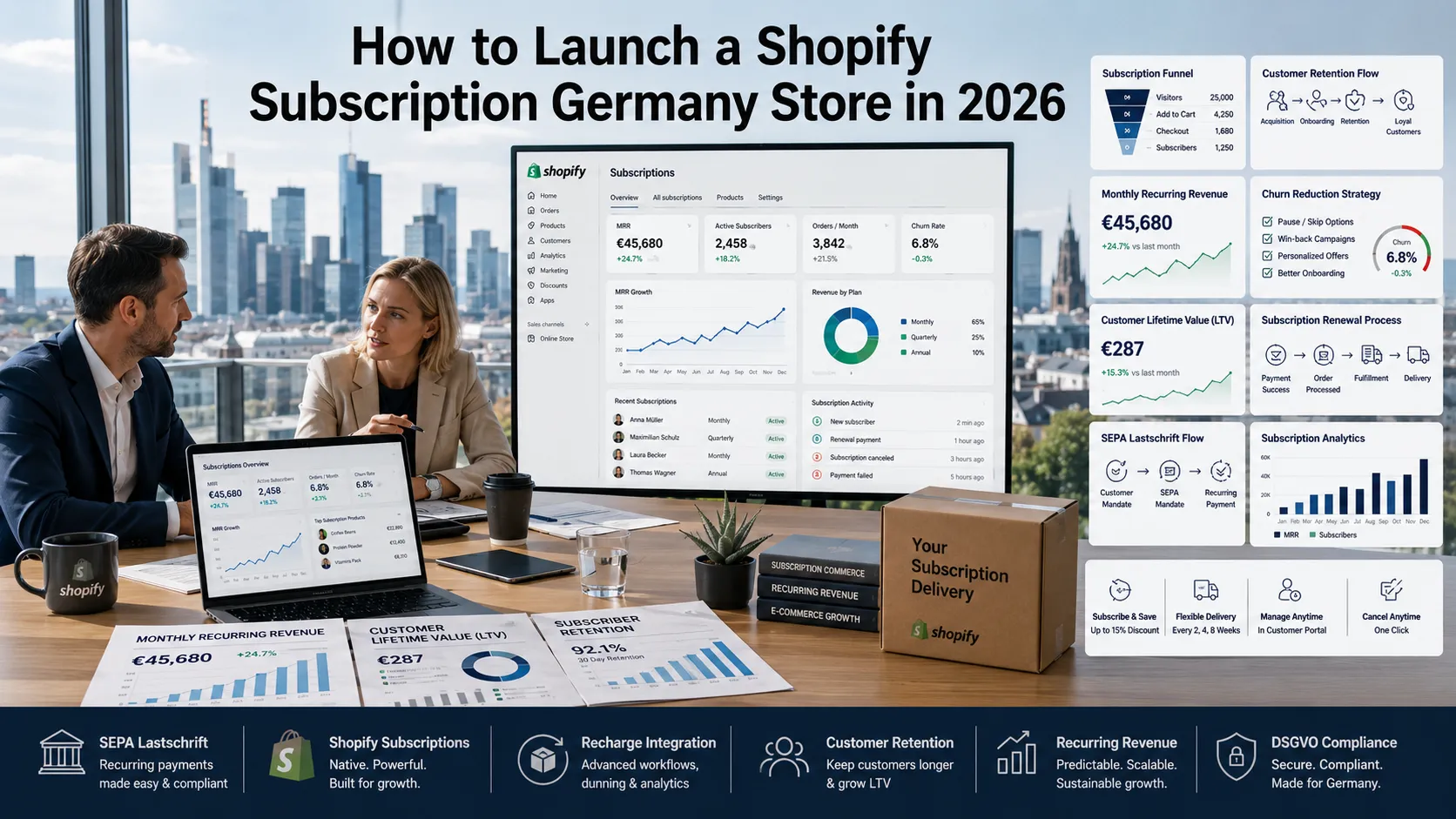
Shopify subscription Germany is one of the strongest business models a German brand can build — recurring revenue, predictable cash flow, higher customer lifetime value, lower acquisition cost per dollar of revenue. From “subscribe and save” consumables to curated boxes to digital memberships, subscription patterns work across most product categories.
This guide walks through what Shopify subscription Germany setup actually requires in 2026: native Shopify Subscriptions vs. Recharge vs. Bold, recurring SEPA Lastschrift handling, German legal compliance for subscriptions, churn management, and realistic EUR build costs.
What subscription patterns work in Germany in 2026?
Five common patterns:
Consumables: “Subscribe and Save”
Products customers reorder regularly (coffee, supplements, cleaning, pet food, beauty). Subscribe → automatic delivery at intervals → 10–15% discount.
Curated boxes
Monthly delivery of curated products (book club, wine club, beauty subscription, snack subscription).
Replenishment
Predictable consumption products (razor blades, contact lenses, water filters). Delivered before customer runs out.
Membership / digital
Access to premium content, community, course library. Combine with our membership website Germany and LMS course platform Germany guides.
SaaS-style subscriptions
For brands selling digital tools, ongoing services, software. Often handled via Shopify Subscriptions + custom apps.
For physical products: focus on consumables + curated boxes first.
What subscription tools work on Shopify in 2026?
Shopify Subscriptions (native)
Launched 2022, matured significantly. Free for stores; transaction fees standard. Native checkout integration. SEPA + PayPal + cards all supported.
Pros: native integration, no separate vendor, free. Cons: less feature-rich than Recharge, fewer subscription-specific tools. Best for: simple subscription patterns, smaller stores starting subscriptions.
Recharge
Most popular Shopify subscription app. Mature, feature-rich. Strong customer portal, advanced flow logic.
Pros: best-in-class subscription features, strong analytics, robust customer portal. Cons: monthly fee + transaction fees, third-party vendor. Best for: subscription-heavy brands needing full feature set.
Pricing: ~€60–€200+/month plus % per transaction.
Bold Subscriptions
Mature alternative to Recharge. Less polished UX but capable.
Pricing: ~€50–€200/month.
Loop Subscriptions
Newer, gaining traction. Modern UX. Good for brands building subscription product from scratch.
For most German Shopify brands launching subscriptions in 2026:
- Starting out / simple: Shopify Subscriptions (native)
- Subscription is core business: Recharge
- Complex needs (membership + product): custom build or Recharge + custom apps
How does recurring SEPA Lastschrift work for subscriptions?
Critical for German market:
Initial mandate
Customer subscribes → enters IBAN → signs SEPA mandate → first charge processed.
Subsequent charges
Same mandate reused. Charges happen automatically at subscription interval. Customer doesn’t re-enter IBAN.
Mandate management
Customers can view + revoke mandate in their account. Plus B2B has Company-level mandate management.
Failed payments
Rücklastschrift (insufficient funds, account closed). Retry logic varies by tool. Recharge has sophisticated dunning; Shopify Subscriptions has basic retry.
Compliance
Each SEPA charge requires creditor identifier (Gläubiger-ID) + unique mandate reference. Shopify Payments / Mollie handle this automatically.
For SEPA depth see our Shopify SEPA Lastschrift Germany guide.
What German legal requirements apply to subscriptions?
Six considerations:
Widerrufsrecht for first subscription order
First-time subscription is a purchase. 14-day right of withdrawal applies. Customer can cancel within 14 days for full refund.
Cancellation flow
German consumer law requires easy cancellation. “Kündigungsbutton” recently required for B2C subscriptions per § 312k BGB — customers must be able to cancel via clear button on the website.
Renewal disclosures
Customer must be informed of: next renewal date, amount, cancellation window. Reminder email common pattern.
Price changes
For ongoing subscriptions, price increases require notice + customer consent (typically opt-in for new price OR cancellation right).
Documentation of consent
Subscribe consent + SEPA mandate + first-order consent all stored with timestamp.
Pause and skip options
Not legally required but customer-friendly. Reduces churn.
What does Shopify subscription setup cost in Germany?
Shopify Subscriptions native
- Setup: €2,000–€8,000 with German agency
- Time: 2–6 weeks
- Free app, transaction fees standard
Recharge integration
- Setup: €4,500–€18,000
- Monthly: ~€60–€200+ + transaction fees
- Time: 4–10 weeks
Custom subscription flow
For unique subscription models:
- €18,000–€80,000+
For broader cost see our Shopify cost Germany guide.
How do you set up Shopify subscriptions step by step?
For native Shopify Subscriptions:
Step 1: Enable Shopify Subscriptions app
Free from Shopify App Store.
Step 2: Configure subscription products
Select products eligible for subscription. Configure: discount %, delivery interval (weekly, bi-weekly, monthly, every 2 months, custom).
Step 3: Configure customer portal
Customer can view subscriptions, change frequency, skip, pause, cancel.
Step 4: Configure German legal flow
- Klare Kündigungsbutton (§ 312k BGB)
- Widerrufsrecht for first order
- Pre-renewal notification email
- Subscription terms in AGB
Step 5: Configure SEPA mandate flow
Customer enters IBAN → signs mandate → first charge.
Step 6: Configure email flows
- Welcome subscriber email
- Pre-renewal reminder (3 days before)
- Charge confirmation
- Cancellation confirmation
- Win-back for cancelled subscriptions
Step 7: Set up customer service tools
For team to handle: pause requests, cancellation requests, payment failures.
Step 8: Test end-to-end
Create test subscription with each payment method. Verify recurring charges, customer portal, emails.
How do you manage subscription churn?
Five tactics:
Easy cancellation
Counterintuitive: making cancellation easy correlates with lower long-term churn. Customers who feel trapped post-angry-reviews.
Pause / skip options
“Pause for 30 days” or “Skip next delivery” prevents many full cancellations.
Win-back flows
Email cancelled subscribers 30 / 60 / 90 days later with discount or new product reveal.
Dunning management
For failed payments, smart retry (3–7 days) + customer email + grace period. Recharge has sophisticated dunning; native Shopify Subscriptions less so.
Periodic upgrade prompts
“You’ve been subscribed 6 months — try our premium box for the same price for 3 months.”
What are common subscription mistakes German brands make?
Five patterns:
Skipping Kündigungsbutton
§ 312k BGB requires it for B2C subscriptions. Forgetting = legal risk.
Auto-translating subscription product copy
Confusing customers. Use native German for subscription product pages.
Aggressive cancellation friction
Making cancellation hard. Backfires via negative reviews + Verbraucherzentrale complaints.
Underestimating dunning
Failed payments without thoughtful retry = unnecessary churn.
Not segmenting subscribers
Treating all subscribers as one cohort. Loyal long-term subscribers want different communications than new ones.
When should you use Recharge over Shopify Subscriptions?
Five signals for Recharge:
- Subscription is core business model (40%+ revenue)
- Need advanced flows (customer-specific bundles, complex schedules)
- Need sophisticated dunning
- Want best-in-class subscription analytics
- Already at scale where the monthly fee is small vs. value
For most starter subscriptions: Shopify native suffices.
What about hybrid product + subscription brands?
Common pattern: brand sells one-time products + subscription-based replenishment of same products.
Shopify Subscriptions native + Recharge both handle this via the “Subscribe and Save” toggle on product pages.
Most successful German subscription brands have: 50–70% subscription revenue, 30–50% one-time. The subscription locks in repeat customers; the one-time captures impulse buyers.
Frequently asked questions
Yes via Shopify Payments or Mollie.
Native Shopify Subscriptions for simple; Recharge for subscription-core.
EUR 2k to 80k+ depending on tool and customization.
Yes for B2C subscriptions per section 312k BGB.
Yes for the first order; renewals usually not new contracts.
Easy cancellation, pause/skip, win-back flows, smart dunning, upgrade prompts.
5 to 15 percent monthly is typical.
Yes for simple memberships; WordPress plus MemberPress for complex.
Need help launching subscriptions?
If you’re scoping subscription commerce on your German Shopify store and want a 30-minute conversation about tool choice, churn strategy, or SEPA setup, book a meeting or send details via our contact page.
Need expert help? Gem Programmers provides Shopify store development for businesses in Germany, Austria and Switzerland. Request a free, no-obligation quote and get a clear plan with scope, timeline and price.