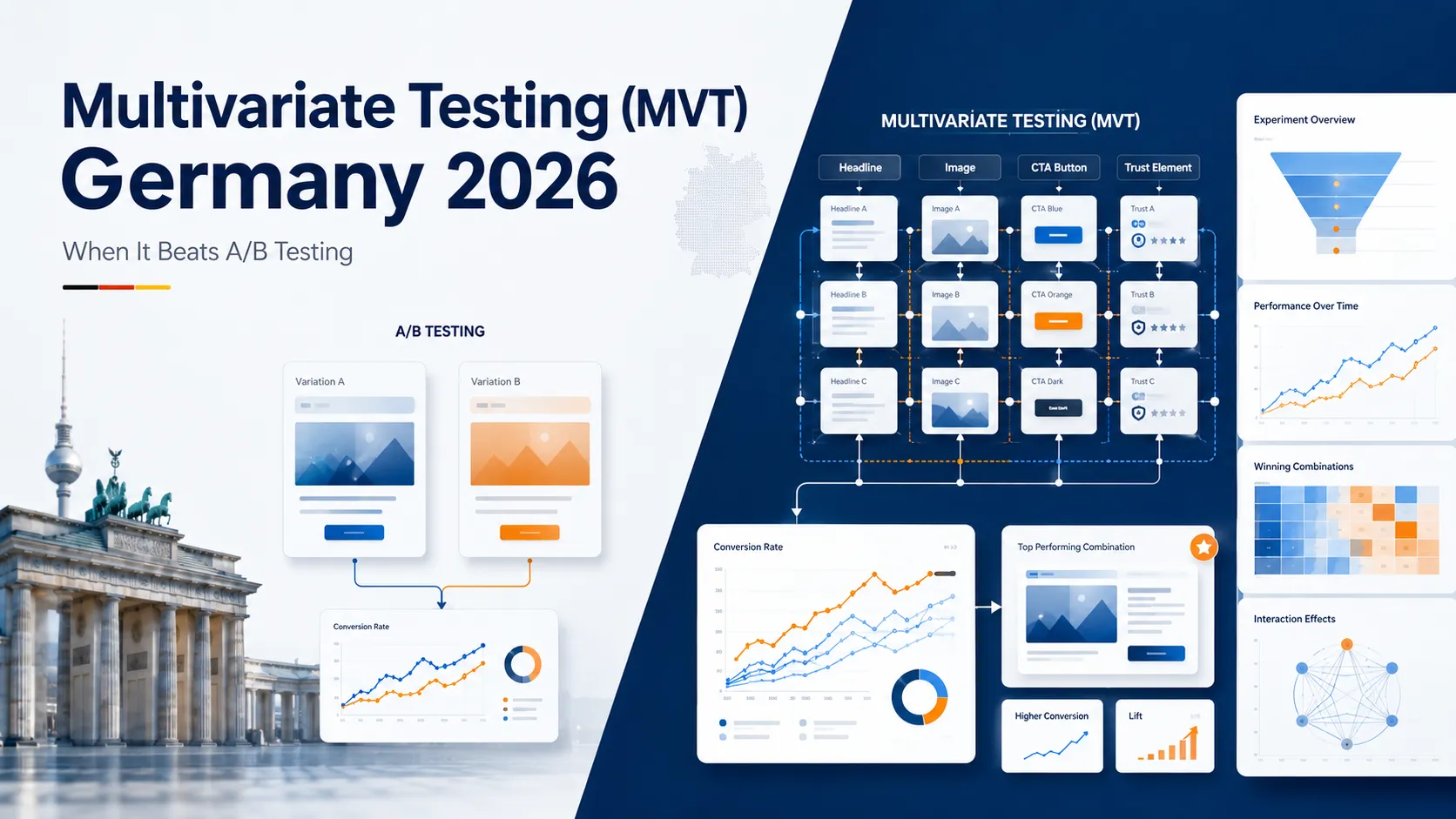
Multivariate testing (MVT) tests multiple variations of multiple elements simultaneously, revealing interaction effects between changes. Sounds powerful — and is, in specific scenarios. But MVT requires substantial traffic + careful design + statistical sophistication. For most German businesses in 2026, sequential A/B testing beats multivariate.
This guide walks through what multivariate testing for German websites actually requires in 2026: when MVT beats A/B, traffic requirements, design considerations, common pitfalls, and MVT vs sequential testing trade-offs.
For broader A/B testing see our A/B testing Germany guide.
What is multivariate testing?
A/B testing tests one variable change. MVT tests multiple variables simultaneously:
Example MVT setup
Testing 3 elements with 2 variants each:
- Headline: A or B
- CTA: A or B
- Hero image: A or B
Total combinations: 2 × 2 × 2 = 8 variants tested simultaneously.
Result
Identifies winning combination + reveals interaction effects (e.g., headline B + CTA A wins together but headline B + CTA B doesn’t).
When this matters
When element interactions could affect outcome. Sometimes “best headline” + “best CTA” individually ≠ “best together.”
When does MVT beat A/B testing?
Three scenarios:
High-traffic sites with element interactions
Need traffic to detect significance across 8+ variants. Suspect element interactions matter.
Page-level redesigns
Testing multiple changes that need to work together. MVT lets you test combinations vs. sequential A/B.
Limited testing time
If you have one big optimization window (e.g., pre-Black-Friday), MVT can identify winning combination faster than sequential A/B.
When NOT to use MVT
- Most German SMEs (insufficient traffic)
- Early-stage CRO (sequential A/B better foundation)
- High-stakes single-variable tests
- Long lead times for tests
How much traffic does MVT require?
The math is unforgiving:
A/B test requirement
~30,000 visitors per variant for 10% lift at 95% confidence = 60,000 total for 2 variants.
MVT with 8 variants
Each variant needs ~30,000 = 240,000 visitors total. 4x more traffic than A/B.
Implication
Sites under 100,000 monthly visitors typically can’t run meaningful MVT. Sequential A/B better.
Mid-traffic sites (100k–500k monthly visitors)
Limited MVT possible. 4-variant MVT achievable.
High-traffic sites (500k+ monthly visitors)
MVT viable for 8+ variants.
What’s the MVT design process?
Step 1: Identify candidate variables
3–5 page elements with multiple variation options. Headlines, CTAs, images, layout, color.
Step 2: Limit variants per element
2–3 max per element. More = exponential variant count.
Step 3: Hypothesize interactions
Why would these elements interact? Predict patterns.
Step 4: Calculate total variants
Multiplication: 3 × 3 × 2 = 18 variants. Often too many.
Step 5: Calculate sample size
Required visitors per variant + traffic projection.
Step 6: Plan test duration
Often 4–8 weeks for adequate MVT.
What’s MVT vs sequential A/B?
Sequential A/B testing
Test headline first. Implement winner. Test CTA next. Implement winner. Test image. Sequential winners stack.
Pros
- Lower traffic per test
- Clear single-variable insights
- Easier statistical analysis
- More learnings per cycle
Cons
- Slower overall progress
- Misses interaction effects
- Sequential winners might not be globally optimal
MVT
Test all combinations simultaneously.
Pros
- Reveals interaction effects
- Single combined experiment
- Faster total experiment time (if traffic sufficient)
Cons
- Requires massive traffic
- Complex statistical analysis
- Harder to interpret which element matters
- Can fail without clear results
For most German businesses: sequential A/B wins.
What German market considerations matter for MVT?
Four considerations:
Lower traffic + lower conversion = more total visitors needed
German market typically has lower CR than US, requiring more visitors for significance.
Cookie banner impact on tests
German cookie banner can affect early variant interactions. Account for it.
Seasonal variations
German retail seasons (Sommerschlussverkauf, Weihnachten) create big shifts. Run MVT outside peak seasons.
DSGVO sub-processor
MVT tool same DSGVO requirements as A/B testing tool.
What does MVT cost?
Tool costs
Same as A/B testing tools — VWO, Convert, Optimizely. €100–€2,000+/month.
Setup time
MVT setup more complex than A/B. 2–4x time investment per test.
Statistical expertise
Real MVT requires statistical knowledge. Either in-house or via specialist.
Total investment
For mid-size German business doing MVT: €15,000–€40,000+ per major MVT campaign.
What are common MVT mistakes?
Five patterns:
Running MVT on low-traffic sites
Below 100k monthly visitors, MVT rarely produces conclusive results.
Too many variants
10+ variants in single MVT. Need too much traffic. Reduce.
Treating MVT as faster A/B
MVT isn’t faster — it tests more variables but needs more traffic.
Misinterpreting interactions
Statistical correlations vs. causations are confused.
Skipping qualitative research
Random MVT without user research backing. Even higher waste than random A/B.
When should German businesses use MVT?
For most German businesses, rarely.
Right scenarios
- 500k+ monthly visitors
- High-conversion product (e-commerce)
- Need to test redesigns
- Significant in-house statistical capability
- Or a premium agency partnership
Wrong scenarios
- Most German SMEs (under 100k visitors)
- Just starting CRO
- Complex products requiring sequential learning
- Limited statistical expertise
For most German businesses, sequential A/B testing produces better outcomes than attempting MVT.
What tools support MVT?
VWO
MVT supported. Strong reporting.
Optimizely
Enterprise MVT support.
Convert.com
MVT included.
Custom / homegrown
GrowthBook, statsig, custom implementations. For tech-heavy teams.
For tool selection see our A/B testing tools guide (forthcoming, #136).
How do you analyze MVT results?
Complex compared to A/B:
Main effects
How does each element individually affect conversion?
Interaction effects
How do combinations affect conversion beyond sum of main effects?
Best combination
Statistically significant winning combination.
Confidence intervals
Range of likely true effect.
Statistical adjustment
Multiple comparison correction (Bonferroni, FDR) to avoid false positives across many comparisons.
Real MVT analysis often requires statistician or specialized agency.
When does sequential A/B beat MVT cleanly?
Five scenarios:
Low/mid traffic
Below 500k monthly visitors.
Early-stage CRO
Building testing discipline first.
Independent elements
When elements don’t interact meaningfully.
Learning over speed
Need sequential insights for future tests.
Limited statistical expertise
Sequential A/B simpler to interpret correctly.
For most German businesses in 2026: sequential A/B testing is the right approach.
Frequently asked questions about multivariate testing
Testing multiple variations of multiple elements simultaneously to reveal interaction effects between changes.
High-traffic sites (500k+ visitors), suspected element interactions, page-level redesigns.
8-variant MVT needs ~240,000 visitors minimum. 4x more than equivalent A/B.
Speed vs 4x traffic requirement vs interpretive simplicity.
Usually no. Sequential A/B testing better below 500k monthly visitors.
VWO, Optimizely, Convert, Kameleoon. Same tools as A/B testing.
4–8 weeks typical for adequate statistical significance.
Identifies winning element combination. Reveals interaction effects between elements.
Need help deciding A/B vs MVT?
If you’re scoping experimentation strategy for your German business and want a 30-minute scoping conversation about A/B vs MVT trade-offs, book a meeting or send details via our contact page.
Need expert help? Gem Programmers provides conversion optimisation support for businesses in Germany, Austria and Switzerland. Request a free, no-obligation quote and get a clear plan with scope, timeline and price.