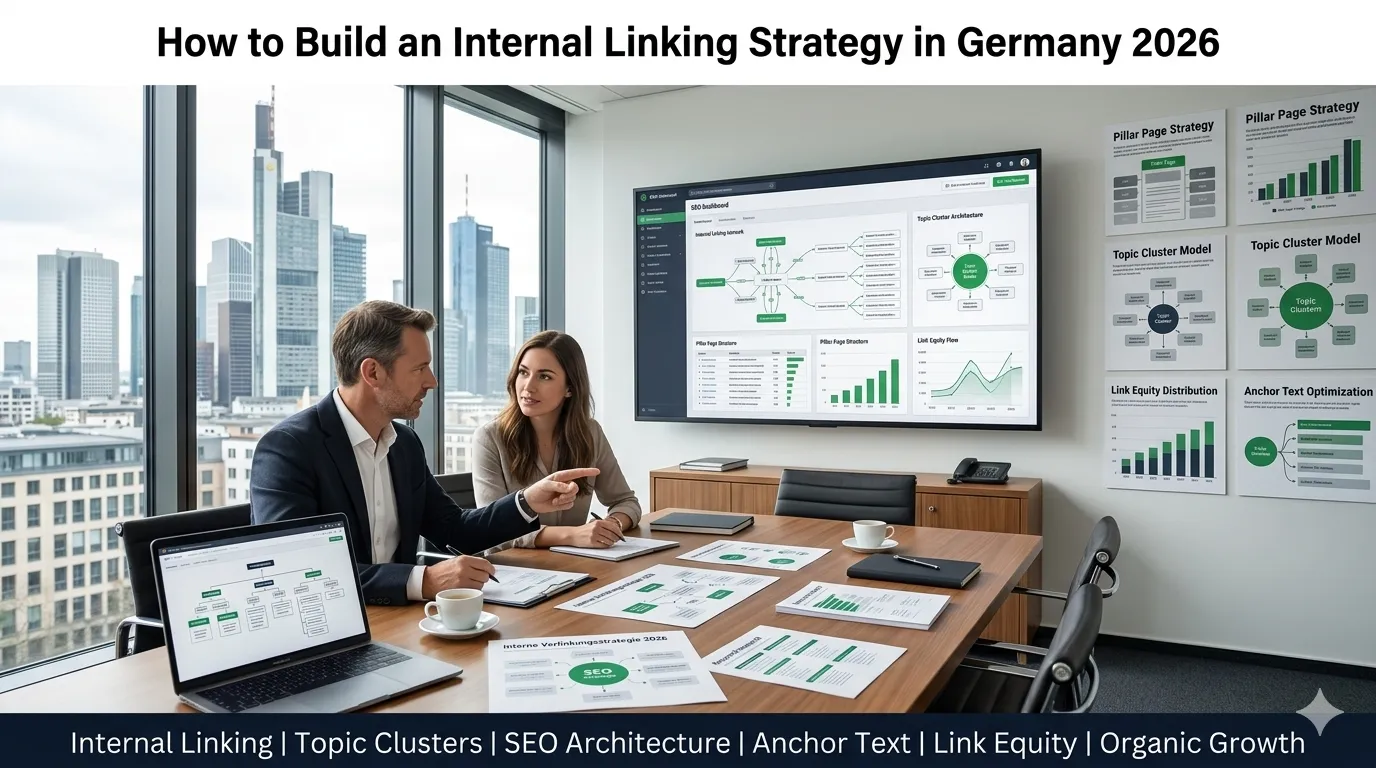
An internal linking strategy is one of the most underrated SEO levers. It’s free, fully under your control, and compounds over time — yet most German websites do it poorly. Strong internal linking lifts rankings on existing pages, accelerates new page indexation, and signals topical authority to Google. Weak internal linking caps the SEO potential of even excellent content.
This guide walks through what internal linking strategy for German websites actually requires in 2026: how link equity flows, anchor text best practices, contextual vs. navigation links, the cluster pattern, audit approaches, and common mistakes.
Why does internal linking matter so much?
Five reasons:
Link equity distribution
Pages with strong external backlinks pass authority to internally-linked pages. Internal linking distributes this authority where you want it.
Crawl + indexation acceleration
New pages linked from existing pages get crawled + indexed faster.
Anchor text signals
Anchor text in internal links tells Google what each page is about.
User journey + engagement
Strong internal links create logical user journeys. Lower bounce, higher time-on-site.
Topical authority signals
Clusters of related pages interlinking signals topic depth to Google.
What types of internal links exist?
Four categories:
Navigation links
Header menu, footer, sidebar. Site-wide. Important pages.
Contextual links
In-body links within content. Most powerful for SEO. Pass topical relevance.
Breadcrumb links
Hierarchical breadcrumbs. Help users + Google understand structure.
Related content links
“Related articles,” “you might also like.” Lower-priority but useful.
For SEO impact: contextual links > breadcrumbs > navigation > related content. Concentrate effort on contextual links in body content.
What does good internal linking look like?
Seven rules:
1. 3–8 contextual links per page
For typical 1,500-word article. More for longer content. Don’t stuff.
2. Link to topically related pages
Don’t link random pages. Link pages that share topic + provide reader value.
3. Descriptive anchor text
“WordPress maintenance pricing in Germany” beats “click here” or “read more.”
4. Avoid over-optimized anchors
If 80% of internal links to a page use “best SEO agency Berlin” exact match, it looks unnatural. Mix exact, partial, and brand anchors.
5. Link from powerful pages
Homepage, top-traffic pages have the most link equity to distribute. Use it intentionally.
6. New pages get links from existing
When publishing new content, add 3–5 internal links to it from existing relevant pages.
7. Bidirectional in clusters
Pillar ↔ cluster articles ↔ each other.
How does the cluster linking pattern work?
For topic cluster architecture:
Pillar page links
- Out to every cluster article (sometimes via outline / TOC links)
- Anchor text varies by cluster article topic
Cluster article links
- Up to pillar page (1–2 times, near top + bottom)
- Across to 2–4 related cluster articles
- Bidirectional links
Example
Pillar: “SEO Services Germany”
- Links to: “SEO Cost Germany”, “Hire SEO Consultant”, “Technical SEO Audit”, “Local SEO”, “Link Building”
Cluster article “SEO Cost Germany”:
- Links back to pillar “SEO Services Germany”
- Links to related clusters: “Hire SEO Consultant”, “Best SEO Agency”, “In-house vs Agency”
This pattern compounds topic authority across the cluster.
How do you audit existing internal linking?
Four-step audit:
Step 1: Crawl your site
Screaming Frog SEO Spider. Export internal link data.
Step 2: Identify orphan pages
Pages with 0 internal links pointing to them. Each needs 2+ inbound links.
Step 3: Identify under-linked pages
Important commercial pages with too few inbound links. Boost their links from related content.
Step 4: Identify over-optimized anchors
Internal anchors that look spammy or repetitive. Diversify.
Tools that help
- Screaming Frog (free up to 500 URLs)
- Sistrix Site Audit (link distribution analysis)
- Ahrefs Site Audit (internal link data)
- Search Console (Performance → Internal Links)
For broader audits see our technical SEO audit Germany guide.
What are the most common internal linking mistakes?
Five patterns:
Generic anchor text
“Click here,” “read more,” “this article.” Wastes anchor text opportunity.
No links to deeper pages
Homepage + top-level pages get all links. Deeper pages starve.\n
Over-optimized anchors
Exact-match anchors repeated 50 times. Looks unnatural.
Orphan pages
Pages with no inbound internal links. Effectively invisible to Google.
One-way pillar-cluster
Pillar links to cluster articles but cluster articles don’t link back. Compounding broken.
How do you handle internal linking at scale?
For sites with 1,000+ pages:
Automated related-content widgets
WordPress + Yoast / RankMath suggests related links automatically. Verify quality.
Internal linking tools
Link Whisper, Internal Link Juicer, SEO Internal Link plugins. WordPress plugins that recommend links based on content matching.
Content team workflow
Editorial process includes “add 3 internal links” step before publishing. Brief writers on what to link to.
Periodic audits
Quarterly review of orphan pages + under-linked commercial pages. Bulk update.
What’s the typical workflow for adding internal links to new content?
A 5-step workflow when publishing new German content:
1. Identify 5–10 related existing pages
Topic-relevant content that complements new page.
2. Link FROM new page
3–6 contextual links from new page to existing related content.
3. Link TO new page
From 3–5 existing pages, add a contextual link to the new page.
4. Update related content widgets
If using auto-generated related links, ensure new page is included.
5. Verify in Search Console
After a few days, check Search Console → Pages → see if new page is being internally linked + indexed.
How does German market specifically affect internal linking?
Three considerations:
German content density
German pages tend to be longer (more comprehensive content expected). More room for internal links naturally.
German anchor text
Use German anchors for German pages. “Beste WordPress Wartung” not “best WordPress maintenance” on a German page.
Sie-form considered
For German B2B sites, internal linking should match site’s voice. Sie/du consistency.
For broader German SEO see our SEO services Germany guide.
When does internal linking become a bottleneck?
Four signals:
- Mid-size site (500–5,000 pages) with no clear cluster structure
- Many orphan pages
- Few contextual links per page (mostly nav links)
- Important pages stuck at page 3–5 of Google for terms they should rank for
If you see these, internal linking improvement is one of the highest-ROI SEO investments.
Frequently asked questions
3 to 8 contextual links for a 1,500-word article.
Descriptive German anchors; mix exact, partial, and brand.
Limited value; focus internal links on deeper pages.
Screaming Frog or Sistrix Site Audit.
Pillar to cluster and back; cluster-to-cluster cross-links.
Useful at scale; review suggestions for quality.
Quarterly minimum; annual deep audits.
External brings authority; internal distributes it.
Need help with internal linking?
If you’re scoping internal linking improvements for your German website and want a 30-minute scoping conversation about audit + cluster strategy, book a meeting or send details via our contact page.
Need expert help? Gem Programmers provides full-service SEO for businesses in Germany, Austria and Switzerland. Request a free, no-obligation quote and get a clear plan with scope, timeline and price.