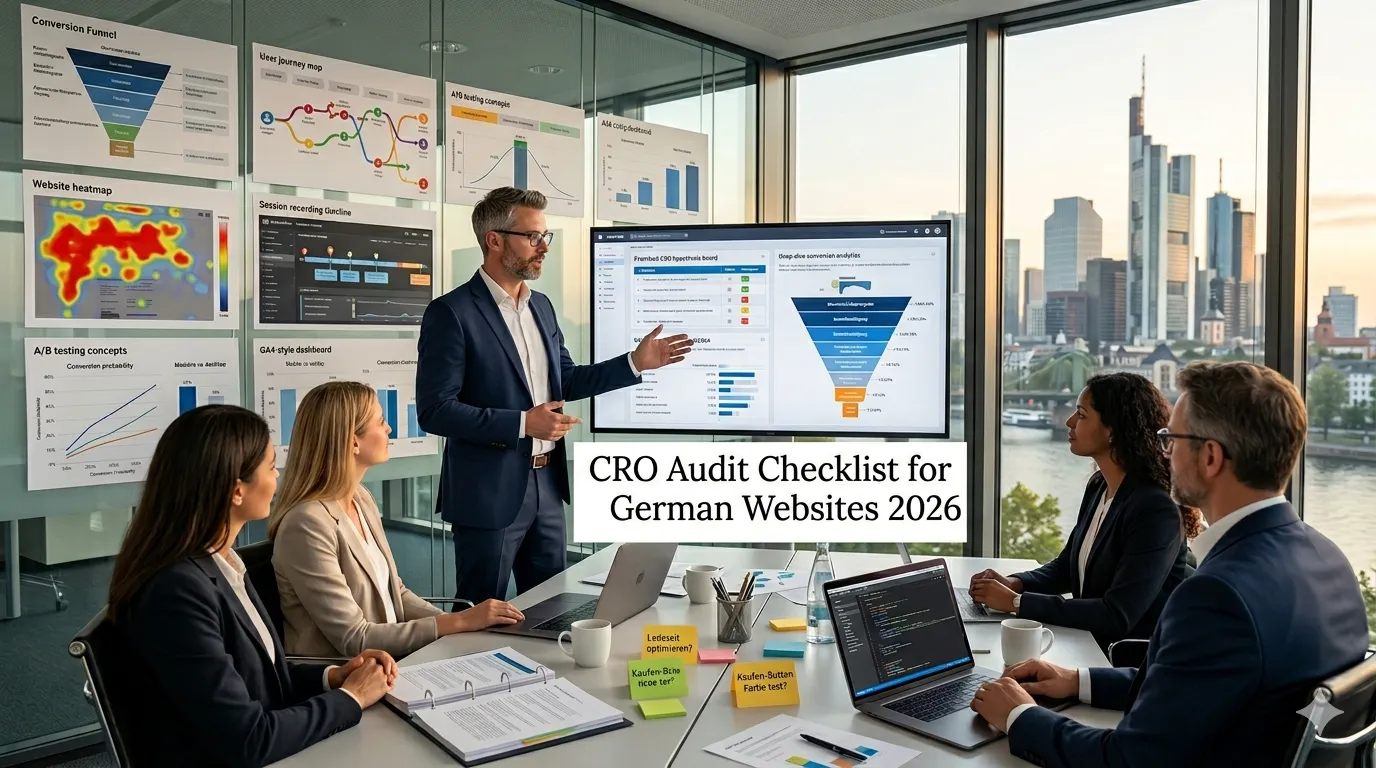
A CRO audit surfaces the highest-impact conversion improvement opportunities on your site. For German websites in 2026, a proper CRO audit combines heuristic review + analytics analysis + qualitative research + technical checks. The output: prioritized list of hypotheses to test, with expected impact + effort scoring.
This guide walks through what a CRO audit checklist for German websites actually covers in 2026: full audit process, what to examine, how to prioritize findings, and converting audit into testing roadmap.
For broader CRO see our CRO services Germany guide.
What does a CRO audit cover?
Eight audit areas:
1. Heuristic review
Manual UX/UI review of key pages. Identifies obvious usability issues.
2. Analytics review
GA4 / analytics data. Funnel drops, page-level conversion, segment analysis.
3. Heatmap + session recording analysis
Hotjar / Microsoft Clarity. Where users click, scroll, hesitate, abandon.
4. Form analytics
Form field completion, drop-off, error rates.
5. Technical / performance review
Core Web Vitals, mobile UX, broken paths.
6. Voice-of-customer research
User interviews, on-site surveys, customer support tickets, reviews.
7. Competitive analysis
How competitors handle similar pages. What they do better/worse.
8. German legal + trust signal review
Cookie banner UX, trust seals, German payment methods, legal page accessibility.
What’s a heuristic CRO review?
Manual page-by-page review applying conversion best practices:
Above-the-fold review
- Clear value proposition
- Primary CTA visible
- Trust signals present
- Page speed acceptable
- No layout shift
- Mobile-friendly
Content + clarity
- Value proposition matches search intent
- Benefits clearly communicated
- Objection handling addressed
- Social proof present
Form / CTA
- Form field count appropriate (fewer = better)
- Field labels clear
- Error states helpful
- Submit button copy specific (“Get Free Demo” not “Submit”)
Trust signals
- Customer logos
- Testimonials
- Awards / credentials
- Trusted Shops / industry seals
- Reviews + ratings visible
Visual hierarchy
- Primary CTA stands out
- Eye flows logically
- Whitespace appropriate
- No competing visual elements
For German market specifically: Sie-form respect, professional tone, trust signals prominent.
What analytics signals reveal CRO opportunities?
Five high-value analytics analyses:
Funnel drop analysis
Where users drop off in conversion funnel. Largest drops = highest-impact opportunities.
Page-level conversion rates
Which pages convert vs. don’t. Compare similar pages.
Mobile vs desktop comparison
Mobile typically converts lower. How much lower? Opportunity to close gap.
Traffic source segmentation
Different sources convert differently. Optimize for high-value sources first.
Search query analysis
Search Console queries leading to your pages. Match content to actual intent.
Audience segmentation
New vs returning, geographic, demographic. Segment-specific issues.
What does heatmap + session recording analysis show?
Six high-value patterns:
Click maps
Where users actually click. Sometimes very different from where designers expect.
Scroll maps
How far users scroll. If only 30% reach mid-page CTA, problem.
Movement / attention maps
Where users hover mouse. Indicates attention zones.
Rage clicks
Multiple frustrated clicks on non-interactive elements. UX gap.
Dead clicks
Clicks on elements expected to be interactive but aren’t. UX bug.
Session recordings
Watch 20–50 real user sessions. Reveals patterns analytics miss.
For German market: also watch how cookie banner affects user flow.
What’s the voice-of-customer research approach?
Five qualitative methods:
User interviewsn
10–15 actual customers + prospects. 30-minute conversations. Open-ended questions.
On-site surveys
Exit intent: “What stopped you from buying today?” Or “What’s the main reason you visited?”
Customer support tickets
Patterns in questions, complaints, confusion points.
Reviews + testimonials
Positive AND negative reviews reveal what matters to buyers.
Social listening
Forums, Reddit, German Facebook groups discussing your category.
Combined qualitative + analytics = strong hypothesis development.
What’s the German-specific audit checklist?
Eight German-market-specific items:
Cookie banner UX
Does banner cover content? Easy to dismiss? Mobile-friendly? Affects CLS + conversion.
Trust signal prominence
Trusted Shops, customer logos, industry awards visible above fold for transactional pages.
Payment methods displayed
SEPA, Klarna, PayPal logos at checkout AND throughout site.
MwSt + Versandkosten transparency
“inkl. MwSt.” labels. Shipping costs visible before checkout.
Widerrufsrecht accessibility
14-day right-of-withdrawal link findable.
German-language contact options
Phone number visible. German live chat or email.
Sie-form vs du-form consistency
Match brand voice. No mixing.
German legal pages compliance
Impressum, Datenschutzerklärung accessible from footer.
For broader compliance see our GDPR compliance guide.
How do you prioritize CRO findings?
PIE / ICE framework:
PIE (Potential, Importance, Ease)
- Potential: How much improvement is possible?
- Importance: How much traffic does this page get?
- Ease: How easy to implement + test?
Score each 1-10. Total = priority score.
ICE (Impact, Confidence, Ease)
- Impact: Expected conversion lift
- Confidence: How sure are we this works?
- Ease: Implementation effort
Similar scoring approach.
Common-sense priority
Top of funnel high-traffic + obvious problems > bottom of funnel low-traffic minor issues.
For most German businesses: focus first on top 3 traffic pages + checkout flow.
What’s the CRO audit deliverable format
A complete audit produces:
Executive summary (1–2 pages)
Key findings + top recommendations. For decision-makers.
Detailed findings (10–30 pages)
Per-page analysis with screenshots + analytics + recommendations.
Hypothesis backlog (5–15 hypotheses)
Prioritized list of tests to run. Each hypothesis with: page, change, expected impact, effort, justification.
Quick-win implementation list
Issues fixable immediately without testing (broken links, missing alt text, obvious bugs).
90-day testing roadmap
Which tests in months 1, 2, 3 of program.
Tracking + measurement plan
GA4 events, conversion goals, KPI definitions.
What does CRO audit cost in Germany?
DIY audit
Your time. 20–80 hours typical. €0 + opportunity cost.
Freelance CRO audit
- Quick audit (under 50 pages): €1,500–€4,500
- Comprehensive audit (50–500 pages): €4,500–€12,000
- Deep audit with user research: €8,000–€25,000
Agency audit
- Comprehensive audit: €5,000–€20,000
- Deep audit with custom research: €15,000–€50,000
For most German businesses: €5,000–€15,000 comprehensive audit + 3-month optimization engagement = great starting point.
What’s the audit-to-testing transition?
After audit:
Step 1: Implement quick wins
Easy fixes that don’t require testing (broken links, error fixes).
Step 2: Build test backlog
Prioritized hypotheses ready to test.
Step 3: Set up testing infrastructure
Testing platform, tracking, sample size calculations.
Step 4: Run first 2–3 tests
Validate process + tooling. Learn what works.
Step 5: Establish cadence
Sustainable testing velocity (3–6 tests/month for mid-size programs).
What are common CRO audit mistakes?
Five patterns:
Audit without action
Producing report that sits in drawer. No implementation. Wasted investment.
Skipping qualitative research
Pure analytics audit. Misses why users behave as they do.
Too many recommendations
Audit producing 50 recommendations all marked “high priority.” Paralysis.
No prioritization framework
Random selection of which to test first.
Ignoring quick wins
Focus on big tests while obvious bugs hurt baseline conversion.
Frequently asked questions about the CRO audit checklist
8 areas: heuristic review, analytics, heatmap, form analytics, technical, voice-of-customer, competitive, German legal and trust review.
Quick: 1–2 weeks. Comprehensive: 3–6 weeks. Deep with research: 6–12 weeks.
DIY: time. Freelance: €1,500–€25,000. Agency: €5,000–€50,000.
Yes. Random testing without audit wastes budget. Audit prioritizes effort.
Annual comprehensive audit. Quarterly mini-audits on priority pages.
Executive summary + detailed findings + prioritized hypothesis backlog + quick-win list + 90-day roadmap.
PIE or ICE framework. Score 1–10 per criterion. Plus common sense.
Audit-only delivers a report. Ongoing engagement implements + tests + iterates. ROI better with ongoing.
Need help with a CRO audit?
If you’re scoping a CRO audit for your German site and want a 30-minute scoping conversation about scope + budget + deliverables, book a meeting or send details via our contact page.
Need expert help? Gem Programmers provides conversion rate optimization services for businesses in Germany, Austria and Switzerland. Request a free, no-obligation quote and get a clear plan with scope, timeline and price.