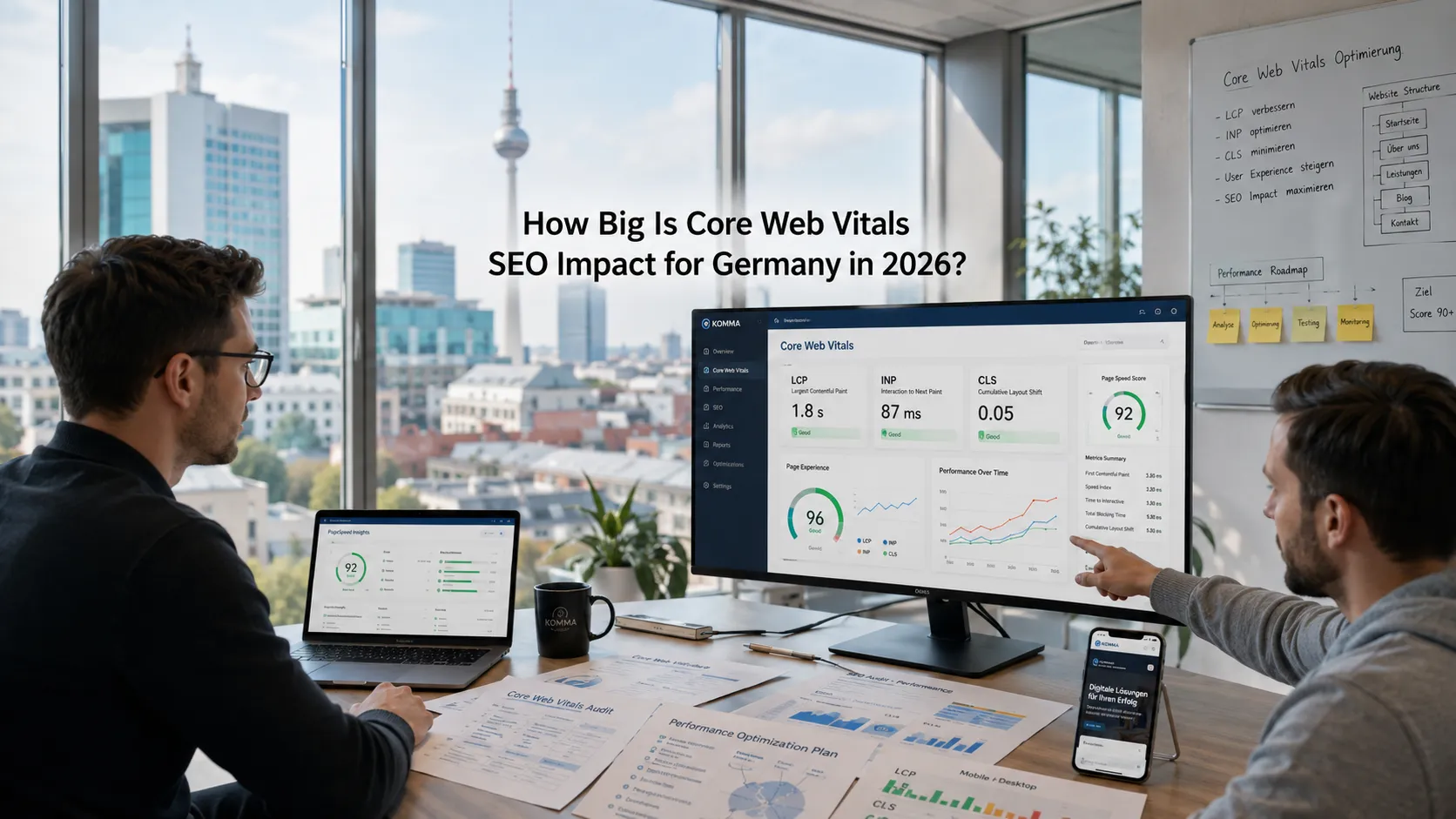
Core Web Vitals SEO impact is real: LCP, INP, and CLS have been confirmed Google ranking factors since 2021. In 2026, Core Web Vitals SEO impact still matters, although its weighting compared to content quality and backlinks remains debated. For German websites, understanding the real Core Web Vitals SEO impact on rankings and conversions helps businesses decide where engineering time delivers the highest ROI.
This guide explains what Core Web Vitals SEO impact actually looks like in Germany in 2026: real ranking influence, LCP/INP/CLS metrics, optimization priorities, German market specifics, and how to measure performance improvements.
You’ll also learn where Core Web Vitals SEO impact is strongest, where it is overrated, and how fast-loading websites can improve both search visibility and user experience.
For broader speed optimization, see our Shopify speed optimization guide (many principles apply across platforms).
What are Core Web Vitals?
Three user-experience metrics Google uses as ranking signals:
LCP (Largest Contentful Paint)
When the largest content element loads. Measures perceived loading speed.
- Good: < 2.5s
- Needs Improvement: 2.5–4.0s
- Poor: > 4.0s
INP (Interaction to Next Paint, replaced FID in 2024)
Responsiveness to user interaction. Measures interactivity.
- Good: < 200ms
- Needs Improvement: 200–500ms
- Poor: > 500ms
CLS (Cumulative Layout Shift)
Visual stability — unexpected layout shifts.
- Good: < 0.1
- Needs Improvement: 0.1–0.25
- Poor: > 0.25
Plus secondary metrics: TTFB (Time to First Byte), FCP (First Contentful Paint), TBT (Total Blocking Time).
How much does Core Web Vitals actually affect rankings?
The honest answer in 2026:
Confirmed ranking factor
Google has confirmed Core Web Vitals are ranking factors.
Tiebreaker primarily
For most queries, content quality + backlinks matter more. Core Web Vitals act as tiebreaker when other factors are similar.
Significant for competitive queries
When 10 competitors have similar content + authority, Core Web Vitals can decide top positions.
More important on mobile
Mobile-first indexing means mobile Core Web Vitals matter more than desktop.
Indirect SEO impact
Better Core Web Vitals → better engagement signals → better rankings (indirect).
Conversion impact often larger than SEO impact
LCP improvement from 4s → 1.5s lifts conversion 5–15%. SEO impact alone may be smaller but conversion impact justifies investment.
What’s the actual ranking impact size?
Realistic in 2026:
Going from Poor to Needs Improvement
Modest ranking impact for competitive queries. Maybe 1–3 position improvement at margins.
Going from Needs Improvement to Good
Modest but measurable. Maybe 2–5 position improvement.
Going from Good to Excellent
Marginal SEO impact. Mostly conversion + UX benefits.
Compared to other ranking factors
Content quality + backlinks + topical authority typically have larger impact than Core Web Vitals.
Don’t fix CWV instead of content
Site with terrible content + perfect CWV won’t rank. Site with great content + poor CWV still ranks.
For broader SEO context see our SEO services Germany guide.
What’s the LCP optimization priority?
LCP is typically the most common Core Web Vitals issue + most actionable:
Common LCP-blocking elements
- Hero image (most common)
- Hero video
- Large heading
- Above-the-fold banner
Optimization tactics
- Image optimization (WebP, proper sizing, modern formats)
- Lazy load below-fold images (don’t lazy-load above-fold)
- Preconnect to required origins
- Inline critical CSS
- Defer non-critical JavaScript
- Use CDN for asset delivery
- Optimize web fonts (preload, font-display: swap)
For typical German websites: aggressive image optimization + critical CSS inlining drops LCP 30–50%.
What’s INP optimization?
INP replaced FID in 2024 as the responsiveness metric:
Common INP issues
- Heavy JavaScript executing on user interaction
- Synchronous blocking operations
- Long tasks > 50ms
- Render-blocking event handlers
Optimization tactics
- Code splitting (load JS as needed)
- Web Workers for heavy computation
- Debouncing + throttling
- Defer non-critical JS
- Optimize third-party scripts
- Use requestIdleCallback for non-urgent work
Common offenders
Chat widgets, marketing tags, A/B testing tools, analytics, cookie banners.
What’s CLS optimization?
CLS often easiest to fix:
Common CLS issues
- Images without explicit dimensions
- Ads / embeds loading without reserved space
- Web fonts swapping (FOIT/FOUT) without proper handling
- Cookie banner pushing content down
Optimization tactics
- Set explicit width + height on images
- Reserve space for ads/embeds before they load
- Use font-display: optional or preload key fonts
- Position cookie banner overlay (not pushing content)
- Avoid injecting content above existing content after load
CLS often most fixable + most user-visible improvement.
What about cookie banners + CLS?
German cookie banner requirement creates CLS challenges:
Bad pattern
Cookie banner appears 200ms after page load, pushes content down. CLS spike.
Good pattern
Cookie banner overlays content with semi-transparent background. No layout shift.
Better
Reserve banner space at page load if displaying inline.
Best
Cookie banner via overlay/modal that doesn’t affect underlying content layout.
For broader cookie banner see our cookie banner compliance Germany guide.
What does Core Web Vitals optimization cost?
DIY optimization
Free if you have technical skills. 10–40 hours of work for typical site.
Freelance developer
€2,000–€8,000 one-time optimization project.
Agency engagement
€5,000–€25,000 for comprehensive performance audit + optimization.
Ongoing maintenance
€500–€2,000/month if performance is critical.
For high-traffic German e-commerce + media: investment usually pays back via conversion improvements alone.
How do you measure Core Web Vitals?
Google PageSpeed Insights
URL-level. Free. Mobile + desktop separate. Lighthouse-based.
Chrome DevTools Lighthouse
Local audit. Real-device data optional.
Google Search Console Core Web Vitals report
Aggregate site data. Field data (real user data).
CrUX Dashboard / API
Chrome User Experience data — real user metrics.
Real-user monitoring (RUM)
SpeedCurve, Pingdom, Sentry Performance. Continuous monitoring.
Sistrix Performance
German market-focused. Visibility correlation.
For most German websites: PageSpeed Insights + Search Console + Lighthouse foundation. Add RUM at scale.
What German market specifics affect Core Web Vitals?
Three considerations:
Cookie banner mandatory
German DSGVO/TTDSG requires cookie banner. Implementation affects CLS + LCP. Optimize carefully.
Trusted Shops + review widgets
Common German trust signals. Their JS can affect INP. Lazy-load where possible.
Klarna + payment widget load
Klarna, PayPal widgets affect performance. Defer non-critical loads.
What’s the Core Web Vitals roadmap for a typical German site?
Phase 1 (week 1-2): Measure
PageSpeed Insights audit. Search Console baseline. Identify top issues.
Phase 2 (week 2-4): Quick wins
Image optimization, critical CSS, defer non-critical JS. Get out of “Poor” if applicable.
Phase 3 (week 4-8): Deeper optimization
Code splitting, INP work, cookie banner CLS fixes.
Phase 4 (week 8-12): Validation
Re-measure. Verify improvements. Track Search Console changes.
Phase 5 (ongoing): Maintain
New content + features shouldn’t regress Core Web Vitals. Performance budgets in CI/CD.
What are common Core Web Vitals mistakes?
Five patterns:
Treating CWV as primary SEO factor
Spending 100 hours on CWV when content is the problem. Misallocated.
Lab tests only
PageSpeed Insights tests synthetic. Real users may have different experience. Use field data from Search Console + RUM.
Optimizing for one metric only
LCP improvement causing INP regression. Balance all three.
Ignoring mobile
Desktop-only optimization. Mobile-first indexing means mobile CWV matters more.
One-time fix mentality
Adding new code/features regresses CWV. Need ongoing monitoring + maintenance.
How does Core Web Vitals interact with AI search?
In 2026:
AI Overview latency includes site performance
If Google’s AI cites your site, slow page load affects AI Overview reliability.
Mobile performance critical
AI search heavily mobile. Slow mobile = lower citation likelihood.
Page experience signals composite
Core Web Vitals + HTTPS + mobile-friendly + no intrusive interstitials. Composite.
For AI search context see our AEO guide.
Frequently asked questions
Yes; typically a tiebreaker rather than primary factor.
Modest SEO; 5-15% conversion lift typical.
LCP < 2.5s, INP < 200ms, CLS < 0.1.
LCP most common; INP rising; CLS easiest to fix.
PageSpeed Insights, Search Console, Lighthouse, RUM.
Yes due to mobile-first indexing.
After foundations; match to traffic volume.
No; content and backlinks matter more.
Need help with Core Web Vitals?
If you’re scoping Core Web Vitals optimization for your German site and want a 30-minute scoping conversation about audit + prioritization, book a meeting or send details via our contact page.
Need expert help? Gem Programmers provides SEO services for Germany for businesses in Germany, Austria and Switzerland. Request a free, no-obligation quote and get a clear plan with scope, timeline and price.