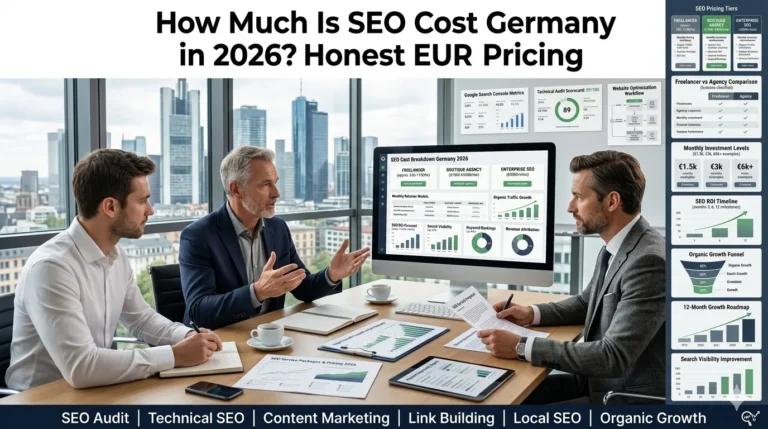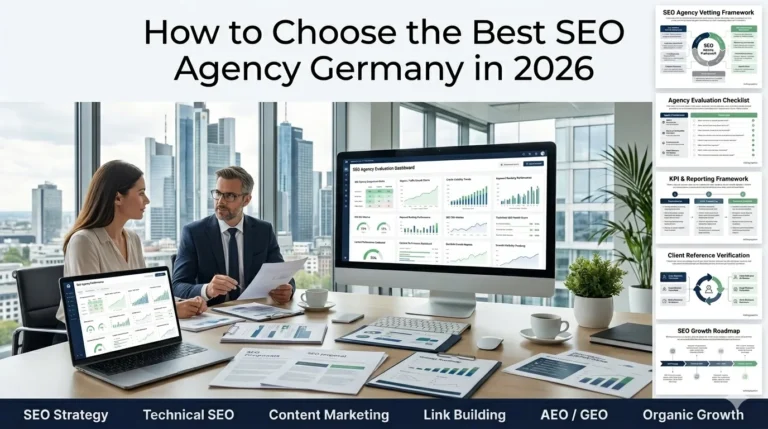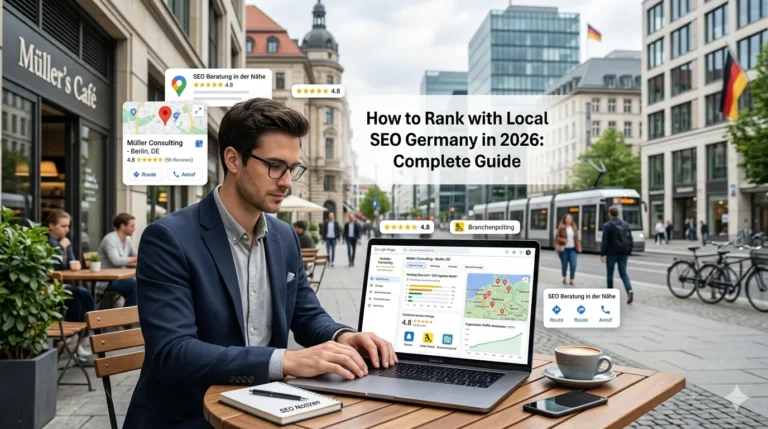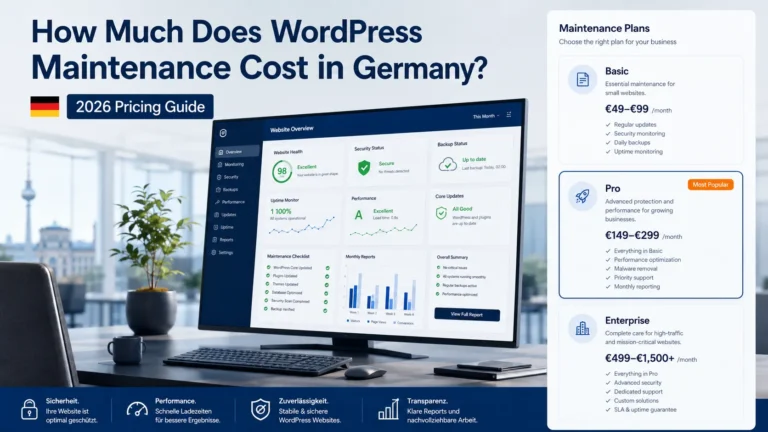
A website without SEO is a brochure no one finds. SEO without a well-built website is investment thrown at infrastructure that can’t convert. The combination — WordPress development plus search engine optimization — is what actually drives business results. Yet most businesses treat them as separate purchases, hire different vendors, and end up with a site that doesn’t rank and a ranking strategy that doesn’t convert.
This guide explains how WordPress development and SEO services work together, what an integrated engagement looks like, what it costs, and how to evaluate whether you need both services or just one. The goal: help you make a defensible decision about how to invest, not sell you on a package you don’t need.
Why do WordPress and SEO need to be developed together?
Five concrete reasons the work overlaps:
1. Site speed is an SEO ranking factor. A WordPress site that doesn’t hit Core Web Vitals (LCP under 2.5s, INP under 200ms, CLS under 0.1) ranks worse than competing sites that do. Speed is a development decision — caching, image optimization, code minification, theme selection — not an SEO afterthought.
2. URL structure and information architecture are built in development. Choosing /%postname%/ permalinks vs /?p=123, designing category structure, creating logical URL hierarchy — these decisions during development determine SEO ceiling. Retrofitting them later requires extensive 301 redirects and authority loss.
3. Schema markup needs to be coded in. Article schema, Organization schema, FAQ schema, BreadcrumbList schema — these structured data foundations live in the theme or are added via plugins. Done well during development, they support every piece of content published later.
4. Mobile-first design is now mandatory. Google’s mobile-first indexing means your mobile site is what gets ranked. Responsive design isn’t a feature — it’s the foundation. Development decisions about mobile performance directly limit SEO performance.
5. Content management workflow affects content velocity. If publishing a blog post requires a developer, you publish less. If your editor friction is low (Gutenberg blocks, custom block patterns, easy media handling), you publish more — and content volume drives SEO over time.
What’s included in integrated WordPress development and SEO services?
Discovery and SEO strategy
Keyword research, competitor analysis, search intent mapping, content gap analysis. Output: a target keyword strategy that informs site architecture and content plan. SEO strategy should precede design and development, not follow them.
Information architecture for SEO
Site map designed around topic clusters and search intent. URL structure planned for clarity and SEO. Internal linking strategy from pillar pages to cluster content. Navigation that supports both user discovery and crawler efficiency.
WordPress development with SEO foundations
Lightweight, well-coded theme (avoiding bloated multipurpose themes that hurt speed). Custom Gutenberg blocks for consistent on-page SEO structure. Image optimization pipeline (WebP/AVIF, responsive sizes, lazy loading). Caching configuration. CDN setup. Server-side performance tuning.
Technical SEO implementation
Yoast SEO or Rank Math configuration, XML sitemap, robots.txt, canonical tags, hreflang for multilingual sites, schema markup (Article, Organization, BreadcrumbList, FAQ, Product), Search Console verification and submission, GA4 with proper event tracking.
On-page SEO setup
Title tag and meta description templates, heading hierarchy standards, image alt text conventions, internal linking patterns, content structure templates that match user search intent.
Content production strategy
Editorial calendar based on keyword research, content brief templates, topic cluster plans, content optimization workflow, content refresh strategy for existing pages.
Ongoing SEO operations
Monthly rank tracking, keyword opportunity identification, content updates, technical SEO audits, backlink monitoring, competitor tracking, monthly reporting with actionable next steps.
When does it make sense to combine WordPress development and SEO?
Integration pays off when one of these is true:
- You’re building a new WordPress site from scratch — building SEO foundations during initial development is dramatically cheaper than retrofitting later
- You’re rebuilding an existing site — the migration risks SEO ranking; integrated planning protects organic traffic
- You’re scaling content production — your CMS needs to support high-velocity publishing with built-in SEO structure
- You’re entering a competitive search niche — every technical and structural decision affects ranking ceiling
- You’ve had previous failures — a beautiful site that doesn’t rank, or content investment that doesn’t compound, signals misalignment between development and SEO
It makes less sense when: you have an established, well-built WordPress site that just needs content and SEO services; you’re testing a market with minimal investment; or your business doesn’t depend on organic search traffic.
What does an integrated engagement cost?
Realistic 2026 ranges for combined WordPress development plus SEO services:
- Small business site + SEO foundations + 6 months SEO: $15,000–$35,000 total
- Mid-market site + SEO foundations + 12 months SEO: $40,000–$120,000 total
- Custom WordPress + content marketing + ongoing SEO: $80,000–$300,000+ year one
- SEO-only ongoing (existing WordPress site): $2,500–$15,000/month depending on scope and competitive intensity
The split: roughly 40% development costs upfront, 60% ongoing SEO over 12 months for typical mid-market engagements. Year-two costs drop substantially as development is one-time but SEO compounds.
How long until integrated WordPress + SEO services pay back?
Realistic timeline:
- Months 1–3: development and SEO foundations — traffic is flat or declining if migrating
- Months 4–6: first organic ranking improvements, initial content drives some traffic
- Months 7–12: meaningful traffic growth, first conversions attributable to organic
- Year 2: compounding traffic, organic becomes meaningful revenue channel
- Year 3+: SEO often becomes top revenue channel for serious programs
The compounding nature of SEO means year-one ROI is often modest; year-two onwards is where the returns become disproportionate. Businesses that cut SEO investment after 9 months typically miss the inflection.
What technical foundations matter most for WordPress SEO?
Core Web Vitals performance
LCP under 2.5s, INP under 200ms, CLS under 0.1 — measured on real mobile devices, not laboratory conditions. Hitting these requires lightweight theme, optimized images, proper caching, minimal third-party scripts, and quality hosting.
Mobile responsiveness
Mobile-first indexing means your mobile experience determines rankings. Responsive themes are baseline; thumb-zone optimization, mobile-specific page weight, and mobile checkout flows separate good from great.
Structured data
Article schema for blog posts, Organization schema sitewide, BreadcrumbList for navigation, FAQ schema for Q&A content, Product schema for e-commerce, LocalBusiness schema for service businesses with physical locations. Implementing schema enables rich results and AI search citations.
URL structure and internal linking
Clean URL structure (/%postname%/), logical category hierarchy, breadcrumb navigation, intentional internal linking from high-authority pages to important commercial pages, pillar-and-cluster topical structure.
Security and trust signals
HTTPS everywhere (now table stakes), no mixed content warnings, regular security updates, clear privacy policy and terms, named author bylines with credentials, business contact information visible. Google rewards sites users trust.
How does content production fit in?
Technical SEO foundations are the platform; content is what actually ranks. A serious integrated program publishes:
- 1–2 pillar pages per service or product area (3,000–8,000 words each)
- 4–10 cluster articles per pillar, each linking back to the pillar (1,500–3,500 words)
- Case studies and customer stories with specific outcome metrics
- Tool/calculator pages for high-intent searchers
- FAQ pages addressing specific buyer concerns
Content velocity matters: a site publishing 4 substantive pieces per month builds organic authority faster than one publishing 1 piece per quarter. The CMS workflow must support that velocity without bottlenecks.
How do you measure WordPress + SEO performance together?
The KPIs that show whether the integration is working:
- Core Web Vitals — site health that affects rankings
- Organic traffic growth — month-over-month and year-over-year
- Keyword rankings — specifically tracked target keywords by position
- Organic conversion rate — how well organic traffic converts compared to other channels
- Organic-sourced revenue — the master metric, measured via GA4 + CRM integration
- Page indexation rate — percentage of intended pages actually indexed by Google
- Backlink growth — quality and quantity of referring domains
- Brand search volume — indicates how well brand is establishing in your category
What’s the right team structure for WordPress + SEO?
Three viable approaches:
Single integrated agency. One vendor handles development, SEO, and content. Coordination is built-in; accountability is clear. Risk: depth in one area may be weaker than specialists. Best for businesses without internal marketing leadership.
Development agency + SEO specialist. One agency builds the site with SEO foundations; a separate SEO specialist or agency handles ongoing optimization. Coordination overhead is higher but specialist depth is better. Best for established businesses with internal marketing oversight.
In-house team + freelance specialists. Internal team handles strategy and content; freelancers provide development and SEO expertise. Most cost-effective but requires strong internal management. Best for businesses with established marketing operations.
What mistakes destroy integrated WordPress + SEO projects?
- Building first, optimizing later. Retrofitting SEO onto a poorly architected site costs more than building it in correctly the first time.
- Migration without redirect strategy. Changing URLs without 301 redirects loses organic traffic. Many businesses lose 30–60% of organic traffic after botched migrations.
- Bloated themes. Multipurpose themes with hundreds of demos load megabytes of CSS/JS, killing Core Web Vitals.
- Page builders for everything. Heavy reliance on Elementor or Divi adds performance overhead and creates vendor lock-in.
- SEO copy stuffed into business pages. Keyword-stuffed home pages and service pages convert badly even when they rank.
- Ignoring analytics integration. Without GA4 + CRM integration, you can’t measure what SEO actually delivers.
- Content velocity drops after launch. Many sites launch, then content stops. SEO compounds only with sustained publishing.
How does this integrate with broader marketing?
WordPress + SEO is a foundation, not a complete marketing program. It pairs with:
- Website development services for technical foundation
- SEO services for ongoing optimization
- Conversion rate optimization — traffic without conversion is wasted
- Digital marketing — paid acquisition, social, email all amplify organic foundations
The integrated WordPress + SEO foundation makes every subsequent marketing investment more efficient. Paid traffic converts better on fast sites. Email lists grow faster with high-quality content. Brand authority compounds when SEO signals are aligned.
Frequently asked questions about WordPress and SEO services
Can I just hire an SEO agency without redoing my WordPress site?
If your existing site is well-built (hits Core Web Vitals, has clean URL structure, proper schema, good mobile experience), yes. SEO services can work on existing infrastructure. If your site has technical problems — slow speed, poor mobile UX, no schema, bad URL structure — SEO alone will hit a ceiling. Either fix the site or accept the ceiling.
How long does SEO take to show results?
First ranking improvements in 3–6 months for less competitive keywords. Meaningful organic traffic growth in 6–12 months. SEO becomes a primary revenue channel in 12–24 months for serious programs. Anyone promising faster results in competitive markets is either overpromising or using risky tactics that hurt long-term.
Why is WordPress good for SEO specifically?
Flexibility, semantic HTML output, ecosystem of SEO plugins (Yoast, Rank Math), well-maintained themes with built-in SEO support, content management workflow that scales, and broad developer expertise. WordPress’s open-source nature means SEO best practices are widely understood and implementable.
Is local SEO different from general SEO?
Yes. Local SEO focuses on Google Business Profile optimization, local citation building, location-specific pages, review management, and local link building. It’s especially important for service businesses with physical locations or service areas. Integrates with WordPress development through location pages, schema for LocalBusiness, and review integration.
What about WordPress SEO plugins — Yoast or Rank Math?
Both are competent. Yoast is more popular and has stronger ecosystem support. Rank Math has more features in its free tier and a cleaner interface. Either works — the plugin is 5% of SEO; the strategy and execution is 95%. Pick one, configure it properly, and don’t switch unless you have a real reason.
Should I worry about AI search engines like ChatGPT and Perplexity?
Yes. AI search optimization (AEO/GEO) is increasingly important alongside traditional SEO. The good news: well-structured WordPress content with question-format headings, schema, and named authorship performs in both traditional and AI search. The same fundamentals serve both. See our AI search optimization content for the specific techniques.
What’s a realistic budget for WordPress + SEO for a small business?
For a small business serious about organic growth: $15,000–$35,000 for development plus six months of SEO. Below that, you’re getting either bare-bones development or minimal SEO — results will be limited. Above $35,000 makes sense when competitive intensity or business stakes warrant it.
Ready to integrate WordPress and SEO properly?
The businesses that win in organic search are those that built WordPress and SEO together — not as separate purchases stitched together later. The technical decisions during development determine the ranking ceiling SEO can ever reach. Investing in both up front, with one team coordinating, pays back over the entire lifetime of the site.
Book a meeting for a free integrated WordPress + SEO consultation. We’ll audit your current site (if any), assess SEO opportunity, and outline a realistic scope and budget for an integrated engagement. Or browse our website development and SEO services, and contact us directly.
Most Asked Questions
Integrated WordPress and SEO services build the technical site foundation and the search optimization strategy together — covering site speed, URL structure, schema markup, content management workflow, keyword strategy, content production, and ongoing optimization. Combined, they deliver organic search results that separate services struggle to match.
First ranking improvements typically appear in 3–6 months for less competitive keywords. Meaningful organic traffic growth in 6–12 months. SEO becomes a primary revenue channel in 12–24 months for serious programs.
WordPress’s flexibility, semantic HTML, ecosystem of SEO plugins, well-maintained themes, and content management workflow that scales make it one of the most SEO-friendly platforms. Out-of-the-box configuration isn’t optimized — professional setup includes proper schema, performance optimization, and technical SEO foundations.
Yes. Local SEO drives nearby customers through Google Business Profile optimization, local citation building, location pages, review management, and LocalBusiness schema. Critical for service businesses with physical locations or defined service areas.
Yes, when integrated correctly. The combined effect of fast, well-built site plus organic search visibility typically delivers 3–5x more qualified traffic than either alone. Conversion rates on organic traffic are often higher than paid because of search intent qualification.
Service businesses where customers research extensively before buying — healthcare, legal, financial services, consulting, B2B services, ecommerce, real estate. The longer the consideration period and higher the customer LTV, the more SEO investment pays back.
Site speed is a confirmed Google ranking factor. Core Web Vitals — LCP under 2.5s, INP under 200ms, CLS under 0.1 — measured on real mobile devices, determine your competitive position. Slow sites rank lower regardless of content quality.