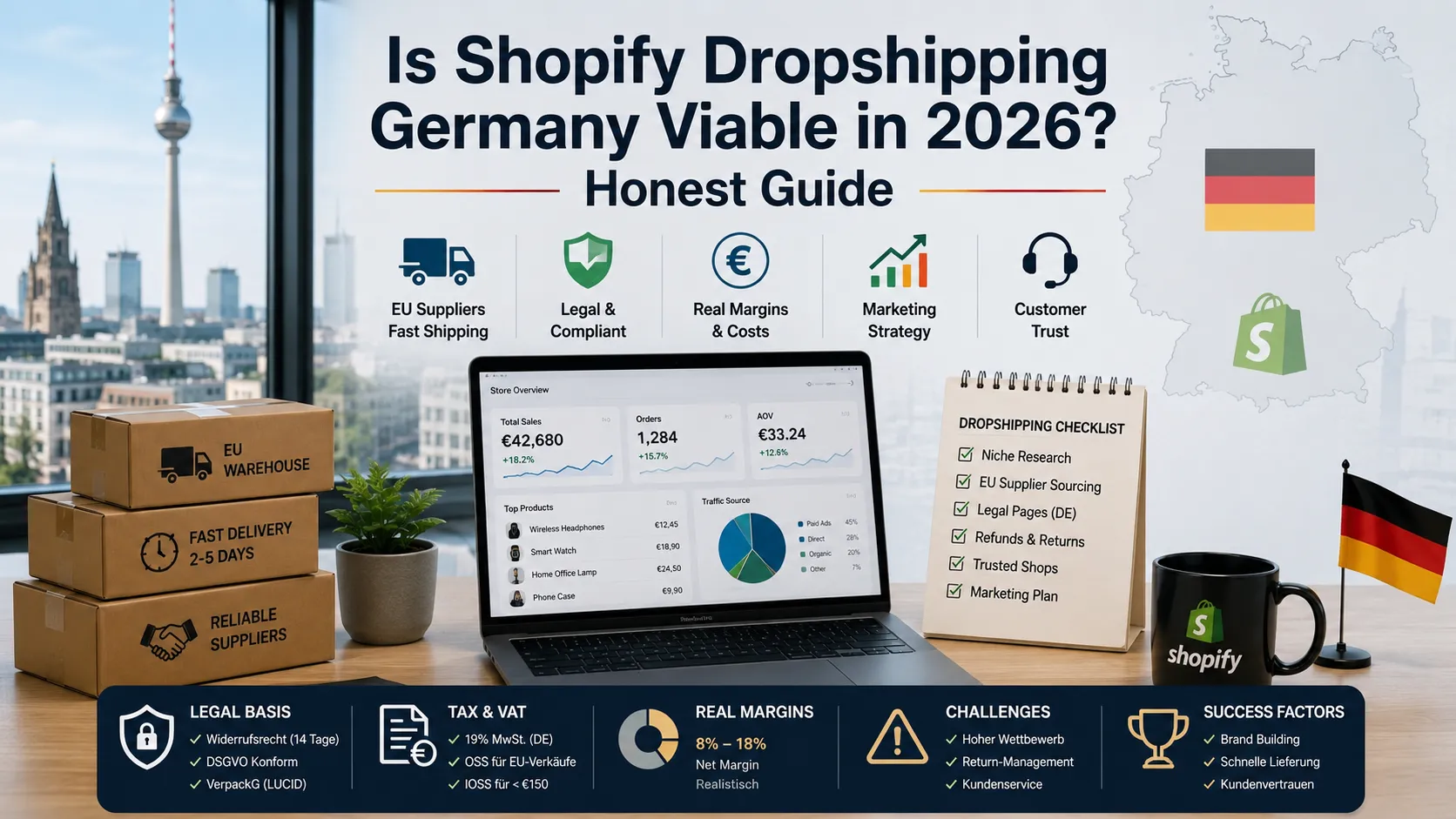
Shopify dropshipping Germany is one of the most marketed e-commerce business models in 2026 — promising fast launch, no inventory, low capital. The reality for German sellers is more nuanced: dropshipping CAN work as a starting business model, but the German legal context, customer expectations, and competitive market mean the easy “find AliExpress product, mark it up, run Meta ads” approach almost never produces sustainable results.
This guide walks through what Shopify dropshipping Germany actually requires in 2026: realistic supplier options (EU suppliers vs. China), Widerrufsrecht and DSGVO realities, EUR margin economics, taxation, when dropshipping works as a starting business and when it doesn’t.
What is dropshipping, and how does it work in 2026?
Dropshipping is a fulfillment model where:
- Customer orders product on your Shopify store
- You forward order to supplier
- Supplier ships directly to customer
- You keep margin between your retail price and supplier cost
You never hold inventory. You don’t ship packages. You’re essentially a marketing + customer-service layer between supplier and customer.
Where do German Shopify dropshipping sellers source from in 2026?
Three primary options:
Option 1: EU-based suppliers (recommended)
Suppliers warehoused in Germany / EU. Delivery 1–5 days to German customers. Higher unit cost (vs. China) but faster shipping, better quality control, easier returns, fewer customs issues.
Examples: BigBuy (Spain), Spocket (curates EU+US), Syncee (Hungary), VidaXL (Netherlands), German-specific wholesale platforms.
Option 2: China-based suppliers (traditional dropshipping)
AliExpress, CJDropshipping, Spocket China selection. Cheaper unit cost. Delivery 10–30 days typically. Customs handling, return logistics challenges.
For German buyers in 2026, China-only dropshipping is a hard model — customers expect 2–5 day delivery; 30-day delivery feels like fraud.
Option 3: Hybrid (recommended)
EU-based for hero products + popular items. China for long-tail products where speed matters less.
Option 4: Print-on-demand
Printify, Printful, Gelato. Customer orders → product printed/manufactured → shipped. German-EU print partners available. Strong for apparel, mugs, posters, accessories.
For most German Shopify dropshipping in 2026: EU-based suppliers + print-on-demand is the path that can actually work.
Why does Germany make dropshipping harder than US/UK?
Five German-specific challenges:
Shipping time expectations
German buyers expect 2–5 day delivery. AliExpress 20-day shipping fails customer expectations.
Widerrufsrecht
14-day right of withdrawal. Customer can return goods even after dispatch. For China-sourced products: return logistics nightmare.
Trust signals
Germans expect Trusted Shops, German legal pages, professional-looking site. Cheap drop-shipped stores look fraudulent.
Quality expectations
Lower tolerance for poor quality than US/UK markets. Bad reviews accumulate fast.
Competition
Established German D2C brands + retailers + Amazon DE compete aggressively. Hard to win on price alone.
What German legal requirements apply to dropshipping?
Same as any German Shopify store, plus:
You are the seller of record
Even though supplier ships, YOU are responsible for: product quality, warranty, returns, customer support, legal compliance. Buyer’s contract is with you, not the supplier.
Widerrufsrecht with realistic return logistics
If customer returns: where does the product go? Back to supplier (often China)? Back to you? Plan + budget for this.
Product safety + CE marking
Electronics, children’s products, cosmetics, textiles all require CE marking or specific compliance markings. Selling non-compliant products triggers Abmahnung + potentially criminal liability.
Packaging law (VerpackG)
Even drop-shipped packaging is your responsibility under § 7 VerpackG. Register with LUCID + pay licensing fees for packaging materials.
German invoicing per GoBD
You issue invoices to customers, even though supplier shipped. Sufio or equivalent generates compliant invoices.
Datenschutz / DSGVO
Customer data flows: you collect → you share with supplier for fulfillment. Document supplier as sub-processor.
For broader compliance see our Germanized for Shopify guide and Shopify DSGVO compliance guide.
What are realistic margins on Shopify dropshipping?
Honest 2026 EUR economics:
China-sourced
- Supplier cost: €5–€20 per unit
- Your retail: €15–€60 per unit
- Margin before Meta ads + Shopify fees + returns: ~€10–€40 per sale
- Margin after costs: €0–€15 per sale on average
EU-sourced
- Supplier cost: €10–€40 per unit
- Your retail: €25–€80 per unit
- Margin: €15–€40 before costs, €5–€20 after
Print-on-demand
- Print cost: €8–€25 per unit
- Your retail: €20–€60 per unit
- Margin: €12–€35 before costs, €5–€15 after
Returns + refunds + chargebacks reduce margin further. Realistic net margin: 8–18% for well-run dropshipping operations.
What does Shopify dropshipping cost to start in Germany?
Minimum viable launch
- Shopify Basic: €29/month
- Domain + SSL: €15/year
- Free Dawn theme
- DSers / Spocket app: €0–€60/month
- Germanized for Shopify: €19/month
- Trusted Shops Light: €40/month
- Klaviyo free tier: €0
- Total monthly: €90–€150
- Plus Meta ad spend: €500–€3,000+/month for launch testing
Realistic year-1 budget
- Total platform + app monthly: €150–€400/month = €1,800–€4,800/year
- Meta + Google ads: €15,000–€80,000/year
- Product testing (samples, photography): €2,000–€10,000
- Trusted Shops upgrades: €500–€2,000/year
- Steuerberater: €1,500–€6,000/year
Realistic year-1 investment: €25,000–€100,000+ to reach meaningful revenue.
What dropshipping apps work on Shopify in Germany in 2026?
DSers
AliExpress dropshipping standard. Order automation, supplier management.
Spocket
Curated EU + US supplier marketplace. Strong for German market (faster shipping).
Syncee
EU-focused marketplace. German-friendly.
BigBuy
Spanish company. EU-warehoused suppliers. German speakers in customer service.
Printify / Printful / Gelato
Print-on-demand. EU print partners. Apparel + accessories focused.
Modalyst
Wix’s, also Shopify-compatible. Less popular but functional.
For most German Shopify dropshipping in 2026: Spocket / Syncee for sourced products + Printify / Printful for print-on-demand.
When does Shopify dropshipping work for German sellers?
Five trigger conditions:
Niche audience + niche products
Generic dropshipping fails. Niche audience (hobby community, professional segment, specific demographic) + niche-specific products can work.
Strong brand + content strategy
Brand identity + content marketing + community drives traffic. Not just paid ads.
EU sourcing + reasonable shipping
EU-sourced products + 2–7 day delivery. Not China + 20-day shipping.
Customer support investment
Real customer support (not just chatbot). German buyers expect responsive support.
Long-term thinking
Building brand over 12–24+ months, not “make €10k this month and quit.”
When does Shopify dropshipping NOT work?
Five red flags:
Generic AliExpress products with marked-up prices
Buyers can find on AliExpress for half the price. Competitive disadvantage.
Pure paid-ads acquisition
Meta ad costs in Germany are climbing. Without organic traffic, unit economics break.
Unwilling to handle returns properly
German Widerrufsrecht demands quick refunds. Suppliers in China make this expensive.
Skipping legal compliance
Germanized, Trusted Shops, GoBD all required. Skipping = Abmahnung risk + customer churn.
Quick-money mindset
Most dropshipping content online sells the dream. Reality: hard work, low margins, high churn rate of stores.
How does dropshipping interact with VAT and OSS?
Specific considerations:
B2C sales to Germany
Standard 19% VAT.
B2C cross-EU
OSS rules apply. Threshold €10,000/year cross-EU B2C. See our Shopify VAT and OSS Germany guide.
Supplier sourced from non-EU
If supplier ships from China directly to German customer: customs + import VAT at delivery (handled by supplier or carrier). For sales above €150, complex.
IOSS for sub-€150 non-EU shipments
Import One-Stop-Shop scheme for sub-€150 packages. Simplifies VAT for non-EU-shipped goods
For most dropshipping setups: engage a Steuerberater early. Tax handling is complex.
What are the most common Shopify dropshipping mistakes German sellers make?
Five patterns:
Picking China-only supplier with 30-day shipping
German buyers won’t wait. Conversion + reviews suffer.
Selling without CE marking on regulated products
Electronics, children’s items, cosmetics. Massive liability risk.
Skipping Trusted Shops + Germanized
Site looks fraudulent. Conversion + Abmahnung risk.
No customer service plan
Customer asks “Where’s my order?” — and the seller has no answer.
Underestimating returns
Returns cost more for dropshipping than traditional retail. Budget for it.
Are there better alternatives to pure dropshipping?
Three patterns that scale better:
Print-on-demand (POD)
Customer designs/picks → printed in EU → shipped within days. Better margins + customer experience than China dropshipping.
3PL fulfillment (you stock products, 3PL ships)
Buy small quantities of selected products, store with German 3PL (Sendcloud-integrated 3PLs, JTL-Wawi-integrated 3PLs). Margins better, speed faster.
Private-label / white-label
Source generic products from China, brand them yourself, store with German 3PL. Higher upfront cost, much better margins + brand-building potential.
For long-term German Shopify success: evolution from dropshipping → POD → 3PL → private label.
Frequently asked questions
Yes with EU sourcing, niche focus, brand discipline, and legal compliance.
Spocket, Syncee, BigBuy, Printify, Printful; DSers for niches.
Possible but hard; EU sourcing is dramatically better.
8 to 18 percent net margin for well-run dropshipping.
Yes; register with LUCID and pay licensing fees.
Regulated products require CE or specific markings.
Yes for German B2C; conversion lift and legal protection.
Print-on-demand, then 3PL, then private label.
Need help building a sustainable Shopify business?
If you’re considering dropshipping or evolving beyond it on your German Shopify store and want a 30-minute scoping conversation, book a meeting or send details via our contact page.
Need expert help? Gem Programmers provides Shopify development services for businesses in Germany, Austria and Switzerland. Request a free, no-obligation quote and get a clear plan with scope, timeline and price.