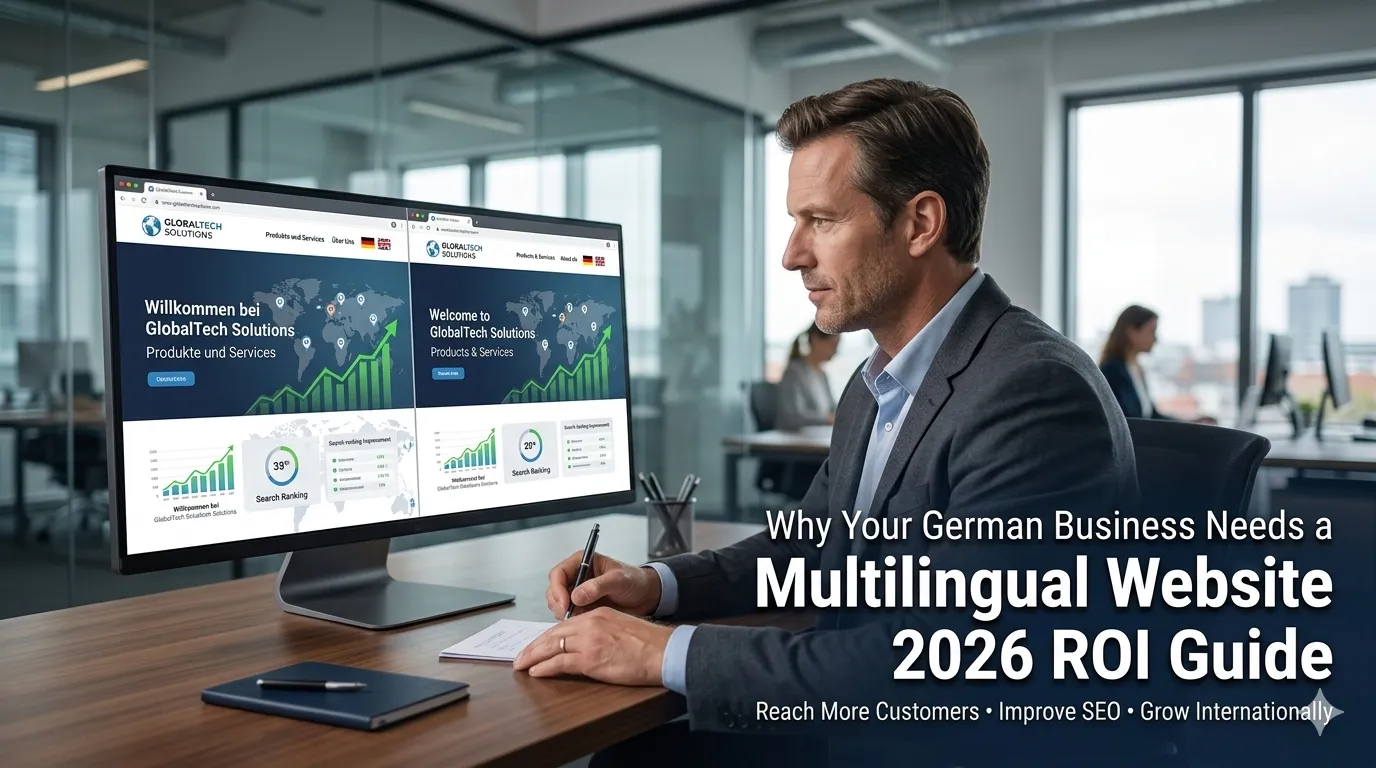
If you sell anywhere beyond the DACH region — or even just to expats and EU customers inside Germany — there’s a strong case for a multilingual website German business strategy in 2026. The question is rarely “should we add English?” anymore. It’s “how do we do this without breaking SEO, blowing the budget on bad translations, or creating a GDPR mess?”
This guide gives you the ROI math, the technical implementation (hreflang done right), the plugin and tool options, and the translation workflow that actually delivers native-quality content without enterprise costs for a multilingual website German business.
Why Adding English to a German Website Pays Back Fast
Three audiences your German-only website is failing to reach:
- Expat residents in Germany. Berlin alone has 700,000+ non-German speakers. Munich, Hamburg, Frankfurt all have large international populations who do business with local German companies.
- EU customers outside DACH. Buyers in Netherlands, Belgium, France, Italy, Spain, Scandinavia — English is the EU lingua franca for B2B research.
- Export markets globally. UK, US, MENA, Asia — most B2B research starts on Google in English.
For most German SMEs with even modest export ambitions, an English version of the site doubles or triples the addressable market for marginal additional cost.
Honest ROI Math for a Multilingual Website
Realistic numbers for a typical German B2B SME with €5M revenue and 5% from international customers:
- Current organic traffic from outside DACH: maybe 5–10% of total (limited because content is German-only)
- After adding proper English version with hreflang: typically grows to 20–40% of organic over 6–12 months
- For a service business with €10k+ average deal size, even 2 additional international clients/year recovers the multilingual investment
- For e-commerce, EU cross-border represents 25%+ of European e-commerce in 2026
Typical multilingual website investment: €3,000–€15,000 setup + €1,500–€8,000 in translation per language depending on site size. Payback often within 6 months on B2B; 3–9 months on D2C.
The Three Approaches (and Their Trade-offs)
Approach 1: Manual Translation by Native Translator
Highest quality, highest cost, slowest. €60–€120 per 1,000 words for native German→English by a professional translator.
- Best for: legal text, contracts, top-of-funnel marketing copy where brand voice matters
- Cost for a 30-page website: €4,000–€10,000
Approach 2: AI-First + Human Post-Edit
Modern hybrid workflow. DeepL Pro for first draft, native translator for review and brand voice. Roughly 60% cost savings vs full manual.
- Best for: most business websites, blog content, product descriptions
- Cost for a 30-page website: €1,500–€4,000
Approach 3: Pure Machine Translation
DeepL or Google Translate without human review. Cheapest, lowest quality. Acceptable for staff-facing content; risky for customer-facing in a multilingual website German business.
Best for: internal portals, low-traffic FAQ pages, never the homepage
Cost for a 30-page website: €0–€200
For most German SMEs in 2026, Approach 2 (AI-first + human post-edit) hits the right balance.
hreflang: The Technical Detail That Most Sites Get Wrong
hreflang is the HTML attribute that tells Google “this page exists in another language at this URL.” Missing it = international SEO doesn’t work.
Correct hreflang implementation:
- Self-referential: every page declares its own language
- Reciprocal: every language version references the others
- Includes
x-defaultfor the default fallback - Implemented in
<head>, XML sitemap, or HTTP headers (pick one) - Uses correct language + region codes (en-GB, en-US, de-DE, de-AT, fr-FR)
For broader international SEO patterns, this is part of our SEO content cluster.
Plugin & Tool Options for WordPress
If you’re on WordPress, the three serious options:
WPML
The veteran. Most powerful, most expensive (€99–€199/year). Translates everything including theme strings, plugin output, custom fields. Industry standard for complex multilingual sites.
- Best for: corporate sites with custom fields, WooCommerce shops, complex multi-language workflows
- Watch out for: performance overhead (use caching aggressively)
Polylang
Free version available, Pro is €99/year. Lighter than WPML, fast, but less polished for complex setups. Strong for simpler multilingual needs.
- Best for: corporate sites with standard content types
- Watch out for: WooCommerce integration is the paid add-on
Weglot
SaaS-based (subscription €15–€499/month depending on words and languages). Translates automatically with AI, adds a layer to your site without restructuring content.
- Best for: fast launches, sites needing many languages quickly
- Watch out for: ongoing subscription cost grows with word count; vendor lock-in
For most German SMEs: WPML for complex sites, Polylang for simple corporate sites, Weglot for fast multi-language rollouts.
Subdomain vs Subdirectory vs ccTLD
Three URL structures for multilingual sites:
- Subdirectory (example.de/en/) — easiest to maintain, all SEO authority on one domain. Best default choice.
- Subdomain (en.example.de) — more separation, mid-effort, decent SEO. Sometimes better for very distinct markets.
- ccTLD (example.com, example.co.uk) — highest geo-signal to Google, hardest to maintain, separate SEO authority. Best only for serious multi-country operations.
For most German SMEs adding English, subdirectory is the right answer.
Common Multilingual Pitfalls That Hurt SEO
Five mistakes we see repeatedly:
- Machine translation without review. Google’s helpful-content updates can demote auto-translated content that reads poorly.
- Missing or incorrect hreflang. International rankings simply don’t materialise.
- Duplicate content across language versions. Without hreflang, Google sees two near-identical pages and picks one to rank.
- Inconsistent translations. Brand terms, product names, key CTAs translated inconsistently across pages — kills user trust.
- No language-switcher UX thought. Auto-redirecting based on browser locale annoys users; never showing a switcher hides versions.
German-Specific Multilingual Considerations
A few DACH-specific details:
- Datenschutzerklärung in both languages. Required if you serve EU customers in those languages.
- Impressum requirements. Need to be in the language(s) of the audience served, or at minimum German.
- AGB / contract translations. Reviewed by a German lawyer if used in legal contexts.
- Cookie banner translations. Borlabs, Real Cookie Banner, Usercentrics all support multi-language out of the box.
- DACH variants. Consider Austria (Österreich) and Switzerland — sometimes different vocabulary (e.g., “Jänner” vs “Januar”). Usually not worth separate language versions, but be aware.
Workflow for Maintaining a Multilingual Site
Long-term, not one-time:
- Source content in primary language (usually German) first
- Hand off to AI translation tool (DeepL Pro) for first draft
- Native translator reviews + edits for brand voice and accuracy
- Publish synchronously across languages
- Quarterly audit: any new pages on the German site missing translations?
- Monitor hreflang in Google Search Console International Targeting report
The hidden cost of multilingual is maintenance discipline. Sites that launch with three languages and let only the German version grow over time fall behind on SEO and create user frustration.
Cost Realities for a Multilingual Rollout
For adding English to an existing German website (~30 pages):
| Component | Cost range |
|---|---|
| Setup (plugin, hreflang, URL structure) | €1,500 – €5,000 |
| Translation (Approach 2 hybrid) | €1,500 – €4,000 |
| Testing + QA | €500 – €1,500 |
| Cookie banner / Datenschutzerklärung translation | €300 – €1,000 |
| Total one-time | €3,800 – €11,500 |
| Annual maintenance (translation of new content) | €1,000 – €5,000/year |
For broader cost context, see our Web Development Cost Germany 2026 guide.
When NOT to Build a Multilingual Site
Honest reasons to skip or defer:
- Your business sells only in DACH and has no export plans
- Your customer service team only speaks German (multilingual site creates inquiries you can’t handle)
- Your content team can’t maintain translations going forward
- Budget is tight enough that one good language beats two mediocre ones
Better to have an excellent German-only site than a half-maintained bilingual site with broken hreflang.
Frequently Asked Questions About Multilingual Websites
Most German SMEs benefit; exception is hyper-local Handwerker businesses with 100% German customers.
€3,800–€11,500 one-time plus €1,000–€5,000/year for adding one language to a 30-page site.
WPML for complex sites, Polylang for simpler corporate sites, Weglot for fast multi-language SaaS rollouts.
DeepL is great as a first draft; always have a native speaker review customer-facing content.
Self-referential, reciprocal, include x-default; validate via Search Console’s International Targeting report.
Match audience languages; have lawyer-reviewed Datenschutzerklärung; Impressum at minimum in German.
Correct hreflang handles it — language variants aren’t duplicates when Google sees the hreflang signals.
Final Word on Multilingual Website for German Business
For most German SMEs with even modest international or expat-facing ambitions, a multilingual website is a high-ROI investment in 2026. Done right — with proper hreflang, AI-first + human-edit translation, and ongoing maintenance discipline — it doubles or triples your addressable audience for a fraction of the cost of starting a foreign branch.
If you’d like to scope a multilingual rollout for your specific site, you can book a meeting with our team, or browse our website development services for the broader delivery model.