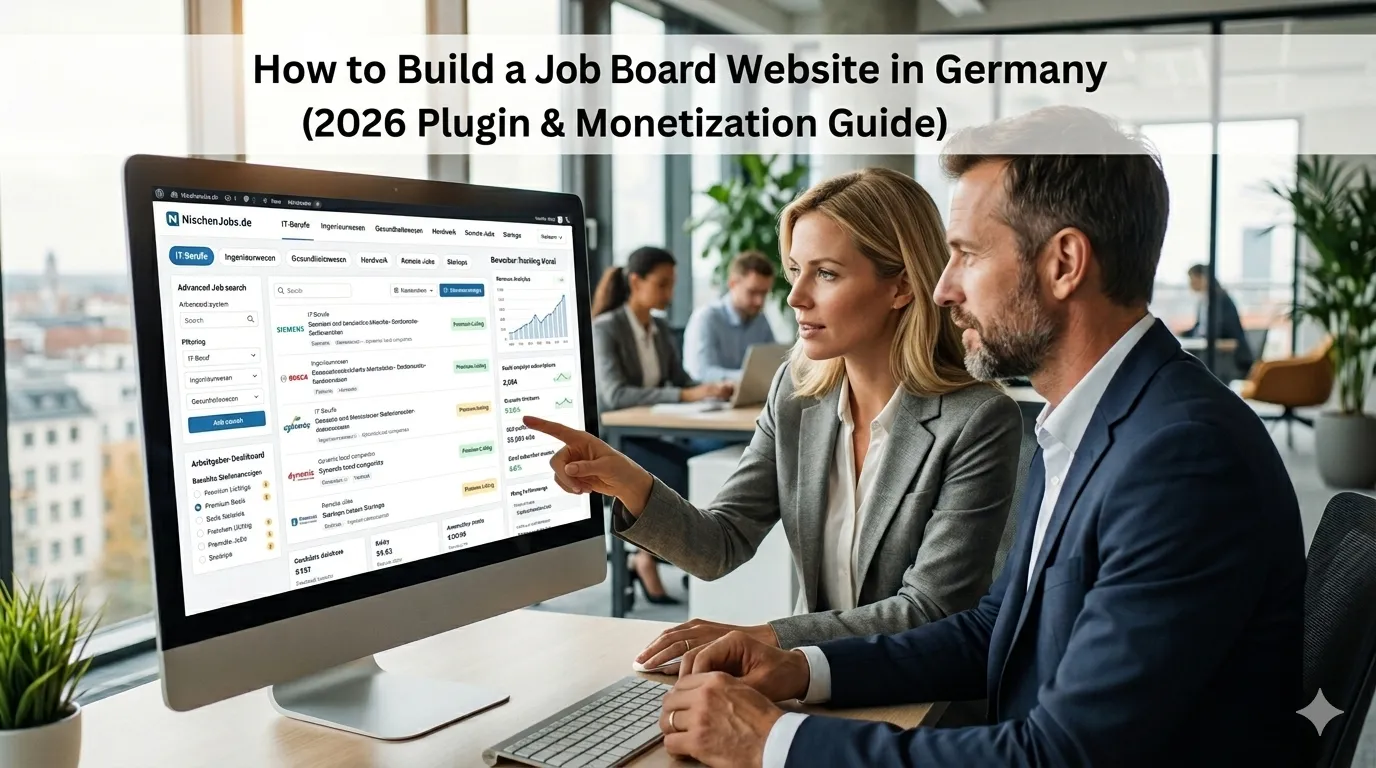
Job boards remain one of the most viable niche businesses a German entrepreneur or agency can build in 2026. The market for general job boards is saturated (StepStone, Indeed, LinkedIn, XING, Glassdoor) — but the market for specialized niche job boards for the German workforce is genuinely open: regional job boards, remote-only boards, industry-specific boards (Mittelstand engineering, Pflege, Handwerk, Tech), purpose-driven boards (Green jobs, Sustainability, Wertorientierte Arbeit).
This guide walks through how to build a job board website in Germany in 2026: which WordPress plugins work, realistic EUR costs, employer pricing models, DSGVO setup for applicant data, and the unfair-advantage strategies for attracting both employers and candidates in a competitive market.
Why are niche job boards still a viable business in Germany in 2026?
Three reasons:
Generalist boards are weak for niches
StepStone and Indeed have scale, but their relevance suffers at the niche level. A specialized board with deep filters (German Pflege jobs, German Handwerk apprenticeships, Mittelstand engineering roles in Bavaria) provides far better matches for both employers and candidates.
Employer willingness to pay
A specialized job ad on a niche board reaches 5,000 highly relevant candidates instead of 500,000 mostly irrelevant ones. Many German employers happily pay €99–€599 for a niche ad that delivers 5 qualified applicants vs. €1,500 on StepStone for 50 unqualified.
SEO compound effects
Job pages naturally rank for long-tail queries: “Stelle als Pflegefachkraft in Köln 2026”. A board with 500 active jobs and 3,000 historical job pages (archived but indexed) accumulates substantial long-tail SEO traffic over time.
The successful German niche job boards we’ve seen built since 2022 share three traits: clearly defined niche audience, strong editorial layer, and disciplined seeding strategy in months 1–6.
What types of job boards work in the German market?
Six patterns have working examples in 2026:
- Regional — jobs in a specific Bundesland or city (Karlsruhe, Sachsen, Norddeutschland).
- Industry-specific — IT, Engineering, Pflege, Gastronomie, Handwerk, Logistics.
- Role-specific — Developer-only, designer-only, founder-only, executive-only.
- Company-type — Mittelstand, Startup, Verein/NGO, Hidden Champions.
- Work-style — Remote-only, hybrid-only, part-time, working-parent-friendly, 4-day-week.
- Purpose-driven — Sustainability, social impact, climate tech, public sector innovation.
The best niches combine 2–3 of these dimensions. “Remote IT jobs at German Startups” is more compelling than just “IT jobs.”
What are the best WordPress job board plugins for German businesses in 2026?
The realistic comparison.
| Plugin | Price (EUR/yr) | Paid Listings | Applicant Tracking | Resume DB |
|---|---|---|---|---|
| WP Job Manager | Free + €39–€399 (add-ons) | Yes | Yes (Resume add-on) | Yes |
| Simple Job Board | Free + extensions | Limited | Yes | No |
| WPJobster | $99 one-time | Yes | Yes | Yes |
| HivePress + Jobs theme | €0–€499 | Yes | Yes | Yes |
| JobBoardWP | Free + €69–€199 | Yes | Yes | Yes |
| Workscout (theme + plugin) | $59 one-time + add-ons | Yes | Yes | Yes |
For most German clients we recommend two patterns:
- WP Job Manager + add-ons — the de facto WordPress job board solution. Mature, well-supported, flexible add-on ecosystem (paid listings, applications, resumes, alerts).
- HivePress with Jobs theme — modern UX, marketplace-style features, well-suited for fresh launches.
Workscout (theme + plugin) is also strong if you want a polished out-of-the-box visual experience.
How do you monetize a German job board?
Five revenue patterns that work in 2026.
Paid job postings
The classic model. Typical 2026 EUR pricing in Germany:
- Single listing: €99–€399 for 30–60 days
- Featured/highlighted listing: €199–€799
- Volume packs (5–25 listings): €399–€2,499
- Subscription (unlimited postings for monthly fee): €499–€2,999/month
Niche boards often charge MORE per listing than generalist boards because the relevance is higher.
Featured employer profiles
Employers pay an annual fee for an enhanced company profile, branded job listings, logo placement, and additional descriptive content. Typical: €99–€599/year per employer.
Resume database access
Recruiters pay to access the candidate database. Typical: €99–€999/month depending on volume. Candidates must explicitly consent to recruiter access and be able to opt out at any time.
Recruitment marketing services
For higher-value clients, offer add-on services: job ad copywriting, social media promotion of the role, branded video content. Typical: €500–€3,000 per role.
Lead-gen for applicants
When candidates apply, the candidate becomes a lead for the employer. Pay-per-application models exist but are less common in Germany than in the UK/US.
The most reliable starting pattern for a new German job board is paid postings + featured employer profiles combined with strong SEO and email marketing to candidates.
What does a German job board ad actually cost employers in 2026?
For competitive market context:
- StepStone single ad: €1,495–€2,895 for 30 days
- Indeed sponsored ad: variable cost per click, typically €5–€25 per applicant
- LinkedIn sponsored ad: €0.10–€7 per click depending on targeting
- XING Stellenmarkt: €690–€1,400 per listing
- Niche boards (Honeypot, sourceCodeJobs.de, Tideri.com): €299–€999 per listing
- Regional / specialist boards: €99–€599 per listing
Your pricing should position somewhere in the niche range — high enough to be taken seriously, low enough to be 3–5x cheaper than StepStone for the niche relevance you offer.
What does building a job board in Germany actually cost?
Realistic 2026 EUR ranges.
DIY job board
- Hosting (Hetzner/Mittwald): €5–€20/month
- Domain + SSL: €15/year
- WP Job Manager + 3–4 add-ons: €99–€399 first year
- Theme: €0–€80
- Time investment: 40–120 hours
- Total to launch: €120–€500
Agency-built starter
WordPress + WP Job Manager Pro bundle + custom theme + payment integration + employer dashboard:
- Build: €7,500–€18,000
- Ongoing maintenance: €149–€349/month
Mid-range custom job board
Custom matching, employer dashboard with analytics, resume database with DSGVO consent flow, payment subscriptions, candidate alerts:
- Build: €18,000–€45,000
- Ongoing: €399–€1,200/month
Enterprise / large-scale board
Multi-region, ATS integration, deep search and matching algorithms, multi-language:
- Build: €45,000–€180,000+
- Ongoing: €1,200–€4,500/month
How does a German job board handle DSGVO compliance?
Job boards process LOTS of personal data: candidate names, contact info, CVs, work history, location, often photos. Five key DSGVO points.
Candidate consent at application
Each application should capture: explicit consent to share with the specific employer, optional consent to broader recruiter searches, optional consent for marketing emails. No pre-ticked boxes.
Resume database consent
If you offer recruiter searches across candidate profiles, you need standalone explicit consent for that. Many candidates only want to apply to specific roles, not enter a general pool.
Data retention rules
German labor law and DSGVO together require: candidate data deleted within 6 months of last activity unless ongoing consent. Failed applicants typically deleted within 6 months. Document retention in your privacy policy.
Right to deletion
Candidates must be able to delete their account and all associated data at any time. The “delete my account” flow must actually delete, not just deactivate.
Where data lives
EU hosting (Hetzner, Mittwald, AWS Frankfurt). For German recruiter access, ensure the recruiter dashboard is also EU-hosted. Resume PDFs in S3 → EU region only.
For a full DSGVO checklist see our GDPR compliance guide.
How do you actually attract employers and candidates to a new job board?
The chicken-and-egg problem of every two-sided market. Four approaches.
Start with candidates, then sell to employers
Build a candidate audience first via SEO content (career guides, salary data, industry analysis) + email newsletter. Once you have a meaningful email list (5,000+ engaged subscribers), employers will pay to reach them.
Start with employers, then advertise to candidates
Approach 30–50 employers in your niche personally. Offer free or discounted initial listings in exchange for being founding employers. Use their jobs as the seed content, then run paid candidate acquisition via Meta Ads or Google Ads.
Acquire an existing board
If a competitor in your niche is stagnating, acquisition can be cheaper than building. We’ve seen niche German boards trade for €15,000–€80,000 — sometimes a steal compared to organic build.
Partner with industry associations
Vereine, IHK chapters, Berufsverbände all want to provide value to members. Offer them a co-branded section of your board, or revenue share on member-employer postings.
The pattern that fails most often: launching an empty board and “hoping” employers and candidates find it via SEO.
What features actually differentiate a great German job board?
The differentiators that move metrics:
Strong filtering
By location (multi-city + Bundesland), salary range, contract type (Festanstellung, Werkstudent, Freelance), remote level, language requirement, working-time model (4-Tage-Woche, Teilzeit), industry.
Salary transparency
Many German boards still let employers post without salary. A board that REQUIRES salary disclosure (or strongly nudges toward it) gains trust with candidates fast. Especially relevant given the 2026 EU Pay Transparency Directive.
Application UX
One-click apply with saved profile. Mobile-optimized. No 20-field application forms that destroy completion rates.
Job alerts that actually match
Daily/weekly emails with new matching jobs. Better matching = better engagement = more applications = more paid postings.
Editorial layer
Career guides, salary studies, industry analysis. The content that brings candidates from Google search, then keeps them subscribed.
Verified employer profiles
Some level of employer verification (UStID, Handelsregister, signed terms) reduces scam listings.
What are the most common mistakes new German job boards make?
Four patterns dominate failures:
Launching empty
Going live with 5 jobs and hoping. Candidates bounce, employers don’t trust you, SEO doesn’t index. Always seed with 50–200 jobs before public launch.
Underestimating moderation
Spam, scam, and fake job listings appear within days of going live. Without moderation tools and policies, the board’s reputation erodes fast.
Over-customizing the platform too early
Building custom features before validating demand. Configure WP Job Manager first; add custom features only when there’s clear demand and revenue to support them.
No email list strategy
The board’s most valuable asset is the candidate email list. Boards that treat email as an afterthought leave 80% of revenue on the table.
When should you build a custom job board instead of using WordPress?
For most niche boards, WordPress + WP Job Manager covers 95% of needs. Custom makes sense when:
- You need a sophisticated matching algorithm (AI-driven candidate-job fit) that no plugin provides
- You’re integrating with ATS systems (BambooHR, Personio, Workday) at scale
- You’re at enterprise scale where plugin performance limits hurt
- You’re building a marketplace where the job board is just one feature
Custom Laravel or Next.js builds for these cases typically cost €30,000–€150,000+. Everyone else should usually configure WordPress instead.
To understand the build vs. buy decision better, see our custom WordPress plugin development guide and directory website guide.
Frequently Asked Questions About Building a Job Board Website in Germany
WP Job Manager + add-ons; HivePress with Jobs theme as a modern alternative.
€120–€500 DIY; €7,500–€18,000 agency; €18,000–€45,000 mid-range; €45,000+ enterprise.
€99–€599 per listing; €199–€799 featured; volume packs and subscriptions on top.
12–24 months to break even; 24–36 to meaningful profit; niche boards faster than generalists.
Granular consent, 6-month retention, easy account deletion, EU hosting, standalone recruiter consent.
Company career pages OK with attribution; scraping competitor boards is copyright/UWG risk.
Forward applications for starter boards; offer simple ATS dashboard at higher tiers. Don’t build a full ATS.
Stripe for cards + SEPA; PayPal as secondary; manual invoice + SEPA for high-ticket subscriptions.
Ready to plan your job board?
A niche job board in Germany is a real long-term business opportunity in 2026 — but only with disciplined niche selection, careful seeding, and strong DSGVO setup from day one.
If you want a 30-minute scoping call to map out your specific job board idea, book a meeting or send the details via our contact page.
Need expert help? Gem Programmers provides web design and development services for businesses in Germany, Austria and Switzerland. Request a free, no-obligation quote and get a clear plan with scope, timeline and price.