
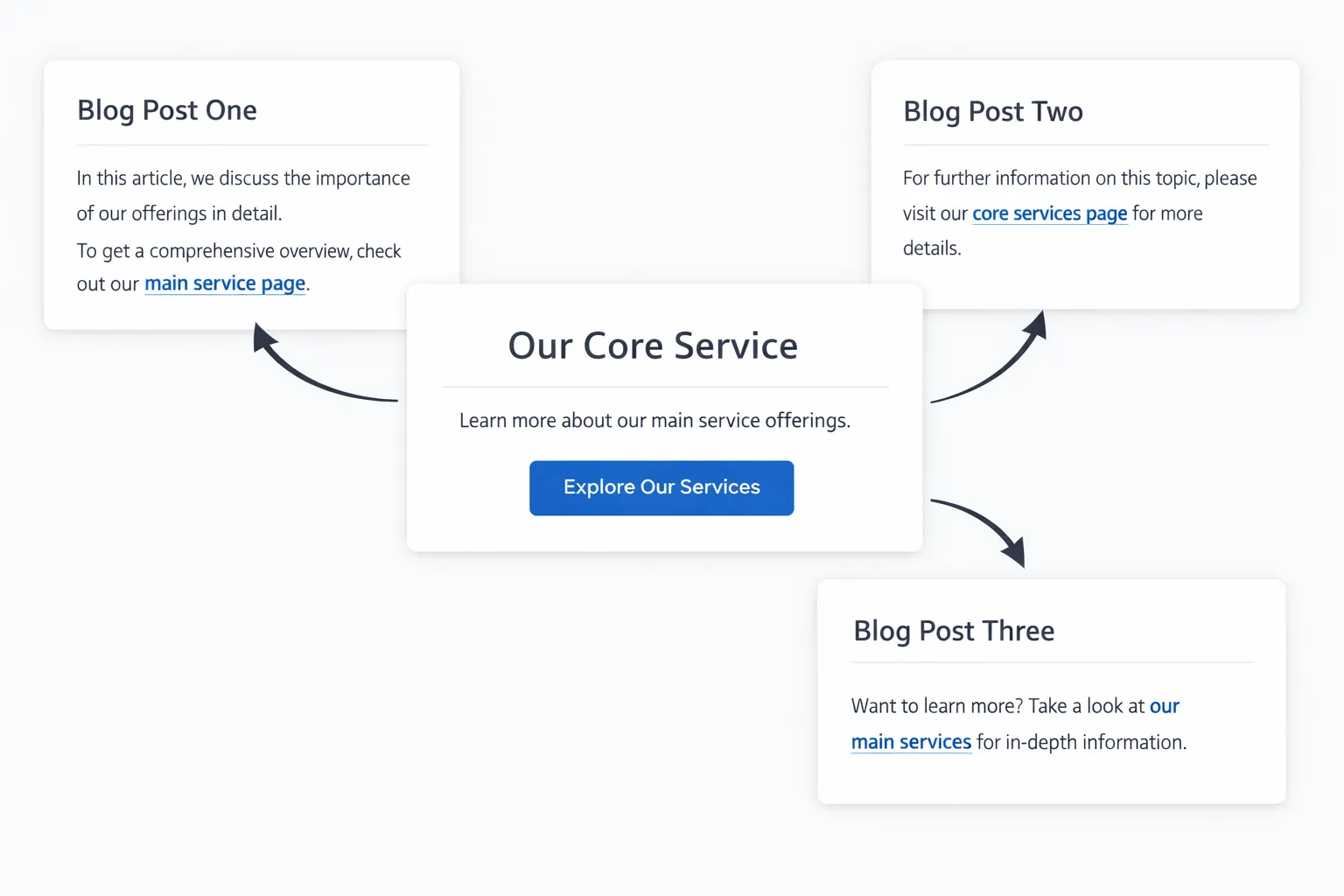
Why Internal Linking for Service Pages Matters in eCommerce
In the competitive world of eCommerce, ranking product pages is important. But ranking service pages is even more critical for long-term revenue.
If you offer Ecommerce Development Services, your service pages must rank for commercial keywords. That’s where internal linking for service pages becomes powerful.
Most websites focus on backlinks. But they ignore:
- Link equity distribution
- Topic clusters
- SEO architecture
- Conversion-focused navigation
- Trust-building pathways
Internal linking for the service pages helps search engines understand your expertise. It also helps users move smoothly across your website.
This guide explains:
- How internal linking improves rankings
- How link equity works
- How topic clusters support service pages
- UX and CTA improvements
- Design and trust enhancements
- Step-by-step SEO architecture strategy
Let’s go deep.
What Is Internal Linking for Service Pages?
Internal linking for the service pages means connecting relevant blog posts, category pages, landing pages, and other service pages to your main service page.
Example:
If you offer Ecommerce Development Services, you may also publish:
- Shopify customization blogs
- WooCommerce guides
- Conversion optimization articles
- Technical SEO tutorials
- UX case studies
Each of these pages should strategically link back to your main service page.
This creates:
- Topical relevance
- Authority signals
- Improved crawl efficiency
- Strong link equity flow
Search engines see this structure and understand that your service page is important.
How Link Equity Works in SEO Architecture
Link equity (sometimes called “link juice”) is the value passed from one page to another through links.
If your blog post ranks well and has backlinks, it holds authority. When you link that blog to your service page, you pass some link equity.
Internal linking pages ensure:
- High-traffic blogs support revenue pages
- Authority flows toward commercial pages
- Important pages get stronger signals
Without linking, your service pages become isolated.
With strategic linking, they become central hubs.
Why Service Pages Struggle Without Internal Linking
Many businesses face these issues:
1. Orphan Pages
Service pages have no incoming links from blogs or the main navigation.
2. Weak Topical Signals
Search engines cannot clearly understand what the page is about.
3. Poor Crawl Depth
Important pages are too deep in the site structure.
4. Low Engagement
Users land on blogs but never reach service pages.
5. Conversion Leakage
Traffic increases, but leads do not.
Internal linking for service solves all these problems.
What Are Topic Clusters and Why Do They Matter?
Topic clusters are groups of related content connected to a central “pillar” page.
Your service page should be the pillar.
Example structure:
Pillar Page: Ecommerce Development Services
Cluster Content:
- Shopify speed optimization
- Magento performance tips
- eCommerce UX best practices
- Conversion rate case studies
- Payment gateway integrations
Each cluster article links back to the pillar.
This structure:
- Builds topical authority
- Strengthens keyword relevance
- Improves link equity flow
- Helps service pages rank faster
Internal linking for the service pages is the backbone of topic clusters.
SEO Architecture: Building a Strong Internal Linking Structure
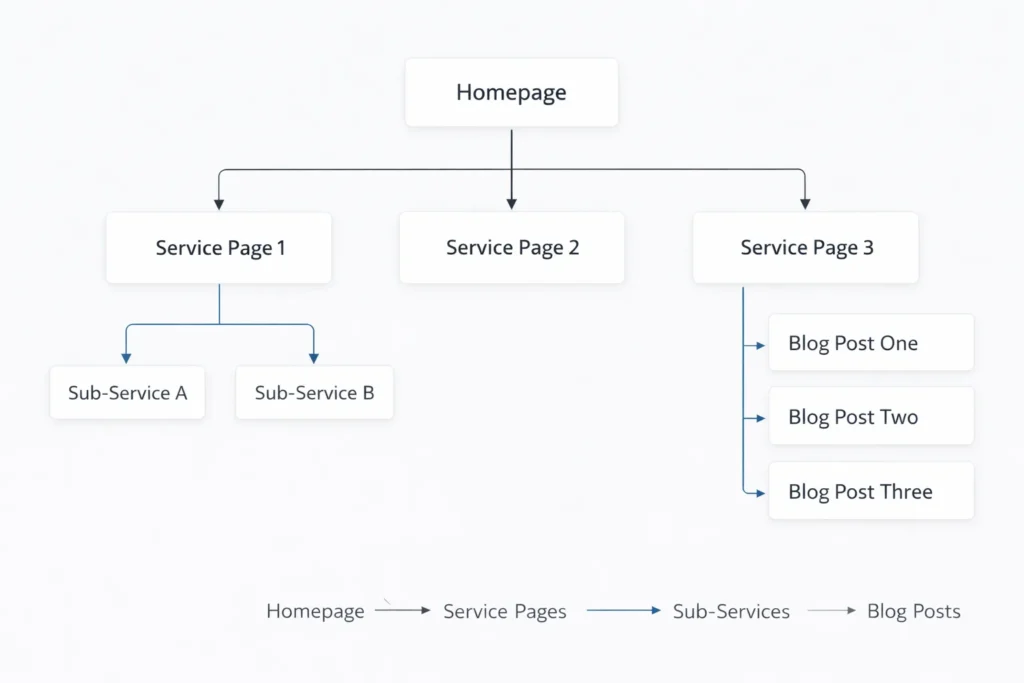
Let’s break it into practical steps.
1. Create a Clear Hierarchy
Your site structure should look like:
Home
→ Services
→ Ecommerce Development Services
→ Sub-services (Shopify, WooCommerce, Magento)
→ Blog Articles
Every blog in this category should link upward.
Internal linking for service works best when the structure is simple and logical.
2. Use Contextual Links (Not Just Footer Links)
Footer links are weak.
Instead, use contextual anchor text like:
- “professional ecommerce development services”
- “custom online store development solutions”
- “Hire ecommerce experts.”
Contextual links:
- Pass stronger relevance
- Improve semantic signals
- Enhance user experience
3. Optimize Anchor Text Strategy
Avoid:
- “Click here”
- “Read more”
Use descriptive anchor text that includes variations of your primary keyword:
- internal linking pages
- ecommerce service page optimization
- SEO architecture for service pages
Anchor text variation prevents over-optimization.
4. Limit Link Depth
Your service page should not be more than 3 clicks from the homepage.
Internal linking for the service pages reduces crawl depth.
Shallow pages rank faster.
UX Benefits of Internal Linking for Service Pages
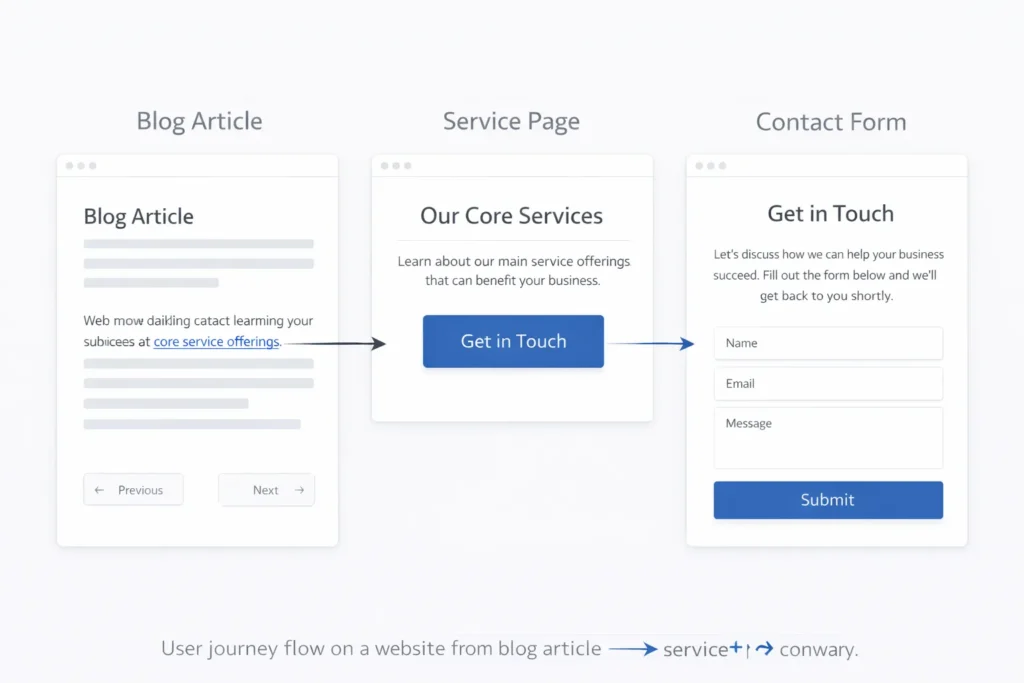
Internal linking is not just for search engines.
It improves:
1. User Journey
Readers discover solutions naturally.
2. Time on Site
Users explore multiple pages.
3. Reduced Bounce Rate
Visitors don’t exit after one blog.
4. Conversion Path Optimization
Blogs act as educational funnels.
If someone reads a blog about eCommerce UX problems, and you link to your Ecommerce Development Services page, it feels helpful — not pushy.
That’s smart UX.
CTA Optimization Through Internal Linking
Instead of aggressive CTAs, use soft internal linking:
- “Need help implementing this strategy?”
- “Our ecommerce development experts can assist.”
- “Explore our full ecommerce development services.”
Internal linking for service pages turns informational traffic into commercial leads.
Design Strategy for Effective Internal Linking
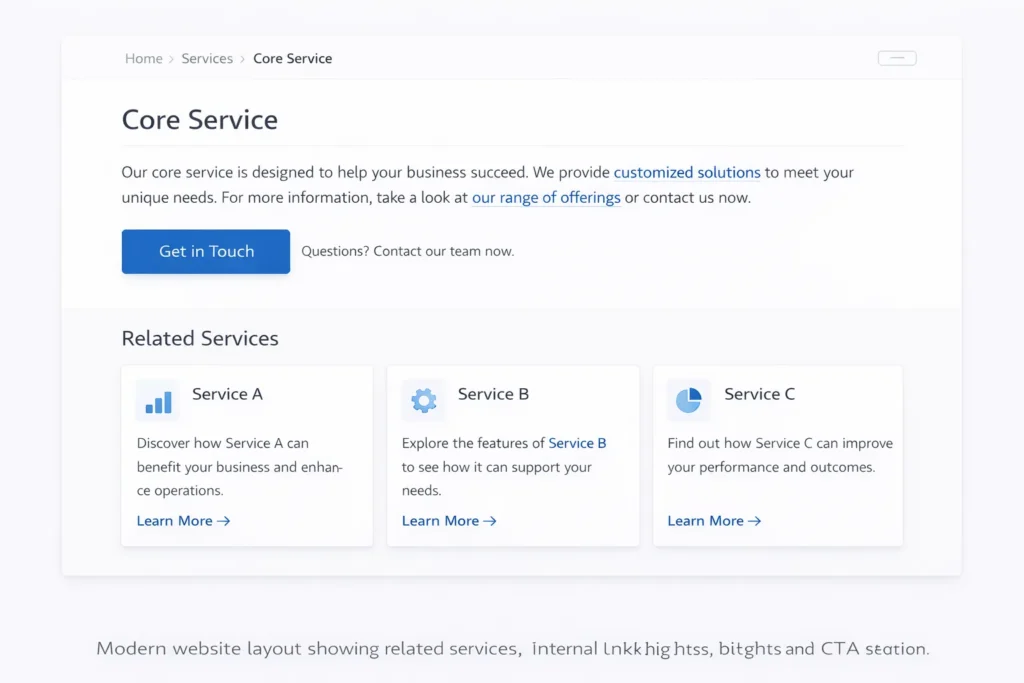
Good SEO architecture requires a clean design.
Best practices:
- Use visually highlighted internal links
- Add “Related Services” sections
- Use service cards inside blogs
- Include contextual banners
- Add breadcrumb navigation
Visual Related Services Section Example
These elements improve:
- Trust
- Professional perception
- Authority
- Navigation clarity
Trust Signals and Internal Linking
Internal linking for the service pages supports trust in subtle ways:
- Linking to case studies
- Linking to testimonials
- Linking to portfolio pages
- Linking to certifications
Instead of keeping proof separate, integrate it inside blog content.
Example:
While discussing site speed, link to a case study showing improved results.
Trust increases. Conversion improves.
Common Internal Linking Mistakes to Avoid
- Over-linking every keyword
- Using identical anchor text repeatedly
- Linking irrelevant pages
- Ignoring high-performing blog pages
- Not updating old content
Internal linking for service pages should feel natural.
Advanced SEO Architecture Strategy for eCommerce Sites
For larger eCommerce businesses:
Use Silo Structure
Group content under clear categories.
Implement Hub Pages
Create sub-hubs like:
- Shopify Development
- WooCommerce Development
- Headless Commerce
Use Breadcrumb Markup
Helps search engines understand the structure.
Link From High Authority Pages
If your homepage has backlinks, strategically link from it.
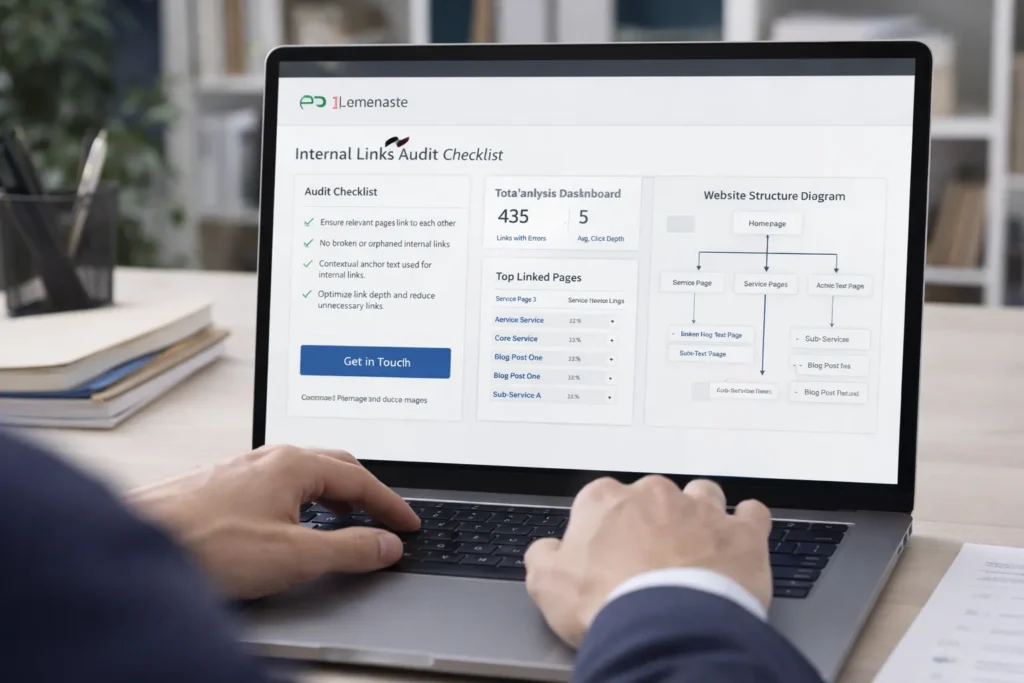
How to Audit Internal Linking for Service Pages
Step-by-step audit:
- Identify your main service page
- Use SEO tools to find orphan pages
- Check pages with high traffic
- Add contextual links from those pages
- Fix broken links
- Improve anchor text diversity
- Reduce crawl depth
Repeat quarterly.
Real-World Example: eCommerce Development Agency
Imagine an agency offering Ecommerce development services.
They publish 50 blog posts.
But only 5 link to the service page.
After restructuring:
- All relevant blogs link to the service page
- Case studies link back
- Sub-services connect upward
- Navigation optimized
Results typically include:
- Higher keyword rankings
- Increased dwell time
- Better crawl frequency
- More qualified leads
That’s the power of internal linking for service pages.
How Internal Linking Supports Commercial Search Intent
Your keyword has commercial intent.
That means users are considering hiring.
Internal linking for service pages helps:
- Move users from awareness to decision
- Reinforce expertise
- Show depth of services
- Provide proof and case studies
This alignment increases conversion probability.
Download The Internal Linking Checklist
Internal Linking Checklist for Service Pages
Before publishing, confirm:
- At least 10 relevant contextual links point to the service page
- Anchor text variations are natural
- Service page links back to blogs
- Breadcrumb navigation exists
- Related services are displayed
- Case studies are linked
- CTA placements feel organic
Conclusion
Internal linking for the service pages is not optional in modern SEO.
It:
- Distributes link equity
- Strengthens topic clusters
- Improves SEO architecture
- Enhances UX
- Supports CTAs
- Builds trust
- Boosts rankings
If you want your Ecommerce Development Services page to rank for commercial keywords, start restructuring your internal links today.
SEO is not only about backlinks.
It’s about structure.
And structure wins.
Faqs
Internal linking for the service pages means connecting relevant blogs and pages to your main service page to improve SEO, link equity flow, rankings, and user navigation.
Link equity passes authority from high-performing pages to service pages, increasing their ranking potential and strengthening their SEO architecture and topical relevance.
Topic clusters group related content around a pillar page. They improve structure, relevance, and help service pages rank faster through strategic internal linking.
There is no fixed number, but high-value service pages should receive multiple contextual links from relevant blog posts and category pages.
Yes. Internal linking for the service pages guides users naturally toward service solutions, improving trust, engagement, and conversion rates.
Use descriptive and varied anchor text. Avoid repetitive keyword stuffing. Maintain natural language while supporting SEO relevance.
You should audit internal linking quarterly to fix orphan pages, update old content, and optimize link equity distribution.