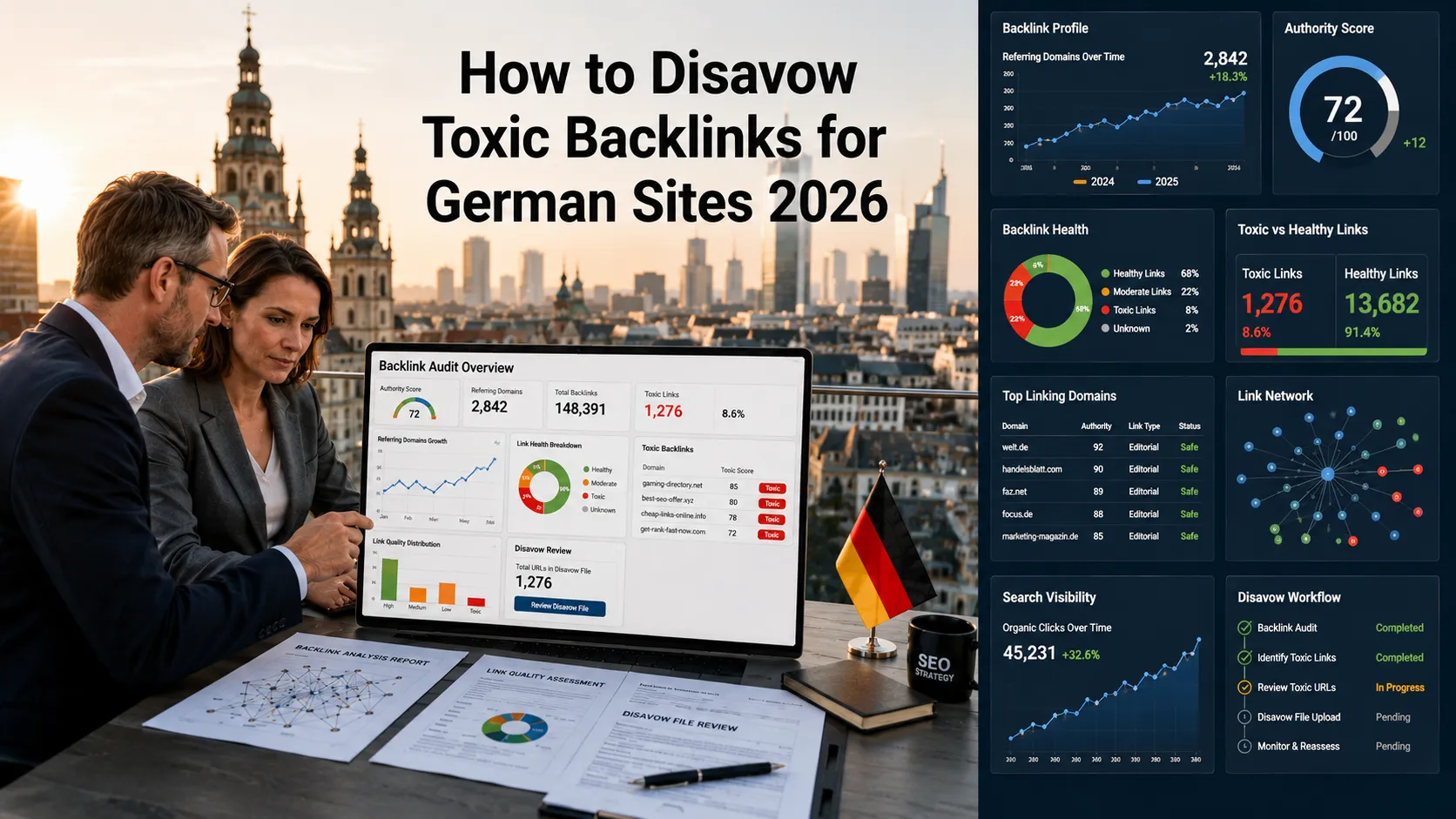
Disavow toxic backlinks decisions rely on the Google Disavow tool, one of the most over-used SEO tools in 2026. Founded in 2012 for genuine cleanup needs, it’s now frequently abused — German businesses disavowing perfectly fine links out of paranoia, agencies offering “disavow services” as snake oil, panicked reactions to negative SEO that wasn’t actually happening.
This guide walks through what disavow toxic backlinks for German websites actually means in 2026: when disavow is genuinely useful, when it’s harmful, decision framework for each link, common mistakes, and the modern reality where most sites don’t need disavow at all.
For broader backlink work see our backlink audit Germany guide.
What is the Google Disavow tool?
Google’s disavow tool tells Google “don’t count these specific links as part of my backlink profile.”
Original purpose (2012)
Help sites recover from Penguin algorithm penalties. Provide a way to clean up bad links acquired through hacked spam or aggressive SEO.
How it works
Submit a text file listing domains or URLs to ignore. Google adds these to internal “don’t count” list.
What it does NOT do
- Remove links from the web
- Get links removed by webmasters
- Provide immediate ranking changes
- Make all bad-looking links irrelevant
Why is disavow over-used in 2026?
Three reasons:
Lingering 2012-era SEO advice
Old “disavow everything bad” advice repeated in outdated articles.
“Toxic Link Score” tools mislead
Some SEO tools show high “toxic scores” for low-quality links that Google ignores anyway. Triggers unnecessary disavow.
Agency upselling
“Disavow service” is easy to sell + bill. Some agencies recommend it regardless of need.
What’s Google’s modern stance on bad links?
Google has improved dramatically at handling spam:
2012 reality
Bad links could tank rankings. Disavow was sometimes necessary.
2026 reality
Google ignores most low-quality links automatically. Algorithm-level spam detection vastly improved.
Google quotes (paraphrased from Search Liaison)
“Most sites don’t need to use disavow. We’re good at ignoring bad links.”
“Disavow only if you bought bad links yourself or got a manual penalty.”
Implications
For 90% of sites: don’t disavow. Spend time on link building, not link disavowal.
When IS disavow genuinely useful?
Five legitimate scenarios:
1. Manual penalty in Search Console
Google sent a manual action notification for unnatural links. Disavow + reconsideration is needed.
2. You bought low-quality links
Past SEO bought links from PBNs / link farms. Cleaning up known problematic links you created.
3. Hacked site spam injection
Hackers injected spam links + you can’t remove them. Disavow what you can’t remove.
4. Negative SEO attack (rare)
Someone clearly built spam links to your site to harm rankings. Disavow defensive.
5. Migration from spammy past
Site you bought has bad link history. Cleaning up inherited problems.
When should you NOT disavow?
Five scenarios where disavow is unnecessary or harmful:
1. Just because a tool flagged “toxic”
Tool scores often false-positive. Verify manually before disavow.
2. Low DR linking sites
Low DR ≠ toxic. Many legitimate small sites have low DR.
3. Foreign-language sites
Random Japanese or Russian site linking to you doesn’t help, but doesn’t hurt. Google ignores.
4. Sites you’re unsure about
If you can’t tell whether it’s harmful, default to leaving it alone.
5. As “regular hygiene”
Disavow isn’t routine maintenance. It’s an exception for specific situations.
How do you assess if a link is actually toxic?
A 5-factor test:
1. Is the site obviously spam?
Auto-generated content, no real audience, content quality near-zero. Yes = consider disavow.
2. Is it from a known link farm or PBN network?
Multiple sites sharing same template, same hosting, same registration patterns. Yes = consider disavow.
3. Did you (or past SEO) pay for the link?
You know the link was purchased. Yes = consider disavow if quality bad.
4. Is anchor text suspicious?
Exact-match keyword stuffing as anchor. Suspicious but not necessarily toxic.
5. Is the linking page penalized in Google?
Site:operator search to see if linking site is in Google. If de-indexed, it’s their problem, not necessarily yours
When 3+ signals appear, consider disavow.
With 0–2 signals, leave them as is.
What’s the disavow process?
If you’ve decided disavow is warranted:
Step 1: List domains/URLs to disavow
Plain text file. Format:
# Domain disavow
domain:badsite.com
domain:linkfarm.net

# Specific URL disavow
http://example.com/bad-page.html
Disavowing entire domain (with domain: prefix) safer than per-URL.
Step 2: Upload to Google Disavow tool
search.google.com/search-console/disavow-links
Step 3: Wait
Google adds disavow file to processing queue. May take days/weeks to fully apply.
Step 4: Monitor
Track rankings + Search Console messages.
Step 5: Re-evaluate periodically
Disavow file is cumulative. Don’t add to it without reason.
What’s the manual penalty recovery process?
If you actually have a manual link penalty:
Step 1: Identify problematic links
Search Console Manual Actions panel + manual review of link profile.
Step 2: Try removing links
Contact webmasters of low-quality linking sites. Request link removal.
Step 3: Document removal efforts
Keep records of who you contacted, when, responses.
Step 4: Disavow what can’t be removed
For links you couldn’t get removed.
Step 5: Submit reconsideration request
Through Search Console. Explain cleanup efforts.
Step 6: Wait
Reconsideration can take weeks to months.
Manual penalties are increasingly rare in 2026 — Google’s algorithm handles most spam without needing manual action.
What about negative SEO?
Negative SEO = someone building spam links to your site to harm rankings.
Is it real?
Rare in 2026. Google’s algorithm is good at distinguishing legitimate from injected spam.
Signs of negative SEO
Sudden spike of obvious spam links from clearly fake sites with manipulated anchors targeting your money keywords.
Response
Document the attack pattern. Disavow obvious spam. Report to Google if severe. Continue normal SEO operations.
Don’t overreact
Most “negative SEO” panic is unwarranted. Google ignores most bad links automatically.
What are common disavow mistakes?
Five patterns:
Disavowing everything below DR 30
Many legitimate small sites have low DR. Disavowing them harms your profile.
Trusting “toxic score” tools blindly
Many false positives. Manual review necessary.
Disavowing as routine maintenance
Disavow is exception, not routine. Don’t do it “just to be safe.”
Disavowing competitor outreach links
Real editorial mentions disavowed by panicked SEO. Self-inflicted damage.
Not maintaining the disavow file
Adding random links over years without strategy. Disavow grows messy.
When should German businesses actually use disavow?
Honest answer for most German SMEs in 2026: never or almost never.
Use when
- Manual penalty received
- You know you bought bad links
- Severe + obvious negative SEO attack
Skip when
- Doing “routine SEO hygiene”
- Tool flagged “toxic” without manual verification
- Just because a link looks low-quality
For most German SEO programs: focus on building good links, not disavowing imagined bad ones.
Frequently asked questions
Yes but rarely needed in 2026.
Manual penalty, bought links, severe negative SEO, hacked spam.
Possibly; many low-DR sites are legitimate.
With heavy skepticism; manual review is required.
Usually Google ignores them; monitor before acting.
Days to weeks for processing.
Usually no; Google ignores irrelevant links.
Yes; remove from file and re-upload.
Need help with link strategy?
If you’re worried about your link profile + want a 30-minute scoping conversation about whether disavow is actually needed, book a meeting or send details via our contact page.
Need expert help? Gem Programmers provides full-service SEO for businesses in Germany, Austria and Switzerland. Request a free, no-obligation quote and get a clear plan with scope, timeline and price.