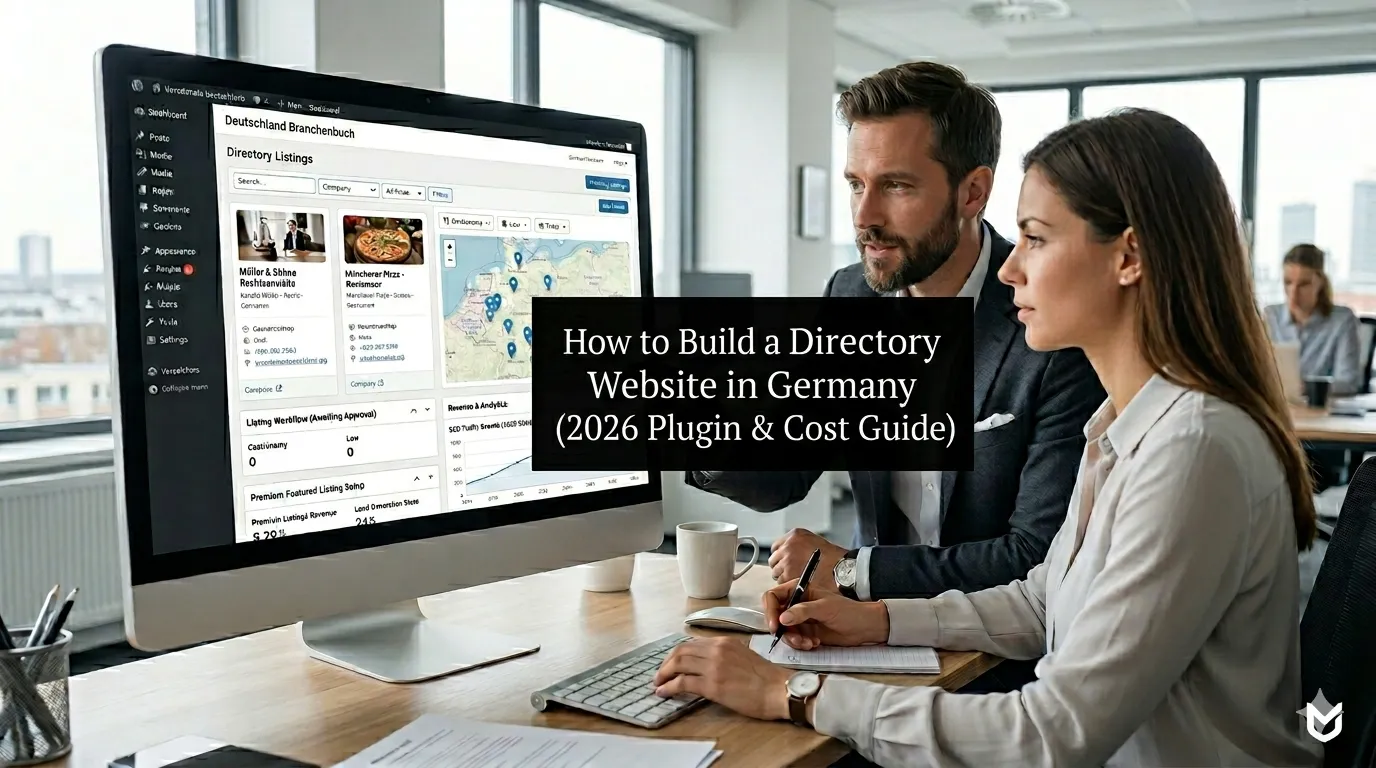
Directory websites — local business directories, niche industry listings, professional finders, restaurant guides — are one of the most underrated business models a German entrepreneur or agency can build in 2026. They compound over time (more listings = more SEO traffic = more listings), they have clear monetization paths (paid listings, featured placement, lead-gen), and they’re achievable with WordPress + the right directory plugin without writing custom code.
This guide walks through how to build a directory website in Germany in 2026: which platform and plugin to use, what it costs in EUR, how to handle DSGVO for business listings, monetization patterns, and how to actually attract the first 100 listings (the hardest part).
What is a directory website, and what types work in Germany?
A directory website is a structured listing site where users can search and filter entries — businesses, professionals, services, properties, events — and (optionally) submit their own listings.
Common types that work in the German market in 2026:
- Local business directories — restaurants, shops, services within a German city or region.
- Niche industry directories — German Steuerberater, Anwälte, Heilpraktiker, Bauunternehmer, IT-Dienstleister.
- Marketplace directories — wedding photographers, freelance designers, B2B suppliers.
- Property and real estate — Immobilien listings, Ferienwohnungen, Coworking spaces.
- Event directories — fairs (Messen), conferences, workshops, cultural events.
- Educational directories — German schools, universities, course providers, Bildungsangebote.
Some types have established competitors (Yelp, Tripadvisor, ImmoScout24, Doctolib) — entering those markets requires genuine differentiation. Niche directories with a clear audience and SEO advantage remain the strongest opportunity.
When is a directory website worth building?
Five signals it’s a good idea:
- There’s no comprehensive German directory for the niche you have in mind
- You have an existing audience or industry network that would seed initial listings
- The niche has high commercial value (paid services where leads are worth €50+ each)
- You can credibly produce or curate content around the directory (blog posts, guides, comparisons)
- You’re prepared for a 12–24 month patient build to reach SEO scale
Signals it’s premature:
- You don’t have time to actively recruit the first 100 listings personally
- The niche is already saturated by major players
- You’re hoping listings will magically appear without seeding effort
- The unit economics don’t work (each lead is worth €2 to listed businesses)
What are the best directory plugins for WordPress in 2026?
The realistic comparison.
| Plugin | Price (EUR/yr) | Multi-Listing | Map Integration | Paid Listings Built-in |
|---|---|---|---|---|
| GeoDirectory | Free + €99–€499 | Yes | Yes (Mapbox/OSM) | Yes (with add-on) |
| ListingPro | €69–€279 | Yes | Yes (Google Maps) | Yes |
| Directorist | Free + €69–€299 | Yes | Yes | Yes |
| Business Directory Plugin | Free + €99–€199 | Yes | Limited | Yes |
| HivePress | Free + €69–€499 | Yes | Yes | Yes |
| WP Job Manager + Listings | €39–€399 | Yes | Yes (with add-on) | Yes (Resume add-on) |
| Toolset | €69–€299 | Custom build | Yes | Custom |
For most German clients we recommend two patterns:
- GeoDirectory — feature-rich, well-maintained, strong community, OpenStreetMap (free) support which is friendlier for DSGVO than Google Maps default.
- HivePress + a niche theme — modern UX, marketplace-friendly, paid bookings/services possible (good for service-marketplace directories).
ListingPro and Directorist are solid alternatives. For very simple “alphabetical listing” needs, the free Business Directory Plugin is enough.
When should you use OpenStreetMap instead of Google Maps?
A specific German consideration: Google Maps loaded directly on a German website creates a DSGVO problem (IP address is sent to Google before consent). Workarounds:
- Load Google Maps only after explicit consent (cookie banner gate)
- Use a “click to load map” placeholder that loads Google Maps on click
- Switch to OpenStreetMap (OSM) via plugins like WP OSM Plugin or via map providers like Maptiler / MapTiler Cloud — fully EU-hostable
For DSGVO-strict German directory sites we default to OpenStreetMap. Quality is excellent for German addresses, and there’s no cookie consent gate required.
How do you monetize a directory website in Germany?
Six revenue patterns that work in 2026.
Paid premium listings
Businesses pay to upgrade their listing — featured placement, larger photos, extended descriptions, contact form, video. Typical: €19–€99/month per listed business.
Lead-gen / pay-per-contact
Free listings, but each contact form submission to a business costs a small fee (€2–€20 depending on industry). Best for high-value services (Steuerberater, Anwalt, Bauunternehmer) where leads are worth €100+ to the business.
Affiliate partnerships
Featured listings link to a partner platform (booking, e-commerce, comparison site) with affiliate tracking. Works well for travel, e-commerce, and SaaS directories.
Display advertising
Google AdSense, Ezoic, or direct ad sales for high-traffic directories. Margins are thin; usually a secondary revenue stream, not primary.
Sponsored content
Companies pay for “Featured Article” or “Sponsored Guide” content alongside their directory listing. Premium positioning at €500–€5,000 per placement for high-traffic niches.
Subscription / membership for end-users
Less common but works for high-value B2B directories where buyers pay for access to the full directory and verified leads.
The most reliable pattern for a new German directory is paid premium listings combined with lead-gen for high-value services. Display ads come later when traffic crosses 50,000+ monthly pageviews.
What does building a directory website in Germany actually cost?
Realistic 2026 EUR ranges.
DIY directory
- Hosting (Hetzner / Mittwald): €5–€20/month
- Domain + SSL: €15/year
- Directory plugin: €0–€299 first year
- Theme: €0–€80
- Time investment: 40–150 hours
- Total to launch: €100–€500
Agency-built starter directory
WordPress + GeoDirectory or HivePress + custom theme + map + 1–2 monetization mechanisms:
- Build: €6,000–€15,000
- Ongoing maintenance: €99–€249/month
Mid-range directory build
Multi-region, advanced search, paid memberships, custom claim/verification workflow, multi-language:
- Build: €15,000–€40,000
- Ongoing: €299–€900/month
Enterprise directory
100,000+ listings, multi-country, deep custom features, API for partners:
- Build: €40,000–€150,000+
- Ongoing: €900–€3,500/month
The biggest cost variable: not the platform build, but content seeding. A directory with 50 listings won’t rank or attract organic traffic. Budget for the work to reach the first 500–1,000 listings — either via manual data entry, scraping permitted public sources, or recruiting listings via outreach.
How does a German directory website handle DSGVO compliance?
Five practical points.
Business listings vs. personal data
Business listings (companies, GmbH, Vereine) generally have lower DSGVO sensitivity than personal data — but sole proprietors and Freelancer listings (Einzelunternehmer with personal name) DO count as personal data. Handle accordingly.
Listing claim and verification
If listings can be claimed by their owners (recommended for accuracy), the claim/verification workflow handles personal data. Standard DSGVO consent flows apply.
Reviews and ratings
User-submitted reviews (with name, sometimes email or social profile) are personal data. Consent for publication, ability to delete on request, moderation for libel — all DSGVO and German UWG (unfair competition) concerns.
Contact forms to listings
When a directory visitor submits a contact form to a listed business, the directory is acting as a data processor between visitor and business. Document this in your Datenschutzerklärung.
Map data and IP
As mentioned above, OpenStreetMap is cleaner than Google Maps for DSGVO. If you use Google Maps, gate it behind consent.
For a full DSGVO checklist see our GDPR compliance guide.
How do you actually get the first 100 listings on a German directory?
The hardest part of any directory launch, and the part most people underestimate. Four practical approaches.
Manually seed from public sources
Scrape or compile listings from public business registries (Handelsregister via Bundesanzeiger, IHK directories, branch associations) for the relevant niche. Add reasonable contact info (publicly available only — no scraping of email harvesters). Be clear in your Datenschutzerklärung about how listings are sourced.
Outreach to industry / association
Approach branch associations, Vereine, or industry groups in your niche. Offer free premium listings to the first 50 members in exchange for permission to list. Many German Vereine and Berufsverbände will happily collaborate if framed correctly.
Partner with adjacent businesses
If you’re building a wedding photographer directory, partner with wedding planners, venues, dressmakers. Cross-promote. Their referrals seed your directory; your traffic eventually feeds theirs.
Pay for initial listings (rarely)
Some directory founders pay €5–€20 per listing to a freelancer or VA to manually add the first 200 listings from a researched list. This works when listings need careful data entry that scraping can’t provide.
The directory starts being useful around 500 listings and starts ranking for niche keywords around 1,000–2,000 listings. Plan for 12–18 months of patient growth.
What separates a successful directory from a stagnating one?
Five differentiators we see consistently:
Unique editorial content
A directory that’s only a database loses to one with editorial layered on: best-of guides, comparisons, niche analysis. The editorial is what makes Google rank you.
Strong on-page SEO per listing
Each listing should have unique title, meta description, structured data (LocalBusiness schema), and ideally unique editorial intro. Listings that are template-only thin content don’t rank.
Easy and trustworthy listing claim
Business owners should be able to claim their listing in under 5 minutes with email or phone verification. Difficult claim flows mean stale data, which hurts trust.
Active moderation
Removing fake listings, fake reviews, spam submissions. Within hours, not weeks. Automated tools (Akismet for comments, plus manual review) plus a clear takedown flow.
Sustainable acquisition channel
SEO is slow but compounding. Paid acquisition (Google Ads, Meta) for directories rarely pays back without strong unit economics. Most successful German directories invest heavily in SEO + niche community building.
When should you build a custom directory instead of using a plugin?
Configure existing plugins by default. Custom makes sense when:
- You need a complex custom data model that no plugin supports (e.g., listings with 40+ structured fields)
- You’re at scale where plugin performance limits matter (1M+ listings)
- You need a custom API for partners or syndication
- You’re building an enterprise B2B directory with unusual auth and access rules
Custom Laravel or Next.js builds typically range from €25,000–€120,000+. For most businesses, GeoDirectory combined with a strong theme and consistent content strategy covers around 95% of requirements. To better understand the build vs. buy decision, see our custom WordPress plugin development guide and the headless WordPress with Next.js guide.
Frequently Asked Questions About Building a Directory Website in Germany
GeoDirectory + OSM for DSGVO; HivePress for marketplace UX; Directorist for budget; WP Job Manager for job-style.
€100–€500 DIY; €6,000–€15,000 agency; €15,000–€40,000 mid-range; €40,000+ enterprise.
Paid premium listings (€19–€99/mo) + lead-gen (€2–€20/lead) is the most reliable combo.
6–18 months to first traffic, 18–36 months to traffic-driven revenue.
OpenStreetMap — cleaner DSGVO, excellent for German addresses, no consent gate needed.
Email-verify, moderate for libel and fake reviews, provide a takedown flow — mind UWG liability.
100–300 at launch; network effect kicks in above 500.
Public registries (Bundesanzeiger, IHK) usually OK with attribution; scraping competitors is a copyright/UWG problem.
Ready to plan your directory website?
A directory website is a long-term play with strong compounding returns — but only if the foundation is right: the right plugin, DSGVO-clean setup, strong editorial layer, and a realistic plan for the first 1,000 listings.
If you want a 30-minute scoping call to map out your specific directory idea, book a meeting or send the details via our contact page.
Need expert help? Gem Programmers provides professional web design services for businesses in Germany, Austria and Switzerland. Request a free, no-obligation quote and get a clear plan with scope, timeline and price.