Custom website development is the process of building a website from scratch — designed, coded, and structured specifically for your business rather than assembled from a template. It’s slower and more expensive than template-based alternatives. It’s also the right choice for businesses where the website is mission-critical for revenue, where unique functionality matters, or where competitive differentiation requires more than what templates can deliver.
This guide explains when custom website development actually makes sense, what it costs, how the process works, and how to evaluate development partners. No filler, no generic promises — just the concrete trade-offs business owners need to weigh.
What does custom website development actually mean?
Custom development covers the spectrum from “highly customized theme” to “fully bespoke build from scratch.” The three real tiers:
Tier 1: Premium theme with deep customization
Starting from a quality theme (Astra, Kadence, GeneratePress for WordPress; Dawn, Impulse for Shopify) and extensively customizing design, layout, and functionality. Faster and cheaper than full custom but constrained by the theme’s underlying architecture. Best for businesses that need quality but have a constrained budget.
Tier 2: Custom theme on standard CMS
Building a custom WordPress theme, Shopify theme, or similar on top of an established CMS. Unique design and structure while still leveraging the CMS’s ecosystem (plugins, content editing workflows, hosting). Best balance of customization and maintainability for most serious businesses.
Tier 3: Headless or fully custom application
Headless architecture (Next.js + Sanity, or Shopify Storefront API + Next.js) or fully bespoke web applications with custom backends. Maximum performance and flexibility. Expensive to build and maintain. Justified when the website genuinely needs custom logic that off-the-shelf platforms can’t deliver.
When does custom website development make sense?
Custom is the right choice when one of these is true:
- Your website is mission-critical for revenue (e-commerce, SaaS, lead generation for high-LTV services)
- You need functionality that off-the-shelf plugins can’t deliver — custom integrations, membership systems, complex search, custom workflows
- Performance is critical — Core Web Vitals dictate competitive position in your category
- Your brand competes on differentiated user experience that templates can’t replicate
- You’re scaling beyond what templates can handle (high traffic, large content volume, many user roles)
- You have compliance requirements (HIPAA, GDPR, accessibility) that need custom implementation
Custom is NOT the right choice when: you’re testing a business idea (use a template), you have minimal budget (templates deliver more value per dollar at small scale), or you can’t articulate specific custom requirements (signs you don’t actually need custom).
What does custom website development actually cost?
Realistic 2026 pricing for custom website development engagements:
- Premium theme deeply customized (Tier 1): $5,000–$15,000 for small business; $15,000–$40,000 for mid-market
- Custom theme on WordPress/Shopify (Tier 2): $15,000–$50,000 for mid-market; $50,000–$150,000 for complex requirements
- Headless or fully custom (Tier 3): $50,000–$250,000+ depending on backend complexity
- Custom e-commerce with integrations: $25,000–$120,000 typical range
- Enterprise custom (multi-region, complex workflows): $100,000–$500,000+
Ongoing maintenance: 15–25% of initial build cost annually for security, updates, performance, and minor enhancements. Major redesigns every 3–5 years.
How does the custom development process work?
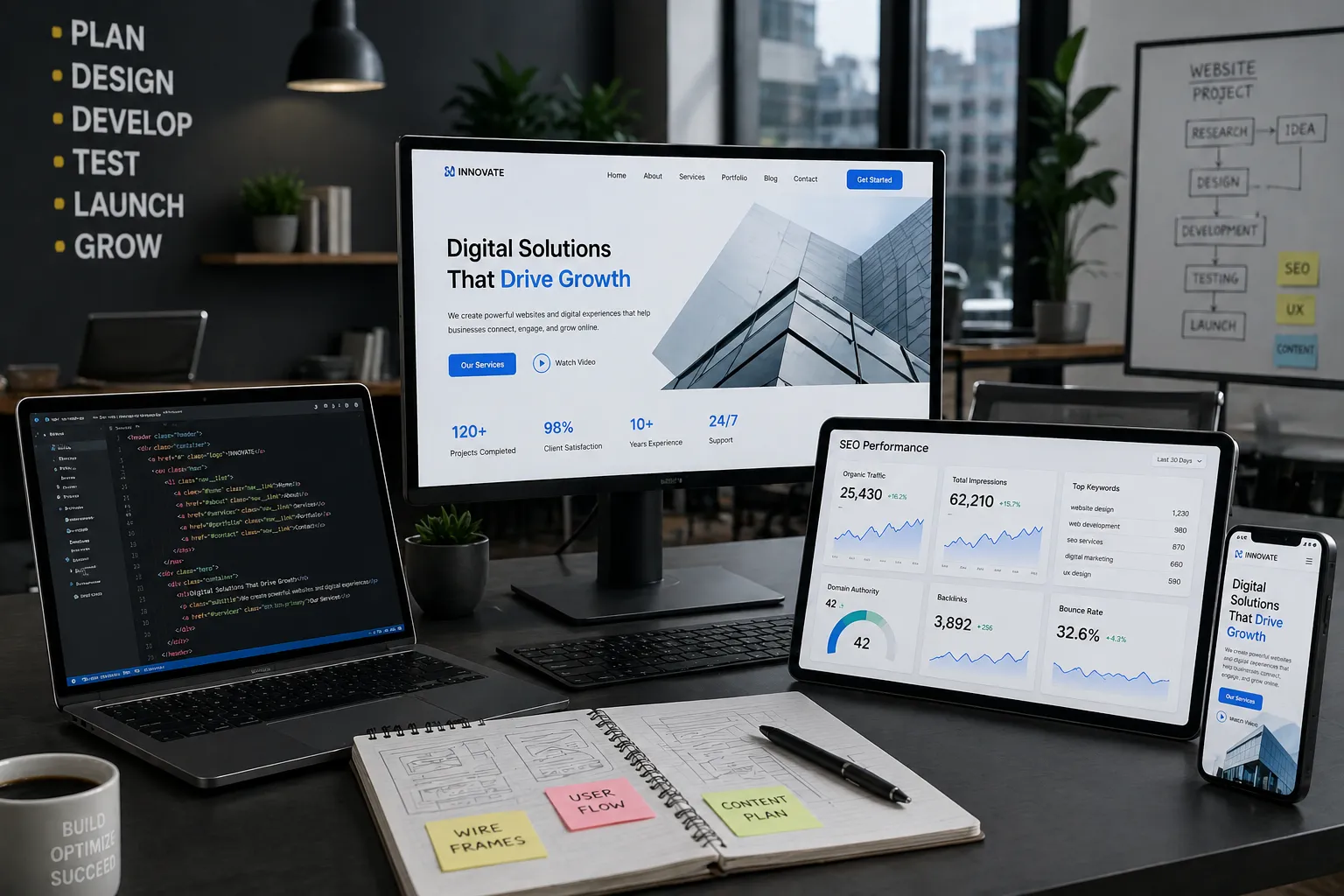
A typical engagement runs 8–20 weeks for a mid-market project:
Weeks 1–2: Discovery and strategy
Goals definition, audience research, competitive analysis, technical requirements, content audit, conversion goal mapping. Without proper discovery, the project produces a beautiful site that doesn’t solve business problems.
Weeks 3–4: Design
Wireframes for key page types, high-fidelity Figma designs, design system establishment (colors, typography, components), mobile-first responsive design, accessibility considered from the start, stakeholder review and approval.
Weeks 5–12: Development
Theme or custom application development, custom Gutenberg blocks or component library, content migration, third-party integrations, payment gateway setup if e-commerce, responsive testing.
Weeks 13–16: QA and optimization
Performance optimization (Core Web Vitals), security hardening, SEO foundations, accessibility audit (WCAG 2.2), cross-browser and cross-device testing, load testing.
Weeks 17–18: Launch and post-launch
DNS configuration, SSL setup, redirect strategy, analytics implementation, Search Console setup, hotfix capacity for first 72 hours, content updates as needed.
What technical foundations matter for custom websites?
Performance
Core Web Vitals: LCP under 2.5s, INP under 200ms, CLS under 0.1, measured on real mobile devices. Performance is a Google ranking factor and a conversion factor — fast sites convert measurably better than slow ones.
Security
HTTPS, WAF configuration, login hardening, secure coding practices, regular dependency updates, vulnerability scanning, automated backups with off-site storage, incident response plan.
SEO foundations
Schema markup (Article, Organization, BreadcrumbList, FAQ where relevant), semantic HTML, proper heading hierarchy, XML sitemap, robots.txt, canonical URLs, hreflang for multilingual sites.
Accessibility
WCAG 2.2 AA compliance: proper color contrast, keyboard navigation, screen reader support, focus indicators, semantic markup. Required by law in many jurisdictions; valuable for user experience regardless.
Mobile-first responsive design
60%+ of web traffic is mobile. Mobile-first design prioritizes the smaller screen as the primary canvas, then enhances for desktop. Mobile-first sites consistently outperform desktop-first sites on Core Web Vitals and conversion.
How do you evaluate custom development partners?
Questions that separate competent partners from polished ones:
- Show me three live custom sites you’ve built, with the developer who built them on the call
- How do you handle Core Web Vitals? What’s your typical LCP/INP/CLS on production sites?
- Who owns the code at project end — me or you?
- What’s included in maintenance vs charged separately?
- What’s your QA and accessibility testing process?
- How do you handle scope changes during development?
- Can I see your contract before we proceed?
Red flags: fixed-price quotes without discovery, refusal to share code at exit, refusal to provide references, hourly rates below $50/hour for senior work, promises of “unlimited revisions.”
How does custom website development integrate with broader business goals?
A custom website is an asset only if it serves business outcomes. The integrations that matter:
- Website development services — technical foundation
- SEO services — organic foundation that custom sites should be designed to support
- Conversion rate optimization — turning visitors into customers
- Digital marketing — paid acquisition that depends on landing page quality
Frequently asked questions about custom website development
How long does custom website development take?
Small business sites with deep theme customization: 6–10 weeks. Mid-market sites with custom theme development: 12–20 weeks. Complex custom builds with bespoke functionality: 24–40 weeks. Enterprise custom with multi-region, integrations, and complex workflows: 6–18 months.
Is custom website development better for SEO than templates?
Sometimes — when custom is built with SEO foundations from the start. Custom sites can be lighter (better Core Web Vitals), structurally cleaner, and easier to optimize. But poorly built custom sites can underperform well-built templates. Quality of execution matters more than custom vs template alone.
Can I add features later to a custom website?
Yes, especially if built with extensibility in mind. Well-architected custom sites accommodate new features more gracefully than maxed-out theme-based sites. The cost of post-launch additions depends on whether the original architecture anticipated them.
Should small businesses invest in custom development?
Most small businesses are better served by quality premium themes deeply customized (Tier 1) than full custom development. Custom makes sense when the website is mission-critical to revenue and competitive differentiation. For testing a business idea: use a template first.
What’s the difference between custom development and using a page builder?
Page builders (Elementor, Divi, Webflow) let non-developers build sites visually. They’re faster to launch but add performance overhead and create platform lock-in. Custom development means cleaner code, better performance, more flexibility — at the cost of needing developer help for changes.
Do I need ongoing maintenance after a custom build?
Yes. Custom sites need security patches, framework updates, dependency updates, performance monitoring, content updates, and minor feature additions. Budget 15–25% of initial build cost per year. Without maintenance, custom sites degrade like any software.
How do I know if I actually need custom or just think I do?
Test: can you list three specific features or experiences a template can’t deliver? If yes, custom is justified. If you can only articulate “I want it to look unique,” deep theme customization usually achieves that for a fraction of the cost. Custom for the sake of “custom” rarely pays back.
Ready to talk about custom website development?
Custom website development is one of the highest-leverage investments a business can make — when the requirements actually justify it. For businesses where the website is mission-critical, the difference between custom and template is the difference between an asset that compounds and an asset that limits growth.
Book a meeting for a free custom development consultation — we’ll review your requirements, recommend the right tier (theme customization vs custom theme vs full custom), and outline a realistic scope and budget. Or browse our website development services and contact us directly.