
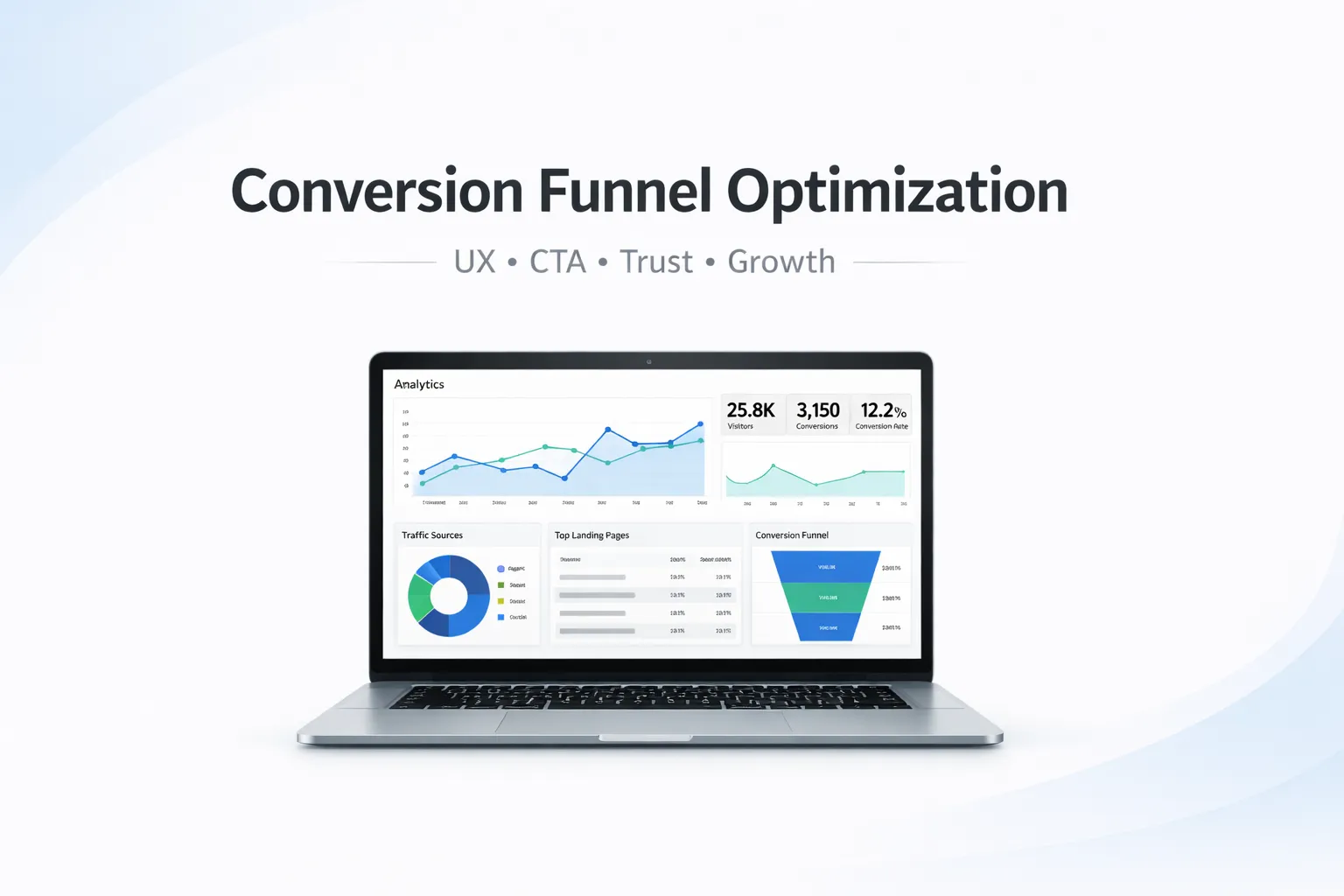
In a competitive digital landscape, driving traffic is no longer the primary challenge for most businesses. The real challenge lies in converting that traffic into measurable business outcomes. Many organizations invest heavily in paid advertising, SEO, and content marketing, yet fail to generate proportional returns. The reason is simple: their conversion funnel is not optimized.
A well-structured Conversion Optimization Guide goes beyond surface-level design improvements. It addresses deep-rooted inefficiencies in user behavior, decision-making psychology, and digital experience architecture. Conversion optimization is not about guesswork—it is a systematic, data-driven process that identifies friction points and eliminates them.
From landing page experience to micro-interactions, every element influences whether a user converts or abandons your site. Businesses that master conversion optimization achieve higher ROI, lower acquisition costs, and sustainable growth.
This guide provides a comprehensive, strategic breakdown of conversion funnel optimization. It focuses on real-world problems and practical solutions across UX, CTA strategy, design systems, trust signals, and behavioral psychology.
What Is Conversion Funnel Optimization in a Business Context?
Conversion funnel optimization is the process of analyzing and improving each stage of the customer journey to maximize the percentage of users who complete a desired action.
Unlike basic marketing tactics, funnel optimization requires:
- Deep understanding of user intent
- Behavioral analytics and tracking
- Continuous A/B testing
- Strategic UX improvements
- Alignment between messaging and user expectations
A typical conversion funnel consists of four key stages:
- Awareness (traffic acquisition)
- Consideration (engagement and evaluation)
- Decision (intent formation)
- Action (conversion event)
At each stage, users encounter friction. These friction points reduce conversion rates and create drop-offs.
Core Problem: Why Most Conversion Funnels Fail
Most businesses do not suffer from a lack of effort. They suffer from misaligned execution. Below are deeper insights into why funnels underperform.
1. Misaligned User Intent
Many websites fail because they do not match user expectations. A user clicks on an ad expecting a solution but lands on a generic or unclear page.
Result: Immediate bounce
2. Cognitive Overload
When users are presented with too many options, they hesitate. Complex layouts, excessive text, and multiple CTAs create confusion.
Result: Decision paralysis
3. Weak Value Proposition
If your value is not instantly clear, users will not invest time in understanding it.
Result: Low engagement
4. Lack of Trust Architecture
Modern users are skeptical. Without visible proof, they assume risk.
Result: Abandoned conversions
5. Poor Micro-Interactions
Small details like button feedback, loading states, or form errors impact perception.
Result: Friction in the user journey
Strategic Conversion Optimization Guide (Advanced Level)
1. Align Messaging with User Intent
The first step in conversion rate is ensuring message match.
Users should feel continuity from:
- Ad → Landing Page
- Search Query → Content
- CTA → Outcome
How to implement:
- Use the same keywords in headlines
- Match user pain points directly
- Avoid generic messaging
2. Reduce Cognitive Load
A high-performing funnel simplifies decisions.
Techniques:
- Limit navigation options
- Use visual hierarchy
- Highlight one primary CTA
- Break content into sections
Result:
Users move faster through the funnel without confusion.
3. Build a Strong Value Proposition
Your value proposition should answer:
Why should I choose you over competitors?
Effective structure:
- What you offer
- Who it is for
- What problem does it solve
- What makes it unique
4. Implement Trust Signals Strategically
Trust is not built on a single element—it’s a system.
High-impact trust signals:
- Verified testimonials
- Case studies with data
- Client logos
- Security badges
- Real user reviews
Pro Tip:
Place trust signals near CTAs for maximum impact.
5. Optimize CTA Strategy
CTAs should guide users, not confuse them.
High-converting CTAs:
- “Start Free Trial”
- “Get Your Demo”
- “Book a Strategy Call”
Avoid:
- Passive language
- Multiple competing CTAs
6. Use Behavioral Psychology
Top-performing funnels use psychological triggers.
Examples:
- Scarcity → “Only 5 spots left.”
- Urgency → “Offer ends today.”
- Social Proof → “Used by 10,000+ businesses”
7. Data-Driven Optimization (Not Guesswork)
You cannot improve what you do not measure.
Track:
- Heatmaps
- Click behavior
- Scroll depth
- Conversion paths
Tools:
- Google Analytics
- Hotjar
- A/B testing tools
What Makes This Guide Different?
Unlike basic blogs, this Conversion Optimization Guide focuses on:
- Strategy over surface-level tips
- User psychology over assumptions
- Systems over random tactics
- Long-term scalability
Conclusion
A strong Conversion Optimization Guide is essential for any business that wants to grow online. Traffic alone does not guarantee success. What matters is how well your website converts visitors into customers.
By focusing on user experience, CTAs, trust signals, and funnel optimization, you can significantly improve your conversion rate. Small changes can lead to big results.
Remember, conversion optimization is not a one-time task. It is an ongoing process of testing, learning, and improving.
If you apply the strategies in this guide, you will build a high-converting website that drives real business growth.
Faqs
A conversion optimization guide helps businesses improve website performance to increase the percentage of visitors who take action, like buying, signing up, or contacting the business.
Conversion optimization improves ROI by turning more visitors into customers without increasing traffic, making your marketing efforts more effective and profitable.
A good conversion rate depends on the industry, but generally, 2% to 5% is considered average, while optimized websites can achieve higher rates.
You can improve conversions by optimizing UX, using strong CTAs, improving page speed, adding trust signals, and simplifying forms.
Trust signals, such as reviews, testimonials, security badges, and guarantees, help build credibility and encourage users to take action.
Tools like Google Analytics, Hotjar, and A/B testing platforms help analyze user behavior and improve website performance.
Conversion optimization can show results within weeks, but consistent testing and improvements are needed for long-term success.