
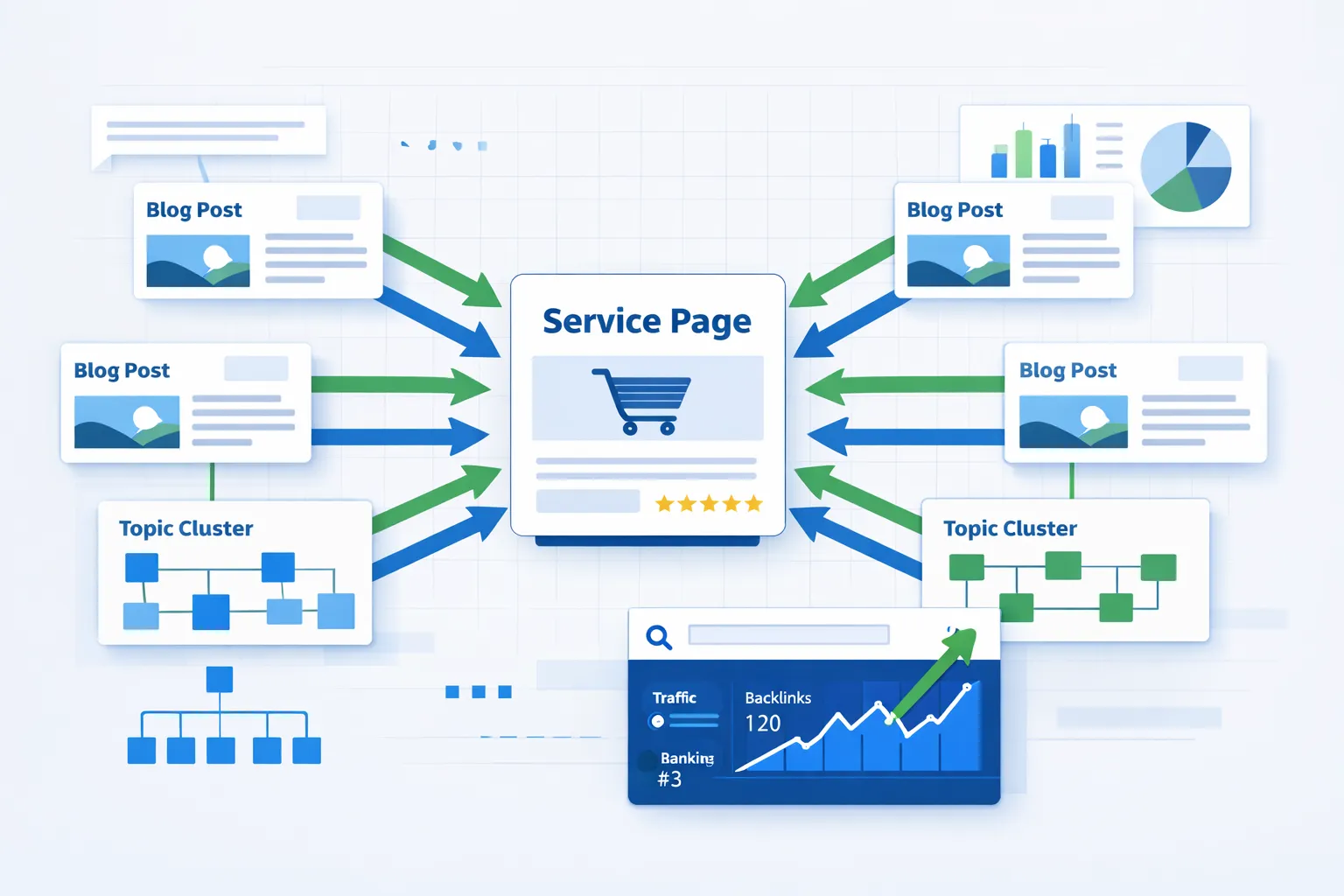
Most ecommerce businesses focus only on backlinks. They chase external links. They ignore their own website structure. That is a big mistake.
Your website already has power. But without smart internal linking, that power stays scattered.
Search engines crawl through links. Users move through links. Authority flows through links.
If your service pages are not internally linked properly, they stay weak. They don’t rank. They don’t convert.
That’s why internal linking for service pages is one of the most powerful but underused SEO strategies in ecommerce development.
In this guide, you will learn:
- How internal links improve rankings
- How link equity flows
- How topic clusters work
- How to fix weak service pages
- How UX + CTA + design connect with linking
- How ecommerce development services benefit most
Let’s go step by step.
What Is Internal Linking for Service Pages?
Internal linking means linking one page of your website to another page of your website.
Simple. But powerful.
Internal linking for service pages means:
- Blog → service page links
- Category → service page links
- Resource → service page links
- Guide → service page links
Example:
A blog about ecommerce speed optimization links to your Website Development Services page.
This tells Google:
This service page is important
This topic is related
This page deserves authority
It also helps users:
Discover services
Understand solutions
Take action faster
Why Service Pages Often Fail to Rank
Many ecommerce service pages do not rank because:
- No internal links pointing to them
- Only the menu link exists
- No contextual links inside content
- No topic relevance signals
- No supporting cluster pages
Result:
Weak authority
Poor crawl depth
Low topical trust
Low conversion traffic
Search engines don’t rank isolated pages easily. They rank connected pages.
Internal linking for service pages fixes this problem.
How Internal Linking Passes Link Equity
Let’s talk about link equity.
Link equity means SEO value passed through links.
When one page has authority and links to another page, it shares some ranking power.
Example:
High-traffic blog → links to service page
Service page → gets ranking strength
This is link equity flow.
Without links:
Authority stops.
With links:
Authority spreads.
Smart ecommerce sites design internal linking paths so their most profitable service pages receive the most link equity.
That is not random. That is a strategy.
What Are Topic Clusters and Why Do They Matter?
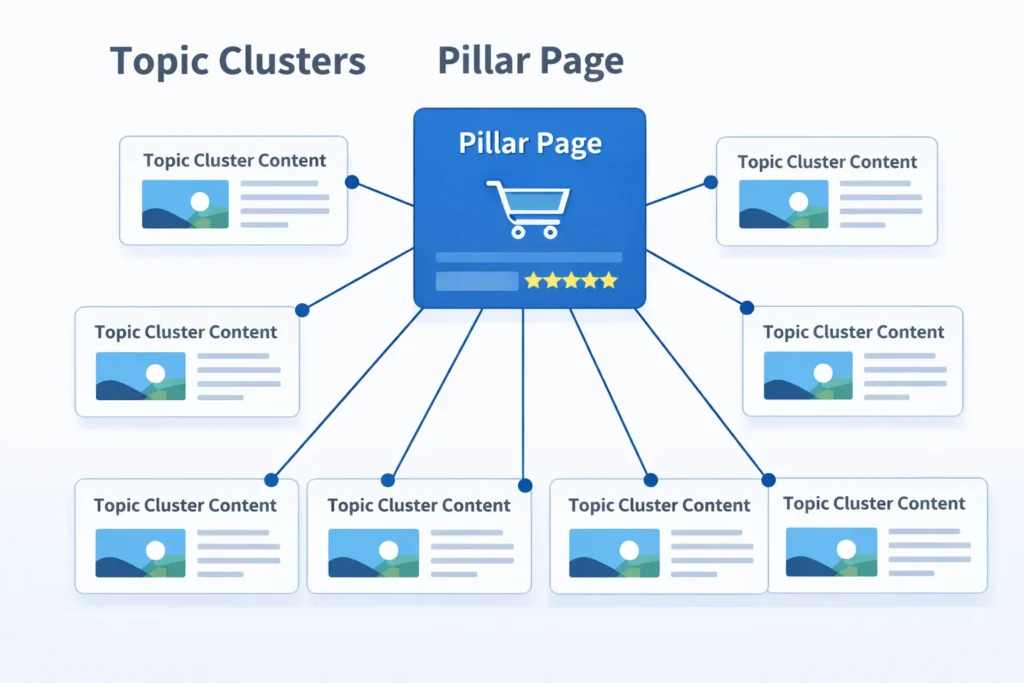
Topic clusters are structured content groups.
They include:
- One main pillar page
- Multiple supporting content pages
- All pages are internally linked together
For ecommerce service SEO, this works extremely well.
Example Topic Cluster:
Pillar: Website Development Services
Cluster Content:
- Ecommerce UX guide
- Checkout optimization
- Site speed improvement
- Conversion design
- Trust badge strategy
- Cart flow design
All these pages link back to the main service page.
This creates topical authority.
Search engines think:
“This site deeply covers this subject.”
That builds ranking trust.
Topic clusters + internal linking for service pages = ranking boost.
How Internal Linking Improves Ecommerce UX
Internal links are not only for SEO. They are also for users.
Good UX includes:
- Easy navigation
- Logical paths
- Helpful next steps
- Clear solutions
When users read a problem article and see a link to your service page, it feels natural.
Example:
“Slow checkout hurting sales? See our Website Development Services.”
That is helpful UX.
Not pushy. Not salesy. Just logical.
Benefits:
Lower bounce rate
More page views
Longer session time
Higher trust
Better conversion chances
Internal Linking Supports Strong CTAs
CTA placement becomes more powerful with contextual links.
Instead of only buttons, you use text links inside content.
Example:
Bad CTA:
“Contact us now.”
Better CTA with internal linking:
“Our Website Development Services fix slow ecommerce checkouts and conversion leaks.”
That feels specific. Relevant. Helpful.
Internal linking turns CTAs into solution pathways.
Best Internal Linking Placement for Service Pages
Not all internal links are equal.
Best placements:
Contextual Content Links
Inside paragraphs. Most powerful.
Guide Sections
“How to fix this → link to service.”
Problem → Solution Links
User problem → your service
Resource Pages
Tool lists → service links
Blog Conclusions
End with sothe lution link
Avoid:
Footer spam links
Random unrelated links
Overlinking the same anchor repeatedly
Anchor Text Strategy for Service Page Links
The anchor text matters a lot.
Anchor text = clickable text.
Use natural variations:
- ecommerce development services
- website development services
- online store development help
- professional ecommerce developers
Avoid repeating the same keyword every time. That looks manipulative.
Natural anchor variation improves ranking safety.
How Many Internal Links Should Point to a Service Page?
There is no fixed number. But practical guidance:
Minimum target:
- 10–30 internal links per important service page
From:
- Blogs
- Guides
- Resources
- Case studies
- Category pages
High-value service pages should receive the most internal links.
Because they are revenue pages.
Ecommerce Sites Need Internal Linking More Than Blogs
Why?
Because ecommerce sites have:
- Deep structures
- Many pages
- Conversion rate goals
- Commercial intent
Without internal linking:
Users get lost.
Search engines get confused.
Service pages stay buried.
Internal linking builds ranking highways.
The internal Linking + Trust Signals = Higher Conversions
Internal links can also support trust.
Example flow:
Problem blog → solution guide → service page → case study → testimonial page
This creates trust layering.
Add trust signals on service pages:
- Testimonials
- Case studies
- Certifications
- Client logos
- Guarantees
Internal linking brings users into this trust ecosystem.
Design Structure That Supports Internal Linking
Your website design should support linking.
Use:
- Content hubs
- Resource centers
- Solution libraries
- Category clusters
Bad design blocks linking.
Good design encourages linking.
Ecommerce development services should always build link-friendly structures.
Common Internal Linking Mistakes
Avoid these mistakes:
Only menu linking
Not enough.
No contextual links
Weak SEO signal.
Same anchor every time
Over-optimization risk.
Linking only to blogs
Service pages ignored.
Broken internal links
Crawl damage.
Deep-buried service pages
Low discoverability.
Internal Linking Audit Checklist
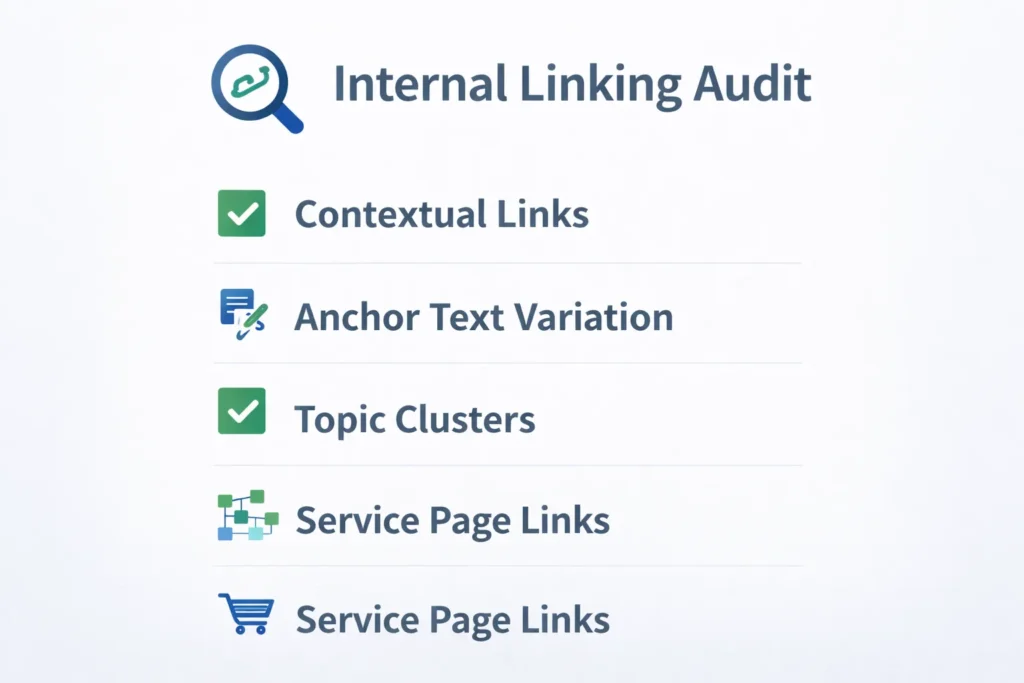
Use this checklist:
- Does each service page have 15+ internal links?
- Do blogs link to services?
- Are anchors natural?
- Are links contextual?
- Are topic clusters connected?
- Are orphan pages removed?
- Are trust pages linked?
If not — fix immediately.
How Internal Linking Supports Website Development Services Ranking
If you want your Website Development Services page to rank:
You must support it with:
- ecommerce UX blogs
- speed optimization guides
- conversion articles
- checkout improvement posts
- trust design resources
Each should internally link to the service page.
This builds authority layers.
Search engines reward structured expertise.
Internal Linking vs Backlinks — Which Is Faster?
Backlinks are powerful. But slow.
Internal linking is:
Instant
Fully controlled
Free
Scalable
Safe
You can improve rankings without waiting months.
Smart ecommerce SEO teams fix internal linking first.
Real Ranking Impact Timeline
When internal linking for service pages is improved:
Typical timeline:
Weeks 1–2 → crawl improvement
Weeks 3–5 → index strength signals
Weeks 6–8 → ranking movement
Weeks 8–12 → traffic growth
Faster if the site already has authority.
Conclusion
Most ecommerce sites don’t have a backlink problem. They have a structural problem.
Internal linking for service pages is one of the fastest ways to improve rankings, authority, and conversions.
It distributes link equity.
builds topic clusters.
improves UX.
strengthens CTAs.
increases trust.
If your service pages are not ranking, don’t just chase backlinks.
Fix your internal links first.
And if you want a structure built correctly from the start, professional Website Development Services can design your ecommerce architecture for ranking and conversions together.
Faqs
Internal linking for service pages means linking from blogs, guides, and resources to your main service pages to pass authority, improve crawlability, and increase ranking signals.
Link equity transfers SEO value from strong pages to target pages through links. When high-authority pages link to services, ranking power increases.
A strong service page should receive at least 15–30 contextual internal links from relevant content across the website for better authority flow.
Topic clusters are groups of related content linked together around a main pillar page, helping search engines understand topical authority and relevance.
Yes. Internal links guide users toward solutions and service pages, improving UX, trust flow, and conversion pathways.
No. Use natural variations. Repeating exact anchors looks spammy. Mixed anchors are safer and more effective.
Both matter, but internal linking is faster and fully controllable. It should be optimized before heavy backlink campaigns.