Launching a Shopify store is easy. Growing one is the hard part. Every day, thousands of new stores go live; most sit at zero sales for months. The difference between stores that struggle and stores that compound revenue isn’t the theme or the products — it’s the marketing infrastructure built around the store.
This guide explains what Shopify store marketing services actually include in 2026, what’s worth investing in, what to skip, and how to measure whether your marketing is working. No filler, no city-name padding — just the specific decisions a store owner needs to make.
What do Shopify store marketing services include?
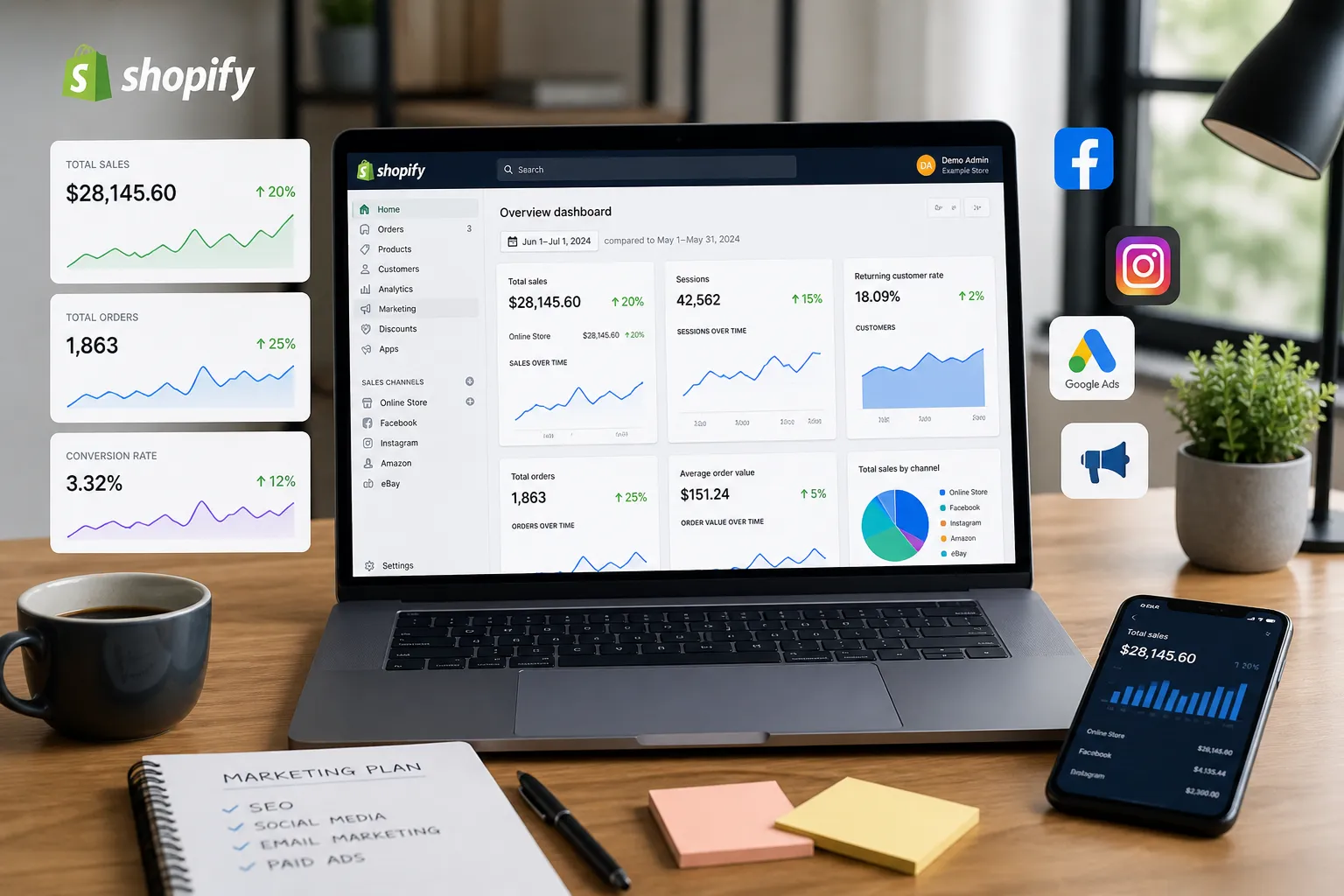
A real Shopify marketing engagement covers seven discrete service areas:
Search engine optimization
Technical SEO (Shopify-specific issues like collection canonicalization, duplicate URL parameters, schema setup), keyword research and content strategy, product page optimization, blog content for top-of-funnel traffic, and ongoing rank tracking. SEO is the slowest channel to start but the highest ROI long-term.
Paid advertising
Google Shopping (the highest-ROI ad type for most stores), Google Search ads on commercial keywords, Meta Ads (Facebook + Instagram) for prospecting and retargeting, TikTok Ads for younger-audience brands, Pinterest Ads for visual product categories, Amazon Ads if you sell there too. Each channel needs its own creative, bidding strategy, and attribution setup.
Email marketing and automation
Welcome series for new subscribers, abandoned cart sequences (recover 10–20% of lost orders), post-purchase flows, win-back campaigns for lapsed customers, weekly newsletter, segmented promotional sends. Klaviyo is the standard platform for serious Shopify email; Brevo and Mailchimp are budget alternatives.
SMS marketing
Klaviyo SMS, Attentive, or Postscript. Higher cost per message than email but 5–10x open rates. Best for time-sensitive promotions and abandoned cart recovery. Compliance-heavy in most markets — opt-in must be explicit.
Social media and influencer marketing
Organic social presence (Instagram, TikTok, Pinterest depending on category), influencer partnerships and creator content for paid amplification, UGC (user-generated content) collection and licensing, community building.
Conversion rate optimization (CRO)
A/B testing product pages, optimizing checkout flow, improving mobile UX, adding trust signals (reviews, badges, guarantees), reducing form friction. Traffic without conversion is wasted spend.
Analytics and attribution
GA4 with proper e-commerce tracking, server-side tracking (post-iOS 14.5 attribution), Meta Conversions API, multi-touch attribution to understand the true customer journey, monthly reporting tied to business outcomes.
Which Shopify marketing channels deliver the best ROI?
Realistic ROI ranking for typical Shopify stores doing $100K–$5M annual revenue:
- Email marketing (mature list) — typically 25–40% of revenue with $30–$50 return per $1 invested
- Google Shopping — 3–6x ROAS for product-led discovery
- Brand search ads — 8–20x ROAS but limited scale
- Meta retargeting — 5–10x ROAS on warm audiences
- Meta prospecting — 1.5–3x ROAS at scale
- TikTok Ads — 1–3x ROAS, more variable; better for brand building
- SEO — slow start, then compounding at near-zero marginal cost
The trap: most new stores chase paid social first because it shows fastest results. The stores that compound revenue invest in email and SEO foundations early, even when initial returns look slow.
How does Shopify SEO differ from generic SEO?
Shopify has structural quirks that affect SEO:
- Default URL structure (/products/, /collections/) is fixed — work with it, not against it
- Collection filter parameters create duplicate URLs — canonical tags must be set correctly
- Product page templates affect every product equally — small template improvements multiply
- Schema markup for Product, Review, BreadcrumbList is critical
- Site speed depends heavily on theme choice and app load — audit ruthlessly
- Blog functionality is limited compared to WordPress — work within constraints
- International stores need hreflang and proper currency handling
For deeper technical detail, see our Shopify SEO checklist.
What does Shopify marketing actually cost?
Realistic 2026 budget ranges for active Shopify marketing engagements:
- Small store ($10K–$50K MRR): $2,500–$6,000/month all-in (agency + ad spend split roughly 30/70)
- Growth-stage store ($50K–$250K MRR): $8,000–$25,000/month all-in
- Established store ($250K–$1M MRR): $25,000–$80,000/month all-in
- Enterprise ($1M+ MRR): $80,000+/month with in-house team plus specialist agencies
Most stores allocate 60–75% to ad spend, 25–40% to management fees. Email and SEO investments are typically smaller in dollar terms but disproportionately impactful long-term.
How do you choose the right marketing partner?
Questions that separate competent partners from polished ones:
- Show me three Shopify stores you’ve grown in my product category, with the specific results
- What’s your approach to attribution post-iOS 14.5?
- How do you handle conflicts between SEO and paid (cannibalization concerns)?
- Who specifically will work on my account weekly, and what’s their tenure?
- What’s your average client tenure?
- How do you split ad spend management between platforms?
Red flags: agencies promising specific ROAS numbers in a written quote, vague “we’ll grow your store” promises without specifics, ownership models where the agency keeps your ad account access at exit, and zero portfolio in your product category.
How long until Shopify marketing pays back?
Realistic payback timeline:
- Email automation: 2–6 weeks for first revenue impact
- Google Shopping: 4–8 weeks to find profitable bid strategy
- Meta Ads: 6–12 weeks to optimize prospecting + retargeting funnel
- SEO: 6–12 months for meaningful organic traffic; 12–24 months for category dominance
- Influencer/UGC content engine: 3–6 months to build sustainable production
The stores that win commit to 12–18 months minimum. Stores that cut marketing at month 4 because “it’s not working yet” miss the inflection point where compounding starts.
What are the biggest Shopify marketing mistakes?
- Spending only on prospecting without strong retargeting and email follow-up — cold visitors rarely buy on first visit
- Heavy theme bloat from too many apps — hurts speed and conversion
- No abandoned cart automation — leaving 10–20% of recoverable revenue on the table
- Ignoring SEO until “later” — by the time you start, competitors are 18 months ahead
- Skipping CRO — doubling conversion rate doubles revenue without spending more on traffic
- Reactive paid spend (turning ads on and off based on cash flow) — algorithms penalize this
- No customer LTV tracking — making CAC decisions without LTV data is guessing
How does Shopify marketing integrate with the broader business?
Marketing isn’t an island. The systems that need to integrate:
- Shopify development — site speed, product page templates, checkout customization
- SEO services — organic foundation for sustainable traffic
- Conversion rate optimization — turning traffic into orders
- Digital marketing — paid acquisition across channels
Frequently asked questions about Shopify store marketing
What’s the minimum budget to start Shopify marketing seriously?
For meaningful results: $2,500/month all-in is the realistic floor. Below that, you’re getting either bare-bones management or minimal ad spend — results will be limited. Above $5,000/month, you can run a multi-channel strategy with email + paid + basic CRO.
Should I run Google Ads or Meta Ads first?
Google Shopping for stores with search demand (people searching for your product category). Meta Ads for visually-driven categories where buyers don’t search by category yet. Most mature stores run both. If forced to pick one with a small budget: Google Shopping wins for established product categories.
How much should email contribute to total revenue?
Healthy benchmark: 25–40% of total revenue for mature Shopify stores. Below 15% suggests under-invested email program. Above 50% may indicate overdependence and that prospecting channels need work.
Can small Shopify stores benefit from professional marketing services?
Yes, but the scope must match the budget. Sub-$50K MRR stores often benefit most from focused email automation + Google Shopping rather than spreading thin across many channels. Specialist freelancers or boutique agencies are typically more cost-effective than large agencies at this stage.
How do I measure if my Shopify marketing is working?
Track these monthly: revenue from marketing-attributed channels, blended CAC (customer acquisition cost), customer LTV by channel, ROAS by channel, email revenue share, repeat purchase rate. The master metric is LTV:CAC ratio — healthy stores hold this at 3:1 or better.
Should I hire one marketing agency or specialist agencies for each channel?
For sub-$1M revenue stores: one integrated agency is more cost-effective and coordinates better. For $1M+ revenue: specialist agencies per channel (paid media specialist + email specialist + SEO specialist) typically outperform a single generalist.
What’s the role of TikTok in 2026 Shopify marketing?
Important for under-35 consumer brands. Less critical for older demographics or B2B-adjacent stores. TikTok Shop integration matters more than TikTok Ads alone now — native commerce features convert better than off-platform redirects. Allocate 10–25% of paid budget for fit-right brands.
Ready to talk about Shopify store marketing?
Shopify marketing is a system of compounding investments, not a single tactic. The stores that compound revenue commit to integrated email, SEO, paid, and CRO operations over 12+ months. Stores that chase tactics quarter-by-quarter rarely break out.
Book a meeting for a free Shopify marketing audit — we’ll review your current channels, attribution setup, and identify the highest-leverage improvements for the next 90 days. Or browse our Shopify services and contact us directly.
Most Asked Questions
SEO, paid advertising (Google Shopping, Meta, TikTok), email marketing and automation, SMS, social media, influencer marketing, conversion rate optimization, and analytics. A full integrated program covering acquisition, conversion, and retention rather than single-channel tactics.