“How long does it take to build a website in Germany?” is the second-most-common question we hear (after cost), and the honest answer is: it depends on what you’re actually building. A 5-page brochure site can ship in 3 weeks. A complex Shopify Plus migration with Datev integration takes 4–5 months. A SaaS MVP can run 4–8 months. Anyone quoting you a definitive timeline before scoping is selling, not estimating.
This guide gives you realistic timelines by project type, what consistently causes delays in German projects, and a practical planning template so a GmbH founder, Mittelstand operations lead, or marketing manager can plan without surprises.
What are realistic project timelines by website type?
Honest 2026 timelines, based on a competent agency with a focused client:
| Project type | Typical duration | What’s included |
|---|---|---|
| Brochure / one-pager | 2–6 weeks | 3–8 pages, template-based, basic GDPR |
| Corporate / SME website | 8–14 weeks | Custom design, bilingual, full GDPR, light integrations |
| E-commerce shop (Shopify/Woo) | 10–18 weeks | Custom theme, payment integration, Trusted Shops, basic ERP sync |
| Headless WordPress + Next.js | 12–20 weeks | Decoupled CMS, performance focus, modern frontend |
| SaaS MVP | 16–32 weeks | Custom product, auth, billing, core feature set |
| Mittelstand portal / B2B platform | 20–40 weeks | SSO, complex roles, ERP integration, custom workflows |
| Enterprise / multi-region rollout | 26–52 weeks | Multi-country, multi-language, advanced compliance, large team |
Anyone quoting significantly faster than these without seeing your scope is either skipping discovery, recycling a template, or about to send change-request invoices.
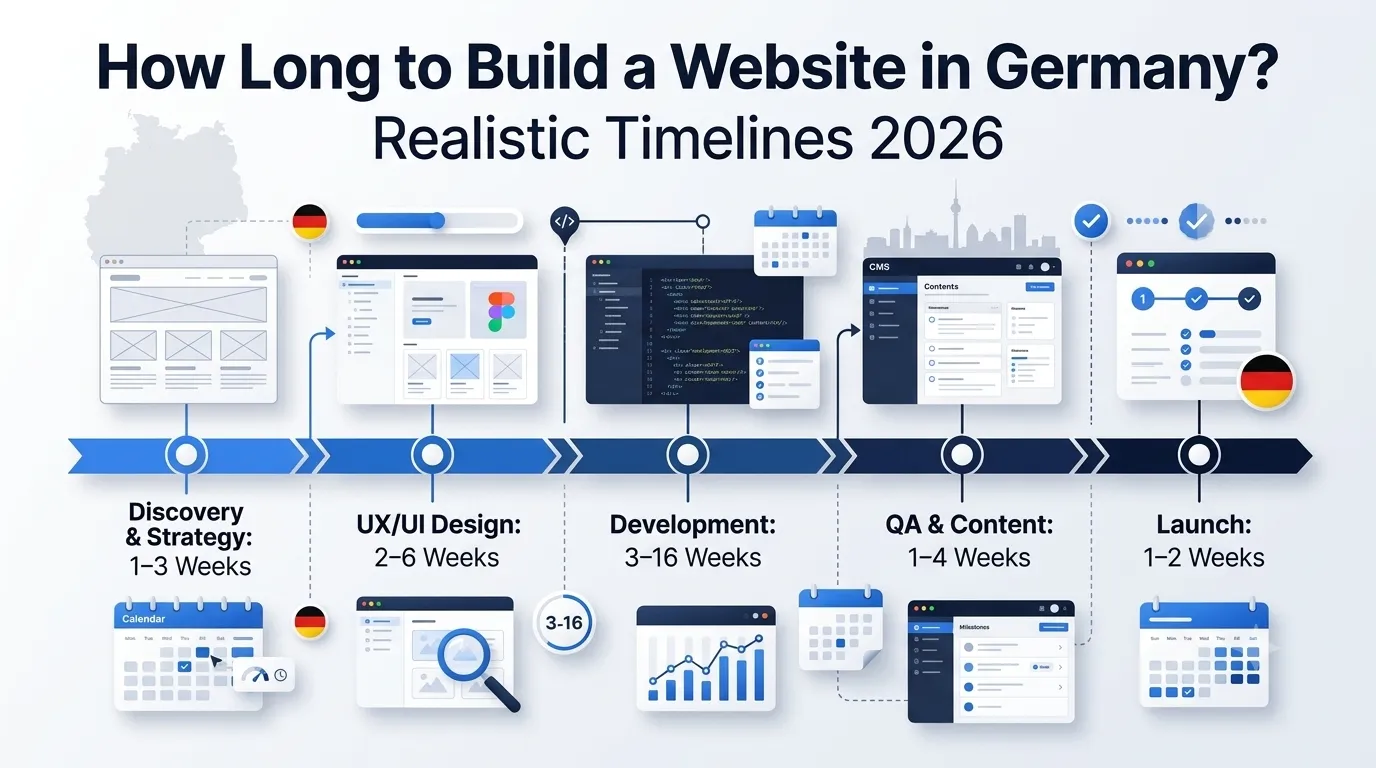
What are the five phases of any real web project?
Every website project — regardless of size — moves through the same phases:
1. Discovery & Scoping (1–3 weeks)
Workshops with stakeholders, sitemap, content strategy, technical requirements, written scope document. Skipping this phase is the single most common reason projects later run 40% over budget.
2. UX & UI Design (2–6 weeks)
Wireframes, prototyping in Figma, brand application, accessibility considerations (BFSG-aware for German projects), responsive design across breakpoints.
3. Development (3–16 weeks, depending on scope)
Frontend + backend build, CMS configuration, integrations (Datev, ERP, payment, email), content management workflows, multilingual handling.
4. Content & QA (1–4 weeks)
Content uploaded, copyediting, multilingual proofreading, cross-browser QA, mobile testing, accessibility audit, performance optimisation, SEO foundation.
5. Launch & Support Window (1–2 weeks + 30-day post-launch)
Pre-launch checklist, DNS migration, staging-to-production cutover, 301 redirects mapped, monitoring, training, 30-day bug-fix window.
What actually delays web projects in Germany?
After hundreds of projects, the delays cluster around the same predictable causes — and almost none of them are technical.
Cause 1: Content Isn’t Ready (Cause of ~40% of Delays)
The most common delay: design and development are complete, but the client team hasn’t written the content. Empty pages can’t launch.
Fix: Lock content delivery dates in the project plan from day one. Treat “client provides final copy by Week 6” as a firm milestone, not a hope.
Cause 2: Indecision on Design (~20% of Delays)
Three rounds of homepage revisions can add 3 weeks. The pattern: stakeholders join late, request structural changes after sign-off, designs cycle indefinitely.
Fix: A single named decision-maker per design review. A maximum of two rounds of revision included; further rounds priced as change requests.
Cause 3: Scope Creep (~15% of Delays)
“Can we also add…” feature requests after development started. Even small additions ripple through QA, content, and translation.
Fix: Written change-request process from day one. Every new request gets a written impact assessment (time + cost) before being approved.
Cause 4: Translation / Multilingual Bottlenecks (~10% of Delays)
For bilingual German sites, translation often becomes the critical path. Native translators are booked weeks ahead; machine translation requires careful editing.
Fix: Source German + English copy in parallel during the content phase, not after. Use DeepL Pro for first drafts, native review for final.
Cause 5: Stakeholder Approval Delays (~10% of Delays)
Final approval needs Geschäftsführung, Datenschutz, Marketing, IT, Legal — and one of them is always on holiday.
Fix: Pre-agree the approver list and SLAs at kickoff. Use written approval gates with clear deadlines.
Cause 6: Late Compliance Discoveries (~5% of Delays)
Discovering BFSG accessibility issues, missing AVV with hosting, or GDPR gaps in Week 10 forces rework.
Fix: Compliance is part of discovery, not a Week 10 audit. The right agency raises BFSG and GDPR in Week 1.
What does “fast” actually look like in 2026?
Genuine compressed timelines without quality compromise:
- Brochure site in 2 weeks: Pre-built premium theme, client provides all content upfront, one decision-maker, no integrations beyond contact form
- Corporate site in 6 weeks: Tight scope, content ready by Week 2, daily standup discipline, single approval chain
- Shopify shop in 8 weeks: Standard Shopify theme with customisations, client manages product upload in parallel, no complex ERP integration
These are achievable but rare — they require a client who’s organised and decisive. Most realistic timelines sit at the higher end of the typical range.
What’s a realistic project schedule template?
For a typical mid-market German SME corporate website (10–12 weeks total):
- Weeks 1–2: Discovery, sitemap, content strategy workshop, written scope document
- Weeks 3–5: Design (wireframes, mood board, homepage, key inner page templates)
- Weeks 4–6: Content production by client (in parallel with design)
- Weeks 6–10: Development sprint (frontend, CMS, integrations, GDPR)
- Week 9–10: Content upload, multilingual proofreading
- Week 11: QA, browser testing, mobile testing, accessibility audit
- Week 12: Launch + 30-day post-launch support window
Build a 1–2 week contingency buffer in. Real projects always need it.
How do you brief an agency on timeline?
The right way to discuss timelines upfront:
- Share your desired go-live date, not a fake “as soon as possible”
- Be honest about your team’s bandwidth for content and reviews
- Name the decision-maker(s) and their availability
- Identify hard external constraints (trade show launch, fiscal year, regulatory deadline)
- Ask the agency for a written timeline tied to your scope, not a generic estimate
Vendors who push back on unrealistic deadlines are protecting your project quality. Vendors who promise miracles are the ones who’ll send change-request invoices later.
Why does agile / sprint-based delivery help when done right?
Most German SME web projects work best with a hybrid approach: fixed-price scope and budget, with agile delivery inside it. Concretely:
- Two-week sprints with a working build at the end of each
- Sprint reviews with the client for fast feedback
- Backlog of features that can flex within fixed scope
- Demos of incremental progress every two weeks
This avoids the “big-bang reveal” failure mode where the client first sees the finished product 10 weeks in and discovers it’s not what they expected.
What internal team time commitment is required?
Founders often underestimate their own team’s time investment. Realistic numbers for a 10–12 week corporate website project:
- Project sponsor (Geschäftsführung): 2–3 hours/week for reviews and approvals
- Marketing lead: 5–8 hours/week (content, decisions, reviews)
- Content team: 20–40 hours total for written content
- IT / DevOps: 2–4 hours/week for technical reviews, DNS, hosting
- Legal / Datenschutz: 4–8 hours total for AVV, Datenschutzerklärung, Impressum
If your team can’t allocate this realistically, the project will slip — not because the agency is slow, but because the inputs they need aren’t arriving on time.
How do you compress a timeline without sacrificing quality?
Three legitimate ways to ship faster:
- Use a pre-built premium theme. Cut design time from 4 weeks to 1, at the cost of bespoke visual identity.
- Use AI for first-draft content. Then human edit. Cuts content time by 50–70%.
- Reduce scope, not quality. Ship V1 with 6 pages, V2 with the rest. Better than a 12-page site that misses launch.
Avoid the false economy: skipping discovery, parallelising design and development (causes rework), or hiring a freelancer to “go faster” without proper QA.
Frequently asked questions about how long to build a website in Germany
8–14 weeks for a custom-designed, bilingual, GDPR-compliant SME corporate site.
Only for simple template-based one-pagers. Custom design or compliance needs 4+ weeks.
Content (40%), design indecision (20%), scope creep (15%), translation (10%), approvals (10%).
Standard: 8–14 weeks. Complex with ERP/multi-region: 14–24 weeks.
16–32 weeks for a focused, well-scoped product. 90-day MVPs are rare and severely constrained.
Yes — 10–15% buffer is realistic. Build it explicitly into your schedule.
Yes with pre-built theme, content ready upfront, single decision-maker, no scope changes. Rare in practice.
Ready to plan how long to build a website in Germany?
The honest answer to “how long does it take to build a website in Germany?” is: it depends, mostly on factors you control more than the agency does. Content readiness, decision speed, and scope discipline drive 80% of timeline outcomes. Pick a realistic timeline, build in a buffer, and protect the timeline from your own scope creep.
If you’d like a written timeline estimate for your specific project, our team provides honest scope-based estimates after a 30-minute discovery call. You can book a meeting or browse our website development services for our typical delivery model.